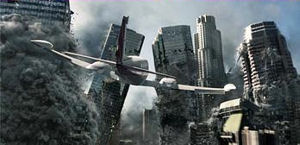
 Remember that time when the world ended on December 21st? And before that on January 1, 2000, at the hands of the Y2K bugaboo? And before that in 1994 as Nostradamus predicted in The Man Who Saw Tomorrow? Neither do I. As the humble survivor of at least three documented ends of the world, I count my blessings and try not to take the failures of those premature endtimes for granted.
In honor of Earth living to rotate another day, I present this cursory clipfest of a few of the most memorable incidents in which someone or something threatened to end or merely ruin life on Earth as we know it. In some cases the day was saved thanks to some meddling kids; in other cases, Earth lost and the survivors pressed on because life had to find a new way. At the bottom are a few provisional inclusions — two stories I haven’t seen through to their conclusions, and two stories I could’ve lived without knowing.
(This list is clearly far from all-inclusive. Beyond what I’m forgetting or dismissing, I’m also setting aside the most famous of all, the one that will end with the Lord’s victory, because of obvious Hall of Fame status. Unfair competition, you see.)
On with the countdown, preferably timed with a red digital readout:
* Falling Skies — If the War of the Worlds Martians had better immune systems, even in victory they’d still have to reckon with the uppity spiritual descendants of America’s founding fathers. As led by the earnest but damaged Noah Wyle and Armageddon survivor Will Patton, the Second Mass is more organized and logical than Revolution, more hope-filled and less defeatist than The Walking Dead, and a lot less canceled than FlashForward.
* 2012 — Not the year itself, but the arguably greatest film of Roland Emmerich’s career has better effects than Godzilla, less jingoism than Independence Day, and higher-quality schmaltz than The Day After Tomorrow. Add in a histrionic John Cusack, a self-parodying Woody Harrelson, and a mandatory impassionate speech at the end delivered by Serenity‘s amazing Chiwetel Ejiofor. With these key components, Emmerich finally nailed the formula he’d striven for years to perfect.
Continue reading →
Share this with your friends and followers!
 Imagine the following scenario: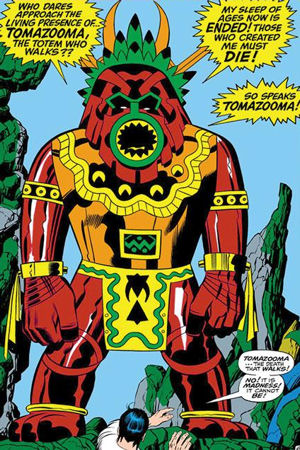

 Consider this list an overdue companion piece to my previous entry, “
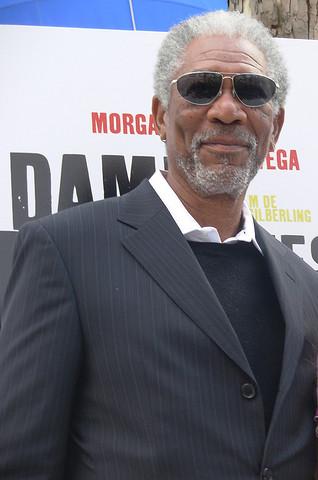 During the solemn, lamentable weekend following last Friday’s senseless tragedy in Newtown, Connecticut, Facebook users who were already struggling with their own reactions, the reactions of their friends, and the fights breaking out between friends of conflicting reactions all found themselves interrupted dozens of times over the course of the weekend by the reassuring face of Academy Award Winner Morgan Freeman, perceived as one of the kindliest, most grandfatherly figures in all of Hollywood. His face was attached to a short essay decrying the culpability of mass media in encouraging too many broken young men to become power-tripping mass murderers because of the seedy allure of posthumous headlines and ten minutes of front-page infamy. Few would argue with the content of the well-meaning essay, but this wasn’t just any old essay written by an ostensibly intelligent typist. This was an essay attached to a photo of Academy Award Winner Morgan Freeman.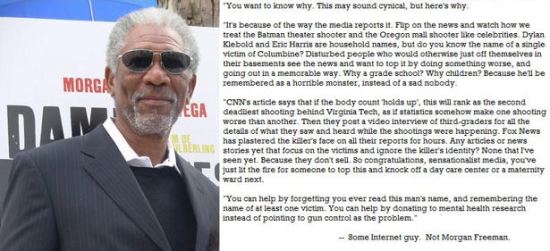





 Despite a few dissidents who wished for something more, Stephen Spielberg’s new film Lincoln has received a host of rave reviews and much name-checking in articles about Academy Award predictions. The film aims to operate numerous levels, which may or may not work depending on what set of preconceptions and expectations you hope to see fulfilled:
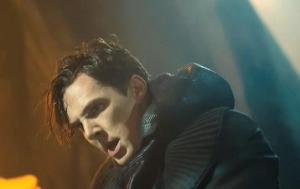 Most of you have already seen the new “announcement trailer” for Star Trek: Into Darkness, apparently heralding the real teaser trailer scheduled for release on December 17th. Internet fans continue debating the exact identity of the villain played by TV’s Sherlock, the inimitable Benedict Cumberbatch. The early rumor-mongers assumed he was Khan, but the more recent consensus is the superhuman Gary Mitchell from the original series’ second pilot, “Where No Man Has Gone Before”. 1966 special effects limited Mitchell’s displays of power, but if that’s SuperCumberbatch’s true identity, then today’s cinematic tools have upgraded him to the same weight class as General Zod, Hancock, and the Chronicle teens. I look forward to seeing him punch the Enterprise out of orbit, and to watching the new Captain Kirk devise something besides an instant avalanche to end their rebooted confrontation.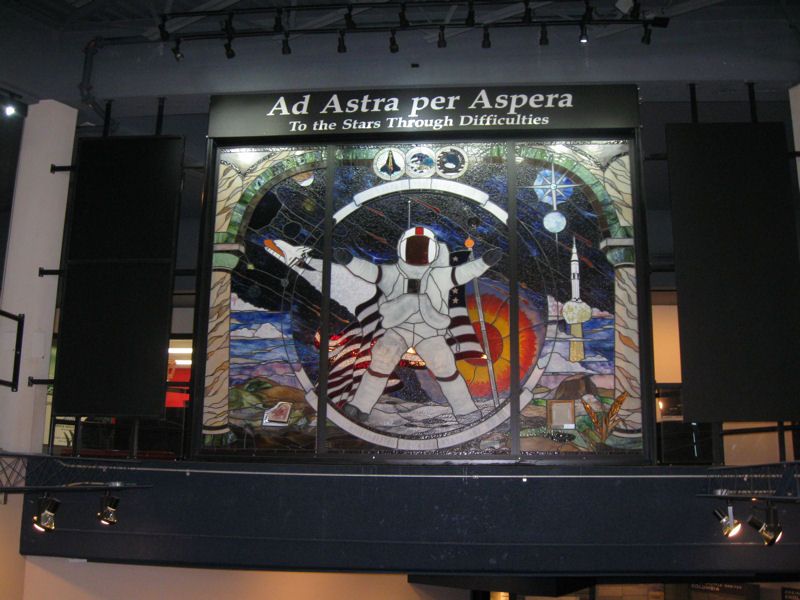
 In recent months I’ve received notification not once, but twice by fellow bloggers who were kind enough to think of me and notice my low follower count when brainstorming their nominations for the Liebster Award. For readers new to the blogosphere: most blogging awards aren’t decades-old ceremonial traditions determined by committees or democracy. Most of them are congenial badges passed from blogger to blogger as a way of promoting each other’s talents, encouraging networking, and spreading good cheer whenever our malicious Site Stats page is lying to us about our traffic stats. In my mind, I think of them as Mega-Likes.


