Zach Cregger Presents Literally the Greatest “Resident Evil” Film in World History

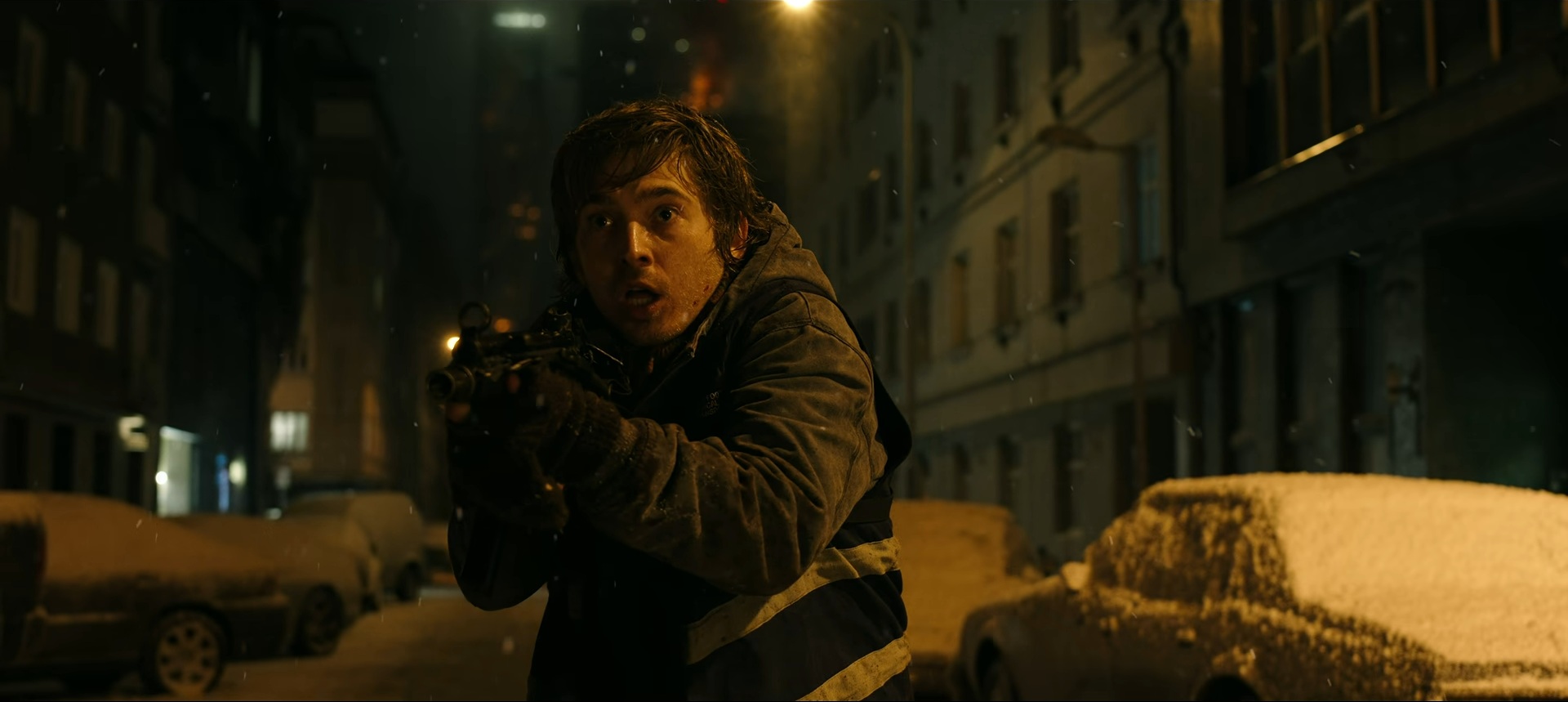
Scared young white guy on a wintry city street vaguely points an assault rifle.

A terrible fright / We’re scrounging tonight / for weapons in a winter wonderland!

Previously on Midlife Crisis Crossover: Horror won big at the Academy Awards! While Sinners and Frankenstein carted off a combined seven categories on behalf of the 2025 field, Zach Cregger’s child-abduction plot-twister Weapons darted out of its own dark corner and took home Best Supporting Actress for Amy Madigan — best known by Gen-X as Field of Dreams‘ Concerned Wife and Uncle Buck’s annoyed girlfriend — who was completely unrecognizable as the mysterious Aunt Gladys, a fiend who one day might be called “iconic” once enough time has passed that revealing her existence isn’t a major spoiler in itself. (I hated skating around her gloriously creepy performance in my own write-up, but knowing nothing made her entrance all the more unnerving to see.)

Like Cregger’s debut Barbarian, Weapons was a sharply crafted, time-shifting puzzlebox that didn’t even reveal the spooky subgenre at its core till you’re lured halfway inside. Its staggering box office performance was even more surprising, and heralded this year’s high-grossing horror wave that’s seen films like Obsession and Backrooms luring millions back to theaters without the sort of old-fashioned Hollywood star power that once made for reliable audience bait. It’s less surprising that some corporation would take heed and entice Cregger to inject new life and/or financial viability into one of their stagnant IPs.

The lucky winner of his undivided attention is Resident Evil, the long-running game series that scrounged up seven films’ worth of zombie-virus mayhem, some of which I watched on a DVD boxed set I bought at a yard sale for a buck, then paid it forward to Goodwill. (I don’t remember how many of ’em it had — at least the first two.) Of the games, I only played through a few levels’ worth of RE4 on my son’s old PS2 — maybe 15 years ago? — till I found myself wishing there were a Bethesda Studios-style option for Leon to shove the President’s daughter Ashley off a roof, accept the bad karma and keep playing through. So I’m not an authority on the world of Raccoon City or the Umbrella Corporation unless seeing dozens of RE cosplayers in every Dragon Con parade counts.
Continue reading →

“28 Years Later”: Undead Will Find a Way

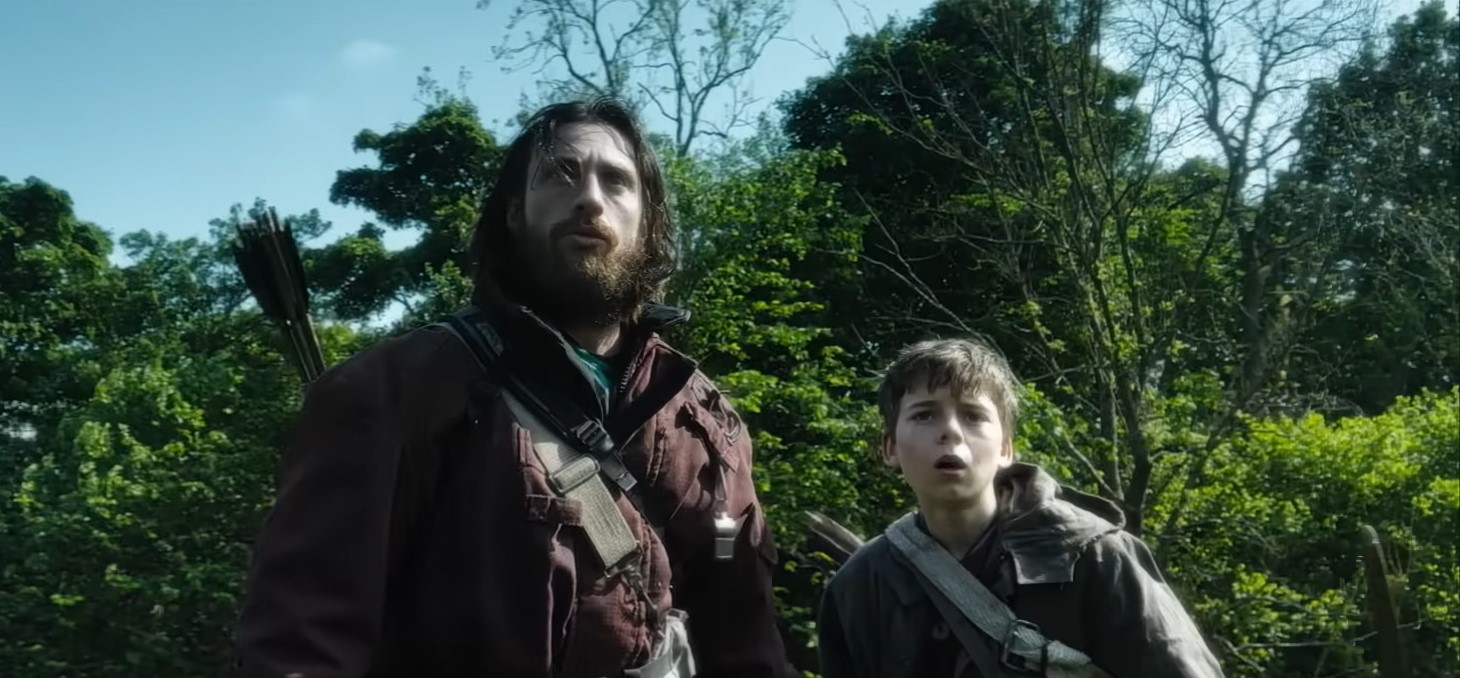
Aaron Taylor-Johnson and a kid actor each dressed like Robin Hood with no hoods, looking incredulously at something offscreen.

A father/son coming-of-age zombie hunt? What’s the worst that could happen?

Once upon a time in 2002, 28 Days Later led a post-Romero zombie revival that’s technically never ended if you’re still following at least one Walking Dead spinoff. (No, thank you.) Its depiction of a paler-than-usual 21st-century England overrun by frantic super-speed vomiting jitterbuggers was an electrifying revelation up until it turned into a military action flick and we all learned Humanity Is The Real Monster. But within the span of that terrifying first half, no one could deny the harmonic convergence of Trainspotting director Danny Boyle, The Beach‘s novelist-turned-first-time-screenwriter Alex Garland, and young unknown Cillian Murphy. The audience’s scars from that first half never fully healed.

Boyle and Garland hopped from horror to sci-fi with the riveting apocalypse of Sunshine, leaving their zombie apocalypse in other hands. I never bothered with the sequel 28 Weeks Later unless you count Screen Junkies’ recent Honest Trailer, which seemed like all the recap I needed. Generations later Boyle and Garland reunite for 28 Years Later along with cinematographer Anthony Dod Mantle, whose early pioneering in digital video worked wonders with Days‘ haunting imagery and jump-scare nerve-shredding before jump-scares were played out. The old team ignores Weeks and once again cranks up the visual voltage for half a film, only to diverge yet again from the undead stampede for someplace else. This time the topical shift resonates more bittersweetly. Well, mostly.

Continue reading →

“The Dead Don’t Die” But They May Be the Last Ones Here to Turn Out the Lights

Sheriffs Don't Die!

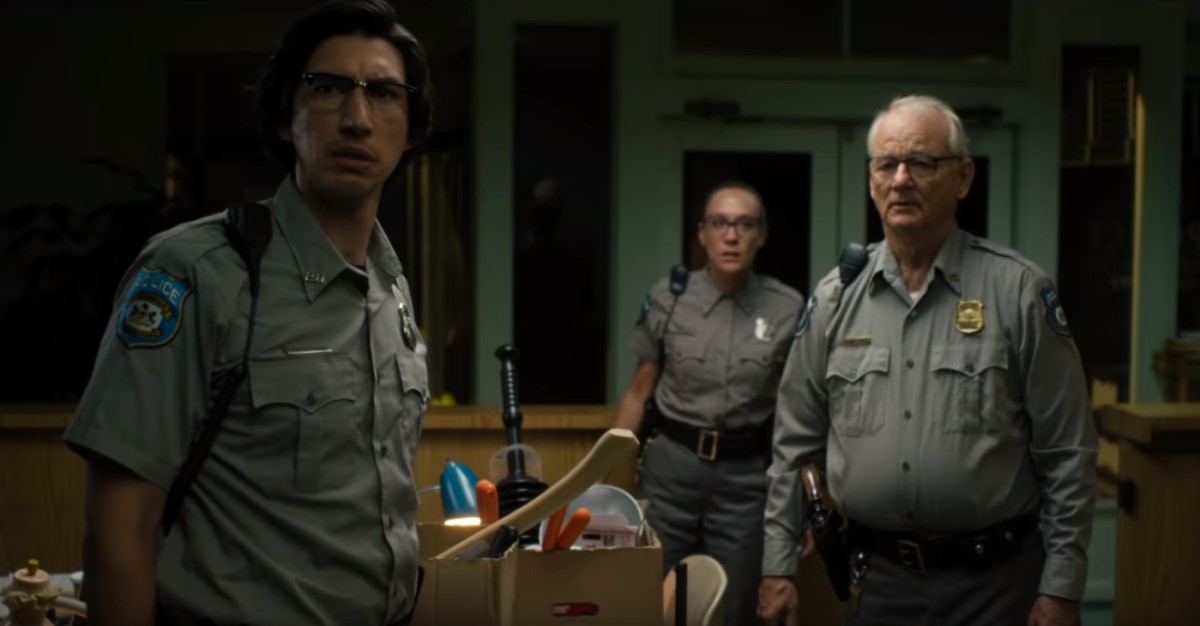
Your local sheriffs scrambling to fathom the zombie menace in a film that could also be called The Living Don’t Live. Ooh, paradoxes.

I remember reading about the films of idiosyncratic director Jim Jarmusch in the Movies section of Entertainment Weekly throughout the course of my now-lapsed 28-year subscription, but I’ve never made an effort to watch one for myself till now. Inertia can be a pathetic anchor like that sometimes. And it’s far too easy to get distracted in a universe of nigh-unlimited cultural options, where the human mind can only hold so many directors’ names in its head at any one time, presuming one is making an effort to retain them.

When I saw Jarmusch’s name on the trailer for The Dead Don’t Die, I knew this could be no ordinary zombie film. After a long journey that involved me showing up at the wrong theater, driving halfway across the city to the correct one, nearly having a breakdown when I had to brake for a funeral procession, and arriving with plenty of minutes to spare thanks to a glut of trailers that stalled for time in my favor…then did I see my prophecy fulfilled.

Continue reading →

“World War Z” First Trailer: Raise Your Hand If You Recognize a Single Moment from the Book

I wouldn’t call myself a horror fan anymore, but I dabble in minuscule doses under controlled circumstances, if I sense some sort of aesthetic at work whose quality isn’t measured by how many sanguinary “epic kills” are racked up for our carnival amazement. I read Max Brooks’ debut novel World War Z a while back and thought it was an exemplary exception. Styled as an assembled “oral history”, WWZ was a patchwork of short stories about human perseverance (or lack thereof at times) in the face of standard undead onslaught, attached to a Big Picture framework you could discern if you paid attention to the little details scattered throughout its varied first-person narratives. Brooks had a remarkably dexterous way of shifting across a full spectrum of cosmopolitan viewpoints across continents, at exploring different levels of survival competence ranging from blind luck to militarily prepared, and especially at extrapolating how governments other than ours might respond to such a nightmarish, supernatural threat. (Ever wonder what extremes China might consider? Brooks does.) Content extremity was kept to a minimum in most sections, opting instead for a more well-rounded, humanizing approach to the storytellers. It wasn’t Frank Peretti, but it wasn’t torture porn or splatterpunk, either.

This mosaic of unrelated characters has apparently now been funneled into the major motion picture World War Z starring Brad Pitt as the Main Character the book didn’t really have, Mireille Enos from The Killing demoted from failed detective to The Wife, and some cute defenseless children, because Paramount Pictures is reportedly aiming for a PG-13 rating so everyone can conscientiously keep a Blu-Ray copy on the family-blockbuster shelf next to Steven Spielberg’s War of the Worlds.

Continue reading →