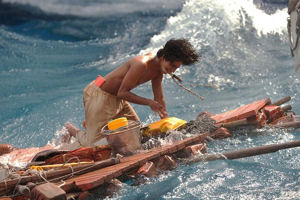
Pi the spiritual drifter.
Ang Lee’s most recent adaptation of a novel I haven’t read, Life of Pi, pops with visuals that dazzle and astonish even without the 3-D upcharge, but many viewers who’ve already chosen their walk in life may be less enthusiastic about the film’s broad presentation of its spiritual themes. Since childhood, our young hero Pi has never adopted a religion he didn’t like. He doesn’t favor any one particular faith over another, instead enjoying the wide latitude of the “Everyone’s right, everyone wins!” pluralistic approach to religion that assumes anyone short of Hitler will be in Heaven if everyone’s excellent to each other, and God is merely an elderly greeter at the gates, waving politely and passing out “Participant” ribbons. As long as a belief system mentions God and endorses unlimited happiness for one and all, it’s on the “nice” list.
Unfortunately for Pi, other characters struggle to accept his lifestyle choice, particularly his pro-science dad, who lectures Pi on behalf of Hollywood’s God-hating half about the merits of siding with Reason as if it’s an option mutually exclusive from religion altogether. In the film’s framing scenes, an older Pi (Irrfan Khan, last seen Stateside as a lackey in Amazing Spider-Man) tells his incredible tale to an earnest skeptic with writer’s block (Rafe Spall, last seen dying stupidly in Prometheus). Beyond these token nods to nonpartisan balance, Pi is otherwise a passionate, stubborn, welcome argument for choosing theism over atheism. In limiting the debate and the viewing experience to that simple baseline context, I was on board and enthralled to that extent.



 “It’s been a long trip.”





 Particularly near and dear to me this year are those who have read, followed, and actively supported me in my endeavors regarding my writing in general and this site in particular, now seven months old and not yet crashed or burnt. Any forms of feedback, from the simplicity of clicks to the extreme generosity of comments, have meant the world to me as I continue this process of exploration, experimentation, and indulgent navel-gazing. While the value of such input into my process is sometimes hard to quantify, the WordPress.com sensors insist that earlier this week marked MCC’s crossing of the 1000-Like threshold. I had no idea they tracked such statistics to that extent. I can’t believe they even have a dashboard icon for it (pictured). The longtime high-traffic bloggers among you probably enjoy this response level as a twice-weekly event, but a small fry like me is in no position to take any forms of encouragement for granted. Obviously I try not to rely on Likes as the foundation for my self-image, but I can’t deny that it’s nice to have some kind of measuring tool (no matter how unscientific) to confirm that I’m not necessarily applying this particular skill set on a daily basis entirely in vain.
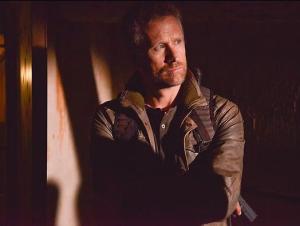 As this week’s new Revolution episode “Kashmir” opens, Our Heroes have commuted a full 280 miles from last week’s endpoint in Ford City, PA (or wherever the Allegheny rapids dumped them south of that), all the way east to West Chester, twenty miles west of destination Philly, and home of a Rebel Alliance faction led by special guest star Reed Diamond. The costar of TV’s Dollhouse and Homicide: Life on the Street was a welcome change of pace from the long line of guests I haven’t been recognizing. I presume this means the show’s mighty ratings have finally earned it a higher casting allowance.