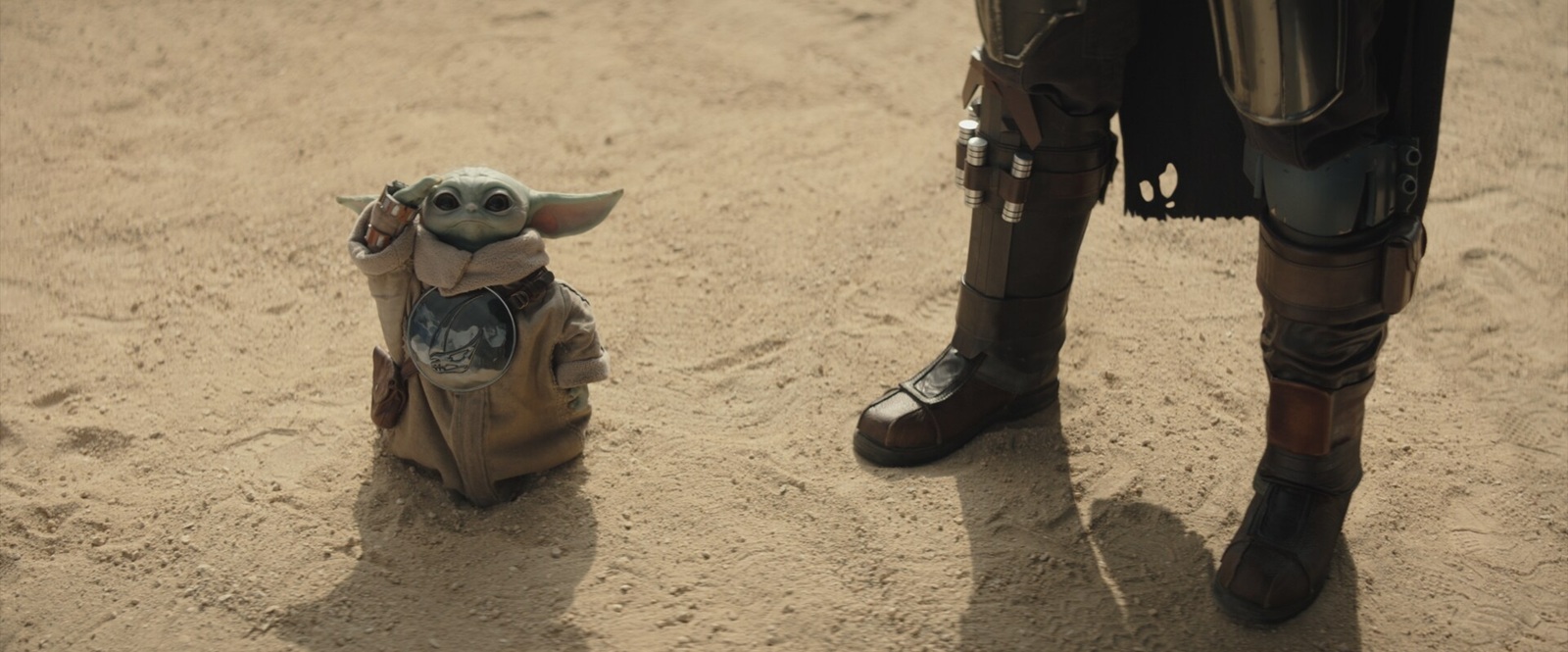
IT’S GROGIN’ TIME!
Previously on Midlife Crisis Crossover: We watch Star Wars movies and shows! My wife Anne and I have kept up with most of the Disney+ series, for better or worse. We aren’t unconditional superfans preaching, “If it says Star Wars on it, it’s A+++!” in a glassy-eyed haze, nor do we hate-watch it and share high-strung “cave-geek shakes impotent angry fist at toy line” harangues for hollow YouTube bucks while our souls decompose into gnarled, oily nubs.
The far-faraway galaxy is large; it contains multitudes. Granted, that’s more of a four-quadrant marketing design than a magnanimous diversity credo. Billion-dollar corporations don’t stay megalithic by catering exclusively to any singular faction. The universe that began with the classic Jedi lightsaber battles of your sacrosanct childhood memories — or your children’s, if you’ve passed down your pop-culture heritage to them! — also includes the protracted Clone Wars continuity, the politically charged Andor, the kiddie-cartoon-to-steely-drama evolution of Star Wars Rebels, the cosmopolitan artistic experiments of Star Wars Visions, the books and comics that can matter but usually don’t, in-story toyetic adverts, nostalgia-pandering, Morals of the Story, super awesome EXPLOSIONS, the aesthetic sins and redemptive apologia of Jar-Jar Binks, spaceships, Halloween masks, clothing lines, infrequent moments of This Is Cinema, and, yes, the character we knew for years as Baby Yoda till The Powers That Be eventually bothered to name him.
Possibly even more polarizing a fictional character than Rey or Barbie or Ugly Sonic or Mel Gibson, Grogu is either the crucifiable symbol of Everything Wrong With Star Wars or the cutest widdle Force-user ever to survive Order 66 and go on space adventures with his adopted dad. By and large, anti-cuteness tantrums bore me. Been there, thrown those, got over myself. I was 10 when I first saw an Ewok, a teenager when I decided Ewoks retroactively suck, 27 when I cringed at Jar-Jar, 28 when I joined my first internet message board and decided not to take George Lucas’ saga that seriously, and 48 when I watched the first episode of The Mandalorian, where the li’l floppy-eared, dead-armed, Margaret Keane-eyed, orphaned, traumatized, neurodivergent mini-monk debuted at the end and a new merchandising line blew up worldwide.
I’m now 54, only a year older than Grogu himself and somewhat more coherent. I’ll own up to a quasi-ironic fascination with the efforts to integrate him into a mostly dramatic storytelling framework with a straight face, belying the Disney Empire’s apolitical, bottom-line mandate that THIS IS STAR WARS NOW, the outstanding yet aberrant Andor notwithstanding. I recognize the ludicrous undercurrent and yet I’m happy to sit in the same theater as space-opera enthusiasts, ordinary folks who can only afford one movie a year, Joseph Campbell disciples, Kurosawa cineastes, black-clad Sith-Goths, and tiny children who love shiny objects and huggable critters. This nonverbal mascot has all the physical articulation of the Arby’s oven mitt and he makes me smile anyway. So does the part where a pea-soup-complected Muppet induces screen-rage in adorablist bigots who demand Serious Science Fiction and insist space heroes cannot be cute, tiny, or “forced” upon them. I’d share some of my blood pressure meds with them if I could.
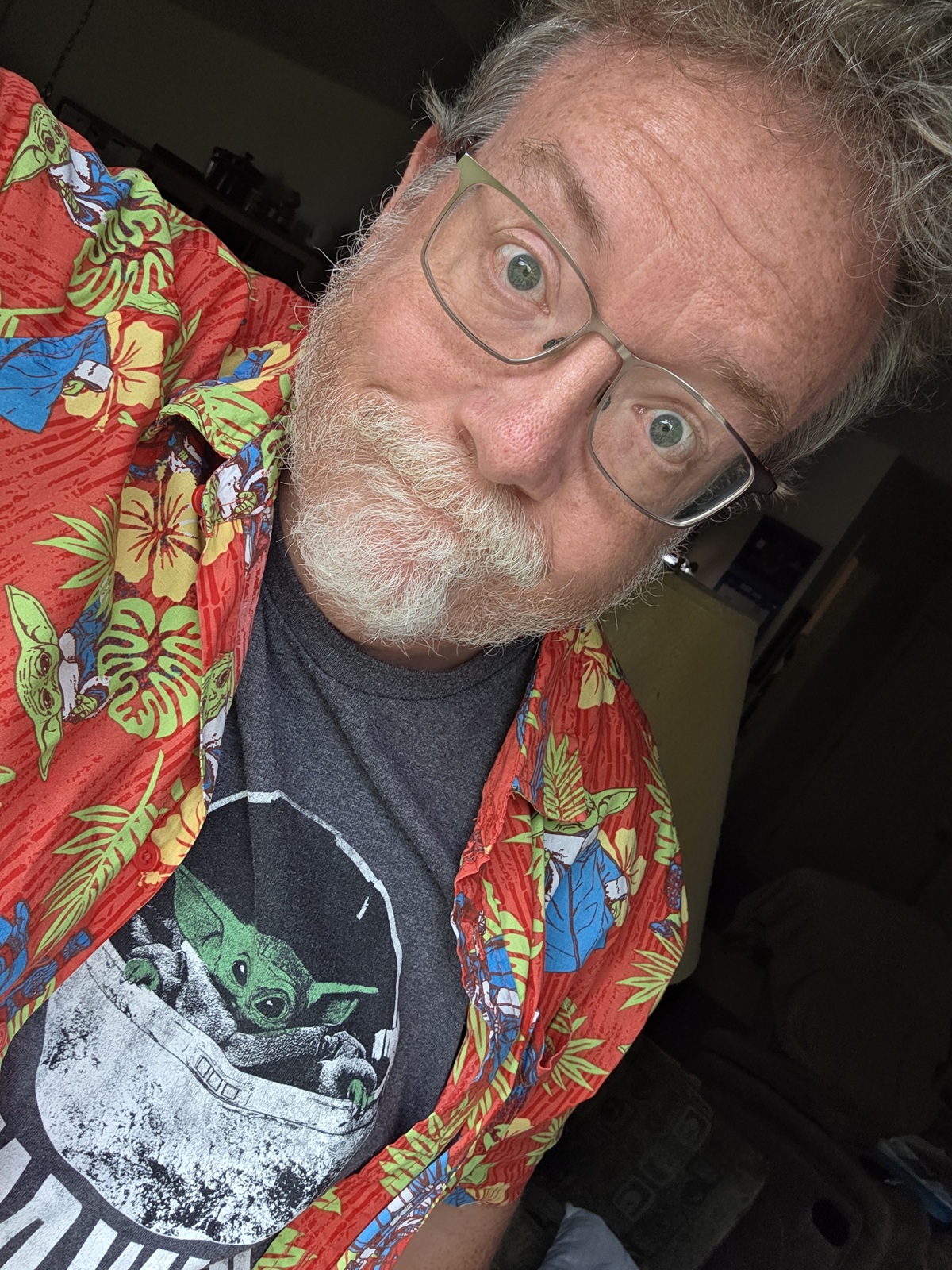
Sporting my Grogu shirts for the occasion — both of them.
TL;DR: if you aren’t already smitten with Baby Yoda, or haven’t at least come to terms with his rationalized presence, then Star Wars: The Mandalorian and Grogu is not for you. I’m game to stick around. I still reserve the right to nitpick, of course.
It’s an unsurprising choice for the saga’s next feature film, ending the six-year moratorium after Episode IX‘s compromised letdown. While the property retreated to the Disney+ hermetic bubble, the Lucasfilm regime announced sixty-seven projects by assorted “hot” filmmakers, almost all of which have been walked back and progressed nary an inch past the giddy press-release stage. For the sake of getting something — anything — out there to non-subscribers and/or amortizing their extravagant production expenses, they’ve taken the path of least innovation back into theaters: by giving us a Mandalorian two-parter stitched together. I’d call it a shameless ploy if they’d made any effort to disguise it: there’s literally a cut-to-black break between the two episodes, right after a cliffhanger — just enough space that could’ve held a “NEXT EPISODE” button for the audience to click.
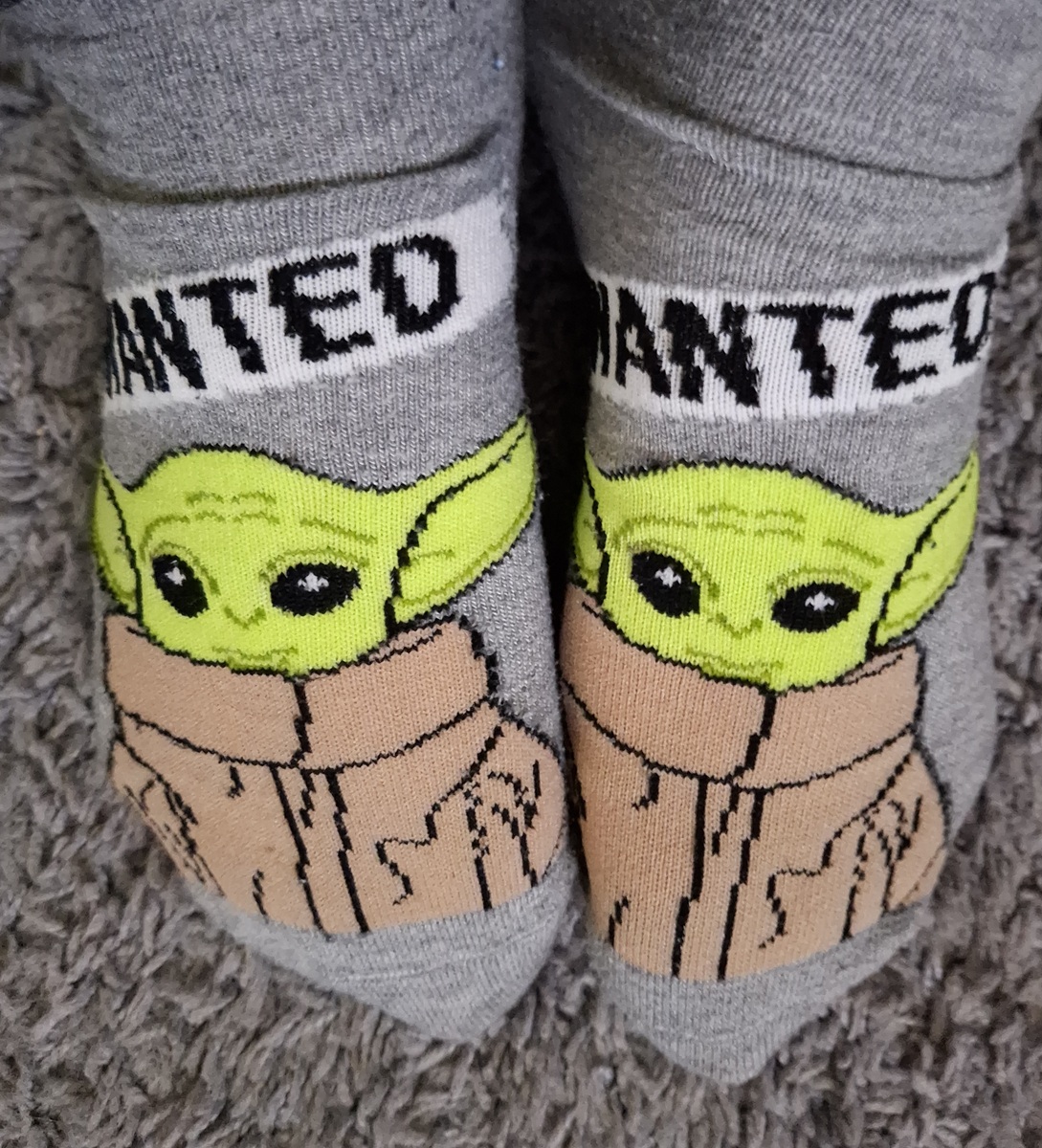
Anne’s Baby Yoda socks.
The Gist: Voice actor Pedro Pascal returns to the central role of armored merc Din Djarin in the further adventures of the neo-noir monster-movie shoot-’em-up space-Western serial — directed by OG helmer/producer Jon Favreau, who co-wrote with recently promoted Lucasfilm chief Dave Filoni and The Book of Boba Fett collaborator Noah Kloor. When last we left Our Heroes…actually, I forgot much of season 3 and had to go look it up just now: they finally wrapped up the Mandalorians’ lengthy saga that ran from Clone Wars to Rebels to the present, which was probably more interesting to viewers who watch ALL the Star Warses and know Bo-Katan had a much richer backstory than just “Girl Mando #2”. The season ended with Mando and Grogu cheerfully living alone but agreeing to accept paying gigs from the New Republic, capturing any Imperial fugitives lurking in the Outer Rim and evading justice and/or war tribunals. As independent contractors rather than full-time team players, the duo could technically still take jobs from seedier enterprises, but what are the odds of Grogu ever traveling within twelve parsecs of a moral gray area?
After a banger of a prologue involving one throwaway outlaw in a snowy mountain hideout stocked with AT-ATs, Our Heroes are (I Am Not Making This Up) dealt their next fetch-quest from a pack of New Republic’s Most Wanted Trading Cards: a middle-management evildoer named Coin. His card is a blank silhouette because no one’s seen him or taken a photo, making the card useless unless Mando needs help remembering his name is “Coin”. Mr. Coin is somewhere in the galaxy, but only one source can purportedly reveal his location. As a paycheck advance Mando and Grogu are given a new starship (remember, the old Razor Crest was destroyed in season 2, episode 6! You took notes on index cards while watching, right?), which they fly to go meet a pair of slightly familiar faces: the Hutt Twins, last seen ceding claims to cousin Jabba’s old turf in Book of Boba Fett (if you’ll check your spiral-bound notebook).
Naturally the Twins have their own fetch-quest they want completed first, as is the tradition in film noir or video games: they want Mando to extract Jabba’s one true heir, his son Rotta the Hutt, from crime lords on the planet Shakari. So Our Heroes pause the main storyline, steel themselves for the chain of twists-‘n’-turns to come, and go take care of this new task on Shakari while wondering silently to themselves just what God needs with a starship.
(Look, Lucasfilm: you cannot seriously name someplace pronounced “Sha Ka Ree” and expect none of us to make Star Trek V jokes. In the great stupid Star Trek/Star Wars fake rivalry, some of us are on both sides.)
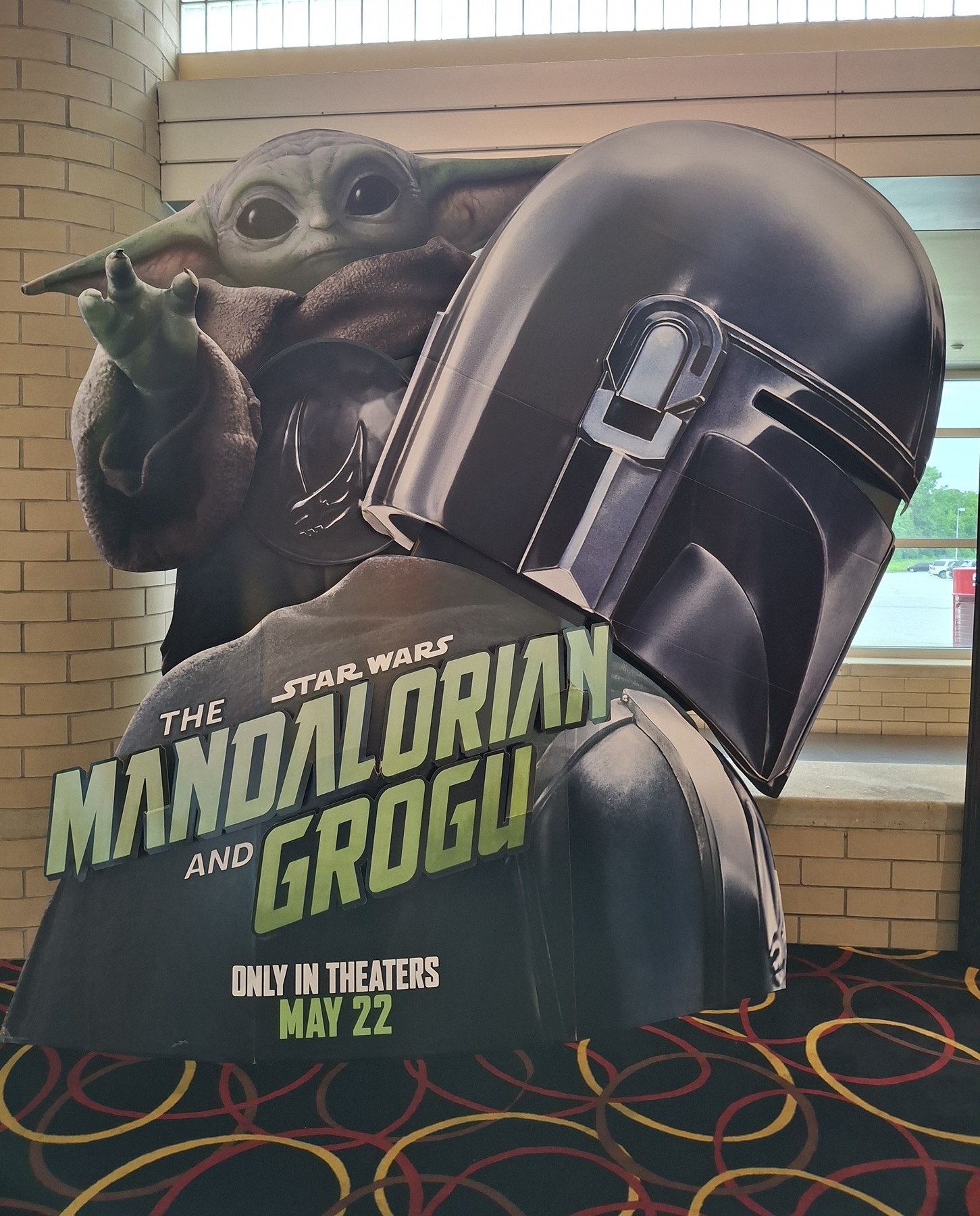
Our Heroes bigger than life in the AMC lobby.
The familiar faces: We’ve met their quarry on Shakari before — Rotta the Huttlet, who was basically Baby Jabba when he was introduced in the extremely wobbly 2008 Clone Wars movie (if you’ll once again check the binders on your reference shelf). Some time has passed: Rotta is all grown up and he’s sent away for some of those Charles Atlas bodybuilding lessons sold through old comic-book ads — now he’s an imposing, musclebound gladiator with an undefeated record. Tired of space bullies picking on him, he’s transformed himself into the Wilson Fisk of Hutts. Call him Rotta the Hunk. He’s “voiced” by The Bear star Jeremy Allen White; I could hear his cadences and imagine him in the recording booth, but Skywalker Sound voice filters have pitch-shifted his every line into a lifeless, brutish monotone. I don’t care that he doesn’t sound like other Hutts (that same Clone Wars movie already set canon precedent that Hutts can have diverse voices, even if the unorthodox ones are wince-inducing), but he’s so flattened, Rotta might as well have been “voiced” by Fran Drescher.
Ubiquitous voice actor Steve Blum gets his meatiest big-screen Star Wars role as Zeb from Rebels, who hangs out with Our Heroes for much of the movie. Shirley Henderson (Pixar’s Elio, Harry Potter‘s Moaning Myrtle) is a quartet of Anzellians, furry little space mechanics like Babu Frik in The Rise of Skywalker for value-added comic relief and toy sales. Other familiar faces include a last-minute cameo from Kim’s Convenience star Paul Sun-Hyung Lee in his recurring role as That One Asian X-Wing Pilot Who Really Gets Around.
Newcomers to the galaxy include Sigourney Weaver as Mando’s New Alliance contact, who can also fly a mean X-Wing, by which I mean “rock back and forth in a practical, gimbel-mounted cockpit spliced with CGI space-dogfight footage” (though she gets more to do here than she did in the recent Dust Bunny); Academy Award Winner Martin Scorsese as a motormouth space-food-truck owner with four arms, a dozen kids, important intel, and frayed nerves; and Stephen McKinley Henderson (Fences, Dune: Part One) as a friendly gent living down on the space bayou. Bad guys include Jonny Coyne (Preacher, Ma Rainey’s Black Bottom) and Hemky Madera, the kindly bodega owner from Spider-Man: Homecoming.
Pascal himself only shows up in person for one sequence when he loses his helmet yet again. As a nice gesture toward the guys who did all the heavy lifting, the opening credits name his two primary stuntmen as full costars — Brendan Wayne (also an X-Wing pilot in Ahsoka) and Lateef Crowder, whose henchman experiences include Furious 7 and Triple Frontier. In two different sequences featuring three or more live humans, you can bet there’re uncredited cameos, including — dull surprise! — Mr. Filoni and his magic hat.
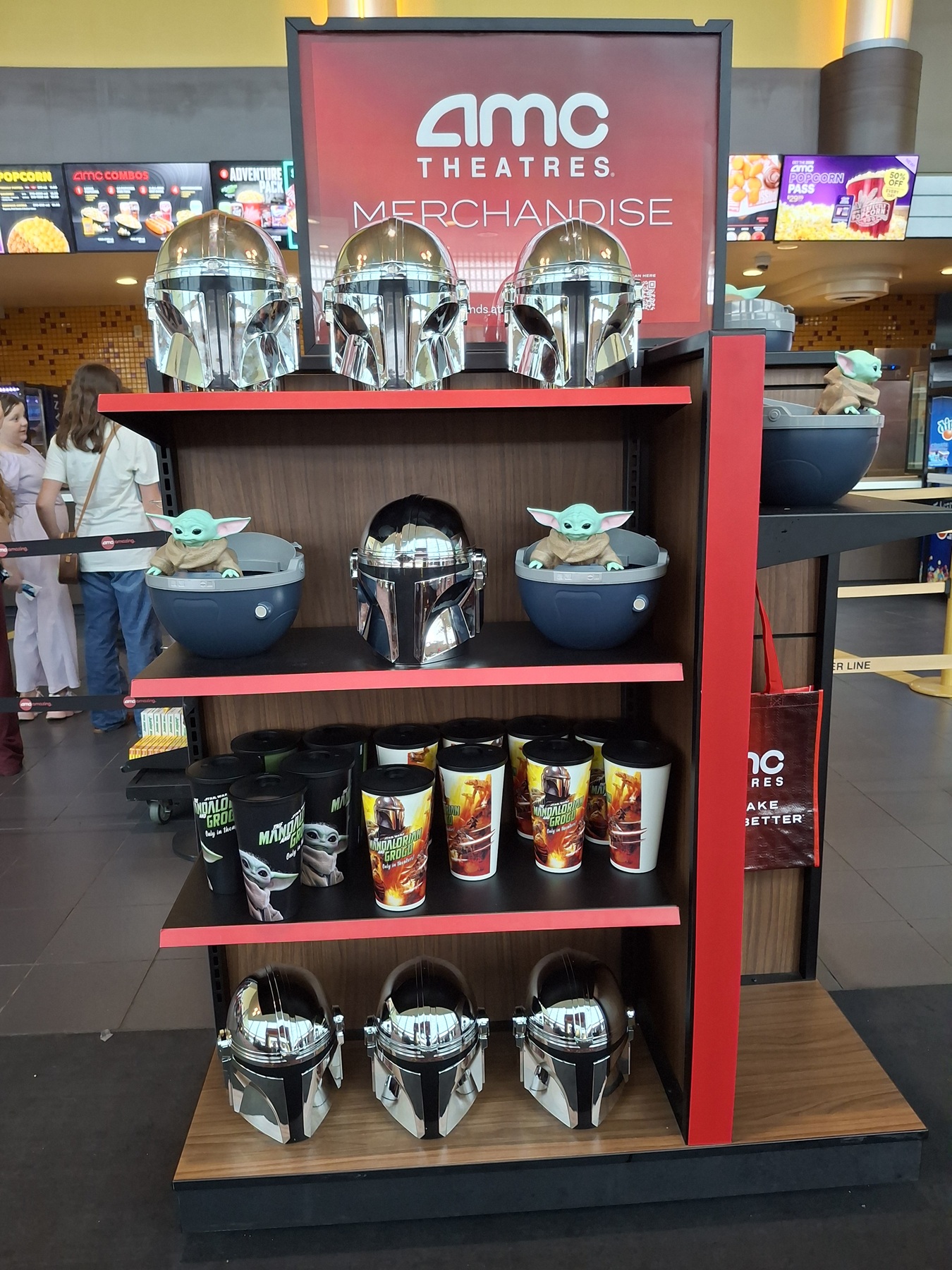
Running low on Baby Yoda merch at home? AMC’s got you covered!
The Impressions: Like many a noir, the initial “plot” may seem simple, while the details are in the convolutions that follow. Then the “noir” gets tossed into the dust late into episode 1 and we’re mostly back to Star Wars action-blockbuster set-pieces that answer the implied question, “Did this really need to be a theatrical release?” Sometimes the answer is yes, especially if you took the plunge like our family did and pay Dolby Cinema upcharges for bigger, brasher A/V returns.
Favreau still has the instincts that served him early into his career (Elf! Zathura! Iron Man!) when he properly balanced VFX roller-coaster dynamics with grounded characters and emotional stakes that helped the explosions, in one sense or another, “matter”. That carried over into the wizardry of his early Mandalorian episodes, a welcome change of pace from the Sequel Trilogy that drew from a different set of genre influences and entertained on more satisfying levels beyond the usual nostalgia overdrive and wall-to-wall Easter-egg backdrops plastered somewhere in every SW installment.
To that end, the best part’s in episode 2, when Mando has been laid low and Grogu has to carry him and the movie on his own for a while. Light slapstick is in order as always, but the wee middle-aged tyke is also stuck silently facing an unhappy subject Dad’s brought up before: as a species with a centuries-long lifespan, Grogu will outlive Dad and have to figure out how to fend for himself. The lengthy, quiet sequence might test the patience of any detractors who really hoped this movie’s selling point would be The Death of Baby Yoda; for fans still on board, it’s charming to see his meager survival skills tested, his improved handling of The Force, and his big tiny heart instead of his rapacious seafood appetite for a change. For once he exhibits more interiority than a Precious Moments ornament, even if his limited animation still makes him a functionally quadriplegic bouncing elf.
That change-of-pace puppetry challenge only accentuates one of the more unexpected drawbacks here: somehow it took three Star Wars TV veterans to phone an entire film’s worth of dialogue — a staid parade of flairless placeholder sentences in dire need of rewrites, very much in the George Lucas tin-ear spirit. That’s not the nostalgia I was looking for. Grogu’s solo survival mini-game was all the better as an oasis getaway from all that. In reciting his share of spaghetti-Western boilerplate, Pascal performs the job to the extent that’s typically asked of him, but I felt a little less cheery than usual because I’ve only recently begun watching his darker lead turn in Netflix’s Narcos, which ended two years before The Mandalorian catapulted him into the pop-culture mainstream. The more I see and the grimmer it gets, the more I find myself unfairly, retroactively judging all the simpler roles he’s taken since then.
It was smart, then, to choose in advance to enter into all this with near-subterranean expectations. Dolby Cinema hyperdrive can’t save every popcorn flick, but Favreau and his teams exploit the cinematic tech available for popcorn-flick maximalism at each episode’s climax. It was worth leaving the living room for the immersive kicks of an arena battle packed with rather familiar creatures whose movements all register in the subwoofer range (apart from groaning when I stepped back and realized the Big Picture itself was an Easter egg). The intermittent hand-to-hand duels were a bit juiced-up, including some melee with one of the overlooked Clone Wars bounty hunters of yore (which you noted on a Post-It in your Trapper Keeper, of course). And from the Department of Things Star Wars Has Never Done Before, how about a no-holds-barred HUTT CAGE MATCH! Along with the aforementioned dogfight and various aerodynamic callbacks throughout the final boss battle at the Hutt twins’ overscaled Tree Tots Family Tree House.
The Mandalorian and Grogu is not the show’s best season and I had a rollicking good time. As an MST3K fan, I often find both things true — here it’s at the expense of, and thanks to, the Star War at hand. It’s arguably the best Star Wars film since…um, since whichever one you hated most, unless you’ve made up your mind that Baby Yoda is absolutely The Worst. Hopefully your personal Jedi journey from fear to anger will lead you to some other stop besides suffering.
(If you simply must show up at a theater looking to stay in touch with The New, might I redirect your attention toward I Love Boosters, which also opened this weekend and, from a certain point of view, might share your strong sense of anti-corporate rage?)
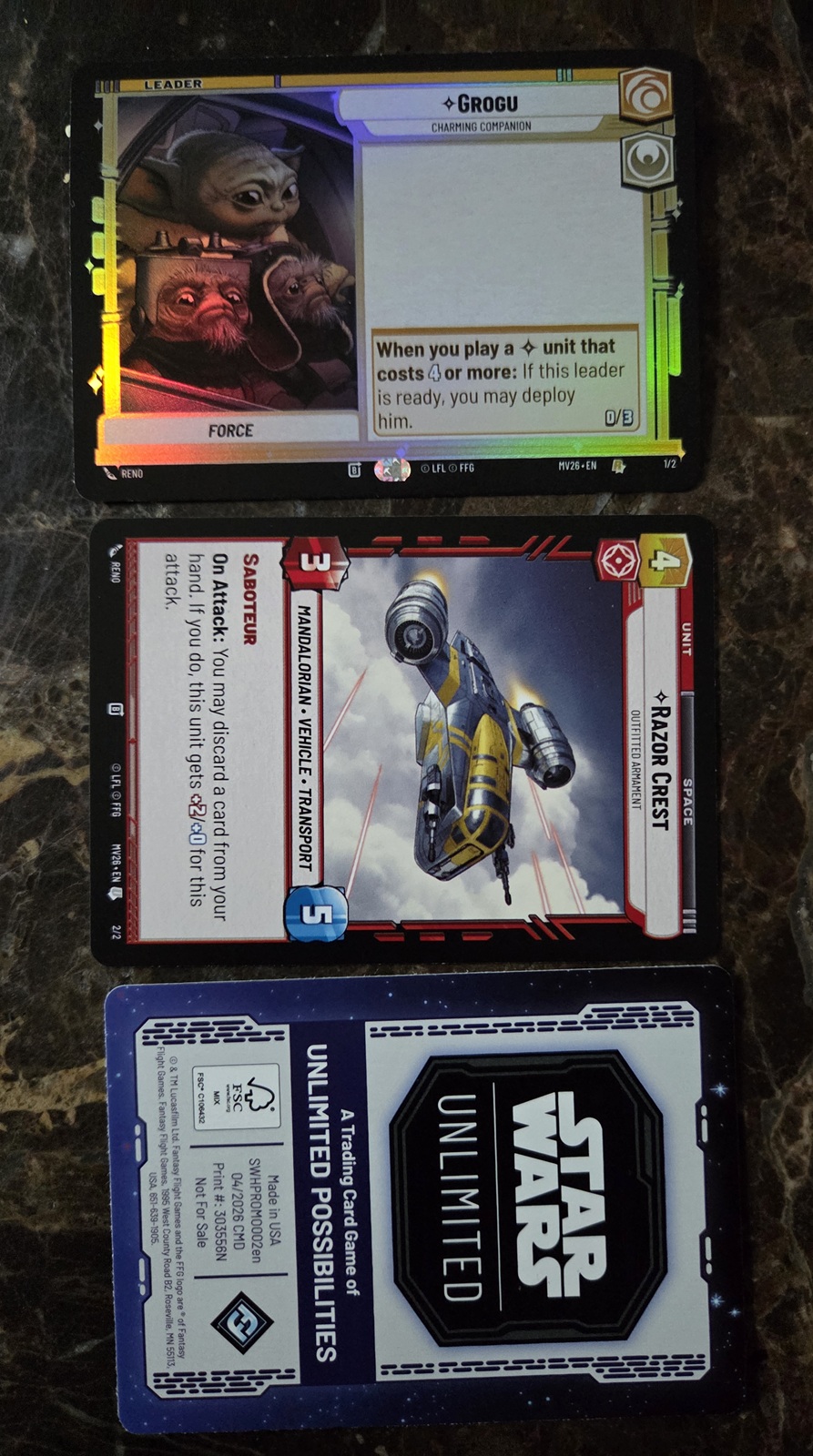
Value-added bonus: they gave us free trading cards for attending on opening weekend!
The end credits? No, there’s no scene after The Mandalorian and Grogu end credits, but they confirm the cameos — some as bar patrons, some as X-Wing pilots — include feature-film directors who’ve also directed Mandalorian episodes. The Special Thanks section high-fives a couple more show contributors, including Taika Waititi. Thankfully the additional selections from Ludwig Göransson’s wildly eclectic score drowned out the two plus-sized guys sitting to our left who were complaining up a storm to each other about what they’d just endured.
At the very end, the credits do not announce “THE MANDALORIAN AND GROGU WILL RETURN.” Given how many Star Wars projects have been vaporized, I can understand their refusal to overpromise and jinx themselves.
Discover more from Midlife Crisis Crossover!
Subscribe to get the latest posts sent to your email.

