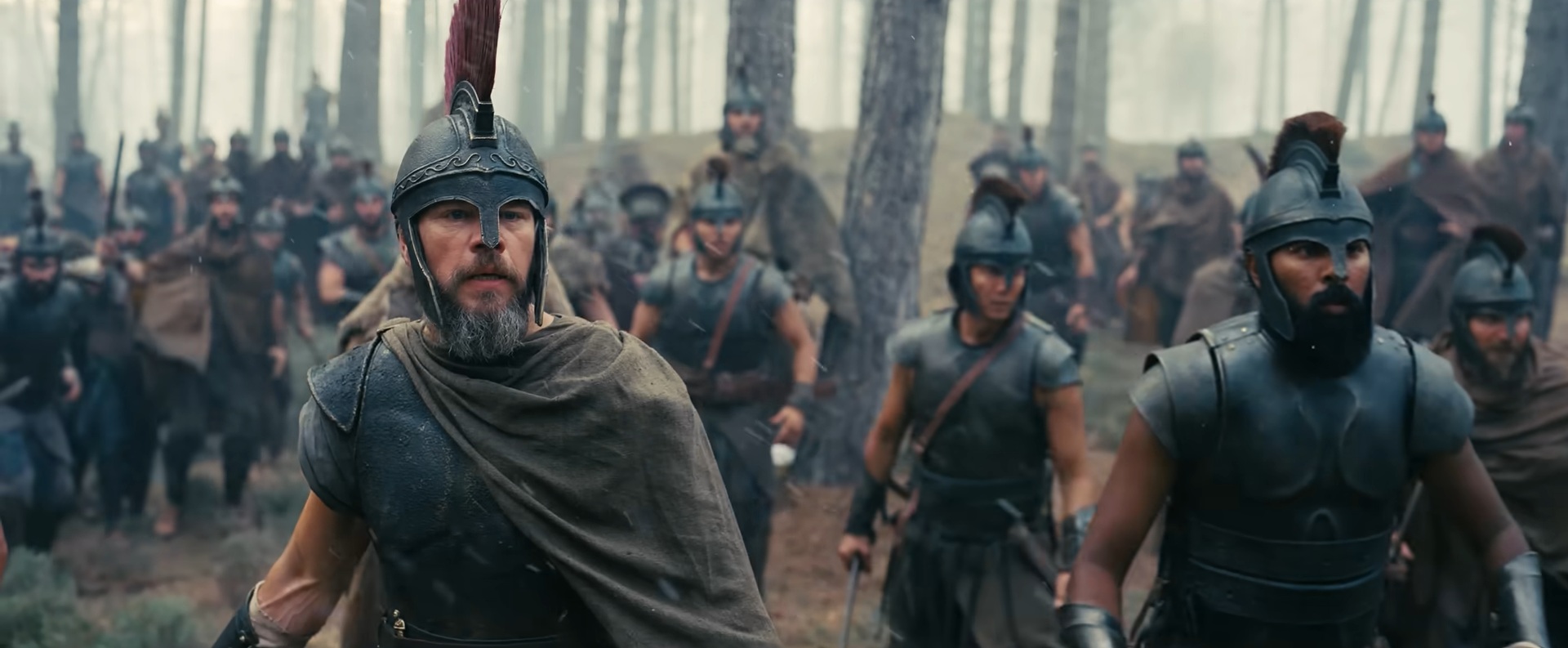
Bourne-Hur.
Previously on Midlife Crisis Crossover: Oppenheimer afforded Academy Award Winner Sir Christopher Nolan a “king of the world” moment that his hardcore fans had been anticipating for years. Few other directors, if any, could’ve reaped a nine-digit box office take and filled a movie-trophy case with a big-budget historical saga about a haunted man who’s hailed as a hero by his peers for having a singular idea that took a team to execute and ended a lengthy war at the cost of countless innocent lives in the process, only to end the film with a monologue about his hubris, sins, and regrets, all as an admonishment to a humankind too quick to celebrate his body count and one day repeat his mistakes.
Handed a virtual blank check to make all his creative impulses come true henceforth in perpetuity, yet again Nolan defied today’s moneymaking traditions in favor of a pet project: a lavish adaptation of Homer’s Odyssey. Sixty years ago it might’ve been reimagined as a bloated three-hour musical with far less blood and lots of female backup dancers, but 20th-century filmmakers generally limited themselves mostly to shorter, less sprawling Greco-Roman fantasies augmented by Ray Harryhausen wizardry, almost as if the Directors Guild unanimously decided to leave it alone until that magical day when a Chosen One might rise up and make it happen.
The usual Nolan superfan excitement was muddled by detractors decrying its Hamilton-style casting process that tampered with the strict historical record, not to mention the fact that this is possibly the first Greek epic ever performed entirely in plain American accents — nary an imperious British lilt from the entire cast, not even among its UK-born costars. So far they’ve been pretty mum about the unrealistic portrayals of the Cyclops, the ten-foot-tall super-soldiers, and the conversations with ghosts. I look forward to their three-hour YouTube rants about the Indian-descended Sir Ben Kingsley and the half-Iraqi Andy Serkis each playing real-life, milky-white Englishmen in Young Washington.
The Gist: Recapping one of the most widely read ancient works of all time seems pointless, so maybe we’ll cut this section short. Academy Award Winner Matt Damon returns from Nolan’s Oppenheimer and Interstellar as the eponymous hero himself. The king of Ithaca spent ten years fighting in the Trojan War until he came up with the idea for the Trojan Horse, which allowed his side to infiltrate the walled city-state of Troy and annihilate them from within. And they all lived happily ever after, except for the massacred citizens of Troy, and except for the winning soldiers who took years to reach home. Odysseus technically could’ve gotten home a lot sooner if he hadn’t kept angering the gods, sometimes out of arrogance and sometimes unwittingly, which still counts as punishable mortal folly in their eyes. A series of unfortunate events ensues!
Nolan can’t resist playing with the chronology, but sticks to a much simpler framework than usual by his standards. The “present day” begins eight years after the Trojan War with Our Hero having already spent several years living far from home with Calypso, portrayed by an uncharacteristically docile Academy Award Winner Charlize Theron as the world’s tallest nymph. She’s kept him compliant with lotus-induced amnesia, but has decided it’s time to let him go and gently coaxes him to relive his long, terrible journey in big-budget, effects-heavy flashbacks on the high sea, with unplanned pit stops at all the worst possible Mediterranean islands.
Meanwhile back in Ithaca, Academy Award Winner Anne Hathaway returns from Nolan’s Interstellar and The Dark Knight Rises as Queen Penelope, who’s had to hold down the fort in her husband’s absence for some eighteen years and counting, with a little help from her son Telemachus (web-swinger Tom Holland), who’s too young to remember his dad yet remains loyal to the idea of him. She’s remained faithful all this time despite the army of suitors who’ve been camping out in their castle for years, all waiting for her to presume her husband dead and pick a new husband to become king. Their self-imagined frontrunner is the sneering Antinous (Robert Pattinson, returning from Nolan’s Tenet), a cowardly braggart who didn’t serve in the Trojan War and whose qualifications for the job include being male, present, and literally nothing else. But someday her king will come! She sure hopes!
The familiar faces: John Leguizamo, who’s about to return in the sixth (!!) Ice Age film, is a dramatic revelation as Odysseus’ longtime servant, likewise keeping a light on for him. Other castle employees include Frankenstein‘s Mia Goth, Logan Marshall-Green (Upgrade, Prometheus), and Sons of Anarchy‘s Ryan Hurst as Telemachus’ fighting instructor.
The always great Jon Bernthal (Walking Dead! Punisher! The Bear!) is Menelaus, king of Sparta and war-buddy of Odysseus’ who didn’t have nearly as much trouble sailing home from Troy. Other Trojan War veterans include Himesh Patel (Tenet, the Enola Holmes series) as Odysseus’ number one guy Eurylochus, Elliot Page (returning from Nolan’s Inception), Will Yun Lee (The Wolverine, San Andreas), Jovan Adepo (The Leftovers, Welcome to Derry) Andrew Howard (Tenet, HBO’s Watchmen, the Oscar-winning Two Distant Strangers), Jesse Garcia (star of the Oscar-nominated Flamin’ Hot), Josh Stewart (a four-time Nolan vet who was one of Bane’s sidekicks and a Punisher big-bad), and hockey player Sean Avery (in his third tiny Nolan role). Not that I recognize him, but while we’re on a “fun trivia” kick, let’s throw him in.
Other presumptuous invaders of Stately Odysseus Manor include Corey Hawkins (The Color Purple, In the Heights), Brian Vernel (Gangs of London, Slow Horses), Elyes Gabel (Interstellar, CBS’ Scorpion), and Iddo Goldberg (Peaky Blinders‘ commie brother-in-law Freddie Thorne). Still more veterans of Nolan’s previous films include James Remar (Oppenheimer, Black Lightning) as the dead prophet Tiresias, and Benny Safdie (Oppenheimer, last seen directing The Smashing Machine) as the Trojan War commander-in-chief Agamemnon, whose face is kept hidden from us in so many scenes that we expect him to be revealed as some mighty A-lister, but nope, it’s not Clooney, it’s just Benny Safdie.
Also, we have a few more women! Lupita Nyong’o is technically playing two different roles — not just Helen of Troy, the character that launched a million internet tirades, but also her half-sister Clytemnestra, eventual wife of Menelaus. Some key dialog is so drowned out or rushed past that I honestly had no idea this was the case till I looked her up. Both her parts add up to about ninety seconds of performance, even less than she netted in The Rise of Skywalker. A mostly silent Zendaya (the Dune and Spidey movies) haunts Odysseus as the goddess Athena, or just a hallucination given the exactly zero times she lends him a hand. Meanwhile over on the Dark Side, Samantha Morton — an MVP in such recent films as The Whale and She Said — is the creepiest villain of all, the witch Circe, who resents the imposition of men beseeching her to feed them from her modest stores, only for her to ambush them with grotesque body-horror trauma by turning them into literal pigs.
The very first character to speak in the film is singer Travis Scott, as a performer who holds sway over an aggressive audience that eventually devolves into a stampede with casualties. This feels like some awfully cruel typecasting on Nolan’s part.
The Impressions: I read some version of The Odyssey long ago as a mere teen, but I remembered a surprising amount. Nolan has retained the most important story beats, by which I mean all the coolest action parts that a teen would love. Almost as terrifying as Circe’s twisted banquet is Our Heroes’ encounter with the carnivorous Cyclops (Legion‘s Bill irwin) in its massive cave, the first of many tragedies to come. Though Charybdis appeared in the trailers — a living whirlpool smaller and duller than the one in Pirates of the Caribbean 3 — they were more discreet about its deadlier partner-in-catastrophe Scylla. On the other hand, the logistical challenge of the scores of battling Laestrygonian giants reduces their Lord of the Rings skirmish to a too-brief interlude (keeping them all firmly helmeted and therefore easier to animate), while the Sirens practically fly by in the distance.
(Again, those vignettes are accurately adapted to the best of my fading recollection, but watching them back-to-back, it’s amusing to note how many tribulations end with Our Heroes overwhelmed by supernatural special effects and surviving only by running away like Monty Python’s Knights of the Round Table. No wonder the Trojan War dragged on for a decade.)
Rather than wall-to-wall spectacle, Nolan dwells at generous length on the human elements, the emotional heft, and the tolls taken in life during and after wartime. We can feel the revolting discomfort of hiding inside a giant wooden horse for days — described more grossly than it’s depicted, but sufficiently harrowing. The formidable tag team of Hathaway ‘n’ Holland are an intense, heartening, all-too-uncommon depiction of unwavering faith in a lost loved one. Damon’s performance may be among the strongest of his career — as his out-of-order sequences are mentally sorted along the way, we can chart Odysseus’ internalized journey from self-assured warrior-king to humbled traveler, brought low by various circumstances that were out of his control yet often his own fault, whether through hasty shortsightedness or by defying the gods themselves, which is a very bad move when you have much boating to do and one of the most aggrieved is mighty Poseidon himself. Every step in their gradual family reunion got to my sentimental side.
In some respects, though, Nolan’s tics once again undercut his imaginative ambitions. Yet again, lines of dialogue often lose the contest to be heard over the explosions and the score by Oppenheimer‘s Academy Award-Winning Ludwig Göransson, whose bombastic percussion is usually welcome whenever it’s the only sound in a scene. After the first hour or so, I found myself less enamored of SO MUCH ROARING AND ROARING AND ROARING AND THEN ALSO ROARING. One of my main reasons for paying extra for an AMC Dolby Cinema screening (as I did here) is the bone-rattling joy of volume-17 speakers aimed directly at sound-effects junkies like myself, but same as with Tenet, Nolan’s design gets repetitive and blurs into a pounding haze, as if he wouldn’t stop toggling the “INCEPTION BWAAAAAH FILTER” on the control panel. Several lines and nuances are lost in yet another of his Charybdian subwoofer maelstroms.
(I did notice the much-ballyhooed showings at the Indiana State Museum’s original, proudly genuine IMAX theater did include some time slots with open captioning. If I were to see this a second time and didn’t mind missing out on more AMC rewards points, that’s how I’d want to see it, once they stop selling out in advance.)
Also disappointing: in a movie about fighters fighting fights with fellow fighty fighters, the fight scenes aren’t exactly choreographed John Wick aggro-ballets. The Laestrygonians manage a fair amount of technical prowess, but the fairer, human-vs.-human duels seem improvised on the day of filming. Considering how much attention was lavished on every other aspect of production, the hand-to-hand melees come off anticlimactically pedestrian. Someone went to the trouble of festooning the sets with a generous Dungeons & Dragons arsenal, but very few are used for any memorable strikes. Maybe Nolan wanted to get realistically messy, awkward, and sans flashy poses…and granted, making the violence look too cool might feel a tad contrary to his whole “war = bad” theme…but really, why do all the bad guys get to have all the coolest-looking parts? The final battle in particular has all the finesse of a drunken barroom brawl. A war hero taking down a room full of bumbling Otises is no one’s idea of justice decreed by the Fates.
The denouement doesn’t quite match my memories, but it’s odd either way. Our main character is hailed by his peers for having a singular idea that took a team to execute and ended a lengthy war at the cost of countless innocent lives in the process, then ends the film with a monologue about his hubris, sins, and regrets, all as an admonishment to a humankind too quick to prize and possibly even repeat his mistakes. As my son reminded me, this is also how Oppenheimer ended. Eighteen years of Odysseus’ life and nearly three hours of film ferry us to The Odyssey‘s most unexpected development of all: Nolan repeating himself. Not that I’m against the message, mind you. But I’m guessing the next item on his to-do list isn’t a super awesome fist-pumping Trojan War prequel.
The end credits? No, there’s no scene after The Odyssey end credits, but the short Special Thanks list includes brother Jonathan Nolan and a brief appreciation for the source material: “Thank you to the people of Greece for their story.” Call it a myth acknowledgment.
Discover more from Midlife Crisis Crossover!
Subscribe to get the latest posts sent to your email.

