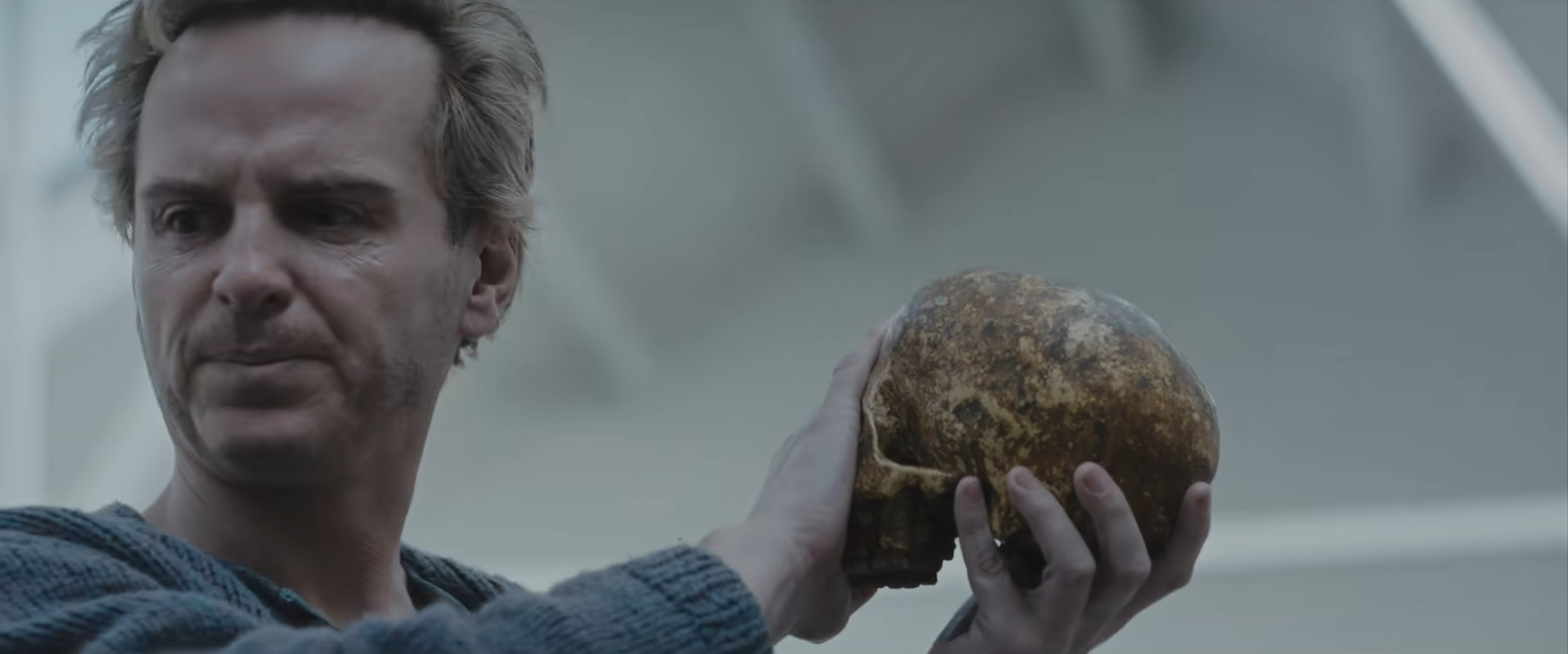
“Stop giving me that look, Yorick. Your infinite jest isn’t helping.”
Previously on Midlife Crisis Crossover:
Since 1992 my hometown of Indianapolis has presented the Heartland International Film Festival, a multi-day, multi-theater celebration of cinema held every October. Local moviegoers have the opportunity to see over a hundred new works in the realms of documentaries, narrative features, shorts, and animation made across multiple continents from myriad points of the human experience. Heartland’s 35th edition runs October 7-18 and will be my fourth time diving in. I’ve made plans to catch at least six films in all, maybe more if time permits…
Next up: the British late-stage biopic Elsinore, which premiered last month at the Telluride Film Festival. Not just the next entry in the Hamlet Cinematic Universe after last year’s Hamnet, it’s a tour de force for actor Andrew Scott, who doesn’t merely breathe new life into the Bard — he pays tribute to another actor who breathed new life into the Bard before he in turn breathed his last.
The Gist: Scott plays the actor Ian Charleson, best known to elderly American audiences as the guy who played Olympic runner Eric Liddell in the 1981 Best Picture winner Chariots of Fire (i.e, the blond one, not the other one who went on to star in the Dark Shadows remake). A so-true-it-hurts running gag confirms how Vangelis’ theme is the only part everyone remembers, though they politely say it’s cool that Charleson was a part of that. As many an actor in an Oscar-winning production has found, that participation ribbon didn’t guarantee him a career boost as he muddles through the rest of the ’80s paycheck-to-paycheck. In one quietly absurd moment, he’s sitting next to his stunt double on the set of a TV action drama — the two of them with identical military costumes, haircuts, and fake facial abrasions, waiting hours for the next scene’s setup, which the double confirms he’ll be doing, not Charleson. In a country with a centuries-old infrastructure for producing the greatest actors and plays of all time, The Guy From Chariots of Fire is interchangeable.
We pick up in 1989 with the AIDS epidemic in full swing, though some among its most prevalent demographic don’t seem as alarmed as you’d think. The popular pickup spots are still hopping, the city parks still teeming with impulse hookups at night. Nuns walk up and down those shagadelic London streets, handing out condoms out of a sort of kindness. Charleson had already been diagnosed as HIV-positive two years earlier but isn’t yet showing any outward symptoms, which he checks his entire body for daily. Then, possibly as divine assurance that everyone is replaceable, the impossible happens: Daniel Day-Lewis has failed! The actor, whose recent film My Left Foot would win him his first Academy Award the following winter, broke down in the middle of Act I Scene I in a grand production of Hamlet at the National Theatre. That leaves a massive job opening, and The Guy From Chariots of Fire is a National Theatre veteran in the right place at the right time.
Johnny Flynn (who sparred with Scott in Ripley) is its director Richard Eyre, in whom Charleson confides about his HIV-positive status. Only a few other close friends are aware of it; Charleson isn’t publicly “out” yet and would rather not be. But really, why worry anyone needlessly? He feels fine! He’s excited and ready to go! He needs something this meaningful in his life. He’s dying to do this.
Then partway into the few short weeks of rehearsals before his premiere, his first Kaposi’s sarcoma lesion blooms near his right eye. This is such poor timing on the Fates’ part. Enter sternly non-glamorized Academy Award Winner Olivia Colman as the real-life Dr. Margaret Johnson, who would become one of the country’s foremost HIV/AIDS experts. She’s recommended highly to Charleson and has seen hundreds of patients in his situation before. By this point she’s well versed in the state of the struggle; we never hear her bring up AZT, the “it” drug of that moment (though someone else does), which I recall reading could be more debilitating than chemotherapy for some. Long-term survival wasn’t a prognosis for many of her patients, but some of them may at least have lengthened their spans a tad by obeying simple doctor’s orders such as “Get lots of rest” and “Try not to think about death.”
But her new patient Ian Charleson has to play Hamlet, the guy who famously won’t shut up about death. Has to play him.
The familiar faces: Doctor Who‘s Billie Piper is his token Straight Best Friend, who shares the most scenes with Scott and hugs him more than anyone else does. Others in his inner circle include Bridgerton‘s Luke Thompson and Matthew Beard (The Testament of Ann Lee) as Sean Mathias, who’d quit acting around then (and to this day remains an active theater director himself). Peter Mullan (The Rings of Power‘s Durin III) and Georgie Glen (The Crown, Call the Midwife) are Charleson’s parents, from whom some secrets can no longer be kept.
Monica Dolan (Cyrano, two Black Mirrors) is the National Theatre’s droll receptionist. The Hamlet cast includes Juliet Stevenson (Truly, Madly, Deeply) and Danny Webb (Alien 3‘s last prisoner standing at the end, who’s now old enough to play Polonius). Charles Edwards (The Crown, Celebrimbor from The Rings of Power) is producer Michael Whitehall.
Among the few who have a bone to pick with Charleson’s closeting is David Dawson (Luther, Peaky Blinders) as the likewise HIV-positive but proudly out Derek Jarman, who directed several films as well as numerous music videos for the Pet Shop Boys, the Smiths and other British icons. The film may have accelerated Jarman’s timeline a bit to intersect more meaningfully with Charleson’s.
Joe Locke (Agatha All Along, Heartstopper) is a relative youngster among the AIDS patients in Dr. Johnson’s ward. Kadiff Kirwan (Slow Horses, Supergirl) is a drag queen. Adeel Akhtar (Enola Holmes, Down Cemetery Road) has one scene as a salesman with an assortment of two-wheeled Rosebuds.
Someday streaming viewers might have fun freeze-framing during the National Theatre courtyard scenes, filled with actors including Nonso Anozie (Sweet Tooth) and Tender Loving Care costar Paul Jesson.
The Impressions: Director Simon Stone (Netflix films The Dig and The Woman in Cabin 10) and screenwriter Stephen Beresford (that Tolkien biopic we all forgot about) keep the spotlight firmly on Scott in nearly every scene, which is arguably why we’re all here. Scott possesses an animated unpredictability that few can tap with such an astonishing dexterity, a raw candor whenever he bares a nerve, and a crafty twinkle whenever he elicits our laughter. He evinces Charleson’s reputedly wicked wit in subtle resplendence, connects with the hearts of every other actor in the room, and howls with agony during the disease’s worst surges and sometimes during the medical process of the era, as flawed and unpioneered as it was.
Here and in other works, Scott’s energy levels are so off-the-charts that at times it’s hard to think of Scott only as Charleson while watching. I’ve seen enough from him to put Moriarty out of mind (y’know that Sherlock finale was nine years ago, right?), but it took awhile to concentrate properly and appreciate the nuances of Scott playing Charleson playing Hamlet. It’s impossible to know how many of those interpretive choices and tics are Charleson’s revisited versus Scott’s own, short of someone streaming one of those 1989 evenings so we can compare for ourselves. As Charleson himself says — in response to Jarman’s demand that he come out and become the gay community’s AIDS-crisis poster paragon — “If people see me and not the character that I play, then I’ve failed.” I’m not entirely sure that’s true, because frankly some of that is on us, the audience. For my part, I’m a bit more curious now to see samples of Charleson’s prime for context.
The final chapters of Charleson’s life story, alternately harrowing and affirming, are certainly worth the experience — the behind-the-scenes journey through British stage production (costuming! sword-fight choreography!); the dilemma of choosing who ought to know about his sexuality and his illness; and, once a doctor has regretted to inform us the great studio executive in the sky has chosen only to renew our lifespan for one final season, the anxiously newfound drive to accomplish whatever we can within the time remaining and hope what we leave behind makes a difference to someone, and finds “the glory [and] the joy” in life as we’ve lived it, whether in our artistic endeavors or in the little things littered around us, even something as dorky as a cassette copy of Ethel Merman’s disco album.
Any viewers hoping for a satisfying Hamlet stage spectacle may come up a bit short. Hamnet didn’t show us the entire three-hour play either, but it did let its characters finish a soliloquy or two. We get some of “To be or not to be”, not the entire piece. Numerous montages — so, so many montages — eavesdrop on Charleson learning or re-learning all those immortal lines, rehearsing with castmates or to empty rooms. Some quotes are more recognizable than others, depending on how many versions you’ve seen or how often you’ve run across the ubiquitous pop-culture references. (I don’t think this one worked in “the conscience of the king”, but I was happy to hear the bit about “the fall of a sparrow“.) They’re all limited snippets, as if the filmmakers feared we’re all bored with the play.
Same as with Hamnet, we’re barred from seeing the rest of the ensemble’s performances to know if any of them were any good. Granted, Elsinore isn’t about them, but no man is an island, not even Ian Charleson. His love for the cast is intrinsic to his final choices as well as to what would prove to be his life’s swan song. It would’ve been keen to see them together in longer stretches, especially those who had noteworthy careers of their own. Among the omissions: this production’s other members included Jeremy Northam — future star of The Net and del Toro’s Mimic! and a bit of The Crown! — as Laertes. We don’t even get so much as a where-are-they-now? postscript that might inform us, for example, Richard Eyre has also worked in film and is still alive. (As of this writing, his next film The Housekeeper is apparently in post-production.)
I’m sure the runtime could only be so long, but the short shrift is more glaring as Charleson’s denouement approaches, when Stone resorts to a montage-of-montages as if he thought we’re more interested in him recapping the entire film for the inattentive kids on the Netflix short bus than affording a single uninterrupted scene of uncut Shakespeare. What we get of Scott-as-Charleson is undeniably powerful and unforgettable, but I’d’ve loved a longer reenactment from any of the 24 performances he managed in his run, certainly now while his memory holds a seat in our distracted globes.
The end credits? No, there’s no scene after the Elsinore end credits, though as with many a modern film, they’re an exhaustingly detailed list of every possible job title at every level, from the legal department execs we don’t care about, down to craft services, even front-of-house and one barista.
Also, I had to look up and confirm Ethel Merman really did record a disco album, and it was actually called The Ethel Merman Disco Album and now I’m now overcome with campy joy. Thanks, Ian Charleson! Unless the filmmakers made that up!
Discover more from Midlife Crisis Crossover!
Subscribe to get the latest posts sent to your email.

