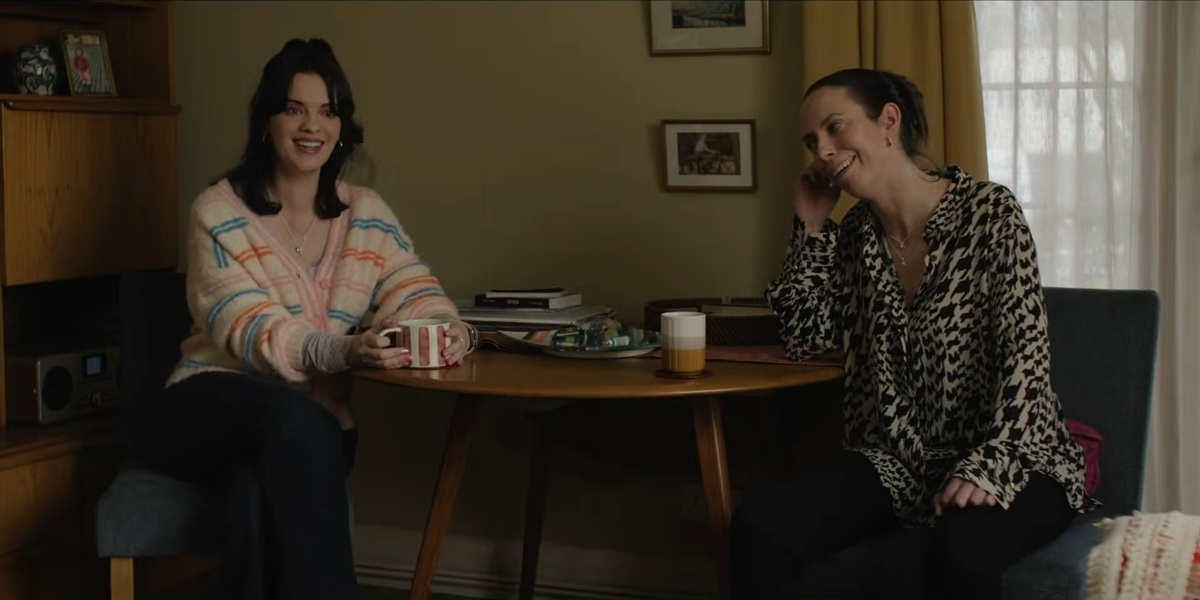
Alice Bailey Johnson and Kate O’Flynn chat about their love lives with elderly parents, as one does.
Previously on Midlife Crisis Crossover:
Since 1992 my hometown of Indianapolis has presented the Heartland International Film Festival, a multi-day, multi-theater celebration of cinema held every October. Local moviegoers have the opportunity to see over a hundred new works in the realms of documentaries, narrative features, shorts, and animation made across multiple continents from myriad points of the human experience. Heartland’s 35th edition runs October 7-18 and will be my fourth time diving in. I’ve made plans to catch at least six films in all, maybe more if time permits…
Next up: the British indie Tender Loving Care, which premiered last month at the Telluride Film Festival. Writer/director Mike Leigh, age 83, has announced his seventeenth film will likely be his last after a 55-year run. I’d only seen two of his prior: the Thatcher-era slice-of-life Meantime costarring the impossibly young Gary Oldman and Tim Roth (call them Rosencrantz & Guildenstern Babies); and the 1996 Best Picture Oscar-nominated Secrets & Lies, concerning unexpected genealogy results and buried traumas. Leigh’s improvisational filmmaking style set them apart from most of my usual fare, but I regret I haven’t prioritized more of his works. TLC offers a strong incentive to attend his farewell party: Emmy Award Winner Kate O’Flynn, who’s had a banner year as one of the stars of Apple’s horror-comedy series Widow’s Bay. As a fan of that bizarre show, obviously I had to see what she’s done next, this time in an accent from her own homeland.
The Gist: O’Flynn, whose first pro acting gig was in Leigh’s Happy-Go-Lucky, is a social worker named Amy who’s left her loutish boyfriend and moved back in with her BFF and fellow social worker Rosie (Alice Bailey Johnson, from Black Mirror‘s “Smithereens” and a bit in Leigh’s Hard Truths). Amy checks on kids in The System and inspects wayward parents for signs of improvement; Rosie specializes in the elderly, whether they appreciate being checked on or not, which they largely don’t. The two thirtysomethings each do the best they can with the resources available post-Brexit, meaning they must maintain thick skin by day and decompress together at night, often with wine. (Yes, they do share one hilarious dance number, the only vaguely Hollywood trope indulged.) They’re available for dates if they could find men worth the effort, which they largely don’t.
Off work, they delight in visiting Amy’s elderly, chipper parents played by Marion Bailey (Leigh’s partner, who’s been in many of his films and was The Crown‘s season-3/4 Queen Mother) and Paul Jesson (three for Leigh, Ralph Fiennes’ Coriolanus, The Crown). In between their frustrating work appointments, much of the film sits comfortably with folks as they share tea, chat, joke, sing, and demonstrate other benefits of this “visiting” that used to be a thing for past generations on either side of the Atlantic. Sadly fate must meddle at some point, and does so upon the sudden onset of elderly distress and we realize the symptoms are coming from inside the family.
The familiar faces: Several cast members have worked with Leigh throughout the years, so it’s like one big family reunion — e.g., Tilly Vosburgh (Meantime) in one scene as a recently widowed friend. Peter Wight (at least five previous Leigh films, plus Hot Fuzz) is a doctor so old-fashioned that he still makes house calls. Brid Brennan (Leigh’s Four Days in July, plus Brooklyn, and was a Peaky Blinders villainess) is having a lie-down in the park, if you wouldn’t mind.
Alan Williams (two Leigh films, Chernobyl, Luther season 2) bookends the film as a mostly silent, seemingly homeless man who isn’t related to any other character as far as we know, yet bears the weight of what seems foremost on Leigh’s mind.
The Impressions: Given that social work is essentially nonprofit and shall never be overfunded, Amy’s and Rosie’s challenges are eminently relatable for American viewers who can feel the despair inherent in terms such as “mental health crisis” and “Child Protective Services”. I’m sure the UK has their own catchphrases, which Leigh doesn’t belabor. He lulls us into Our Heroines’ everyday rhythms and stresses as they interview their dysfunctional subjects whose apparent common bond among all ages is their lack of adequate support systems at home, both familial and publicly provided. Whether abandoned kids or unsupervised octogenarians, they’re jaded after having answered the same well-intended questions again and again without feeling much reason to hope or aspire. The young ladies can be exceptionally cheery when they don’t have to wear their Official Business faces, but that’s part of their work uniform — a necessary defense amid the everyday confrontations. One harried young mother in particular (Sandy Foster, from Leigh’s Mr. Turner) is oblivious to her own, er, opportunities for improvement, yet is perceptive enough to get a bead on the woman that she accuses of judging her from across the class divide.
Leigh invokes our sympathies with intimate camera work courtesy of cinematographer Lucy Bristow (a camera operator on several of his films), who composes most scenes with closeups on the actors’ faces, which seems quotidian and commonplace until you realize how many of today’s big-screen films keep characters at arm’s length in mostly medium shots. We’re invited to feel with them, next to them, to be with them in the moment. Once we’ve spent so much time in the pleasure of their company, it’s all the more painful when cogency begins to slip away for one, and everyone else dreads exactly where this is going.
Tender Loving Care is an especially compassionate heartbreaker in its final sections as we worry a quickly beloved character might be taken from us. (I couldn’t help focusing on their breathing in every scene, just to be sure.) As the parents who’ve been together practically forever cling to each other, Amy and Rosie exchange glances beyond mere immediate concern — perhaps marveling at love enduring across decades, perhaps wondering what might happen if and when it’s their turn. Earlier scenes aren’t encouraging indicators that they’ll ever know what it’s like to celebrate a 50th anniversary — frankly, good luck with today’s crop of men and finding any willing and/or worth aging gracefully together with. Perhaps the evidence at hand is anecdotal and selectively skewed, but passable suitors under 65 are collectively Sirs Not Appearing in This Film. Should they prepare to be at each other’s bedsides, then?
Judging by the prologue and epilogue — together a quiet condemnation on behalf of those who have no loved ones to turn to, whether in their twilight or their formative years — Amy and Rosie might do well to keep such contingencies in mind. Even as a filmmaker with a storied career preparing to leave the sets behind once and for all, Leigh seems worried about what his own future might bring, let alone the rest of ours.
The end credits? No, there’s no scene after the Tender Loving Care end credits, but they confirm the infrequent score was performed by a single marimba soloist; that this was indeed shot entirely in Britain, so kudos to Leigh for resisting the siren calls of Vancouver and Atlanta; and that the song “Boiled Beef and Carrots” is in public domain, so we’re all free to perform and upload our own versions, to the confusion and horror of new generations worldwide.
Discover more from Midlife Crisis Crossover!
Subscribe to get the latest posts sent to your email.

