How Green Was My Varmint.
Previously on Toy Story: After Toy Story 3 proved the perfect finale for Pixar’s flagship series, the formerly impeccable animation studio held the IP upside-down and shook really hard to see if any more coins might fall out of Hamm’s back-hole. I later summed up the fourth one…
The series was OVER. The trilogy was COMPLETE. The finale with Bonnie was PERFECT. But no, Pixar had to yank out the stitches on that beautiful closure and march Bonnie’s toys through the motions of yet another toys-on-the-run escapade that benches half its all-stars, loses track of its own rules, manufactures one needless chase too many, and drops one of its decent, nonwhite human characters into a disturbingly harrowing police encounter — blithely pretending such a scene evokes absolutely no alarming real-world relevance — all so Sheriff Woody can ride off into the sunset AGAIN, but this time literally instead of metaphorically. We were FINE with “metaphorically”.
Our family crossed Pixar films off our automatic-theater-trip shortlist years ago. Among the next nine films since TS3, I’ve only seen three on the big screen and have yet to fire up Hoppers or The Good Dinosaur. I refused in advance to let the inevitable Toy Story 5 be an easy sell. The presence of director Andrew Stanton — overseer of the classics Finding Nemo and WALL-E — brought slight hope till I remembered his last time at a Pixar helm was Finding Dory, ten years ago and just-okay. But a few tidbits among the pro critics’ advance reviews caught my attention, chiefly that Stanton and co-writer Kenna Harris (a Pixar staffer responsible for Luca‘s epilogue short Ciao Alberto) found new conflicts to explore for a few of the toys and for li’l Bonnie herself, their current caretaker.
The Gist: Scarlett Spears (Young Glinda in Wicked: For Good) is the latest voice of Bonnie, aged up into an intensely shy 8-year-old who’s still enamored with her toys. Alas, it’s the modern world and she’s apparently the only girl her age who isn’t addicted to screens and whose parents still encourage the old-fashioned, three-dimensional, tactile playtime experience. (A single young male sneaks into the film’s largely no-boys’-land, only for a few seconds and only because a twin sister got him past the velvet rope. A few nameless space-fillers in the end-credits scene don’t count.)
Concerned about the tears of loneliness welling up in her Margaret Keane eyes, her parents (returning from TS4: Suicide Squad‘s Jay Hernandez and SpongeBob‘s Lori Alan) hate to see her miserable and hastily shortcut their way to what they hope is a surefire cure for her social awkwardness: they buy her a tablet. No, not Prozac — an imitation Leapfrog portable plastic computer for learning, playing games, and connecting with other users within her vicinity and age range, and luckily not child-trafficking pervs. Bonnie’s naive parents were possibly raised in picnic shelters and don’t foresee any pitfalls in a machine that combines all the worst qualities of Twitter and an Atari 2600.
As voiced by Greta Lee (Past Lives, Tron: Ares), Bonnie’s Lilypad tablet is programmed to be her new best friend, advocate, salesperson, and friending concierge, and even takes it upon her microchipped self to line up potential flesh-‘n’-blood friends through her proprietary, kiddie-gamified social-media network. Lilypad thinks she knows what’s best for humans, just like any other self-aware Star Trek computer run amuck. What’s the worst that could happen to Bonnie? I mean, that Pixar would be willing to show?
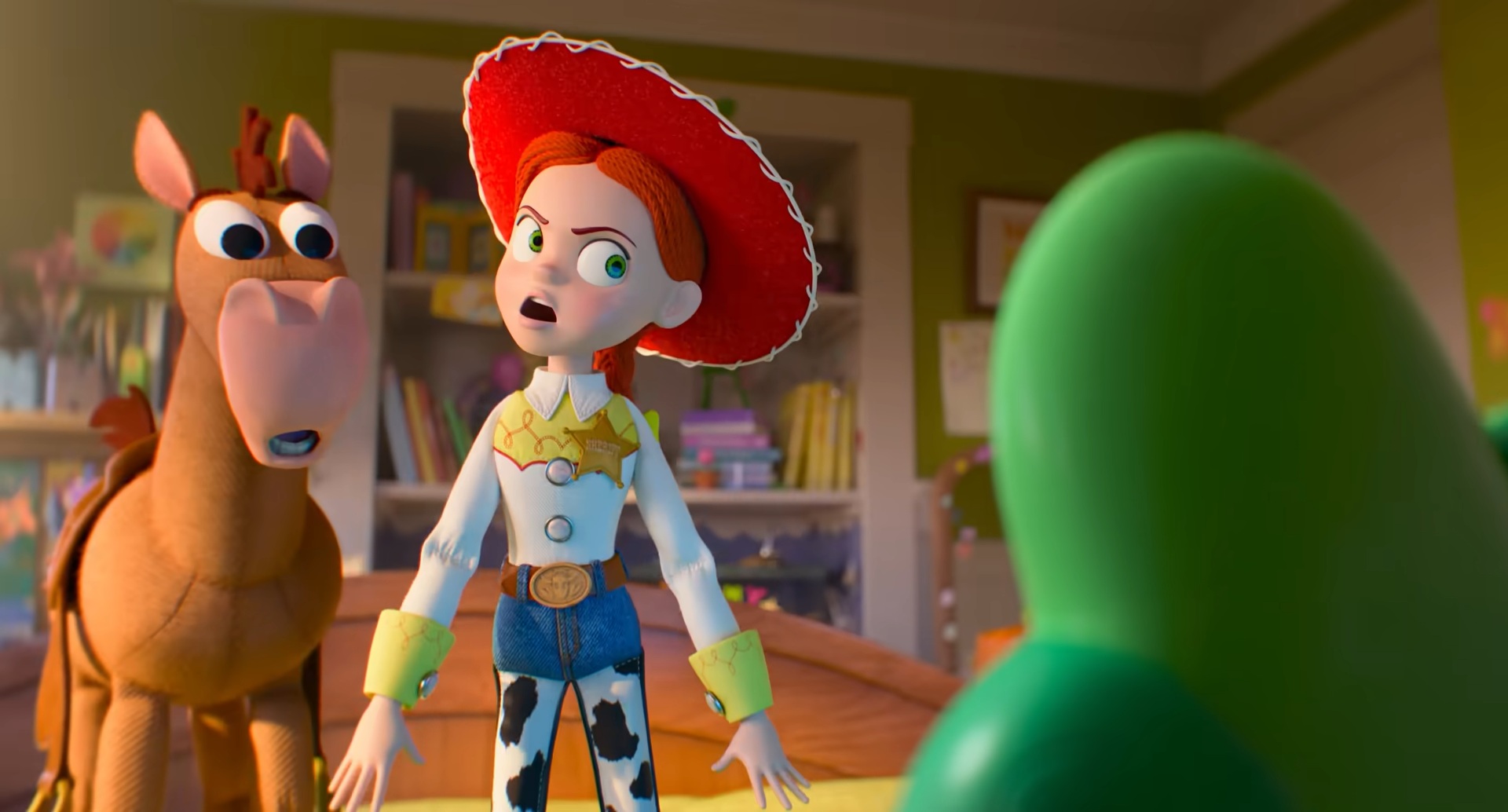
Fortunately for Bonnie, like other Kids These Days, she has at least one friend who gets her more than her parents do: Sheriff Jessie! After Tom Hanks’ Sheriff Woody “retired” from active plaything duty at the end of TS4 and promoted his olde-tyme TV sidekick to his “job”, Joan Cusack steps up to become our main character, though the trailers play up the familiar male co-leads at her expense, possibly for fear of fragile macho boys refusing to watch. Tim Allen’s Buzz Lightyear is Jessie’s loyal deputy, who wants to take their platonic relationship to a new level, to the extent that Pixar would be willing to show, but she doesn’t have time to stand still and await his overtures. She’s busy getting into heated arguments with Lilypad over their philosophical and generational differences, and watching from afar as Bonnie’s arranged friendships fall apart and etch new scars across her psyche. Before long, multiple inanimate objects in various team-ups — not all of them toys per se — are running hither and yon around town in their own separate subplots.
But Our Heroes need to do more than just survive and avoid getting caught by humans. If they can’t all get on the same page, Bonnie might grow up an introverted loner who gets way too much into computers and grows up to work at some stupid generative-AI company and post on Chan boards, and THAT CAN’T HAPPEN.
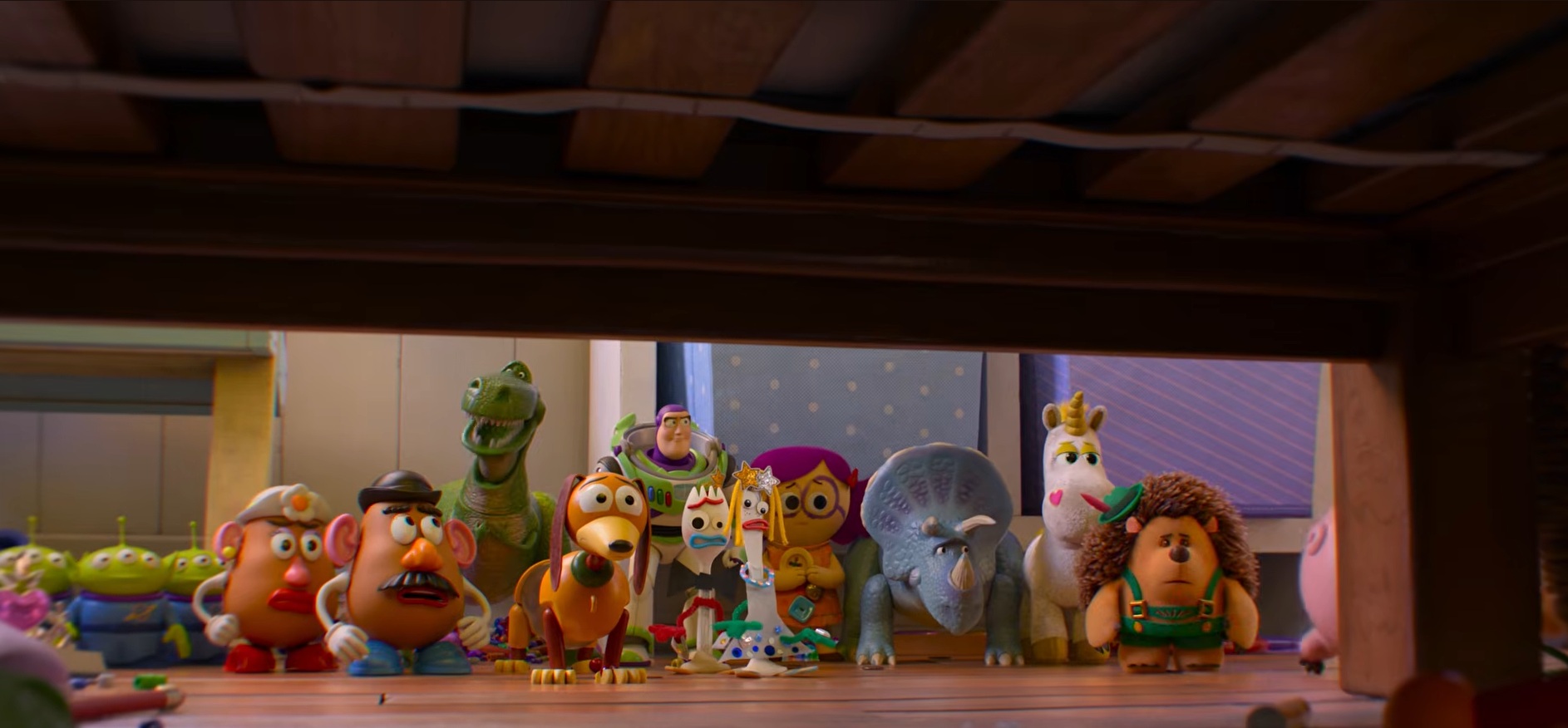
The familiar faces: Yes, Buzz and Woody are back — more than one Buzz, in fact — and they brought some of the old merchandise with them! Welcome back three more surviving OGs — Ghostbusters‘ Annie Potts as Woody’s domestic partner Bo Peep, Wallace “Inconceivable!” Shawn as Rex, and Cheers‘ John Ratzenberger as Hamm. Returnees from the previous sequels include the great Bonnie Hunt as Dolly the dolly, comic-book writer Keanu Reeves as stunt-cyclist Duke Caboom, What We Do in the Shadows’ Kristen Schaal as Trixie the triceratops, comedian Blake Clark (Home Improvement) in his third turn as the successor Slinky Dog, Veep’s Tony Hale as Forky the cheap plastic fork, and ex-SNLer Melissa Villaseñor as Forky’s plastic-knife partner Karen Beverly.
Among the new replacements for absent old friends, Ghostbuster Ernie Hudson takes over briefly for the late Carl Weathers as Combat Carl; longtime Looney Tunes vocalist Jeff Bergman and Snapped: Killer Couples narrator Anna Vocino are the new Mr. & Mrs. Potato Head.
When the story moves to another household in town, Jessie mingles with other toy collections that include The Office’s Craig Robinson as a kiddie GPS device (that’s a thing?); The Bear‘s Matty Matheson as, uh, a neurotic flying peanut, I think; and beloved Super Bowl halftime icon Bad Bunny as one of those really lousy fast-food kiddie-meal freebies. New humans include Krys Marshall (so desperately missed in For All Mankind‘s recent season) as the mom of another girl in search of friends.
Yes, that’s a lot of toys to service. Everybody gets at least one punchline, but most are competing for cameo space at best. Everyone on the call sheet pales before the mightiest MVP among the rookies: elderly podcaster Conan O’Brien as an electronic potty-training pep-talk gizmo named Smarty Pants. Once he’s charged up after years of disuse in an old junk drawer — his sole mission presumably accomplished — Conan steals every scene he’s in, gift-wraps them, kindly hands them back, then steals them again.
Still a smaller good-guy crowd than Stranger Things‘.
The Impressions: Toy Story 5 tops TS4 thanks to Conan’s formidable comedy presence alone, but there’s still more going for it. Stanton plays with some of the series formulae, starting with the visuals. This time the toys spend more time lurking in shadows, living in dusty corners, and interacting in forgotten nooks below human eyelines — a fair distance from Andy’s uniformly lit childhood bedroom and other Disney-standard toyetic showcases. Whenever Bonnie’s role-playing scenarios take over, her imagination is rendered in daydream pastels of shiny happy delight.
Existential toy angst rears its head for a fifth go-around as multiple collectibles gnash their unarticulated plastic teeth and wail to the ceilings above, “THE AGE OF TOYS IS OVER!” Among our endless 21st-century struggles is the attention-economy competition between screen-based symbiosis/parasitism and…well, any and every offscreen aspect of life at all whatsoever. (…he said while blogging on a Friday night to an invisible audience mostly comprising silent bots.)
Far be it from a kids’ movie to take a hard-line Luddite stance, though: despite the recurring images of humans mesmerized by their flat boob-tubes of all sizes (watch the backgrounds during some chase scenes), the War on Screen Addiction pulls back in the final act because Disney and Leapfrog are partnering to produce and sell real-life Lilypad Leapfrogs and need consumers not to go home and rethink their lives. Though Lilypad is introduced as an obnoxious rival (among the best gags not involving Conan, she amuses herself by self-doomscrolling while patronizing the other toys), at some script-doctored point a sudden about-face rewards her with a quickie redemption arc.
For once, though, the world of toys isn’t the point. The heart of the film is the subjects without whom toys wouldn’t even exist. This time, it’s about the kids. I loved seeing Jessie take charge and Cusack confidently upstaging the bickering hand-me-down boy-toys, but same as with Finding Dory, Stanton’s strongest concentration is reserved for the youngsters. Until Andy’s offscreen coming-of-age in TS3, he was a figurehead whose sole trait was fretting about whichever toys had gone missing that week. Other humans were incidental lumbering giants, mostly headless obstacles to avoid. In TS5, Bonnie’s vulnerable little school-age self matters more than the toys’ magical self-actualization. The wee lass suffers the heartache of solitude, the heartbreak of bullying, and the daunting terror of daring to try again when a new, kinder stranger reaches out to her.
Therein lies Jessie’s toughest challenge to date, through her perspective as Bonnie’s favorite companion. In between momentary flashbacks to Sarah McLachlan’s stirring TS2 musical interlude, Bonnie’s social crisis might send her walking away from her wonderful world of toys, which triggers Jessie’s toy-PTSD. More than once she’s gone through an average toy’s end-of-life cycle from uselessness to rejection to abandonment. At first her quest to help Bonnie isn’t just about making her owner feel better; it’s about making sure she herself is never discarded again. It’s partly self-preservation, but Jessie must eventually reckon with the realization that that’s arguably selfish. She has to figure out what’s more important: perpetuating her decades-old run with as little change as possible, or being there for the hurting child in front of her right now.
It’s almost as if Jessie is achieving a new level of toy enlightenment as she considers the critical importance and impact of a child’s plaything. Playtime can be more than just self-amusement with one’s prized possessions. It’s also practice for learning how to play well with others, from childhood to adulthood and beyond.
For those who’d rather return to the first four films’ basic premise of toys having wacky adventures in their own little world, TS5 occasionally lapses into E-Z cartoon mode with toy slap-fights and chase scenes and whatnot. Yet again they flaunt the toy kingdom’s “rules” forbidding them to reveal their sentience to humankind. Sometimes they deactivate whenever cars pass by; sometimes they remain fully mobile while vehicles are charging straight at them and cannot possibly overlook them. Also, considering how much havoc is wrought through Lilypad’s shenanigans and apps — not always her own doing — if Bonnie and her parents ever sit down together and review Lilypad’s history logs someday, the toys will have a lot of explaining to do, possibly even necessitating a sixth Toy Story in which the Parliament of Toys brings several cast members up on charges of flagrantly betraying the Toy Box Code.
That’s not an entirely implausible setup: the ending offers even less closure than TS4, leaving every door in Al’s Toy Barn wide open for still more sequels, spinoffs, and ancillary storytelling media. Despite how much of Toy Story 5‘s chaos is all Lilypad’s fault, it does not climax with Jessie using Rex as a sledgehammer to smash her to bits. (It’s just as well — her parents probably paid Best Buy extra for the extended warranty.) So Lilypad is totally welcome to join them in future escapades because, like, tech dependency is just a different kind of playtime and totally not a gateway drug to soulless attention-seeking or hateful troll-farming or typing all-caps obscenities at your ideological opposites before you say your prayers at bedtime.
Here’s to screens: the cause of, and solution to, all the world’s problems!
The end credits? To answer the burning question that MCC is always happy to verify: yes, there indeed are extras after the Toy Story 5 end credits. For those who tuned out prematurely and really want to know, and didn’t already click elsewhere…
…
…
[…insert space for courtesy spoiler alert in case anyone needs to abandon ship…]
…
…
…during the end credits, right after the “and they all lived happily ever after” 2-D montage as Taylor Swift’s new hit single “I Knew It, I Knew You” winds down: at a nearby school playground during recess, suddenly it’s raining Hi-Tech Buzz Lightyears everywhere! You get a Buzz! And YOU get a Buzz! And YOU get a Buzz! Even the teacher gets a Buzz!
And everyone’s thrilled…until one oddly prepared kid reaches into his backpack and brings out Zurg! Alas, Our Hero’s worst enemy/father is back! “NOOOOO!” cry all the Buzzes in unison.
Then the actual credits roll, wherein the Additional Voices section names such animation stalwarts as Tara Strong, Kari Wahlgren, and Fred Tatasciore. For any of my fellow persistent ticketholders who keep sticking around because we paid for an entire movie and WE MEAN TO HAVE IT, toward the end several characters reemerge amid and around the remaining departments, led by Lilypad in a Toy Story rap about how they spent the summer helping Bonnie make a friend. That’s it, that’s the gist of the “rap”. Trixie complains they really need a melody, but no one cares.
As the beat lingers and sputters, we can hear Smarty Pants yell one last time from afar, “I AM NOT A CHAIR!”
Discover more from Midlife Crisis Crossover!
Subscribe to get the latest posts sent to your email.

