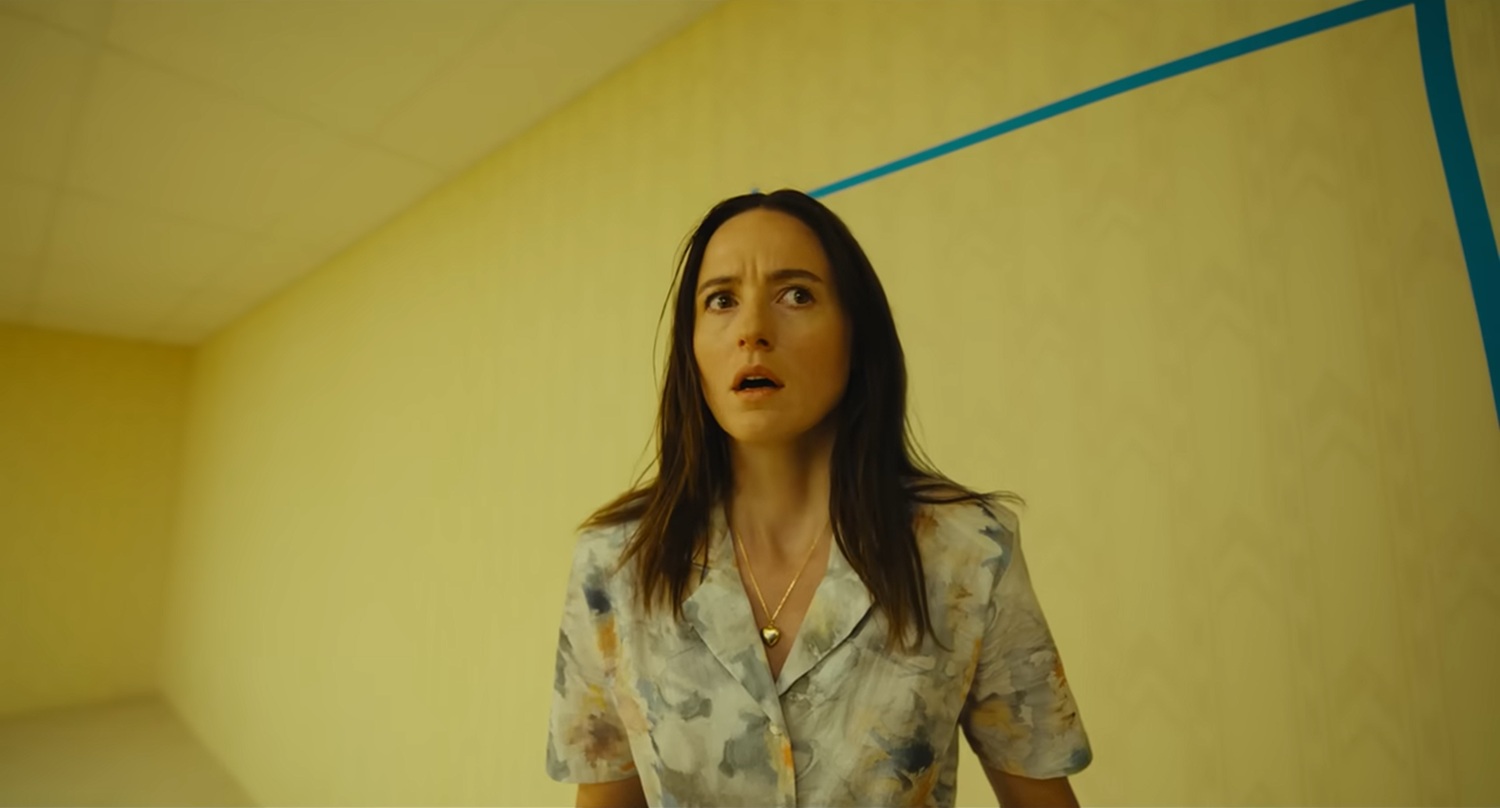
o/~ Oh, what a thing to do, and it was all yellow… o/~
Previously on Midlife Crisis Crossover: Longtime MCC readers may recall I’m not of Generation YouTube and don’t really keep tabs on any of their channels or series except Screen Junkies’ “Honest Trailers”. Bonus points go to creator/director Kane Parsons for grabbing my attention with his feature-film debut Backrooms, which builds on his YouTube horror series of the same name that I’d never heard of until I saw the trailer and may have held my breath for a moment as I thought to myself, I’ve had dreams exactly like this.
I don’t normally do homework before going to the theater — not even refresher rewatching of previous films in a series — but I felt compelled to grant an exception and watched all 22 Backrooms shorts before plunging into feature-length episode 23. The core episodes are found-footage horror — slow-burn mysterious explorations that succumb to oblique shreds of vertigo-inducing terror. The rest are a mix of montages, collages, industrial tutorials (e.g., an eight-minute technical video about electrical wiring), and other jigsaw pieces, some non sequitur and some sharing recurring imagery, that don’t yet add up to some as-yet-unseen Big Picture, but are just tantalizing enough to feel potentially connected in the final analysis if Parsons truly has an endgame in mind and the talent to sew all the threads together.
Going into the theater with all that context in mind helped tremendously, though I’ve never been one for conspiracy string-boards. But that two-night binge was more studying than I’d ever devoted to the dozen or so random X-Files “mythology” episodes I sat through.
The Gist: In the same 1990 setting as most of the shorts, Academy Award Nominee Chiwetel Ejiofor (12 Years a Slave) is a divorced former architect named Clark who’s apparently blown all past opportunities to make something of himself. He’s reduced to owning a pirate-themed furniture store, complete with self-made, zero-budget, pirate-costumed, goofy-accented ads for local-access cable. We never see a single customer walk in, he owes back pay to his sole employee Kat (Shrinking‘s Lukita Maxwell), and he lives in the store basement, but through the blessings of Movie Magic he can afford his ex-wife’s mortgage and therapy appointments, for all the good they do him.
One night he discovers an intangible gap in the basement wall that leads into a confusing pocket dimension of mostly empty rooms that are all stacked or connected in wrong ways, with furniture strewn around, mirror-lettered street signs, cardboard standees, nonsensical dead ends, embedded debris, and maybe the occasional monster. Imagine a nearly sold-out IKEA where all the walls are painted sanitarium yellow, Escherist architects accepted input from Bizarro, and distorted New Age trance ambiance piped through the speakers keeps viewers off-balance. (Parsons composed the shorts’ music as well, and here collaborates with composer Edo Van Breemen, who’s coming off Keeper and The Monkey.)
Unlike the shorts’ victims, Clark survives his first freaky foray and absolutely must blab about it to his therapist Mary, played by fellow Academy Award Nominee Renate Reinsve (Sentimental Value, The Worst Person in the World). Mary is successful enough to have published a banal self-help book and advertise it on those same quaint airwaves, but keeps her own baggage locked up — a hermit-homed childhood with an unwell mom. Mary’s a polite listener and seems to engage her patients while looking for openings to give them insight, but she’s as unimpressed by fantastical tall tales as any other movie character…until she’s drawn into those dingy depths to see what’s happening for herself.
The familiar faces: Finn Bennett (Warfare, A Knight of the Seven Kingdoms) is Kat’s boyfriend and Clark’s cameraman, which comes in handy for TV ads or for camcorder descents into the unknown. Indie actor/filmmaker Mark Duplass (Bombshell, Zero Dark Thirty) might or might not be a scientist. Avan Jogia (Zombieland: Double Tap) is the POV character in the prologue, basically a new found-footage episode unto itself as a proof-of-concept hazing for Backrooms newcomers.
The Impressions: I used to have recurring dreams about wandering around buildings that were bigger on the inside. Sometimes it was my great-aunt Nova’s house, which had a sort-of sunroom on one end and I often wondered why we almost never sat in whenever we visited. Sometimes I’d dream I’d moved into a much larger house in a forest, only to find it had a secret bedroom in the rear I wasn’t shown before I moved in, and then there was a room behind that one, and I’d be afraid the doors wouldn’t lock and things would break in. Or there was the McDonald’s I worked in as a teenager that in reality had a huge basement that contained their stockroom, break room, freezer, owner’s office, and closet under the stairs where they kept the birthday-party stuff, and I’d dream there was a secret door at the back of that closet, which led to a forgotten special stockroom, which had yet another door leading further down into burrowed tunnels and darker subbasements.
The Backrooms trailer brought back all those once-forgotten dreams. As if our two leads hadn’t already caught my attention, I had pre-creepiness nagging at the periphery of my psyche. I didn’t know the idea of “liminal spaces” was a popular internet preoccupation until pretty much every pro critic brought it up in their reviews of this, but I get the fascination with large, unadorned, virtually featureless indoor spaces that once were something and now serve nothing, the cavernous rendered purposeless, imaginary echoes mingling with the echoes of one’s own footsteps.
I’ve felt that faint frisson of uneasiness myself, staring into emptied areas for long minutes and just feeling off…
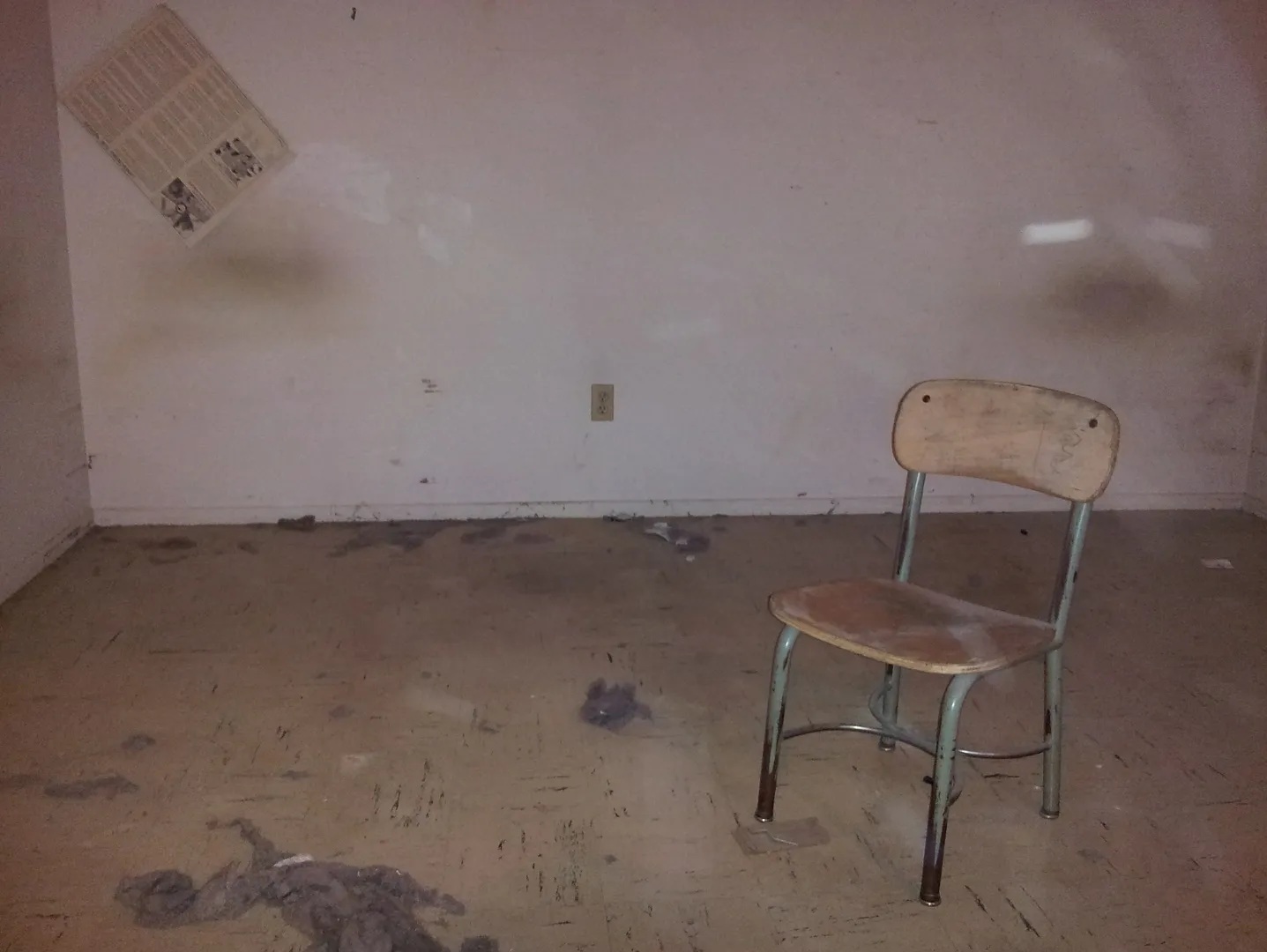
The final image of my childhood home after we moved my mom out.
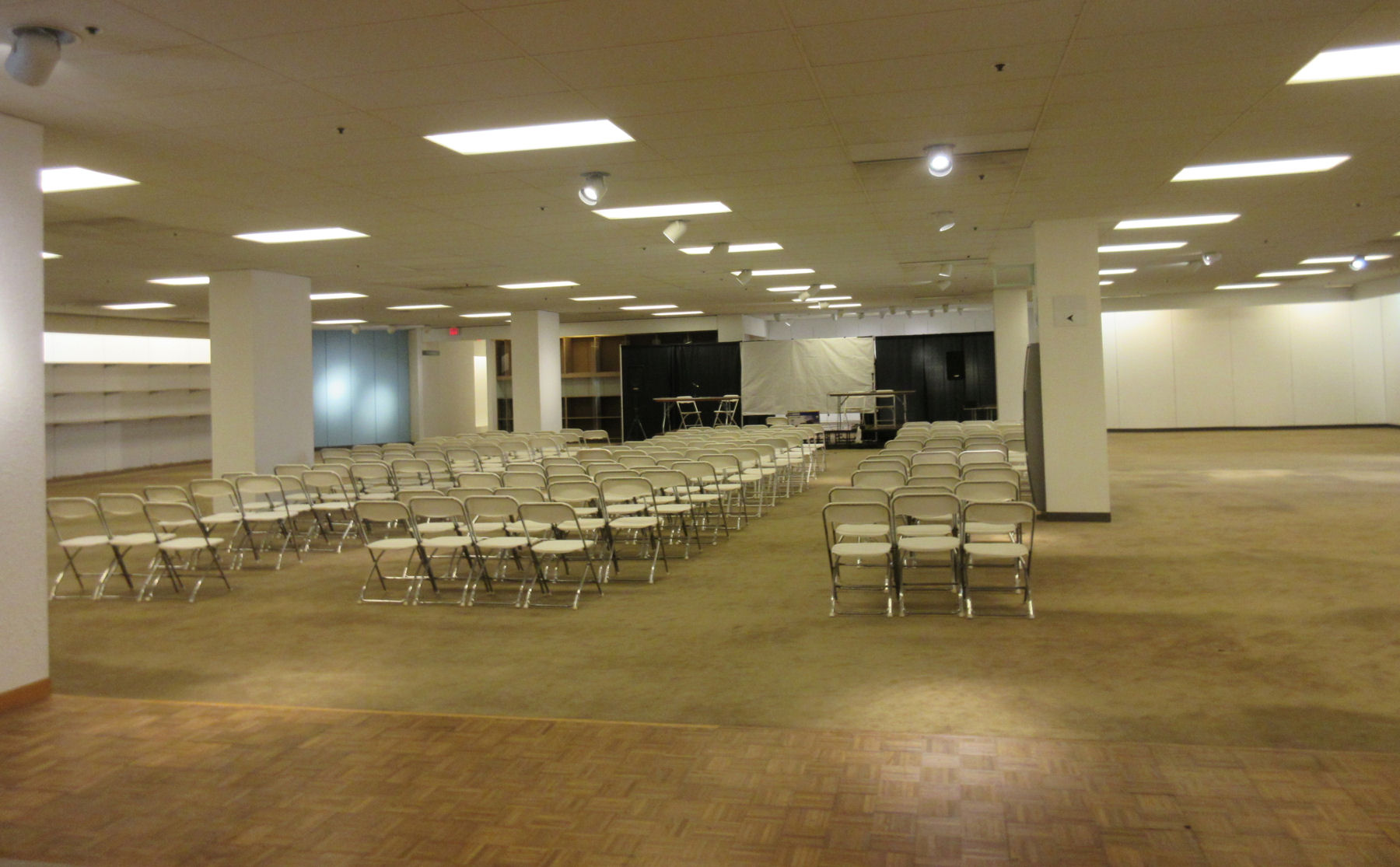
That time we attended a failed convention held inside a former department store that’d been closed for years.
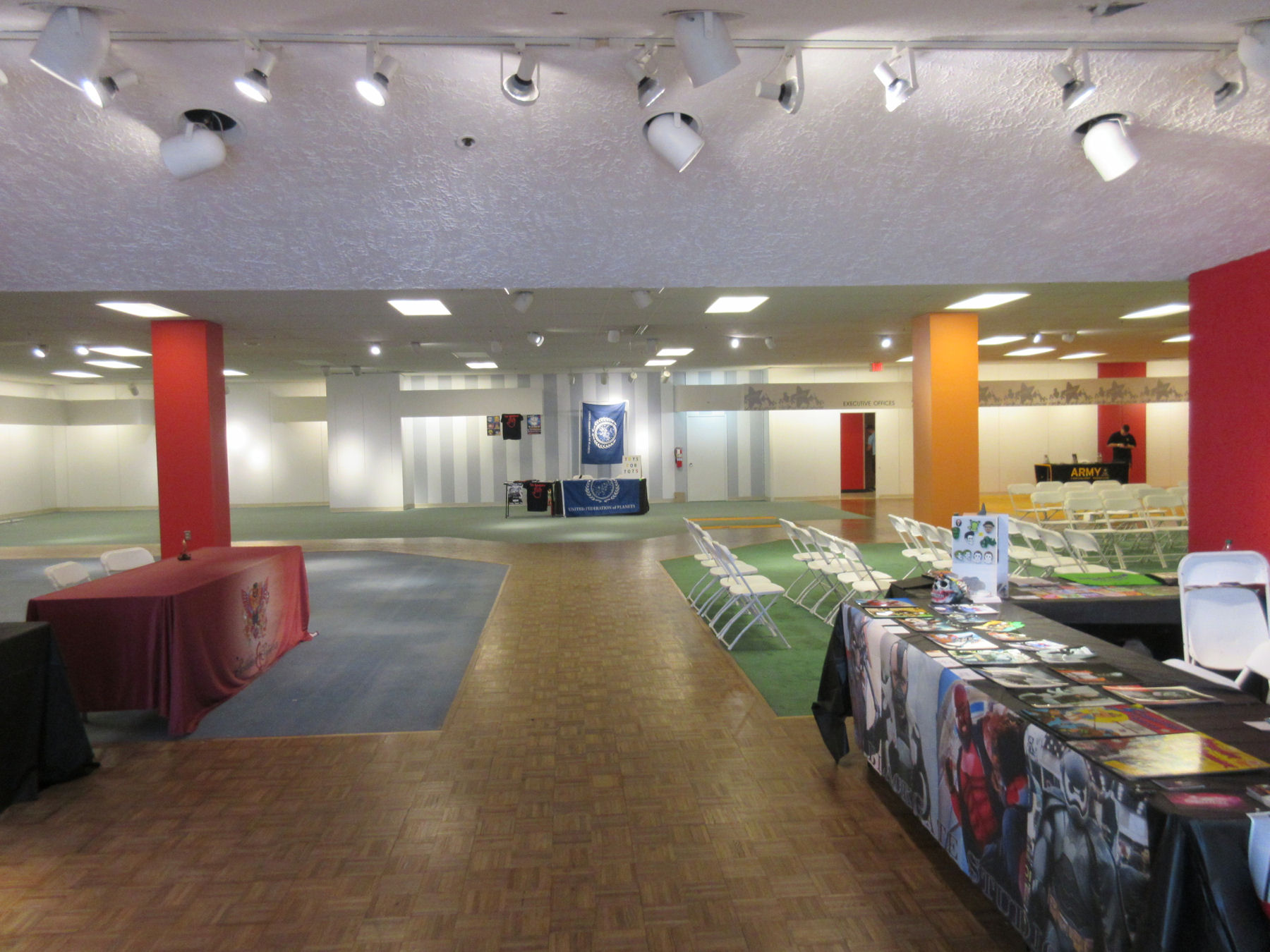
Same con, second floor, an enormous showroom only occupied by two distant tables — a Trek fan group in the center and a military recruiter at far upper right.
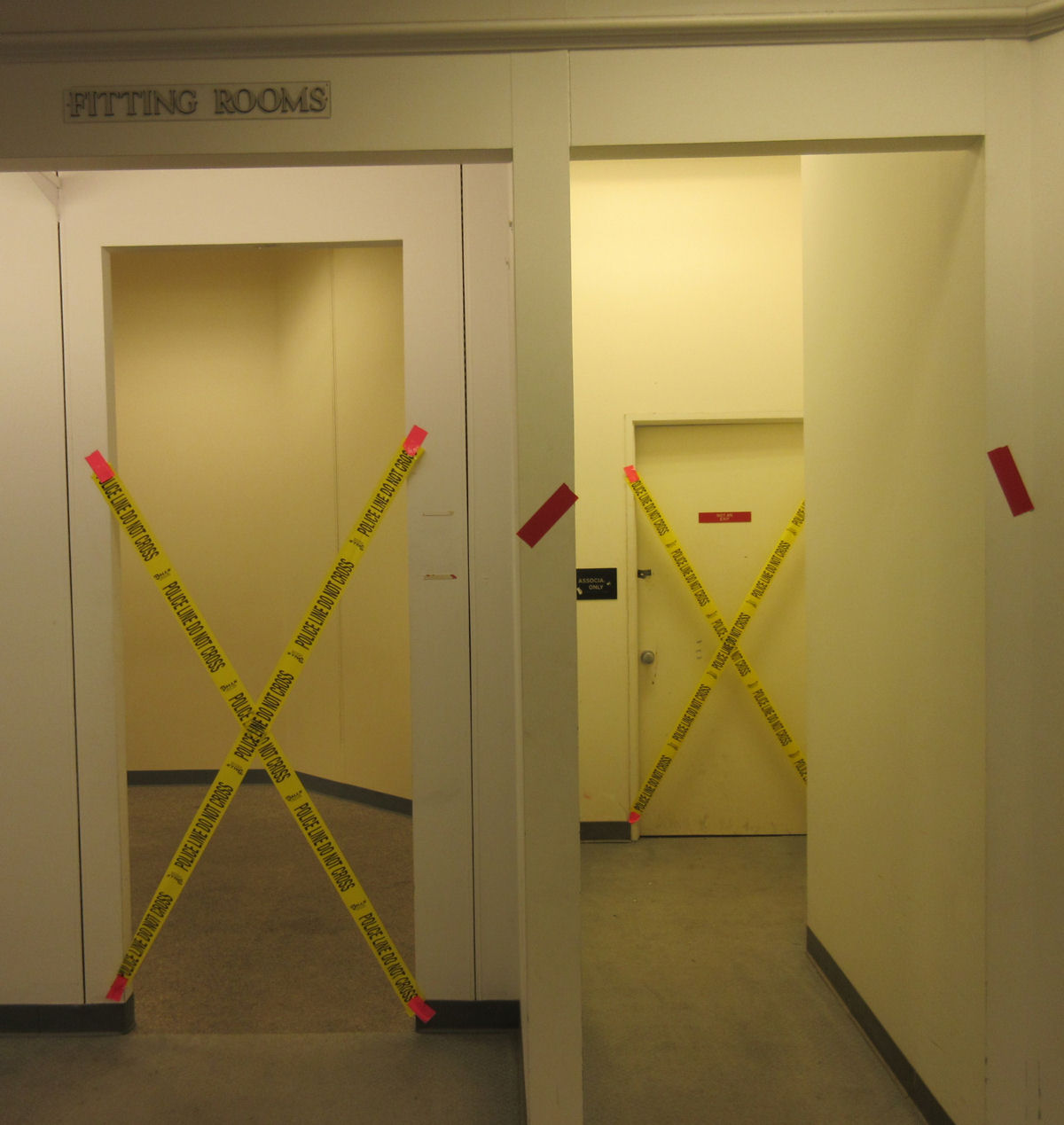
Same con, same ex-Macy’s, even eerier now than it was at the time.
…so yeah, I watched all 22 shorts Parsons has released to date under the Backrooms umbrella — largely self-made, self-scored, self-animated by a teen prodigy using Blender and other tools almost impeccably. (Sometimes he draws moving legs about as well as Rob Liefeld draws feet, and the few sighted “monsters” resemble art-class pipe-cleaner sculptures…but somehow those only compound the unreality.) They’re an amalgamated faux marathon of Dark Web remnants, corporate recordings, security-cam snippets, scientific project records, and other components meaningless on their own yet, by virtue of belonging to a series, imply It All Means Something. Or maybe that’s just geek apophenia talking. Parsons isn’t yet connecting the dots, just scattering seeds of discombobulation around for us to imbue with import or disdain at our discretion. Clearly it’s awakened the dormant home-TV-detective urges in anyone who got a little too attached to Lost, The X-Files, The Leftovers, or any of Apple’s 600 different puzzle-box streaming shows.
At times I was reminded of Severance, Stranger Things, Annihilation, Paranormal Activity, Wolfenstein 3-D, Fallout, Barbarian, and Cabin in the Woods to varying degrees of intensity, whether homage or ripoff or unplanned coincidence. (At least one of those goes the opposite direction: Severance creator Dan Erickson has reportedly cited “The Backrooms” as an influence.) Among the less endearing precedents it mimics: The Blair Witch Project‘s extreme shaky-cam. As someone with a history of motion-sickness issues from roller coasters, herky-jerky video games (e.g. Mirror’s Edge) and other forms of super-jittery sensory overload, I was fine watching most of the shorts on a PC monitor, but I made the mistake of watching the best and longest one, “Found Footage #3“, on our full-size TV. My stomach did not enjoy those 45 minutes.
(YouTube’s random ad break-ins did the longer episodes no favors, either…though one normally innocuous commercial for Lowe’s Hardware felt so disturbing when inserted into the wrong context. Could’ve been labeled short #22½.)
Hence Backrooms: The Motion Picture, a moneyed extension of that shrewdly crafted, low-budget world/brand, not a reboot. Parsons’ subscribers will recognize familiar items — in particular Async, the company whose name pops up a lot and who reveal some new lore. This is more of the same, but longer, and our two mesmerizing performers do a lot of Parsons’ heaviest lifting to elevate the proceedings above YouTube level as they dungeon-crawl through those labyrinths. Parsons keeps each of them onscreen mostly throughout, though the cameraman sidekick rationalizes a temporary return to first-person mode for a while. And rather than the shorts’ shock-teleport incursions, Clark’s discovery is gentler and closer in model to the Twilight Zone episode “Little Girl Lost”, except in that one, the kid’s side of the magic wall was left to our imaginations.
Ejiofor has gotten lost amid some crowded genre flicks (Dr. Strange, The Martian, the third Venom), stood taller in others (Serenity, The Life of Chuck), and given some creaky contraptions more than they deserved (Emmerich’s 2012, the Lion King remake), but here he’s front-row in the ensemble bleachers, not a backup singer. With only a small yet sturdy troupe at hand, he’s given all the room(s?) he needs to draw us into Clark’s mindset — a rudderless dud who’s shed one role after another and scapegoats others for his poor choices. The Backrooms’ trappings only amplify his everyday frustrations until he and we begin wondering if they’re mocking his own emptiness.
After Act 2 the film has a visually pronounced psychotic break and chucks the narrative baton to Reinsve. She’s arguably just as overqualified for the material as Ejiofor, but she likewise goes above and beyond in bringing her own strengths and subtleties into the fray. Armed only with a child’s cement hand-print she keeps pocketed as a sort of security totem, Mary’s ongoing professional relationship — her job to help her patient cope with reality — crescendos to a new level, forces some tough choices, and has us worrying whether her own psychological scars will resurface and if they might be the reserves she’ll need to draw power from to survive amid all the fun-house reflections, the lightning-quick turn-scares, and the eventual “monsters”.
Each of them reckons in their own ways with the human need to explore, to explain, to define, to control our surroundings. Exactly as surreal and alarming as the shorts, Backrooms opens doorways into nightmares of infinite disillusionment where asking “WHY?” is a cry for help that’ll never be answered and the curiosity to keep pushing forward might never lead to satisfying exposition delivered from a Masterpiece Theatre armchair. The real backrooms are our pasts, our memories, the repressed compartments of our own psyches. The more deeply we keep retreating into our own mental rabbit holes, the less likely we are ever to reemerge in the real world.
The end credits? No, there’s no scene after the Backrooms end credits, but after initial accompaniment by a new track from the band Boards of Canada, the score veers right back into otherworldly distortion, like broken instruments recorded on melted wax. A roster of VFX artists confirms Parsons definitely didn’t animate the entire film alone in Blender this time. There’s also a Canadian land acknowledgment, for anyone who collects those.
For value-added disorientation, after the end credits our screening cut directly to a Dolby 5.1 Channel ID Test — black shapes labeled for each speaker, white background, hearing-check tones, ran for less than a minute, no employees in sight. We’ve never seen one of these, which I presume aren’t normally run while patrons are still around. I’d be happy to share an example if I could find that exact test anywhere online. We stood there watching and wondering whether this was the theater’s own sonic maintenance or if this was actually part of the movie and we should’ve been taking notes in case it contained more clues to the Big Picture, though it’d probably just be banalities like “yep, their subwoofer growled five-by-five.” But you never know! That could’ve meant something! In worlds like Backrooms, there’s a thin line between “uselessly banal” and “will totally be revealed as something sinister in 5-10 years.”
Discover more from Midlife Crisis Crossover!
Subscribe to get the latest posts sent to your email.

