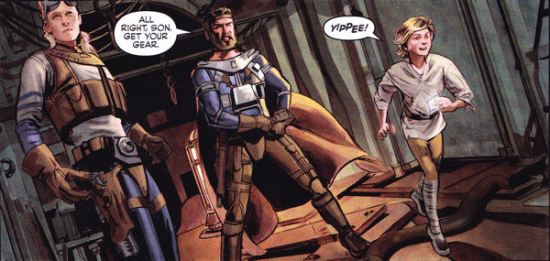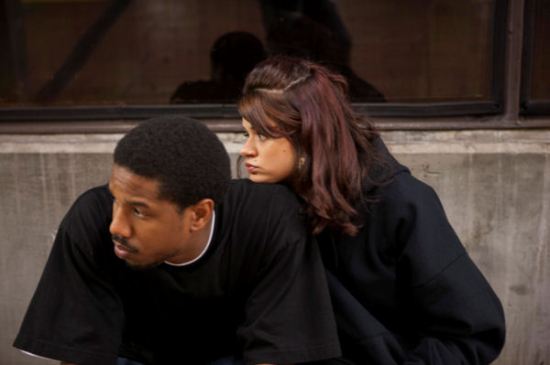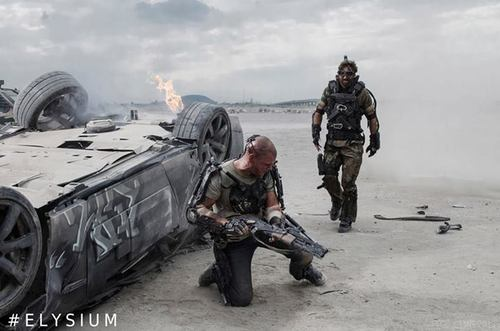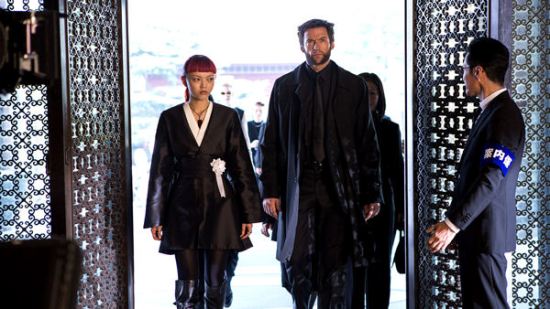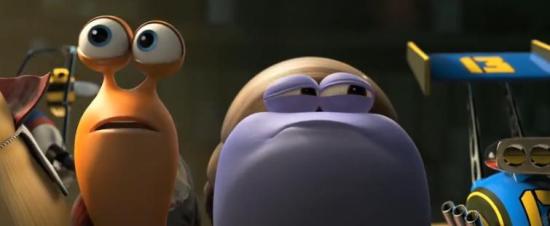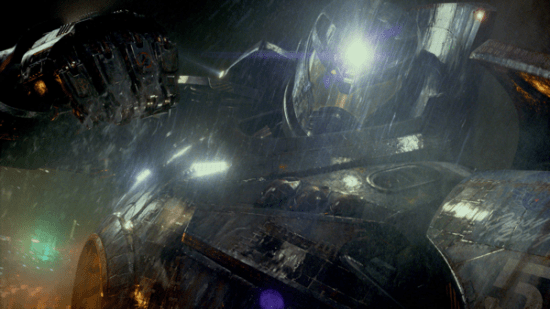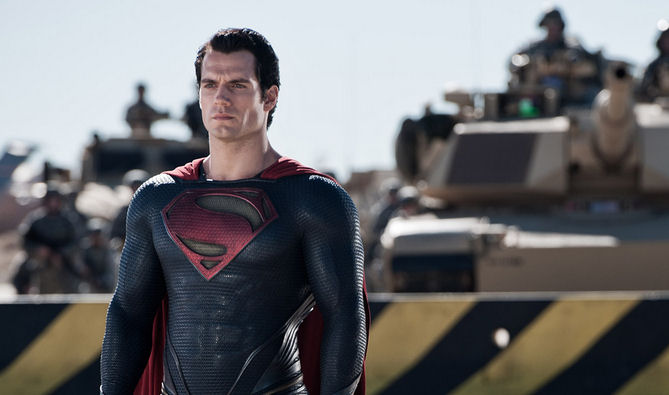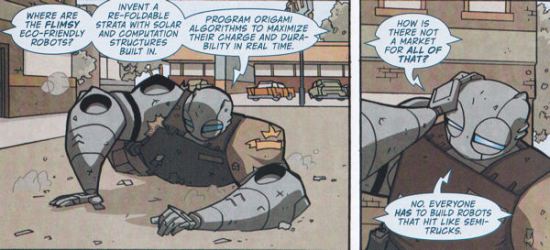
Tony Stark and his sidekick, the Bot Wonder.

Tony Stark and his sidekick, the Bot Wonder.
As with most big-budget sci-fi films nowadays, many viewers will spend half the running time of the new Tom Cruise vehicle Oblivion mentally tallying how many refurbished components they recognize from other sci-fi flicks. That doesn’t automatically make the film bad in my book, but it can be a pervasive distraction that turns my viewing experience into one long Highlights for Children puzzle. (Score one point for every borrowed element you spot! If you spot ten or more, you’re a Certified Movie Maven!) Oblivion is the second feature film from Joseph Kosinski, the director of Tron: Legacy, which was a visual wonderland and a surprisingly classy act considering it was a Disney sequel to a film I’ve disliked since I was ten.

Once again our old friend the White House is humiliated, this time in G.I. Joe: Retaliation.
One of my least favorite moments in college was sitting in an intense English class and concentrating on maintaining a straight face while a classmate explained his theory of how the scene from Edgar Allan Poe’s “The Murders in the Morgue” in which a gorilla stuffs a victim up a chimney somehow, in his mind, represented a return-to-the-womb motif. I have no idea how he thought that related to the rest of the story at all. After the few first few sentences my mind turned to white noise in self-defense.
This evening I had flashbacks to that moment while watching Rodney Ascher’s thought-provoking new documentary Room 237, an examination of hidden meanings in Stanley Kubrick’s film adaptation of Stephen King’s novel The Shining. Whether you hated or loved either or both, few would accuse Kubrick of taking a slapdash approach to the project, regardless of the lengthy list of differences between it and the book. Room 237 is narrated by five Shining enthusiasts: ABC News war correspondent Bill Blakemore; playwright/novelist Juli Kearns; author/conspiracy theorist Jay Weidner; history professor Geoffrey Cocks; and Excepter frontman John Fell Ryan. Each one has their own interpretation of the recurring motifs and subliminal imagery buried in the mix, all adding up to a grand design on Kubrick’s part in their minds. The nature of that grand design, though, varies wildly by viewer…very wildly, in this case.

photo credit: Articulate MediaWorks via photopin cc
I can’t remember what impressionable age I was when I first encountered their popular syndicated movie-review series Siskel & Ebert at the Movies. Our local affiliates sometimes aired it on Saturday afternoons, sometimes in the dead of night, and occasionally found it useful for filling any programming holes outside primetime. I’d never seen anything like it; thirty minutes of two movie fans sitting in a deserted theater balcony and telling viewers whether they thought the latest movies were good or bad. It sounded like a dull concept for a TV show. I could imagine the fun if they were brandishing weapons, but just sitting there? Talking? Why?
As unimpressed as I was with the trailer, The Croods turned out to be an unexpected delight, with a sincere message for parents who want to protect their children from the world, but struggle with the knowledge that someday that job won’t be theirs anymore. (Says the nervous guy counting down the days until his son begins college.)
As of this weekend, I can now say I’ve seen every full-length motion picture directed to date by Christoper Nolan. In December 2012 his debut, Following, earned a Criterion Collection re-release. Shot in 1998 in 16mm black-and-white, it was minimally restored for this edition, with the original aspect ratio and much of the old-media grittiness retained for historical verisimilitude. Its seventy speedy minutes contain an amateur no-star cast (as well as crowds of unwitting “extras” captured on the fly) and were shot for just five thousand dollars, a bargain compared to other self-financed B&W debut films from the same decade (e.g., Kevin Smith’s Clerks, Robert Rodriguez’ El Mariachi). With such budgetary constraints and no established names involved in the creative process, a casual browser would expect Following to feel like a young-adult vanity project fit only for YouTube.
Shame on that casual browser, then, with so little faith in the Nolan brand name. Continue reading
As much as I contemplated bowing out in a previous entry, I just couldn’t quit John McClane. Besides, I had a relative desperate to get away from home for a while, which is one of the commonest rationalizations for doing something you know won’t end well.
Fortunately for impatient viewers, the “plot” portion of A Good Day to Die Hard occupies only the first ten minutes. Legendary neo-cowboy John McClane travels to Russia, where his son, a mere toddler without lines in the original Die Hard, stands trial for murder alongside another political prisoner named Komarov (Sebastian Koch, whom I last saw as the playwright under surveillance in the Oscar-winning The Lives of Others). Little does Dad know that Jack (Jai Courtney, suppressing his Australian accent just fine) is a CIA agent with a plan. Little does Jack know that he’s not the only one gunning for Komarov and the MacGuffin he holds. Little do Komarov’s pursuers know that he’s not as helpless as they think. And everyone but everyone knows sooner or later there’ll be explosions, bullets, and death-defying feats that would kill the average super-hero.
If you fear the aging process and aren’t remotely excited in seeing your possible future as a senior citizen writ large without any regard for your afterlife possibilities, chances are Michael Haneke’s new film Amour will be your scariest encounter of the year.
Except for the silent opening scene of one happy date night, the film is contained entirely within the spacious apartment where elderly couple Georges and Anne (Jean-Louis Trintignant and Emmanuelle Riva) are finishing out their decades of wedded bliss. The first telltale sign that something is wrong occurs when one normal morning is interrupted by one abnormal moment of stupor. After we learn from a reluctant Anne about her distrust of doctors, her condition quickly progresses to a full-blown stroke that leaves her paralyzed on one side and requires Georges to transition from the role of equal partner to majority decision-maker and full-time caretaker. Subsequent days bring new forms of debilitation and add new responsibilities to Georges’ list. How can he continue to manage? Can he continue? The film asks: should he continue?
I saw Silver Linings Playbook over a week ago and have been procrastinating saying anything about it because it’s tough to express my opinion without ruining the ending. I suppose the ads aren’t that coy about the gist of the film, but part of my enjoyment was derived from that rare feeling of having no idea what would happen next. Under the guidance of director David O. Russell (previously appreciated for The Fighter and Three Kings), I wasn’t sure if Playbook would be predictably atypical or deceptively Hollywood about the strange relationship between its May/December starring couple. Would it end in for-your-Oscar-consideration breakup and tears? Would it opt for the mushy happily-ever-after ending, complete with gratuitous dance party at the end? Would the payoff be just-good-friendship, like Lost in Translation? Would they both die horribly of movie cancer? My second-guessing was useless against it.
Each year since 2009 my wife and I have made a day-long date of visiting Keystone Art Cinema, the only dedicated art-film theater in Indianapolis, to view the big-screen release of the Academy Award nominees for Best Live-Action Short Film and Best Animated Short Film. Results vary each time and aren’t always for all audiences, but we appreciate this opportunity to sample such works and see what the Academy of Motion Picture Arts & Sciences deemed worthy of celebrating, whether we agree with their collective opinions or not. A few of the past marathons have varied wildly in quality, but this year’s proved a superb bunch. To be honest, this is the first time in memory that I’ve preferred the live-action contenders to their animated colleagues.
Presented below are my rankings of this year’s five Live-Action Short Film nominees, from the most effective to the slightly flawed. None of these appear to be streaming online for free as the animated nominees are, but it’s my understanding they’re available on iTunes or on Video On Demand if your carrier offers the channel called Shorts HD (ours doesn’t). Links are provided to the most official-looking sites I could locate. Enjoy where possible!
Curfew: Writer/director/editor/star Shawn Christensen plays a deadbeat at the end of his rope, granted a fateful reprieve in the form of a phone call from his estranged sister, begging him for one night of babysitting the niece he hasn’t seen since infancy. The premise easily could’ve been expanded into a ninety-minute dumb-adult/smart-kid mismatch comedy starring Jason Bateman and a doomed child star. The tentative reunion, expectant life lessons, and mandatory cutesy musical number belie the sharp turns taken in the later scenes, when we learn more about the rift between siblings, and about how Mom spent her evening out. A charming, disturbing, sometimes intense drama about family, forgiveness, and our sad propensity for overlooking our importance to others who love and need us.
Each year since 2009 my wife and I have made a day-long date of visiting Keystone Art Cinema, the only dedicated art-film theater in Indianapolis, to view the big-screen release of the Academy Award nominees for Best Live-Action Short Film and Best Animated Short Film. Results vary each time and aren’t always for all audiences, but we appreciate this opportunity to sample such works and see what the Academy of Motion Picture Arts & Sciences deemed worthy of celebrating, whether we agree with their collective opinions or not.
Presented below are my rankings of this year’s five Animated Short Film nominees, from the greatest to the most head-scratching. Unlike last year, all five nominated animated shorts can be viewed online for free…as of today, at least. Links are provided for each, but may be subject to change without notice. Enjoy!
Paperman: You should’ve already seen this in front of Wreck-It Ralph. If you didn’t, it was unique in its use of Disney’s new CG/2-D hybrid system called Meander. The blend worked wondrously, and the meet-cute romance was sweet-hearted.

Warning: those uncharacteristically dopey smiles are a LIE.
As of tonight, NBC is back in the business of catering specifically to me once again. For the next few months, my Thursdays have returned to form with all the right series back in the correct batting order as follows:
* Community: For dedicated fans like myself and my son, October 19th arrived at long last tonight with its fourth-season premiere, a full 111 days after NBC first promised it would be. The four-month drought was dispiriting, filled as it was with very little meta-humor, a complete lack of Troy and Abed in the Morning, and a heartbreaking parade of lost souls who keep telling me how much they prefer The Big Bang Theory, just to make me cry in my sleep.
After seeing Zero Dark Thirty as part of my annual Best Picture nominee binge, I exited the theater with just one thought on my mind: I’d hate to be a guy trying to start a new country in this day and age.
It’s a fun daydream, wondering what it would be like to find a deserted island no one’s yet claimed, plant a flag, invite a few friends to be charter citizens, and then declaring yourselves the new sovereign nation of YourNameHereLand. You build at least one impressive building to house your government. You write your own constitution that justifies everything you’ll ever want to do and lays down basic ground rules to protect you from any future jerks who emigrate inside your borders or grow up inside your school system. You figure out how your economy should function, discern your people’s industrial skill sets, plan for necessary imports, form relationships with all the right countries, fill out the proper UN forms, and you’re off and running. You could probably find how-to guides on the Internet that fill in your knowledge gaps, complete with instructional YouTube videos. How cool would that be?
Long-term answer: sooner or later, not very. Continue reading
My annual quest to see all the Best Picture Academy Award nominees continued last weekend with the scrappy indie competitor of the lot, Beasts of the Southern Wild, a magical-realism fable about stubborn penury-dwellers who do their best to ignore ripped-from-the-headlines natural disaster and do whatever they want whether it’s healthy for them or not. Not since No Country for Old Men has a film left me so depressed.
The film’s plot, as well as I can relay it without major spoilers:
I hadn’t originally planned to see Quentin Tarantino’s Django Unchained. Unlike many of my longtime Internet peers, his films aren’t an automatic draw for me. Though Reservoir Dogs has been a qualified favorite of mine since college, the rest have been a mixed bag. His previous work, Inglorious Badwerds, was a mature, complex, riveting film about WWII and about the role of film in WWII, but was hampered by Brad Pitt’s Kentucky-fried B-movie brigade who snuck in from the direct-to-video good-ol’-boys revenge flick next door. From the trailers, Django looked to me like a 2-cool-4-school blaxploitation Western. Call it Shaft in Texas or Black Grit. Despite the talented cast involved and the joyous responses from the critical majority, it didn’t really sound like my kind of movie.
Then it was nominated for the Best Picture Oscar. As explained in a previous entry, I’ve watched every Best Picture nominee since 1997, whether I was enthusiastic about them or not. On this technicality alone, I checked Django out.
The advance screening of Broken City I attended last night was made possible through a marketing promotion run by a social-event notification service, from which I’d considered unsubscribing months prior. Lucky for me, their very first useful offer crossed my path at just the right time.
Just so we’re clear: last night’s entry was not a paid product review. I’m not opposed to attempting one of those on principle, but for some reason no one submits such offers to the occasionally biased sarcastic guy, even one who sometimes enjoys the things he tries. Also, in blogosphere big-picture terms, I’m still small-fry. Dare to dream, though.
One of the advantages of living in a city of above-average size is that we have enough theaters and moviegoers to warrant sporadic attention from the major studios, who use advance screenings as one of the handy tools in their marketing toolbox. Theoretically the studio partners with a theater to hold one screening of an upcoming film to a full house of Average Joes before its official release date. Said Joes reciprocate the favor by spending the saved ticket money on refreshments instead; sitting through the movie, perhaps a little more patiently than usual since it was free; then sharing their love for the movie across their personal social-media outlets of choice. You become their li’l marketing assistant for an evening, and your paycheck is a flick of their choosing.
Some evenings at the theater, the marquee only has two choices: $200 million action blockbusters and $5,000 found-footage camcorder flicks. If you’re yearning for a simple, mid-sized film with no CGI monsters and at least two famous actors, Broken City offers an R-rated option for fans of crime drama in general and tough-talking guys in particular. It’s a capable primer for anyone who’s never seen a film about political scandal or government corruption, and comfort food for those who can’t get enough of watching little guys taking down big dogs.
Mark Wahlberg is Billy Taggart, a former policeman who lost his badge over a controversial incident involving a homicidal rapist. He now runs his own PI business, though his clients are mostly deadbeats and his photos are amateurish. Russell Crowe is NYC Mayor Nicholas Hostetler, up for yet another reelection and riding high publicity on the sale of the low-income Bolton Village tenement area for a cool four billion bucks, nicely covering the city’s billion-dollar deficit and leaving plenty of surplus to earn him good Election Day will. Hostetler faces challenges on two fronts: his election opponent, smarmy upper-crust councilman Jack Valliant (Barry Pepper, who turns from stiff-upper-lip to unsettling devastation when things go wrong for him); and his wife Cathleen (Catherine Zeta-Jones, an Oscar-winning placeholder), who may be cheating on him. Or he may be paranoid. Or evil.
2012 was my worst year for comic book enjoyment in the last fifteen years. I’ve collected them for thirty-four years, ever since the well-stocked spinner racks at Marsh Supermarket caught my eye at age six and opened new worlds of imagination and heroism. For the majority of my life they’ve been my primary hobby among all my hobbies. Once upon a time, friends could count on me to spout the occasional essay about a particular series, event, historical recollection, or rage-filled response to an aesthetic offense. When I launched Midlife Crisis Crossover last April, I thought the topic of comic books would inspire a lot more posts than they have so far.
I have no plans to wave farewell to the medium altogether, but my personal backlash started during the last half of 2011, when DC Comics purged their continuity yet again and rebooted their entire universe with the “New 52” initiative. The first time they rebooted after Crisis on Infinite Earths, I was fourteen and the combined talents of John Byrne, George Perez, Marv Wolfman, Mike Baron, and others were more than enough to convince me that this new direction was right up my alley. Twenty-six years and countless post-Crisis emendations later, DC and I are no longer the same entities under the same conditions. I can handle reboots to a certain extent, but when the new versions are poorly thought out — or worse, prone to twice as many crossovers as they used to be — I exercise my right as a consumer to opt out.
Marvel’s response was to concentrate on crossovers for a while longer, then roll out their own restarts without rebooting. I’ve found their results a little less alienating, but they’re still leaving some of my money on the table. Image stepped up mightily for a while and snatched some of my leftover Big Two bucks, but their titles have varied in quality and performance. I was glad to see other publishers continue earning attention from me as well — Dark Horse, BOOM!, IDW, Red 5, Valiant, and even Aspen. Again, results varied, but I appreciated the alternatives they offered.
Even though I’m increasingly disappointed with the current majority readership’s predilection for overspending on prequels, crossovers, and do-overs, my year had several bright spots in the world of monthly titles. (For purposes of personal categorization, I treat original graphic novels and trade paperback collections as “Books”, which are grouped and ranked separately from “Comic Books” in my head. Those might be fodder for a separate MCC list.)
The following were my favorite comic book series throughout 2012:
* Journey into Mystery — Kieron Gillen, Rich Elson, and other artists delivered one of the very few series that inspired any MCC thoughts at all, and ended their two-year storyline on a note of epic tragedy. After seeing the reincarnated Kid Loki and his best frenemy Leah through so many misadventures (not to mention the only A-plus crossover tie-ins of any crossover by any company in the last two years), I felt helpless and bereaved to see it all coming crashing down ’round his ears. Marvel’s formerly unrepentant trickster god was so close to redeeming himself for his previous lifetime of treachery and lies, albeit by finding clever ways to wield treachery and lies as forces for Good, only to see everything fall apart because of the lies he told himself and us. I wish every series aspired to thematic examinations this complex and riveting. More fire-breathing angry puppies like lethal li’l Thori would also be welcome.
Welcome once again to the Midlife Crisis Crossover Request Line, in which recommendations from MCC fans send me reading, viewing, and reviewing assorted art and art-like objects, either because they want a proxy to evaluate the damage, or because my life won’t be complete without seeing them. Today’s suggestion came from Niki, one of MCC’s most dedicated fellow Bunheads fans. (Believe it or not, I hadn’t forgotten!)
Today’s subject: The world-famous Les Miserables, the mammoth French novel turned immortal Broadway play turned Hollywood film (not for its first time), today nominated for twelve Academy Awards. Niki’s original suggestion was for any version of the tale, but for some reason our local big-box stores have yet to be flooded with copies of the previous Liam Neeson/Geoffrey Rush version. The touring version of the musical performed in Indianapolis at some point, but that was before I received the suggestion. Blame the timing.
What I knew beforehand: It’s a big, famous book. More people have probably seen the musical than read the book. I knew it had characters named Jean Valjean and Inspector Javert, whose cat-and-mouse routine was an early precursor to The Fugitive. A tiny girl was prominent in all the musical’s ads and best-selling merchandise. That’s really all I knew before walking in.