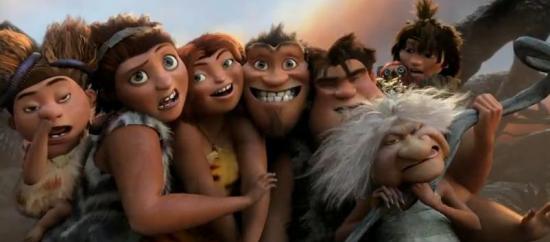
As unimpressed as I was with the trailer, The Croods turned out to be an unexpected delight, with a sincere message for parents who want to protect their children from the world, but struggle with the knowledge that someday that job won’t be theirs anymore. (Says the nervous guy counting down the days until his son begins college.)
Category Archives: Movies/Films/Flicks
“Following”: the Last Gap in Your Christopher Nolan Collection
As of this weekend, I can now say I’ve seen every full-length motion picture directed to date by Christoper Nolan. In December 2012 his debut, Following, earned a Criterion Collection re-release. Shot in 1998 in 16mm black-and-white, it was minimally restored for this edition, with the original aspect ratio and much of the old-media grittiness retained for historical verisimilitude. Its seventy speedy minutes contain an amateur no-star cast (as well as crowds of unwitting “extras” captured on the fly) and were shot for just five thousand dollars, a bargain compared to other self-financed B&W debut films from the same decade (e.g., Kevin Smith’s Clerks, Robert Rodriguez’ El Mariachi). With such budgetary constraints and no established names involved in the creative process, a casual browser would expect Following to feel like a young-adult vanity project fit only for YouTube.

Shame on that casual browser, then, with so little faith in the Nolan brand name. Continue reading
“Veronica Mars: the Motion Picture”: My List of Demands

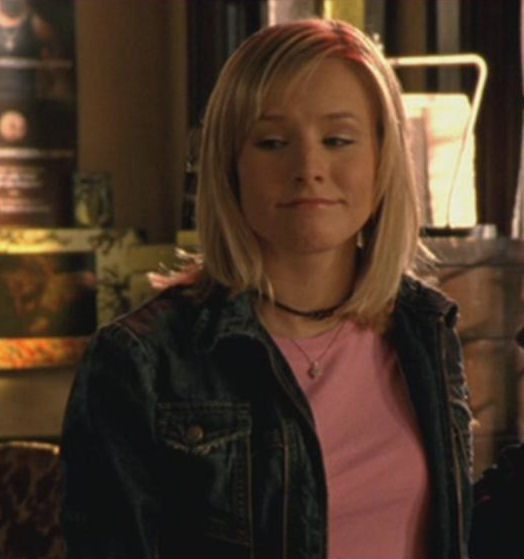
File Photos Guaranteed Not to be Used on Anyone Else’s Veronica Mars Article #49: the time she went undercover as a gamer.
I later caught up with the DVDs and stuck with the show to the bitter end, by which I mean I was bitter. Eventually I moved on, but I’m not opposed to revisiting Veronica’s world if the occasion warrants.
The March 22nd issue of Entertainment Weekly summarizes creator Rob Thomas’ planned premise:
Set a decade after the show’s third and final season, the plot has Veronica returning to her hometown of Neptune, Calif., after much schooling (a bachelor’s from Stanford; a Columbia Law School degree) when she gets a distress call from ex-boyfriend Logan: His pop-star girlfriend has been murdered, and he’s the prime suspect.
“Veronica Mars” Kickstarter Success Raises Unreasonable Hopes in Fans of Every Canceled Series Ever
Just as Star Wars fans spent weeks celebrating in the streets at the news that their beloved childhood franchise will return to theaters, so is another fan base breaking out the party hats this week…and, more importantly, their wallets.
In a first for a major-studio intellectual property, Warner Bros. has allowed producer/creator Rob Thomas to use the power of crowdfunding to extract Veronica Mars from mothballs and feature her in a major motion picture. Thomas launched a Kickstarter campaign less than 48 hours ago with a lofty goal of $2,000,000.00. As Thomas describes the conditional deal with Warner Bros.:
Of course, Warner Bros. still owns Veronica Mars and we would need their blessing and cooperation to pull this off. Kristen and I met with the Warner Bros. brass, and they agreed to allow us to take this shot. They were extremely cool about it, as a matter of fact. Their reaction was, if you can show there’s enough fan interest to warrant a movie, we’re on board. So this is it. This is our shot. I believe it’s the only one we’ve got. It’s nerve-wracking. I suppose we could fail in spectacular fashion, but there’s also the chance that we completely revolutionize how projects like ours can get made. No Kickstarter project ever has set a goal this high. It’s up to you, the fans, now. If the project is successful, our plan is to go into production this summer and the movie will be released in early 2014.
Thomas worried for naught. Pledges from tens of thousands of fans reached that formidable goal in a record-setting, jaw-dropping twelve hours, leaving 29½ days for slower fans and curious bandwagon-jumpers to keep adding to the budget in hopes of upgrading the film from niche project to wide-release underdog, maybe even with action scenes and trained stuntmen. At the rate the pledges are accumulating, they’ll have enough money to set it in 2030 and equip Veronica and her dad with robot sidekicks.
DVD Shelving Systems: Where All Collectors Agree to Disagree
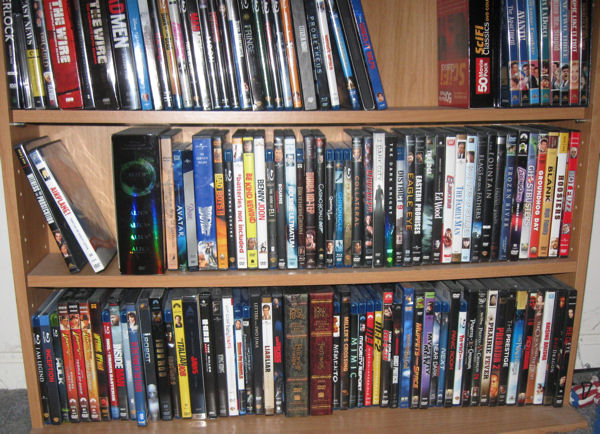
In a brief side discussion after a previous entry, I mentioned in passing how my DVD organizational system suits me but not necessarily my family. If they watched DVDs more often, this might be a more pressing issue. They’re well aware I’m happy to help them locate specific titles, just as any helpful librarian, curator, or clerk might. Besides, if I allow them too much input into the process, they’ll do as they please, sticking any given DVD in any open slot, turning it all into a pell-mell pit of chaos. Everything would be ruined and I’d cry.
Is There Ever a Good Day for “A Good Day to Die Hard”?
As much as I contemplated bowing out in a previous entry, I just couldn’t quit John McClane. Besides, I had a relative desperate to get away from home for a while, which is one of the commonest rationalizations for doing something you know won’t end well.
Fortunately for impatient viewers, the “plot” portion of A Good Day to Die Hard occupies only the first ten minutes. Legendary neo-cowboy John McClane travels to Russia, where his son, a mere toddler without lines in the original Die Hard, stands trial for murder alongside another political prisoner named Komarov (Sebastian Koch, whom I last saw as the playwright under surveillance in the Oscar-winning The Lives of Others). Little does Dad know that Jack (Jai Courtney, suppressing his Australian accent just fine) is a CIA agent with a plan. Little does Jack know that he’s not the only one gunning for Komarov and the MacGuffin he holds. Little do Komarov’s pursuers know that he’s not as helpless as they think. And everyone but everyone knows sooner or later there’ll be explosions, bullets, and death-defying feats that would kill the average super-hero.
Have You Inventoried Your Directors Lately?
Easy, time-consuming, stress-reducing exercise for movie lovers who pay too much attention to the credits: brainstorm as many film directors as you can recall; then review their output (IMDb, WikiPedia, your massive home library, wherever) and see which directors you’ve followed the most throughout your life, whether you realize it or not. To simplify the vetting processing, limit yourself to feature films only — no episodes of TV shows, no short “segments” in any movies, no writer/producer/executive producer credits whatsoever. Just the count the movies they directed that received a theatrical release.
My results tallied are as follows, for better or for worse. I’m certain I missed a few. I gave up on cross-referencing pre-1990 Disney films because it might’ve kept me up all night. Perhaps I can edit and follow up another time.
That list, then:
Christopher Nolan’s “Interstellar”: Big-Budget Crowd-Pleasing Holiday Blockbuster About Quantum Mechanics

Christopher Nolan, never one to keep it simple. (photo credit: charlieanders2 via photopin cc)
Developed from a script by Nolan’s brother, Jonathan Nolan, the sci-fi movie is a time travel epic based on scientific theories developed by American physicist Kip Thorne, who will executive produce. The press release announcing the distribution news describes the film as “a heroic interstellar voyage to the furthest reaches of our scientific understanding.”
For now, that’s all we have. Collaborations between the Nolan brothers have yet to create dreadful results. Their track record tells us it won’t be a straightforward ninety-minute shoot-’em-up. Based on the precedents set by Nolan and Nolan’s innovative narrative explorations of dreams, memory, anarchy, class warfare, and Robin Williams’ serious side, I expect a time travel tale crafted under their watch to be a mind-bending reexamination of that sci-fi subgenre in a way we didn’t already see in Back to the Future, Bill and Ted’s Excellent Adventure, the various conflicting Terminator products, and several hundred Star Trek episodes.
If the Nolans plan to incorporate the work of a real physicist into the script instead of borrowing from other time-travel films (which is typically how those films are made), you can bet that at some point half the audience will be lost, no matter how hard they concentrate, no matter how many pages of grad-school textbook exposition are seamlessly woven into the dialogue.
The proactive solution is obvious: if we intend to enjoy Interstellar to the fullest, then we have nineteen months to subject ourselves to as many intensive, self-taught science classes as possible before it arrives in theaters. Continue reading
“The Rocketeer: Hollywood Horror”: Merry All-Star 1940s Pop Culture Crossover!
That may prove to be hyperbole, but the initial signs are promising. You’re looking at sign #1 in the panels sampled above. No two ways about it: any comic that features very special guest appearances by unnamed ringers for the dynamite duo of Nick and Nora Charles automatically earns my personal seal of approval.
MCC Q&A #3: How “Kill Bill Vol. 1” Ruined Revenge Flicks for Me
Whereas the first two editions of “MCC Q&A” were comprised of tongue-in-cheek responses to odd queries and sentence fragments that brought search engine users to my humble doorstep, this one is devoted to a single question from an MCC commentator. Far be it from me to allow the plaintive mumblings of nameless strangers to monopolize this slightly recurring feature.
In my previous entry about Django Unchained, I mentioned in passing that Kill Bill Vol. 1 remains my least favorite Quentin Tarantino film to date. To be fair, that statement was limited in scope since I’ve seen neither Kill Bill Vol. 2 nor Death Proof. I’ll concede that either or both could be worse. As of this writing, I wouldn’t know.
In response, reader Tommy Gardner wrote:
What do you have against Kill Bill? It was a perfect live-action anime. I don’t watch much anime because I think very few of them are really good (Trigun, Ghost In Shell, FMA) and Kill Bill nailed the genre in a very R rated way.
My answer involves the little girl in the above photo. Continue reading
Oscars Blow-by-Blow 2013
As my seventh annual foray into this personal fun ritual, presented below anyway is the timeline of events as I witnessed them during tonight’s ABC telecast of the 85th Academy Awards. All quotes are approximate as best as possible without benefit of rewatching, cribbing from national news outlets, or much proofreading. Our household does not own a DVR; all recollections are a combination of short-term memory and notes hastily handwritten on a legal pad, not a copy/paste reassembly of a distracted live-tweet flood. When I’m seated in front of a TV, I’d much rather watch than type.
8:30 — Our host Seth MacFarlane takes the stage with minimal intro and his first joke: “The quest to make Tommy Lee Jones laugh begins.” Naturally he jokes that he was only offered the gig after the producers were turned down by everyone else “from Whoopi on down to Ron Jeremy.” MacFarlane seems at ease and on his game most of the night, albeit with occasional edginess, such as a Rihanna/Chris Brown joke that seems more dated than offensive.
My 2013 Oscar Picks, 100% Accurate on Some Alternate Earth
I already explained in a previous entry about my predilection for the greatest spectacle in movie awarding. The last four entries were my version of a very special Oscar-themed week (located here, here, here, and here). All that remains before the big ceremony, then, is the burning question: my personal picks for the 85th Academy Awards.
If I were a card-carrying member of the Academy of Motion Picture Arts and Sciences, the following list would represent my hypothetical ballot selections. These are not my predictions as to who will win, which is a slightly different but even more useless list. To be honest, my Oscar guessing rate is abysmal. Of all the fans worldwide who go to the trouble of watching all Best Picture nominees, I’m the last one you want to ask for hot gambling tips. I’m not plugged in to the Hollywood zeitgeist, the trendiest groupthink sects, or nearly as many movie news sites as I ought to be. In fact, I’m pretty sure I’ve jinxed a lot of nominees in previous years and owe a round of apologies to numerous filmmakers who lost their races specifically because I picked them. (Sorry about that, The Social Network. My fault.)
A Few Best Picture Nominees That Didn’t Deserve Better
As mentioned previously, I’ve seen every Academy Award winner for Best Picture from Wings to The Artist, retaining varying degrees of recollection. I’ve also seen every Best Picture nominee from 1997 to the present, and have embarked on a slow, low-priority, extra-long-term quest to see how far backwards in time I can extend that date. Right now I’m stalled on 1996 because the DVD version of Secrets & Lies is out of print, secondhand copies are priced much higher than I’d prefer, and I’ve never caught it airing on a cable network. Someday I’ll overcome that obstacle and continue down the line in reverse order.
I watched a lot of those winners and nominees on cruddy VHS copies, many recorded from Turner Classic Movies at EP speed for maximum storage conservation, and therefore suffered subpar A/V quality and the dreaded pan-‘n’-scan method that ruined countless widescreen films for the sake of home video as it existed back then. I wouldn’t mind revisiting some past winners and nominees in upgraded formats as time and funding allow. (Tonight, for example, I watched The Sound of Music on Blu-ray, my first time seeing the original widescreen presentation with the composition and gorgeous Alpine scenery intact. Massive difference.)
The following list is a sampling of Best Picture nominees that not only lost the Oscar, but also lost me when I did my best to stomach them, and won’t entice me to an encore presentation, not even as a thrifty Blu-ray with myriad extras.
The loser nominees are:
* Chocolat. The citizens of an all-Catholic town who’ve apparently never studied the Bible find themselves easily tempted away from their convictions during Lent when a dismissive heathen outsider opens a chocolate shop and mocks their fasting. I can see the groundwork laid here for a meaty Stephen King novel, if we modify Act Two so that the lady turns out to be an underworld minion whose Satanic powers manifest in the form of evil bonbons. Call it Needful Things 2: Day of the Truffles. Alas, no, the lady is typical and the self-righteous moral of the story is snacks are better than God. Though the town has other underlying problems that sugar somehow cures, my diagnosis would be that the town merely needed a more competent minister to guide and edify that particular flock.
* The Reader. My wife doesn’t share my quixotic quest and is consequently under no obligation to see films against her will. If I think a film has merit, I’ll regale her with a précis of the better parts, spoilers and all. Some films, I really don’t want to summarize. No loyal husband wants to confront the innocent question of “How was the movie?” with an answer like “It was basically Kate Winslet having lots of wild sex with a teenager.” In the theater I tried to stay focused on her character’s role as a gruff German guard who may or may not have been a Nazi war criminal. I lost that focus completely when her deep, dark secret — which I predicted several minutes in advance — reminded me of the “Oscar Clip” scene from Wayne’s World. After my little flashback, I couldn’t stop laughing all through her deadly serious court trial. So that ended poorly.
A Few Best Picture Nominees That Deserved Better
Everyone who watches the Academy Awards has their disagreements with the Academy. Not one living person would look at the complete list of Best Picture nominees and argue that the right movie has won every single year since Wings. We all have our own ideas about what makes one movie better than other movies. The idea of separate, distinct works of art being forced to compete against each other in an expensive dog-and-pony show may seem crass, especially considering the plethora of talents, genres, budgets, studio systems, sweetheart agent deals, and marketing departments that are fundamentally incomparable in any reasonable aesthetic discussion. Big-budget award-grubbing machines and high-minded shoestring-budget indie flicks shouldn’t be fighting each other; they should be working side-by-side, providing viewers with a vast assortment of reasons for film lovers to remain invested in the medium, and maybe even teaming up for the occasional crossover.
Just the same, the Academy of Motion Picture Arts and Sciences insists on the annual flickfights. Sometimes Academy voters pick the right winner. Sometimes they struggle with hard choices. Sometimes they get it wrong. Sometimes they do it on purpose to upset the rest of the world, or at least me specifically.
The following Best Picture nominees from decades past represent a few differences of opinion between my biases and the questionable preferences of the Hollywood voting majority. While I have the advantage of limited, selfish hindsight peering back from outside their contemporary context, they have the advantage of being famous artists and filmmakers whose personal valets make more in a month than I do in a year. Thus do they have the privilege of deciding whose names are engraved on the statues and which ones have to settle for “I coulda been a contendah” jokes.
Some of those nominees are:
* The Thin Man (1934). Not that I have anything against the fun romance of It Happened One Night, but Nick and Nora Charles are five times the fun, not to mention one of the most solid husband/wife couples in anything ever, fellow detectives or otherwise. Living in a bygone era where “politically incorrect” wasn’t a thing yet, their methodology was questionable (gather all the suspects and hope someone tips their hand? Foolish but genius); Nick’s alcohol dependence was played for a few laughs but not taken entirely for granted (he grudgingly quit drinking in later films); and their relationship was 100% unflappably rock-solid (in one hectic scene, Nick saves Nora from a bullet by punching her in the face, somehow without destroying their marriage — good luck pulling off that trick outside a tasteless R-rated comedy today). “They don’t make ’em like they used to” doesn’t begin to describe the series’ legacy. The happy couple regrettably didn’t stand a chance against a shirtless Clark Gable.
A Few of My Least Favorite Best Picture Winners
After yesterday’s mandatory entry, it’s still the week before the Academy Awards ceremony, when Oscar fans have the best excuse to wax eloquent about the greatest awards show of all time. Also, they can indulge in as much hyperbole as they want without fear of retribution. ‘Tis the season.
As I mentioned yesterday, I saw all the Best Picture winners over the course of a several-year journey back in the 1990s. Some were invaluable enterprises that I’m glad I went out of my way to catch. Some…not so much. It’s been my geek experience that when you dedicate yourself to absolute completism on a given subject without fail or compromise, you find yourself having to tolerate a lot of damaged goods that you’ll regret later, in exchange for those bragging rights.
My list of the most regrettable Best Picture winners to date is thankfully shorter than my Best Best Pictures list. I’ve seen several Best Picture nominees that were far more toxic than most of these, but that doesn’t improve their own letter grades in my amateur-appreciator book.
Presented in no conscious order:
* The English Patient. Seinfeld mocked this beloved non-linear adaptation years before I saw it. I allowed it an impartial chance to stand or fall on its own merits nonetheless. I even watched it twice in order to grasp the complexities of the interwoven timelines. Despite my efforts, it never had a chance. Fun trivia: stories in which I’m expected to sympathize with adulterers will find me next to impossible to win over. It’s a sore spot inflicted by my own personal history, a flagrant bias I have no interest in setting aside. Out of Africa failed me for this same reason, though at least Meryl Streep didn’t compound her sins by abetting the Nazis in the name of lust.
A Few of My Favorite Best Picture Winners
It’s that time of year again, the week before the Academy Awards ceremony, when anyone who pontificates online about movies to any degree is compelled to reflect on Oscar winners of years past and mine their history for writing material in lieu of relevant news updates and Oscar pool handicapping. I suppose I should add my two cents quickly, lest I risk being last in line, though I’m sure all mine are taken by other Oscar fans now, if not necessarily in matching quantity. Years ago I completed a lengthy quest to see every Best Picture winner from Wings to the present, just to see what would happen. Some I’ve long since forgotten, some were travesties I wish I could unsee, but many were worthwhile experiences.
As with all such lists, the following is purely subjective, not constrained by your mortal ideas about standards of fairness or codified film-school guidelines, and rife with random acts of unjustified, whimsical favoritism. This is my Best Best Pictures Ever list. There are many others like it, but this one is mine.
Because ranking them against each other would require extensive arguments against myself that I couldn’t possibly win, these are presented in no intentional order:
* My Fair Lady. The first musical I ever enjoyed in my life that wasn’t a cartoon or a puppet show. The idea of better living through diction and poise lessons was fascinating in my youth. Also, the songs are catchy despite their lack of American Idol vocal sheen, and Eliza’s Cockney scream at the horse race cracks me up every time.
“Amour”: a Gerascophobe’s Worst Nightmare
If you fear the aging process and aren’t remotely excited in seeing your possible future as a senior citizen writ large without any regard for your afterlife possibilities, chances are Michael Haneke’s new film Amour will be your scariest encounter of the year.
Except for the silent opening scene of one happy date night, the film is contained entirely within the spacious apartment where elderly couple Georges and Anne (Jean-Louis Trintignant and Emmanuelle Riva) are finishing out their decades of wedded bliss. The first telltale sign that something is wrong occurs when one normal morning is interrupted by one abnormal moment of stupor. After we learn from a reluctant Anne about her distrust of doctors, her condition quickly progresses to a full-blown stroke that leaves her paralyzed on one side and requires Georges to transition from the role of equal partner to majority decision-maker and full-time caretaker. Subsequent days bring new forms of debilitation and add new responsibilities to Georges’ list. How can he continue to manage? Can he continue? The film asks: should he continue?
How Hard Can it Be to Quit a Movie Series?
To Die Hard or not to Die Hard: that is the question now before me.
Anyone who knows me well is aware that — even at my advanced, increasingly prudish age — the original Die Hard remains my unqualified favorite movie of all time. None of them understand why because I’ve never outlined the many reasons. Suffice it to say it’s my incontrovertible opinion. I’ve seen all four movies even though they varied in worth. For the record, the correct ranking is 1, 2, 4, 3. I can understand arguments for and against Renny Harlin’s Die Harder, but I question the wisdom of anyone who ranks Die Hard with a Vengeance anywhere but dead last. For some reason I assumed that Len Wiseman’s ludicrous but giddy Live Free or Die Hard would be the series endcap, and John McClane could ride off into the sunset with Gary Cooper. When the fifth one was announced, I had no idea what to think.
As I’m contemplating the post-Oscar movie release schedule, A Good Day to Die Hard is the only non-Oscar film in theaters that’s not an automatic “no”. That doesn’t mean it’s an enthusiastic “yes”, though. As of this moment its Tomatometer rating rests at a paltry 13%. Its director’s oeuvre has never once tempted me into a theater. The main villain, which can make or break a Die Hard flick, is buried in the trailers as if the filmmakers are ashamed of him. Bruce Willis is now 57, younger than Schwarzenegger and Stallone but not exactly in his prime. I’m not optimistic, but I’m torn. Is now the right time to walk away from John McClane?
“Silver Linings Playbook”: Your Best Bet for an Oscar/Valentine Crossover
I saw Silver Linings Playbook over a week ago and have been procrastinating saying anything about it because it’s tough to express my opinion without ruining the ending. I suppose the ads aren’t that coy about the gist of the film, but part of my enjoyment was derived from that rare feeling of having no idea what would happen next. Under the guidance of director David O. Russell (previously appreciated for The Fighter and Three Kings), I wasn’t sure if Playbook would be predictably atypical or deceptively Hollywood about the strange relationship between its May/December starring couple. Would it end in for-your-Oscar-consideration breakup and tears? Would it opt for the mushy happily-ever-after ending, complete with gratuitous dance party at the end? Would the payoff be just-good-friendship, like Lost in Translation? Would they both die horribly of movie cancer? My second-guessing was useless against it.
2013 Oscar-Nominated Live-Action Shorts: From Best to Not-Best
Each year since 2009 my wife and I have made a day-long date of visiting Keystone Art Cinema, the only dedicated art-film theater in Indianapolis, to view the big-screen release of the Academy Award nominees for Best Live-Action Short Film and Best Animated Short Film. Results vary each time and aren’t always for all audiences, but we appreciate this opportunity to sample such works and see what the Academy of Motion Picture Arts & Sciences deemed worthy of celebrating, whether we agree with their collective opinions or not. A few of the past marathons have varied wildly in quality, but this year’s proved a superb bunch. To be honest, this is the first time in memory that I’ve preferred the live-action contenders to their animated colleagues.
Presented below are my rankings of this year’s five Live-Action Short Film nominees, from the most effective to the slightly flawed. None of these appear to be streaming online for free as the animated nominees are, but it’s my understanding they’re available on iTunes or on Video On Demand if your carrier offers the channel called Shorts HD (ours doesn’t). Links are provided to the most official-looking sites I could locate. Enjoy where possible!
Curfew: Writer/director/editor/star Shawn Christensen plays a deadbeat at the end of his rope, granted a fateful reprieve in the form of a phone call from his estranged sister, begging him for one night of babysitting the niece he hasn’t seen since infancy. The premise easily could’ve been expanded into a ninety-minute dumb-adult/smart-kid mismatch comedy starring Jason Bateman and a doomed child star. The tentative reunion, expectant life lessons, and mandatory cutesy musical number belie the sharp turns taken in the later scenes, when we learn more about the rift between siblings, and about how Mom spent her evening out. A charming, disturbing, sometimes intense drama about family, forgiveness, and our sad propensity for overlooking our importance to others who love and need us.