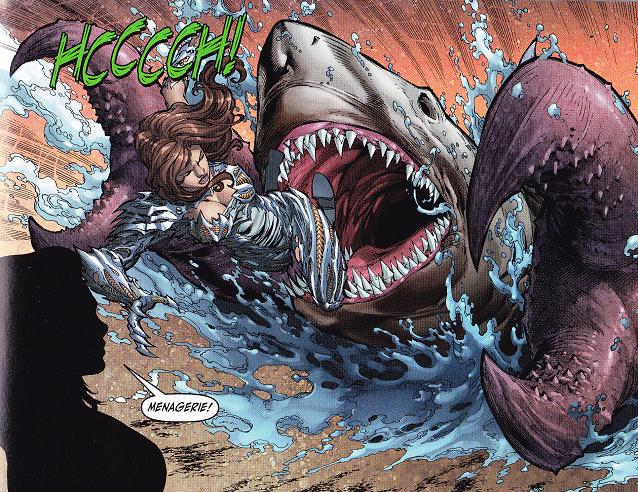
MCC Request Line #4: “Witchblade”

Witchblade vs. MenagerieWelcome back to MCCRL, in which I take on reading, viewing, or reviewing suggestions from MCC readers just to see what happens, whether the results are good, bad, or mixed-bag. Today’s suggestion came to me from The Smile Scavenger, optimistic pursuer of that eternal expression that some find elusive and others elude to their own detriment.

Today’s subject: Witchblade, the longest running series from Top Cow Productions, one of the flagship divisions of Image Comics. The most recent issue, #161, was released on Halloween.

Continue reading

“Revolution” 11/5/2012 (spoilers): Charlie vs. the Monroe Youth Academy of Evil

Miles Matheson, "Revolution", NBCThe moral of this week’s new episode of Revolution, “The Children’s Crusade”: nothing weighs more heavily on a conscience than watching others suffer for our sins. Nowhere is this more radically demonstrated than when our man Miles finally finds himself moved by something other than Charlie’s harping about Doing the Right Thing. He realizes that his duties as former evil assistant overlord of the Monroe Republic included unwitting orphan-making. When Our Heroes encounter ragtag Lord of the Flies refugees, something inside Miles’ head asks: won’t someone think of the children?

Continue reading

The Joy of the “Wreck-It Ralph” End Credits, and the Extra-Special Movie Attached to Them

John C. Reilly IS Disney's Wreck-It Ralph!Important things first: Wreck-It Ralph is the best non-Pixar Disney film in years, proof positive that both divisions are up to the task of delivering solid results when the right talents are lined up and the marketing department is kept in check. The end credits confirm Ralph was wrangled by four different writers, two of which are omitted by IMDB — Jim Reardon and director Rich Moore, both veterans of the glory days of The Simpsons. (Of the other two, one, Phil Johnston, was responsible for last year’s indie Midwest comedy Cedar Rapids.) From where I sat, I couldn’t see the seams.
Academy Award nominee John C. Reilly is an unloved palooka who chafes in his day job as the villain of Fix-It Felix, Jr., one of several old-school cabinet games at Litwak’s Family Fun Center (elderly owner voiced by Ed O’Neill). Ralph’s major beef isn’t necessarily that he hates his job, but that he hates how shabbily he’s treated because he does it so convincingly. Even when Litwak’s is closed and all gaming characters are allowed to go home for the night, Ralph’s coworkers — the titular hero Felix (30 Rock‘s Jack McBrayer) and the townspeople he saves every day — relax and party in their high-rise apartment building while poor Ralph is forced to live and sleep outside on a mound of loose bricks. Perversely, in their neighborhood Ralph is the 1% and the well-to-do are the 99%. The manufacturer clearly didn’t program these civilians to recognize the sight of homelessness.

Continue reading

“Revolution” 10/29/2012 (spoilers): Charlie vs. the Poppy-Pushing Pig

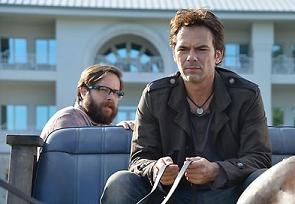
Aaron and Miles, "Revolution", NBCI had assumed that this week’s new episode of Revolution, “Sex and Drugs”, would begin with Nora perfectly fine and her stab wound from episode five healed over nicely. Instead, last week’s fake episode recap turned out to be 10% prescient, as her wound became infected and demanded serious medical attention. Rubbing dirt in it just wasn’t working. Maybe she was doing it wrong.
Continue reading

“Argo”: Heroics More Harrowing Than Hilarious

Ben Affleck, "Argo"I can’t remember which reviewer or random Internet commenter gave me the impression that director/actor Ben Affleck’s new film Argo was surprisingly funny, or words to that effect. If I could recall their identity, I’d express mild annoyance in their general direction. My general opinion is in lockstep with the theater-going majority who’ve given it a collective thumbs-up and touted it as a likely nominee at next year’s Academy Awards in some fashion, but for some reason I walked into it expecting something more along the lines of satirical movies-about-movies such as Wag the Dog, Living in Oblivion, or even The Naked Gun 33⅓: The Final Insult. My expectations were a little off-base.
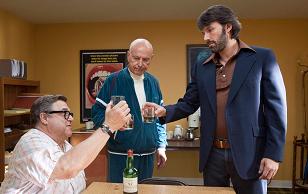
Certainly the film takes its potshots at Hollywood. Affleck is our hero Tony Mendez, a CIA agent assigned to the task of exfiltrating six stranded Americans from Iran during its prime hostage-taking years. His plan: enter the country posing as a filmmaker, build cover identities for the sextet as part of his film crew, and hustle them out of the country via commercial airline. Phase One of his plan enlists John Goodman as an Oscar-winning makeup artist, who in turn recruits Alan Arkin as a longtime director. The three of them create a fake production company, purchase a space-opera script in turnaround for chump change, hire a storyboard artist, and spend CIA dollars on a lavish pre-production advertising campaign and press-party announcing their fake intent to pretend to rip off Star Wars. Goodman and Arkin have all the best scenes as old friends who know the eccentricities of their surroundings all too well as they push their faux-flick Argo upon an audience that will never see a frame of it.

The moviemaking scenes comprise a minority portion of the running time. They’re prefaced with a jolting reenactment of the day the American embassy fell, and surrounded by a subdued political thriller whose searing images of religious conflict aren’t too far removed from the present-day future thirty years hence. The era and situation are rife with all manner of tension and discomfort. The claustrophobia and paranoid isolation of the refugees, forced to hide out for months at the Canadian ambassador’s place. The monotonous grind of the child laborers tasked to reconstruct mountains of shredded American documents. The Ayatollah Khomeini’s loyal followers, furious in their yearning to hold the Shah accountable for acts against Iran in general and Allah in particular. The tumult of an Iranian bazaar, no good place for Westerners. Even Mendez has personal struggles off the job, as he does his best to be a generous non-custodial father when time allows between covert ops.

All of this dovetails serendipitously in the final sequences involving airport security issues, cumbersome red tape, split-second timing, Bryan Cranston shouting at people, Kyle Chandler clogging up the works through force of smugness, and those seemingly futile Argo storyboards, unwittingly chronicling a sci-fi allegory of the Iranian revolution that connects with a command audience at just the right dangerous crossroads.

I’ll be curious to see what sort of attention it garners during this winter’s awards nomination processes. I just wish I hadn’t entered into it with the unjustified mindset that the humor at Hollywood’s expense would be a more pervasive presence, like a Kevin Smith film with a larger budget. In retrospect I’m pleased it wasn’t, and richer for the experience.

Two final notes, in keeping with past movie entries:

1. I caught no veterans from The Wire among the cast, but Buffy/Angel fans should refrain from blinking or else miss a literal three-second cameo from Tom Lenk (Andrew!) as one of several suckered entertainment reporters.

2. The end credits have no scene at the very, very end, but I recommend sticking around through the extras in the first half. Cast photos are juxtaposed with copies of their real-life counterparts’ real-life fake IDs. Several key scenes are juxtaposed with the period-specific photos that inspired them. And the entire movie is capped with a brand new soundbite from a certain erstwhile Commander-in-Chief about this previously undisclosed moment in his administration’s beleaguered history.

MCC Request Line #3: “Grifter”

Welcome to our recurring feature in which I take on reading, viewing, or reviewing suggestions from MCC readers and sharing my results in the interest of entertainment science. Today’s suggestion was offered a few months ago by wwayne, who left me an English comment that seemed like quite a departure from his own moribund Italian blog. Nevertheless, a suggestion is a suggestion. This one’s for you, wwayne, wherever you are.

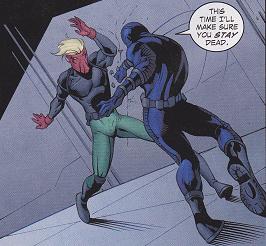
Grifter, Midnighter, DC Comics New 52Today’s subject: Grifter, one of the initial titles from DC Comics’ “New 52” relaunch of September 2011. For review purposes I picked up the most recent issue, #13, which was new in stores last Wednesday.

What I knew beforehand: Grifter was created in 1991 by superstar writer/artist Jim Lee as a cast member of the creator-owned super-hero series WildC.A.T.s: Covert Action Teams, about a team of heroes from space who travel to Earth to hunt their nefarious arch-nemeses, the Daemonites. I was indifferent to the Image Comics series except for a handful of issues written by James Robinson (Starman) and a memorable run written by the legendary Alan Moore before comics publishers and Hollywood turned him bitter and X-rated. Grifter was present in those days but not a focal point. Lee later sold his babies to DC Comics and is now one of the company’s reigning vice presidents. His creations were later integrated into the DC Universe in altered forms.

As far as I could remember, Grifter’s super-power was being a guy with guns. One sentence in one panel of this issue hints at telekinesis, but I don’t remember that from my prior WildC.A.T.s reading experience. Perhaps it was always there but never mattered.

Continue reading

“Revolution” 10/15/2012 (spoilers): Charlie vs. Choo-Choo and the Philly Flash

Giancarlo Esposito IS Tom Neville IN NBC's "Revolution"Barely recovered from last week’s Shocking Character Death, the heroes of the Revolution are allowed to dawdle in mourning for all of half an hour before action hero Miles Matheson decides that grief is over and it’s time for everyone to move on. As soon as they cross the next set of bushes without benefit of jump-cut or montage, presto! They’re in Noblesville. Keeping in mind that Indiana Beach is 85 miles northwest of Noblesville, I infer from this instant arrival that our intrepid remainders — Miles, Charlie, Aaron, and “willing” “prisoner” “Nate” — graciously carried their fallen comrade’s body all eighty-five of those miles before deciding that the time and place were right for a proper funeral service, right next door to our villains’ current location. If you ask me, the Indiana Beach area is much prettier and farther away from evil. On the other hand, Noblesville has a large concert venue, the Deer Creek Verizon Wireless Klipsch now presumably sponsorless Music Center. Maybe music fans of the future would love a final resting place near that.

Continue reading

MCC Request Line #2: “Dredd”

Welcome to the sophomore installment of our recurring feature in which I’m accepting viewing or reading suggestions from MCC readers and sharing my results in the interest of entertainment science. Today’s suggestion came from Senator Brett, photographer and Thought-of-the-Day thinker extraordinaire.

Karl Urban IS Judge Dredd IN "Dredd"Today’s subject: Dredd, the movie industry’s second attempt to adapt the iconic British comics character to the silver screen. The first attempt had okay visual effects, Sylvester Stallone reprising Cobra in funnier clothes, and Rob Schneider. Incredibly, the new version has fared even worse at the American box office, possibly because of rampant fears of an uncredited Schneider cameo.
What I knew beforehand: In a post-apocalyptic future, the grim and gritty Mega-City One sprawls across the land, contains hundreds of millions of inhabitants, too many of them evil. Whatever government remains has essentially given up on ruling and created an army of Punishers — duly authorized judges, juries, and executioners. The savings to taxpayers must be enormous. Judge Dredd is the best and angriest of the bunch. One of his frequent coworkers is Judge Anderson, a blonde with psionic powers. They kill crime.

Continue reading

“Revolution” 10/8/2012 (spoilers): Charlie vs. Old Man Witherby at the Abandoned Amusement Park

Billy Burke, Revolution, NBCViewers have had a week since last week’s episode of Revolution to write down their guesses as to which character would die tonight. Would it be Aaron, the softest of Our Heroes, whose death would take all sense of comic relief with him? Would it be Miles, the main character? Would it be Charlie, the character that the show keeps telling us is the main character? Would it be “Nate”, sacrificing himself to atone for his nebulous militia past? Would it be Neville, executed for the crime of being too interesting a villain?

Before that moment of tragedy, we saw at least one victory in tonight’s new episode, “The Plague Dogs”, named after the Richard Adams novel about a pair of lab-experiment dogs on the run, like our heroes except with stranger side effects. Our cast finally reunites in the ghost town of Lowell, Indiana, as previously promised, fifty miles south-by-southeast of Chicago. (One empty business sports a sign reading “G. Stein Furniture Company”, the name of a real business in North Carolina. But never mind that.) As they merge and move along, their old buddy “Nate” also stumbles out of the shadows and joins them as a willing prisoner. We’re told that his last encounter with Charlie from episode 2 (“Chained Heat”) happened someplace called Pontiac. Presumably this is Pontiac, Illinois, one hundred miles southwest of Chicago and less than thirty miles away from Chatsworth, the recently raided town that the Rebel Alliance name-checked last week. (Pontiac, Indiana, is even more out of the way, hours south of Lowell. Obviously the larger city of Pontiac, Michigan, also won’t do.)

Their objective is to catch up with Neville’s entourage, en route with Charlie’s brother Danny to Noblesville, Indiana, which is thirty miles from where I’m now sitting and typing. Lowell to Noblesville is 120+ miles beyond what they’ve already walked from Chicago to Lowell. The bulk of the episode detours them into an abandoned amusement park, which in our reality would most likely mean a ten-mile digression off I-65 to Indiana Beach in scenic Monticello. It’s not a ride-for-ride carbon copy, but the show captures the basic essence of roller coaster, water slide, Ferris wheel with extra-wide gondolas, and plastic beach chairs. The show version has more water towers, its 1950s diner looks more like a place I know at Ohio’s Kings Island, and the giant-size guitar in the background of one shot gives away its true identity as the Hard Rock Amusement Park in Myrtle Beach, SC. As a single-episode stand-in, I guess it’ll do.

Also different from Indiana Beach: the attack dogs and their unhinged master, who sics his minions on Our Heroes and then vows revenge when they kill one in self-defense. How dare they! His poor, innocent, feral dogs were minding their own business and just going about their bloodthirsty day, and then that happens! Clearly the humans are at fault and must pay. Instead of haunting them with a fake ghost like most amusement park caretakers would, this grizzled stalker attacks from the shadows and even designs a primitive deathtrap for Charlie. Luckily for her the fixtures are authentically rickety and her day is saved. Ah, if only everyone’s day could be saved…

Meanwhile on the road to Noblesville, Danny does his own bit of heroic lifesaving after finding himself trapped with Neville in a storm cellar during a genuine Indiana tornado. The twister seemingly passes; Neville shouts “Amen!”; and I couldn’t help laughing as the ceiling collapsed on him. That’s our unpredictable Indiana weather in a nutshell, folks. If nothing else, Revolution nailed that part. Alas, Danny and Neville re-enact the old fable about the scorpion and the fox, as Danny conscientiously saves Neville’s life, only to be stung by him in return. Points to Danny for moral superiority in the face of a CG storm, at least.

Meanwhile down in Noblesville, now revealed as Monroe Militia HQ, Evil Dictator “Bass” Monroe continues holding Charlie’s mom Rachel captive, perpetuating what must be a years-long tradition of interrogating her unsuccessfully, even with sadistic lackey involvement. A flashback reveals that not only did Rachel turn herself in to save her family, but that her original captor…was Miles himself! DUN DUN DUUUUUN! I suppose this should be shocking, but it’s kind of not. Now that we know the Monroe Republic is half Monroe’s fault and half Miles’, I expect we’re in for a long parade of stunning revelations about the evil Miles committed before he realized what a series of grave mistakes he’d made, like My Name is Earl with more bloodletting.

To his credit, Miles corrects one important wrong in this episode. After two acts’ worth of wishy-washy quitter angst once again, he finally takes a leap of faith into the waiting arms of family commitment, officially deciding to stay with his niece and help see her quest through to the doubtlessly heroic end. The impetus that inspires this decision is tonight’s Shocking Character Death…which would be a lot more shocking if I hadn’t totally called it last week.

Alas, poor Maggie, we knew you slightly. Your flashbacks reveal a little more history, of your children separated from you in England, of your epic one-woman journey from Seattle to Buffalo, and of your unbelievable discovery that large boats capable of sailing to England are now extinct because of wars that demolished them all and, I suppose, resulted in the deaths of every boatwright and every boating company in America. Never mind that Christopher Columbus and several centuries of pirates managed just fine without today’s boat construction technology. Were all those Carnival Cruise liners drafted into the wars and sunk during fierce naval conflicts, too?

Sorry, where were we? Yes, Maggie, then — Charlie’s de facto stepmother passes away due to femoral artery damage from one vicious stab wound courtesy of the Phantom of Indiana Beach. A sad ending to her story, after being rescued from suicidal thoughts by Charlie’s dad Ben, made a part of the family, and now…this. In her final flashback, Maggie reads to her kids from yet another classic road-trip tale, The Wonderful Wizard of Oz, a copy of which she leaves behind with Our Heroes, perhaps serving as a reminder to keep following that yellow brick road. Or a reminder of a more innocent time when adorable dogs like Toto were the norm and not the exception.

MCC Request Line #1: “New Girl”

Welcome to the first installment of a recurring feature in which I’ll be accepting viewing or reading suggestions from MCC readers and sharing my results, for better or for worse, for richer or for poorer. Rather than dive face-first toward the bottom of the barrel, I’m leading off with a softball pitch of a show, as suggested by the curator and creator of Enchanted Seashells, a tugboat captain’s wife who’s also an accomplished artist in the medium of seashells. Check out her blog for some pretty inspired creations!

Zooey Deschanel, "New Girl", Fox sitcomToday’s subject: the Fox sitcom New Girl, now in its second season. Instead of researching at length and arming myself with knowledge of characters and situations in advance, I followed in the footsteps of our primitive ancestors and sat through a random episode with as little forethought as possible. In the old days of comic books, there was a saying that would translate into the TV world as, “Every episode is someone’s first.” Theoretically, if a TV show would like to attract new viewers and see ratings rise over the years, instead of dropping steadily from episode one to episode the last, then it would be in the showrunners’ best interest to ensure that every episode is a satisfying dosage for any viewer, whether new or returning.

To simplify the process, I tried the most recent episode available on Fox.com, entitled “Katie”. If any factual errors appear below, it’s because I relied only on my own knowledge and whatever was presented to me within the episode itself.

Continue reading

“MCC Request Line” Prologue: What Do YOU, the Viewers at Home, Think I Should Try Out?

I’m trying something new here. Bear with me while I work out the details and set up my premise.

A few of my MCC commenters, the greatest Internet citizens of all time, have suggested works they think I ought to check out, either because they might be aesthetically rewarding, or because they’re likely to instill the kind of garment-rending anguish that I can only exorcise through verbal backlash in this particular venue. Some are things I’ve thought about but merely never took the time to sample. Some I’ve not tried or have actively avoided because of the awfulness I can sense emanating from them at a great distance. As my way of showing my appreciation for your suggestions, I’d like to give them a shot and then write about the results here. Since I have a few such requests lined up, an umbrella title seems in order.

Continue reading

“Looper”: Five-Film Sci-Fi Mash-Up is Terrifying, Tear-Jerking, Terrific

Joseph Gordon-Levitt, "Looper"The short, spoiler-free version of my impression of Looper: the film is a knotty but ingenious cat-and-mouse thriller that moves from urban squalor to rural tranquility with an enviable dexterity while contemplating the effects of poor choices on our lives (our own as well as others’), the things we’ll sacrifice to stay true to our selfish nature, and what we’re willing to sacrifice if we think harder about what’s most important in the grand scheme. Other reviews have already noted the effectiveness of the makeup, the subtlety of the near-future visual designs, and the fun of watching Bruce Willis and Joseph Gordon-Levitt playing different versions of the same character. Consider those thoughts seconded here, since I can’t think of a good reason to retype them in my own redundant words.
However, I wouldn’t go so far as to grade it A+++++. I recognized more than a few moving parts from other films, albeit parts that are shuffled together skillfully, retooled for improved functionality, and kept as far removed from the trailers as possible.

Before proceeding, I brake here for COURTESY SPOILER ALERT for those who plan to see it but have been too busy or who avoid theaters. Now is your moment to escape for the sake of your future moviegoing experience, and I look forward to seeing you tomorrow.


Continue reading

“Revolution” 10/1/2012 (spoilers): Educating Charlie, the Secret of Miles, and 10,000 Sniper Bullets

Charlie and Nora, "Revolution"

Action heroine class is now in session.

Week Three of NBC’s Revolution, entitled “No Quarter”, took major strides toward turning Charlie into the main character at last. She found a personal mentor in Nora; she completed her third kill (random crossbow takedown); she took out an entire bridge with archery and explosives, and — most shocking of all — she learned Miles’ deep, dark, horrible secret that makes her morally superior to him.

Miles’ shady past may never have come to light if Nora hadn’t introduced us to her friends in the Rebel Alliance, including their leader, Nicholas (Derek Webster from Damages and Harry’s Law), labeled a Catholic priest but struggling to walk the walk in a world turned topsy-turvy. More credit for the rebels’ survival may be owed to their nameless sniper who has the pleasure of mercilessly wielding the precious M40A rifle that Our Heroes acquired last week. (If they distinguished which of the three kinds of M40As it was, then I missed the last digit.) While everyone else hides in the basement of a former restaurant called Harrigan’s that resembled a Bennigan’s except of course totally different, the noble sniper mowed down the onslaught of evil cannon fodder as quickly as they could be ushered out of hiding by their leader, Jeremy (Mark Pellegrino from Supernatural, playing quite the remarkable villain here). Fortunately for the sniper, either Nora also lifted a gigantic box of M40Ax rounds along the way back to Harrigan’s, or the rebels stole the bullets previously and kept lugging the dead weight around until they could locate a weapon to match with them.

Continue reading

Driveway Tunnelers Fail to Find Hoffa, But Recover My Lost “Cabin in the Woods” Review

My daily MCC followers may recall a recent entry in which I eulogized one of my oldest entries, a review of The Cabin in the Woods that somehow vanished from this blog without malice aforethought or explanation forthcoming. Originally posted on May 6th, I tried to return to it months later to double-check something I’d written (I don’t even recall exactly what), only to discover a large hole in my history where once it had existed. The software left a trail of another post that I intentionally deleted a few weeks later, but not the Cabin piece.

Wanna hear a funny story about a forgetful old man?

Continue reading

My 2012 Staycation Movie Marathon Midweek Report

I’m blessed to have spent the past twelve years working for a company that firmly believes in allowing its employees too much vacation time. Each year I take one week off to spend with my family in the summer (cf. the ongoing “Road Trip” series) and one week in the fall to spend at home alone. While my son is in school and my wife is at work, during the daytime I have the house all to myself, as long as I don’t mind sharing the territory with our dog.

I’m also ridiculously blessed with a wife who doesn’t view my annual one-man one-week staycation as an opportunity to hit me with a dreaded “Honey-Do List” of five hundred different odd jobs that remain undone around the house. A friend at work complains that whenever he takes a staycation, his wife schedules enough activities for him that he spends all his so-called “time off” alternating between playing handyman and Mr. Mom. This is not a problem for me because my wife wants me to rest, in hopes that she’ll get to keep me around and alive for as many decades as possible. I wouldn’t call myself a workaholic, but I do have my frequent moments of appearing burnt out and frazzled. I’m told that relaxation makes a difference in my condition.

In most years, when I haven’t violated the premise and written myself a lengthy to-do list, my staycation usually takes the form of a week-long movie marathon. Like many American families, we suffer the first-world problem of buying more DVDs than we can possibly watch in a reasonable number of sittings. In an average week, when I’m burning the candle at both ends between my full-time day job (plus overtime) and my part-time non-paying night job (i.e., the blog), to say nothing of other activities and requirements of adult life, I’m lucky if I have time to sit still for three TV shows and a single movie. The high ratio of purchasing-to-watching means I have a never-ending stockpile of works on hand to ensure that I’ll never be bored inside my own home for the rest of my life.

The portion of the stockpile with the densest accumulation is comprised of things that no one in the house except me is interested in watching — movies and shows that have little chance of making the cut for Family Quality Time, a few of which I arguably shouldn’t be watching. Lately I’ve been actively curtailing my purchases in that subsection — partly for spiritual reasons, partly due to volume, and partly because watching things alone is a lot less enjoyable than viewing experiences that I can share with others around me. Anything in that subsection has to wait on the shelf and collect dust until I have extended time to myself and an inclination for solitude.

That’s where my annual one-man one-week staycation comes in handy. It’s one of my best opportunities to chip away at that particular viewing pile. Much of this week has been spent running errands around town, sleeping too much, and busying myself with the Internet and my part-time non-paying night job, which cruelly offers no paid vacation time. In between all of that, so far I’ve found time to watch six movies that I’d never seen before. I’m saving the DVD extras for another time, to fill small time slots between activities in future work weeks wherever possible.

Ranked below from best to worst, this week’s staycation feature presentations have been:

1. Broadcast News. Writer/director/producer James L. Brooks’ lamentation of the ever-growing superficiality of network TV news, and its increasingly money-minded fixation on entertainment value, is a tragic reminder of how little has improved since 1987. Amidst the anti-sheen commentary is a complicated love triangle between William Hurt’s shallow but skillful anchor-hunk, Albert Brooks’ sharp-minded but blindered nebbish, and Holly Hunter’s professional but bamboozled producer. I picked this up for the satire, but was surprised to discover that it cloaked a relationship film that I wished had been longer. Fortunately my copy is a Criterion Collection edition that includes additional scenes and an alternate ending among the extras, so eventually my wish for more will technically be granted.

2. The Town. The second film from writer/director Ben Affleck, making the most of the second phase of his career as he’s successfully moved beyond the grasp of super-stardom that placed him in several awful films in a row before he stepped back and took stock of his life. Affleck directs himself and an explosive Jeremy Renner as Charlestown bank robbers with a lifelong hometown-boy camaraderie, but slowly diverging opinions as to what they should be doing with their lives. Renner is perfectly happy to stay the course, but Affleck discovers new motivations to find a new direction for living. In that sense it’s practically a parable of Affleck’s own film career before segueing to directing. (If one reached too far, one could even insert an unfair observation about Renner standing in for Matt Damon in yet another context…)

3. Miller’s Crossing. The third big-screen collaboration between young Joel and Ethan Coen, this 1990 production about a 1920s gang war is mostly two hours of Albert Finney, Jon Polito, Marcia Gay Harden, and various other actors taking turns punching Gabriel Byrne in the face and stomach. In between the body blows, Byrne’s convoluted plan to establish long-term peace by escalating the war into a bloody free-for-all reminded me of Kid Loki’s recent efforts in Marvel’s Journey into Mystery series. The ambiguity of some characters’ actions was occasionally dissatisfying, but would evolve into a polished motif in later Coen Bros. films.

4. Last of the Wild Horses. This was actually a sixth-season episode of Mystery Science Theater 3000, the celebrated TV show that mocked a different bad film in every episode. The original feature was a so-so Western about…something. I’m not even sure now. All I remember is a cranky wheelchair-bound father being shot to death on his front porch in poorly conceived indignity. Mike Nelson and the ‘Bots defend themselves against the movie’s mediocrity with verbal slings and arrows. As a parody of the Star Trek episode “Mirror, Mirror”, the host segments center around a transporter calamity that causes Mike Nelson and Tom Servo to swap places with their evil counterparts from another dimension. We know they’re evil because Evil Mike has a mustache and goatee, and Evil Servo wears a yellow sash. Meanwhile in the MST3K mirror universe, the good versions of Dr. Forrester and TV’s Frank are forced to watch the first twenty minutes of the film, marking the only time those two entered the theater in the show’s history.

5. Sucker Punch. On the plus side, Zack Snyder’s girl-power action yarn is much less exploitative than I’d feared, even as reconfigured into a 127-minute Extended Edition. This alleviated some anticipated guilt, but didn’t make it a success. Emily Browning (Violet Baudelaire in A Series of Unfortunate Events) is a victimized teen consigned by her wicked stepfather to a mental asylum, which she reimagines to herself as a stylized brothel in which she’s trained to dance alongside fellow inmates Jamie Chung (Premium Rush), Disney’s Vanessa Hudgins, Abbie Cornish (the Robocop remake), and Jena Malone (Johanna in the upcoming Catching Fire). Rather than hire a choreographer to design a memorable Bunheads-style routine for Browning to master, Snyder instead has her delve one level deeper into her subconscious and symbolically represent each dance as a vapid, meaningless, expensive video game sequence. A rotating onslaught of giant artillery-wielding samurai, undead WWI German trench-dwellers, Lord of the Rings orcs, and sci-fi security robots each take turns destroying everything and meaning nothing. Some might find comfort in the movie’s message of The Power Is In You, but I was occasionally bored and ultimately bothered by the passing structural similarity to Pan’s Labyrinth, a more poetic and far superior film about a young girl escaping an oppressive environment through a secret entrance into a fantastical world.

6. Blow Out. Writer/director Brian DePalma’s 1981 take on the Hitchcockian wrong-place/wrong-time thriller sees post-Kotter John Travolta as a sound technician for grade-Z film productions caught in a conspiracy web when he records a fateful car accident with a high-profile victim and a telltale sound effect meant to go unheard. Robocop‘s Nancy Allen is surprising as a ditzy call girl with even worse timing that Travolta’s. Dennis Franz is suitable as a sleazy paparazzo who makes things even worse. John Lithgow cuts his teeth in what would be the first of many irredeemable psychos he would play throughout his career. I enjoyed the old-time scenes of Travolta editing and cutting recordings the old-fashioned way on reel-to-reel tapes, with all the constant rewinding and forwarding. Undercutting the suspense and making this difficult to recommend are the satirical pandering of the first five intentionally exploitative minutes, and the final thirty seconds of the film, in which an ostensibly tragic ending instead came off as out-of-character and revolting.

That’s what has passed for “relaxation” for me so far this week. I’ve exhausted my errands list, but I’ve no shortage of movies on deck. Assuming I don’t oversleep any more, I’ll see how the moods and options guide the rest of my staycation.

To Be Continued!

“Revolution” 9/24/2012 (spoilers): Mitigating Morality and Fussing Over Flags

The Rebel Alliance goes up to 11Last week’s premiere of the new JJ Abrams series Revolution achieved encouraging Nielsen ratings. Then again, so did the pilots for The Event and FlashForward. We’ll have to wait until Tuesday morning to discover how episode two fared. I’m sticking with it for now with some form of curiosity, but I can’t say the show is firing on all cylinders yet.

The interesting sword-fighting scenes in this week’s episode, “Chained Heat”, are mostly between Miles and special guest C. Thomas Howell as a generic bounty hunter. Unfortunately for Miles, all his other party members lack key adventuring skills. If they were Dungeons & Dragons characters, their class would be Hostage. Worse still in Miles’ mind, head hostage Charlie still adheres to old-fashioned, inconvenient, old-world beliefs such as Killing Is Wrong and Slavery Must Be Stopped. Through the course of the hour, Uncle Miles has to teach his niece that (1) life in the new world is basically a constant state of war, so killing is mandatory until someone reinvents the American legal and penal systems; and (2) they have better things to do than become a traveling abolition squad. The validity of either lesson remains open to debate.

At first Miles abandons his dead-weight companions and tries to carry the series solo, but Charlie refuses to let him because she believes she’s the main character, and also she wants to fight by his side with her crossbow that she’ll willingly use to wound animals or shield herself from swinging swords. Despite her inexperience and naivete, despite Miles’ considerable head start, and despite a scene where she plods around a playground for a while and has an intense childhood flashback, somehow she catches up with him anyway. One has to wonder if perhaps she possesses innate tracking skills not yet mentioned, if Miles somehow got lost, or if he was just testing her to see if she would follow him, and had been hiding in the bushes all this time.

Miles wouldn’t be alone in using shrubbery as camouflage. That’s exactly where “Nate” spent this episode, keeping himself, his conflicting motives, and his general brooding hidden but never far from the action. Basically he’s set up as a season 1 Angel to Charlie’s Buffy. Those are some big shoes to fill, “Nate”.

Of course, in order to follow Miles in the name of “only trying to help”, Charlie had to let Aaron and Maggie stay abandoned and fending for themselves. The duo reacts to this by not staying put, instead venturing forth armed only with the late Ben Matheson’s potentially world-saving flash-drive MacGuffin amulet, a dead iPhone that hopefully doesn’t experience memory degradation issues, and Aaron’s magic glasses that have survived fifteen years or more without collecting scratches all over the lenses. Maybe I shop at all the wrong optometrists, but after two or three years with the same pair of glasses, I’m usually half-blind and having to learn how to focus through the few clear spots.

Thus do Aaron and Maggie throw caution to the wind and advance in the direction of Grant Park, the hometown of Grace, the mysterious lady from last week that Danny met by pure happenstance, who then threw him to the wolves, and who for some reason has a working computer with a 56K modem with the old dial-up squawks and everything. We know little else about her so far except she had/has an asthmatic son whose inhaler had no expiration date; she’s not afraid to throw innocents to the wolves for the sake of saving her own skin or cause (too early to tell which of those means more to her); and her subplot ends in a cliffhanger involving a rude home invader named Randall. I like to think that a character with that name just has to be awesome, so I’m sure there was a perfectly courteous reason for him to smash her door down.

Funny thing about Grant Park, though: it’s fifty miles south of Chicago. That wouldn’t be a cakewalk for the Fellowship of the Ring, let alone for casual pedestrians. I can’t wait to see how that goes for Maggie and Aaron, who’s not exactly built like a cross-country runner. I also look forward to finding out how Charlie’s brother Danny, who was taken captive many miles west of Chicago in the pilot, somehow beat them to Grant Park by a full episode — accidentally and with asthma, at that. They do have one thing in their favor: Miles told everyone to meet in two weeks in Lowell, Indiana, which lies a measly fifteen miles east of Grant Park. That leg of their trip should be a breeze compared to the Chicago-to-Grant-Park marathon.

Miles’ side quest, as it turns out, is to recruit the last cast member, Nora (Daniella Alonso), who can hold her own in a fight, can allegedly blow stuff up, is willing to steal herself better weapons, and has a Rebel Alliance tattoo on her back, in the form of an eleven-star American flag. Apparently the rebels are so hardcore, they think North Carolina and Rhode Island don’t count as Original Colonies because they were too slow to get ratified. 11-OC in full effect, y’all.

Meanwhile, Giancarlo Esposito’s Neville, the most interesting evildoer in the show, saw reduced screen time, but taught us two key lessons: he’s some kind of religious (for me, the most eye-rolling revelation this week), and the original fifty-star American flag has been renamed the “rebel flag”. With the series taking place in northeast Illinois, it may be years before the characters walk far enough south for us to learn what a Confederate flag is now called. His superior, Sebastian Monroe, presidential monarch of the Monroe Republic, had even less screen time with only two scenes to call his own: one demonstrating that he’s against torture but not murder; and one revealing that Charlie’s mom is alive and captive.

Hopefully the future doesn’t see Charlie following her mom’s lead in every other episode. I’d like to see her grow as a character, preferably sooner rather than later. It was sad to see her innocence die a little when she experienced her first kill (and, seconds later, her second kill) while helping Nora steal the cool sniper rifle from the copter-hoarding Imperial forces. She doubtlessly has more trials ahead of her, so she’ll need to keep working on her backbone development, stop letting strong men back her into helpless positions, and start owning the fact that this entire journey was her idea.

If she keeps insisting on retreating to the background, I would recommend the show change focus ASAP so that Miles really is the one true main character. Along those lines, they’d do well to change the name of the show as well. My suggestions for a new name would include Miles to Go; Miles Down the Road; Crossing Miles; Miles and Nora’s Infinite Hit List; or We’re Walking, We’re Walking, We’re Walking.

“The Bourne Legacy”: 2½ Hours of Jeremy Renner Having the Time of His Life

Tonight’s entertainment was a discount showing of The Bourne Legacy, in which Academy Award Nominee Jeremy Renner enjoys the perks of action heroism without looking like a plasticine sellout. That’s all I wanted, and I’m happy that my expectations were cheerfully met. I was willing to let most of the deficiencies slide.
To understand my mindset, head directly the $5 DVD bin at your nearest Wal*Mart and pick up a copy of 2003’s S.W.A.T., which was chiefly a loud mash-up of the incongruous stylings of Samuel L. Jackson and Colin Farrell. When I watched it years ago, I couldn’t help noticing the showy bad-cop with all the best lines, played by a confident young guy who seemed to be enjoying himself a lot more than the marquee names were. Not long after, I caught him during my Angel DVD marathon in a season-one role as a gleefully evil vampire — once again, cockier and smiling a lot more than his opponent. After back-to-back favorable experience,s I made a mental note to keep an eye out for young Renner in the future.

Fast-forward years later: now his resumé includes The Avengers, The Hurt Locker, and Mission Impossible: Ghost Protocol — all grade-A films in my book, all this close to making Renner a household name. Also of interest: last November Entertainment Weekly published a lengthy article about him that detailed his lean years as a struggling actor living a life far from luxury while chasing his dreams. That struck a chord with me, and only served to upgrade my mental note into a full-fledged set of index cards. In the filing cabinet that is my mind, that’s a kind of praise.

Renner finally worked his way up to carrying a big-budget action film on his own (instead of as a sidekick or teammate) with The Bourne Legacy, in which his character is torn between a government that needs him dead and a skeptical audience that’s 95% certain he’s not Matt Damon. I liked the original trilogy, but not nearly enough to consider it sacrosanct. The same screenwriter, Tony Gilroy, is now in the director’s chair adapting his own words for the screen, and he even allows cameos from previous players David Strathairn, Joan Allen, and Scott Glenn. We still have the specter of the evil government programs named Treadstone and Blackbriar, begging to be joined by other new evil programs with ten-letter compound names like “Thumbscrew” or “Riverdance”. It’s in the same timeline as the trilogy, no reboot or disregard for what came before. (Granted, I have no idea how hardcore Robert Ludlum fans feel about what amounts to an apocryphal spinoff…)

I wasn’t really concerned with whether or not it lived up to its predecessors. I harbored no delusion that it would be groundbreaking. I entered in hopes of seeing a guy who used to live on ramen noodles and unpaid light bills enjoy the fruits of a turnaround of fate. As the last survivor of a black-ops Super-Soldier Program made possible by the sinister forces of Big Pharmaceutical, Renner finds plenty of quiet moments for emotion and sincerity in between the running, chasing, punching, kicking, parkour, motorcycle stunts, and smash-cam closeups. His earnestness and lack of Hollywood sheen go a long way toward redeeming a role that, in the shallow end of the ’80s, would have been relegated to any number of direct-to-video martial-arts “stars”.

Also worth noting is Rachel Weisz as the requisite damsel in distress, trying on an American accent for a change, carefully modulating her fearfulness instead of aiming for full-tilt histrionics like others might in her place, and standing her ground as needed with her fully accredited science skills. Edward Norton stands out a tad as the evil overseer with the best-written lines (particularly his discomfiting description of the evil Program as “morally indefensible and absolutely necessary”). I spent the entire movie thinking Stacy Keach was Albert Finney as Evil Overseer #2, so I guess that’s a job well done. And after having coincidentally watched *batteries not included the other night, I was shocked to see that Dennis Boutsikaris, as the constantly upset Evil Overseer #3, has indeed aged a full twenty-five years over the last twenty-five years. Shocking but true.

I had to focus on the performances because the rest of the movie was a mixed bag. The “plot” is Our Heroes enduring one long chase scene while all the best villains hide in a faraway room. All armed henchmen working outside the main control room are one-note, including one Super-Duper-Soldier with no lines and no demonstrable evidence as to why his even-eviler Evil Program was superior to Our Hero’s. The climactic auto-wrecking dance is shot with such a claustrophobic eye that I lost all sense of setting and placement, and thought I was trapped on a merry-go-round. And the movie pauses all that chasing instead of actually ending, as if everyone involved simply stopped and called a truce so they could move on to their next projects.

But for my money’s worth, I achieved my goal of watching Renner hang out with interesting people in exotic locales while stunts are performed and entertainment is adequately concocted for my discounted dollar. Hopefully we won’t have to watch the sad sight of Renner selling out altogether in future years and demanding ten times his salary for an extra-bloated sequel called The Bourne Travesty.

Three final notes, in keeping with past movie entries:

1. The Bourne Legacy has no scene after the end credits. Once again for the true fans, the credits do roll to a reprise of the official Bourne theme, Moby’s “Extreme Ways”.

2. In terms of content, mostly it’s about the smashing and exploding, with very few curse words added so we know it’s still a Hollywood film. For those with the sensibilities of a great-great-grandmother, the end credits include a warning label about the scenes of smoking (*gasp!*) being “an artistic choice” rather than paid product placement. If that makes or breaks the deal for you, consider yourself warned.

3. I counted one veteran of The Wire onscreen: blink and you’ll miss Christopher Mann — a.k.a. one-time mayoral candidate Tony Gray — as a panicky guard desperately failing to smash his way through a locked door. Poor Tony just can’t catch a break.

“Revolution” Pilot: From Slow Burn to Swashbuckling

Billy Burke, NBC, "Revolution"Tonight was the broadcast premiere of NBC’s newest genre series Revolution, from executive producer JJ Abrams and creator Eric Kripke, best known as the original mind behind Supernatural. In a world where electricity has gone the way of the dinosaur and the physics of combustion engines have magically suspended operation, factions have arisen to make the most of a scary new world without advanced technology, lifesaving devices, or Angry Birds.

After a cursory intro peppered by distant, low-key plane crashes, the show’s setting begins fifteen years later after mankind has regressed to villages and an entire generation has grown up with only vague memories of ice cream and the Internet. Our heroine, Charlie (Tracy Spiridakos), is a more optimistic, less assured Katniss Everdeen who eschews regular bows in favor of a crossbow, which serves her poorly when she learns the hard way that reloading takes longer. At least, I hope she realizes her error. If she sticks with the crossbow simply to avoid trademark confusion, I’ve no doubt that future fight scenes will sadly gloss over this issue. Don’t be fooled by how easy the Huntress makes it look, kids.

After a tragic death and the passing of a family MacGuffin, Charlie reluctantly inspires a ragtag team of misfits to quest with her to Chicago. There’s her dad’s Australian girlfriend Maggie (Anna Lise Phillips), a doctor with sly methods for maiming a foe; Aaron (Zak Orth), a former Google exec who tags along because of comic relief; and Nate (JD Pardo), an archer with multiple weapon proficiencies and shifty priorities. They vow to walk dozens of miles together for justice, revenge, safety, and premise.

The reason for this quest? Charlie’s asthmatic brother Danny (Graham Rogers) has been taken captive by the most immediate Big Bad, Giancarlo Esposito (now departed from Breaking Bad and incarcerated on Once Upon a Time), a sinister militia captain named Neville who’s not thrilled with the orders he has to follow, but has no qualms about putting his crack-shot skills to use for his overlord, Sebastian Monroe, ringleader of the militia that rules the immediate surroundings within the landmass formerly known as the USA. Esposito firmly takes charge of every scene and won’t let go, particularly in a sequence in which he nimbly and unflinchingly mows down a row of uppity villagers, exactly one split-second bullet per villager.

Our Heroes’ not-quite-epic journey to save David — even though he’s a prisoner waaaay back home — trots them through O’Hare International Airport, fifteen miles east to Wrigley Field, a few miles south to the Magnificent Mile, then into the heart of the Loop, where an old hotel sets the stage to introduce Charlie’s long-lost uncle Miles (Twilight dad Billy Burke), who may be the lynchpin of their cause if only he can put down the bottle, stop hiding, and assume his role as the One True Main Character…who’s apparently expected to drop all his plans, trek with them back across twenty-odd miles of I-90 North, and save the day without an audition or an incentive beyond “Because family is important!”

When Evil Esposito isn’t onscreen, the first ¾ of the pilot skims through a lot of character meetings without many chances to get to know anyone at length. The energy level cranks up at the 45-minute mark (including network ads) when Miles, previously described in an offhand manner as a “killing machine” as if it weren’t nothin’, engages in the sort of well-choreographed, high-speed, one-man-army swordplay demonstration that was once the hallmark of bygone shows such as TV’s Angel. For a few minutes, I was on Action TV Cloud Nine.

If you’re patient enough to endure the setup and introductions, lying in wait after all that happy Errol Flynn-ing are two special surprises in the final five minutes: a revelation that threatens to undercut the show’s entire premise; and a better look at one of the show’s secret weapons barely noted in the preview materials — David Lyons, once known as TV’s The Cape! Somewhere out there, Abed Nadir is deliriously happy.

The pilot was released online early at NBC’s official site, but that’s not helpful to people like me who prefer larger TV screens, or to people also like me who somehow didn’t find out about the early release until after the fact. (For shame, Internet — you’re supposed to tell me these things!) Revolution isn’t quite A-plus material yet, but the pilot, as directed by Iron Man‘s Jon Favreau, climaxes with enough pizzazz and tantalizes with enough promise that I plan to check back next week for more, though I’m making no long-term commitment yet. After the sweat and tears normally poured into a pilot on big-budget double overtime, it’s usually the second episode that doesn’t try as hard to impress, and is a better indicator of the real quality control levels to be expected in the weeks ahead. Also, I’d like to see if Charlie wises up and ditches that awkward crossbow.

Internet Commenters Demand Legislation Against Complex Sentences

Hello, readers. How are you? I am hunky-dory.

Today was a good day. I got to rest. I ate good food. I watched some DVD extras. One was a documentary. It was about A Night to Remember. That movie was about the Titanic. The documentary was not fun. The photos were okay. The narrators were all very old men. They talked a lot. Sometimes they talked for many minutes. They talked very slowly. Sometimes there were very long pauses. Then they talked some more. They were nice men. I felt like a great-grandchild. I did not see the last fifteen minutes. I stopped the DVD early. I was sleepy.

Then I got on the Internet. It has interesting pages. I wanted to read a movie review. It was about The Master. I have mentioned that movie before. Joaquin Phoenix is angry and confused. Phillip Seymour Hoffman is charming and maybe evil. Amy Adams is happy and unhappy. I may go see it. I have not decided. My city is not showing it yet. Maybe they will show it in October.

The review was written by a movie critic. Her name is Lisa Schwarzbaum. Her boss is named Entertainment Weekly. She has worked there for decades. She likes itty-bitty foreign films. She also likes movies about sexiness. Sometimes I do not agree with her. Sometimes I do. She uses big words and long sentences. I can usually understand her. Sometimes I also use big words and long sentences. Sometimes she mentions really weird movies. That does not bother me. Sometimes I also talk about weird things.

Ms. Schwarzbaum liked The Master very much. She gave it an A. Her review had big words and long sentences. This was the last sentence of her review:

The cubism of the concluding third of the picture allows a disoriented viewer to consider this singular movie not only as a character portrait, but also as a photographic travel diary, from the days before Instagram, by an important artist following the itinerary of Americans seeking salvation and prosperity when an exterior world war was over but interior psychological battles raged.

The word “cubism” threw me for a moment. I looked it up on the Internet. It has dictionaries and WikiPedia in it. I found Cubism in there. Now I understand the whole sentence. “Cubism” is a good word for a Paul Thomas Anderson film.

Some readers did not like her review. They really did not like her last sentence. A few readers said mean things about her. One reader said this direct quote:

…it is exhausting – why does she have to create super complex sentences with thesaurus worthy big words – it doesn’t impress me, it belittles me. and that last sentence, WTF? I’d hate to be stuck next to a cooler with her, attempting to carry on a conversation about the latest small town drama. Know your audience.

Her audience does not like long sentences or big words. “Entertainment” is a big word. Lisa’s words are mostly shorter than “entertainment”. They should rename the magazine Things Weekly. The audience would like them better.

Another unhappy reader said this direct quote:

“the cubism of the final third……….” this sentence is not only THE most pretentious piece of critical crap I’ve ever read, it also convinced me not see the probable load of “important” blarney that inspired it.

The Internet has many pretentious pieces of critical crap. I have read some of them. I usually do not rank them. Some reviews can be pretentious and not crap. Sometimes I like pretentiousness. That word is even bigger than “entertainment”. It does not scare me. I used to be an English major. Other English majors scared me. One time our class talked about “Murders in the Rue Morgue”. That is an old story about gross murders. One victim was stuffed inside a chimney. One classmate had a theory about the scene’s meaning. He used the phrase “return-to-the-womb motif”. I was very scared. I wanted to leave class immediately. Now I am older. I have conquered that fear.

Ms. Schwarzbaum probably writes how she wants. Maybe she even thinks that way. Her writing made other people sad. She should rewrite her last sentence. It should be many sentences. The sad people might like the new sentences. They could look like this:

The movie shows you things about each character. Some of those things are very different from each other. It takes place in the past. The old places tell one long story. It is better than random photos. The story comes after a war. People were not happy yet. They had a lot to think about. They tried to make money and be saved. The movie is very good. The director is neat.

Shorter sentences can be happier sentences. The biggest word in those sentences is “different”. That word should not be scary. I think Liza Schwarzbaum is a different writer. Maybe I am a very different reader.

Well, got to go. Have a nice day. I will see you all tomorrow. My next entry may have commas and more clauses in it because of pretentiousness. I hope you will not hate my important blarney. I promise I will not read it aloud to you with extra long pauses. That might make it worse.

All “Dark Knight Rises” Reviews Must Assign at Least an A-Plus-Plus-Plus-Plus-Plus OR ELSE.

Internet flame wars are no rare occurrence, but I was surprised to see them in the headlines again, not just in a headline’s poorly moderated Comments section. Entertainment Weekly reported Wednesday on the decision of the colossal movie-review aggregator Rotten Tomatoes to revoke discussion privileges for any and all reviews of The Dark Knight Rises, opening nationwide this weekend. The drastic measure, whether temporary or not, was invoked after a few early negative reviews spurred a combined thousand-plus responses from diehard fans of either Batman or director Christopher Nolan behaving in a manner allegedly on the scale somewhere between junior-high-snotty and creepy-terrorist-threat.

The official statement of RT editor-in-chief Matt Atchity seems well-reasoned, polite, diplomatic, and firm about the situation. Clearly this man has no place on the Internets and should not be taken seriously unless he calls out his opponents using misspelled epithets from all the worst R-rated comedies.

The release of the final film in Nolan’s Bat-trilogy is doubtlessly a sensitive time for our nation. Batman Begins stood above all else as a remarkable turnaround from its Bat-predecessors. The Dark Knight was, regardless of its flaws, the apex of Heath Ledger’s film legacy. Between the two, they’re prime examples of what happens when a super-hero movie attempts to transcend such singular classification without necessarily failing at it. Geek America would love to see lightning strike a third time and herald the very first successful super-hero trilogy. Fantasy fans had Lord of the Rings. Animation fans had Toy Story. Horror fans had Evil Dead, and maybe George Romero’s Night of the Living Dead and its sequels (I only saw part of the original). Adventure fans had Indiana Jones. Spy fans had Jason Bourne, any three favorite Bond films of their choice, and Mission Impossible if you skip the second and include the fourth instead. Comic book fans have, at best, several records with two-hits-and-a-miss. Just once, a successful hat trick in our genre would be a wonder to behold.

I read through some of the preserved responses to the reviews by Christy Lemire and Marshall Fine, two of the most heinous criminals targeted in the War on Negative Bat-Reviews. I’m not convinced that assailing naysayers with playground tactics will somehow result in a better movie. I’m sure more than one fan wishes they could have the power of li’l Billy Mumy from that famous Twilight Zone episode and force everyone to agree with them on everything. Alas, God’s gift of free will and the nonexistence of super-villain cornfields permit otherwise.

I won’t have time to see DKR for myself until at least Sunday afternoon, but I plan to keep an open mind in every sense. Nolan has an impeccable track record with me thus far. Then again, once upon a time, so did Pixar. DKR may the Greatest Film of All Times. It may be Nolan’s weakest film to date. I may go home afterward and rethink my life. I may spend all three hours comparing Tom Hardy’s performance unfavorably to Gail Simone’s superlative version of Bane from DC’s Secret Six. I may or may not reevaluate my lifelong indifference to every version of Catwoman ever (yes, including even the great Julie Newmar’s rendition). I may hang on its every word and quote portions of it for days afterward, or I may have to suppress the internal MST3K track that clicks on in my head when a film begins to crash and burn before my eyes.

I truly have no idea what reaction to expect, and refuse to form my opinion until after I’ve seen the movie for myself. Whatever my personal results, I don’t plan to spend my free time heaping scorn upon others for their own reactions, questioning their credentials, besmirching their integrity, or scrutinizing their kinder reviews of other, lesser films for signs of hypocrisy. Not even those notorious critics that I consider to be the anti-Me.

I’d like to think I can be honest in my response without fear of being bullied in return. I would hope the Internet can sustain isolated safe zones where the notion of civil discourse isn’t more radical than any concepts DKR has to offer.