“World War Z” First Trailer: Raise Your Hand If You Recognize a Single Moment from the Book

I wouldn’t call myself a horror fan anymore, but I dabble in minuscule doses under controlled circumstances, if I sense some sort of aesthetic at work whose quality isn’t measured by how many sanguinary “epic kills” are racked up for our carnival amazement. I read Max Brooks’ debut novel World War Z a while back and thought it was an exemplary exception. Styled as an assembled “oral history”, WWZ was a patchwork of short stories about human perseverance (or lack thereof at times) in the face of standard undead onslaught, attached to a Big Picture framework you could discern if you paid attention to the little details scattered throughout its varied first-person narratives. Brooks had a remarkably dexterous way of shifting across a full spectrum of cosmopolitan viewpoints across continents, at exploring different levels of survival competence ranging from blind luck to militarily prepared, and especially at extrapolating how governments other than ours might respond to such a nightmarish, supernatural threat. (Ever wonder what extremes China might consider? Brooks does.) Content extremity was kept to a minimum in most sections, opting instead for a more well-rounded, humanizing approach to the storytellers. It wasn’t Frank Peretti, but it wasn’t torture porn or splatterpunk, either.

This mosaic of unrelated characters has apparently now been funneled into the major motion picture World War Z starring Brad Pitt as the Main Character the book didn’t really have, Mireille Enos from The Killing demoted from failed detective to The Wife, and some cute defenseless children, because Paramount Pictures is reportedly aiming for a PG-13 rating so everyone can conscientiously keep a Blu-Ray copy on the family-blockbuster shelf next to Steven Spielberg’s War of the Worlds.

Continue reading

The Joy of the “Wreck-It Ralph” End Credits, and the Extra-Special Movie Attached to Them

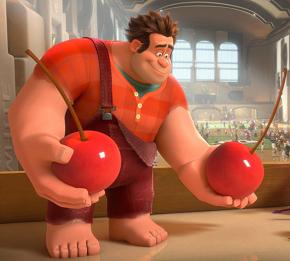
John C. Reilly IS Disney's Wreck-It Ralph!Important things first: Wreck-It Ralph is the best non-Pixar Disney film in years, proof positive that both divisions are up to the task of delivering solid results when the right talents are lined up and the marketing department is kept in check. The end credits confirm Ralph was wrangled by four different writers, two of which are omitted by IMDB — Jim Reardon and director Rich Moore, both veterans of the glory days of The Simpsons. (Of the other two, one, Phil Johnston, was responsible for last year’s indie Midwest comedy Cedar Rapids.) From where I sat, I couldn’t see the seams.
Academy Award nominee John C. Reilly is an unloved palooka who chafes in his day job as the villain of Fix-It Felix, Jr., one of several old-school cabinet games at Litwak’s Family Fun Center (elderly owner voiced by Ed O’Neill). Ralph’s major beef isn’t necessarily that he hates his job, but that he hates how shabbily he’s treated because he does it so convincingly. Even when Litwak’s is closed and all gaming characters are allowed to go home for the night, Ralph’s coworkers — the titular hero Felix (30 Rock‘s Jack McBrayer) and the townspeople he saves every day — relax and party in their high-rise apartment building while poor Ralph is forced to live and sleep outside on a mound of loose bricks. Perversely, in their neighborhood Ralph is the 1% and the well-to-do are the 99%. The manufacturer clearly didn’t program these civilians to recognize the sight of homelessness.

Continue reading

“Argo”: Heroics More Harrowing Than Hilarious

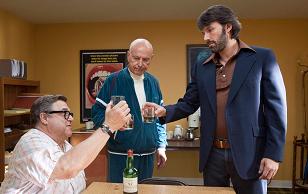
Ben Affleck, "Argo"I can’t remember which reviewer or random Internet commenter gave me the impression that director/actor Ben Affleck’s new film Argo was surprisingly funny, or words to that effect. If I could recall their identity, I’d express mild annoyance in their general direction. My general opinion is in lockstep with the theater-going majority who’ve given it a collective thumbs-up and touted it as a likely nominee at next year’s Academy Awards in some fashion, but for some reason I walked into it expecting something more along the lines of satirical movies-about-movies such as Wag the Dog, Living in Oblivion, or even The Naked Gun 33â…“: The Final Insult. My expectations were a little off-base.

Certainly the film takes its potshots at Hollywood. Affleck is our hero Tony Mendez, a CIA agent assigned to the task of exfiltrating six stranded Americans from Iran during its prime hostage-taking years. His plan: enter the country posing as a filmmaker, build cover identities for the sextet as part of his film crew, and hustle them out of the country via commercial airline. Phase One of his plan enlists John Goodman as an Oscar-winning makeup artist, who in turn recruits Alan Arkin as a longtime director. The three of them create a fake production company, purchase a space-opera script in turnaround for chump change, hire a storyboard artist, and spend CIA dollars on a lavish pre-production advertising campaign and press-party announcing their fake intent to pretend to rip off Star Wars. Goodman and Arkin have all the best scenes as old friends who know the eccentricities of their surroundings all too well as they push their faux-flick Argo upon an audience that will never see a frame of it.

The moviemaking scenes comprise a minority portion of the running time. They’re prefaced with a jolting reenactment of the day the American embassy fell, and surrounded by a subdued political thriller whose searing images of religious conflict aren’t too far removed from the present-day future thirty years hence. The era and situation are rife with all manner of tension and discomfort. The claustrophobia and paranoid isolation of the refugees, forced to hide out for months at the Canadian ambassador’s place. The monotonous grind of the child laborers tasked to reconstruct mountains of shredded American documents. The Ayatollah Khomeini’s loyal followers, furious in their yearning to hold the Shah accountable for acts against Iran in general and Allah in particular. The tumult of an Iranian bazaar, no good place for Westerners. Even Mendez has personal struggles off the job, as he does his best to be a generous non-custodial father when time allows between covert ops.

All of this dovetails serendipitously in the final sequences involving airport security issues, cumbersome red tape, split-second timing, Bryan Cranston shouting at people, Kyle Chandler clogging up the works through force of smugness, and those seemingly futile Argo storyboards, unwittingly chronicling a sci-fi allegory of the Iranian revolution that connects with a command audience at just the right dangerous crossroads.

I’ll be curious to see what sort of attention it garners during this winter’s awards nomination processes. I just wish I hadn’t entered into it with the unjustified mindset that the humor at Hollywood’s expense would be a more pervasive presence, like a Kevin Smith film with a larger budget. In retrospect I’m pleased it wasn’t, and richer for the experience.

Two final notes, in keeping with past movie entries:

1. I caught no veterans from The Wire among the cast, but Buffy/Angel fans should refrain from blinking or else miss a literal three-second cameo from Tom Lenk (Andrew!) as one of several suckered entertainment reporters.

2. The end credits have no scene at the very, very end, but I recommend sticking around through the extras in the first half. Cast photos are juxtaposed with copies of their real-life counterparts’ real-life fake IDs. Several key scenes are juxtaposed with the period-specific photos that inspired them. And the entire movie is capped with a brand new soundbite from a certain erstwhile Commander-in-Chief about this previously undisclosed moment in his administration’s beleaguered history.

“Iron Man 3” First Trailer: Destruction, Desolation, Mandarin

The first trailer for Iron Man 3 is here at last. Writer/director Shane Black (Kiss Kiss Bang Bang, among several other sharp action-film scripts) takes Tony Stark and friends into their explosion-filled darkest hour, while Sir Ben Kingsley and Guy Pearce show up in clips full of foreboding menace.

Cheers!

MCC Request Line #2: “Dredd”

Welcome to the sophomore installment of our recurring feature in which I’m accepting viewing or reading suggestions from MCC readers and sharing my results in the interest of entertainment science. Today’s suggestion came from Senator Brett, photographer and Thought-of-the-Day thinker extraordinaire.

Karl Urban IS Judge Dredd IN "Dredd"Today’s subject: Dredd, the movie industry’s second attempt to adapt the iconic British comics character to the silver screen. The first attempt had okay visual effects, Sylvester Stallone reprising Cobra in funnier clothes, and Rob Schneider. Incredibly, the new version has fared even worse at the American box office, possibly because of rampant fears of an uncredited Schneider cameo.
What I knew beforehand: In a post-apocalyptic future, the grim and gritty Mega-City One sprawls across the land, contains hundreds of millions of inhabitants, too many of them evil. Whatever government remains has essentially given up on ruling and created an army of Punishers — duly authorized judges, juries, and executioners. The savings to taxpayers must be enormous. Judge Dredd is the best and angriest of the bunch. One of his frequent coworkers is Judge Anderson, a blonde with psionic powers. They kill crime.

Continue reading

“Looper”: Five-Film Sci-Fi Mash-Up is Terrifying, Tear-Jerking, Terrific

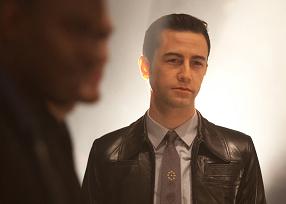
Joseph Gordon-Levitt, "Looper"The short, spoiler-free version of my impression of Looper: the film is a knotty but ingenious cat-and-mouse thriller that moves from urban squalor to rural tranquility with an enviable dexterity while contemplating the effects of poor choices on our lives (our own as well as others’), the things we’ll sacrifice to stay true to our selfish nature, and what we’re willing to sacrifice if we think harder about what’s most important in the grand scheme. Other reviews have already noted the effectiveness of the makeup, the subtlety of the near-future visual designs, and the fun of watching Bruce Willis and Joseph Gordon-Levitt playing different versions of the same character. Consider those thoughts seconded here, since I can’t think of a good reason to retype them in my own redundant words.
However, I wouldn’t go so far as to grade it A+++++. I recognized more than a few moving parts from other films, albeit parts that are shuffled together skillfully, retooled for improved functionality, and kept as far removed from the trailers as possible.

Before proceeding, I brake here for COURTESY SPOILER ALERT for those who plan to see it but have been too busy or who avoid theaters. Now is your moment to escape for the sake of your future moviegoing experience, and I look forward to seeing you tomorrow.


Continue reading

Driveway Tunnelers Fail to Find Hoffa, But Recover My Lost “Cabin in the Woods” Review

My daily MCC followers may recall a recent entry in which I eulogized one of my oldest entries, a review of The Cabin in the Woods that somehow vanished from this blog without malice aforethought or explanation forthcoming. Originally posted on May 6th, I tried to return to it months later to double-check something I’d written (I don’t even recall exactly what), only to discover a large hole in my history where once it had existed. The software left a trail of another post that I intentionally deleted a few weeks later, but not the Cabin piece.

Wanna hear a funny story about a forgetful old man?

Continue reading

My 2012 Staycation Movie Marathon Midweek Report

I’m blessed to have spent the past twelve years working for a company that firmly believes in allowing its employees too much vacation time. Each year I take one week off to spend with my family in the summer (cf. the ongoing “Road Trip” series) and one week in the fall to spend at home alone. While my son is in school and my wife is at work, during the daytime I have the house all to myself, as long as I don’t mind sharing the territory with our dog.

I’m also ridiculously blessed with a wife who doesn’t view my annual one-man one-week staycation as an opportunity to hit me with a dreaded “Honey-Do List” of five hundred different odd jobs that remain undone around the house. A friend at work complains that whenever he takes a staycation, his wife schedules enough activities for him that he spends all his so-called “time off” alternating between playing handyman and Mr. Mom. This is not a problem for me because my wife wants me to rest, in hopes that she’ll get to keep me around and alive for as many decades as possible. I wouldn’t call myself a workaholic, but I do have my frequent moments of appearing burnt out and frazzled. I’m told that relaxation makes a difference in my condition.

In most years, when I haven’t violated the premise and written myself a lengthy to-do list, my staycation usually takes the form of a week-long movie marathon. Like many American families, we suffer the first-world problem of buying more DVDs than we can possibly watch in a reasonable number of sittings. In an average week, when I’m burning the candle at both ends between my full-time day job (plus overtime) and my part-time non-paying night job (i.e., the blog), to say nothing of other activities and requirements of adult life, I’m lucky if I have time to sit still for three TV shows and a single movie. The high ratio of purchasing-to-watching means I have a never-ending stockpile of works on hand to ensure that I’ll never be bored inside my own home for the rest of my life.

The portion of the stockpile with the densest accumulation is comprised of things that no one in the house except me is interested in watching — movies and shows that have little chance of making the cut for Family Quality Time, a few of which I arguably shouldn’t be watching. Lately I’ve been actively curtailing my purchases in that subsection — partly for spiritual reasons, partly due to volume, and partly because watching things alone is a lot less enjoyable than viewing experiences that I can share with others around me. Anything in that subsection has to wait on the shelf and collect dust until I have extended time to myself and an inclination for solitude.

That’s where my annual one-man one-week staycation comes in handy. It’s one of my best opportunities to chip away at that particular viewing pile. Much of this week has been spent running errands around town, sleeping too much, and busying myself with the Internet and my part-time non-paying night job, which cruelly offers no paid vacation time. In between all of that, so far I’ve found time to watch six movies that I’d never seen before. I’m saving the DVD extras for another time, to fill small time slots between activities in future work weeks wherever possible.

Ranked below from best to worst, this week’s staycation feature presentations have been:

1. Broadcast News. Writer/director/producer James L. Brooks’ lamentation of the ever-growing superficiality of network TV news, and its increasingly money-minded fixation on entertainment value, is a tragic reminder of how little has improved since 1987. Amidst the anti-sheen commentary is a complicated love triangle between William Hurt’s shallow but skillful anchor-hunk, Albert Brooks’ sharp-minded but blindered nebbish, and Holly Hunter’s professional but bamboozled producer. I picked this up for the satire, but was surprised to discover that it cloaked a relationship film that I wished had been longer. Fortunately my copy is a Criterion Collection edition that includes additional scenes and an alternate ending among the extras, so eventually my wish for more will technically be granted.

2. The Town. The second film from writer/director Ben Affleck, making the most of the second phase of his career as he’s successfully moved beyond the grasp of super-stardom that placed him in several awful films in a row before he stepped back and took stock of his life. Affleck directs himself and an explosive Jeremy Renner as Charlestown bank robbers with a lifelong hometown-boy camaraderie, but slowly diverging opinions as to what they should be doing with their lives. Renner is perfectly happy to stay the course, but Affleck discovers new motivations to find a new direction for living. In that sense it’s practically a parable of Affleck’s own film career before segueing to directing. (If one reached too far, one could even insert an unfair observation about Renner standing in for Matt Damon in yet another context…)

3. Miller’s Crossing. The third big-screen collaboration between young Joel and Ethan Coen, this 1990 production about a 1920s gang war is mostly two hours of Albert Finney, Jon Polito, Marcia Gay Harden, and various other actors taking turns punching Gabriel Byrne in the face and stomach. In between the body blows, Byrne’s convoluted plan to establish long-term peace by escalating the war into a bloody free-for-all reminded me of Kid Loki’s recent efforts in Marvel’s Journey into Mystery series. The ambiguity of some characters’ actions was occasionally dissatisfying, but would evolve into a polished motif in later Coen Bros. films.

4. Last of the Wild Horses. This was actually a sixth-season episode of Mystery Science Theater 3000, the celebrated TV show that mocked a different bad film in every episode. The original feature was a so-so Western about…something. I’m not even sure now. All I remember is a cranky wheelchair-bound father being shot to death on his front porch in poorly conceived indignity. Mike Nelson and the ‘Bots defend themselves against the movie’s mediocrity with verbal slings and arrows. As a parody of the Star Trek episode “Mirror, Mirror”, the host segments center around a transporter calamity that causes Mike Nelson and Tom Servo to swap places with their evil counterparts from another dimension. We know they’re evil because Evil Mike has a mustache and goatee, and Evil Servo wears a yellow sash. Meanwhile in the MST3K mirror universe, the good versions of Dr. Forrester and TV’s Frank are forced to watch the first twenty minutes of the film, marking the only time those two entered the theater in the show’s history.

5. Sucker Punch. On the plus side, Zack Snyder’s girl-power action yarn is much less exploitative than I’d feared, even as reconfigured into a 127-minute Extended Edition. This alleviated some anticipated guilt, but didn’t make it a success. Emily Browning (Violet Baudelaire in A Series of Unfortunate Events) is a victimized teen consigned by her wicked stepfather to a mental asylum, which she reimagines to herself as a stylized brothel in which she’s trained to dance alongside fellow inmates Jamie Chung (Premium Rush), Disney’s Vanessa Hudgins, Abbie Cornish (the Robocop remake), and Jena Malone (Johanna in the upcoming Catching Fire). Rather than hire a choreographer to design a memorable Bunheads-style routine for Browning to master, Snyder instead has her delve one level deeper into her subconscious and symbolically represent each dance as a vapid, meaningless, expensive video game sequence. A rotating onslaught of giant artillery-wielding samurai, undead WWI German trench-dwellers, Lord of the Rings orcs, and sci-fi security robots each take turns destroying everything and meaning nothing. Some might find comfort in the movie’s message of The Power Is In You, but I was occasionally bored and ultimately bothered by the passing structural similarity to Pan’s Labyrinth, a more poetic and far superior film about a young girl escaping an oppressive environment through a secret entrance into a fantastical world.

6. Blow Out. Writer/director Brian DePalma’s 1981 take on the Hitchcockian wrong-place/wrong-time thriller sees post-Kotter John Travolta as a sound technician for grade-Z film productions caught in a conspiracy web when he records a fateful car accident with a high-profile victim and a telltale sound effect meant to go unheard. Robocop‘s Nancy Allen is surprising as a ditzy call girl with even worse timing that Travolta’s. Dennis Franz is suitable as a sleazy paparazzo who makes things even worse. John Lithgow cuts his teeth in what would be the first of many irredeemable psychos he would play throughout his career. I enjoyed the old-time scenes of Travolta editing and cutting recordings the old-fashioned way on reel-to-reel tapes, with all the constant rewinding and forwarding. Undercutting the suspense and making this difficult to recommend are the satirical pandering of the first five intentionally exploitative minutes, and the final thirty seconds of the film, in which an ostensibly tragic ending instead came off as out-of-character and revolting.

That’s what has passed for “relaxation” for me so far this week. I’ve exhausted my errands list, but I’ve no shortage of movies on deck. Assuming I don’t oversleep any more, I’ll see how the moods and options guide the rest of my staycation.

To Be Continued!

Trailer #2 for “The Hobbit” Starring Dr. Watson and Doctor Who

Longtime fans of Peter Jackson’s Lord of the Rings trilogy who’ve been watching last December’s two-minute teaser for The Hobbit: an Unexpected Journey on an endless loop every day for the past nine months can finally close that browser and tune in for the new, full-length trailer that was released to the Internet on Wednesday. It’s comforting to see our old friends Ian McKellen, Cate Blanchett, Hugo Weaving, and Andy Serkis all returned and on point, but I’m personally more interested in the new tidbits:

I’m delighted to see Martin Freeman portraying astounded exasperation with his usual finesse. Whether as Tim from The Office, Arthur Dent from The Hitchhiker’s Guide to the Galaxy, or the average-minded John Watson from Sherlock, Freeman specializes in men who can’t believe what he sees in the other men that surround them. To his credit, his Bilbo Baggins (at least in these scant samples) seems to retain at least a smidgen of confidence in stressful situations, a trait that his adopted nephew struggled to inherit in the trilogy.

New to our eyes this time around: Sylvester McCoy, erstwhile Doctor Who, as Radagast the Brown, a wizard colleague of Gandalf and Saruman who was name-checked in passing in J.R.R. Tolkien’s original novel. I remember reading it in seventh-grade English class, where our teacher Mrs. Price gave us extra credit if we completed our Hobbit homework and quizzes in green ink. I don’t recall Radagast’s name at all, but I’ll take everyone else’s word for it. Here his role has been broadened to compensate for his complete deletion from the LOTR trilogy, and set far apart from those other, mainstream sellout wizards by donning the world’s craziest winter hat and possibly threatening to invoke a divination method certain to make the Middle-Earth Humane Society cry.

Also integral to my seventh-grade Hobbit experience: the three trolls! I was hoping one of my favorite scenes from the book would be included in the first movie, instead of being relegated to The Hobbit Part 7 or however long this series ends up.

I’m especially curious to see more of Richard Armitage’s version of dwarf’s dwarf Thorin Oakenshield, the new face of 21st-century dwarfdom — to say nothing of his dozen companions. Compared to these nimble warriors, in hindsight Gimli son of Gloin looks like Volstagg the Voluminous.

You’ll also note the younger, cleaner Gollum who’s a little less sinister in his threats of hobbit cannibalism. Little does Prequel Gollum know he’s sparring with an opponent who’s a little less highstrung and morose than Frodo was. I don’t look forward to the moment when crafty ol’ Bilbo absconds with his Precious and shatters his heart.

In the grand tradition of The Return of the King and its endless parade of endings, Warner Bros.’ official movie site offers a total of five different versions of this trailer that end with different scenes, each one amusing in its own right, four of them at Bilbo’s expense. Laugh while you can, pesky dwarven bullies. Over the next three years, Bilbo will show you all.

“The Bourne Legacy”: 2½ Hours of Jeremy Renner Having the Time of His Life

Tonight’s entertainment was a discount showing of The Bourne Legacy, in which Academy Award Nominee Jeremy Renner enjoys the perks of action heroism without looking like a plasticine sellout. That’s all I wanted, and I’m happy that my expectations were cheerfully met. I was willing to let most of the deficiencies slide.

To understand my mindset, head directly the $5 DVD bin at your nearest Wal*Mart and pick up a copy of 2003’s S.W.A.T., which was chiefly a loud mash-up of the incongruous stylings of Samuel L. Jackson and Colin Farrell. When I watched it years ago, I couldn’t help noticing the showy bad-cop with all the best lines, played by a confident young guy who seemed to be enjoying himself a lot more than the marquee names were. Not long after, I caught him during my Angel DVD marathon in a season-one role as a gleefully evil vampire — once again, cockier and smiling a lot more than his opponent. After back-to-back favorable experience,s I made a mental note to keep an eye out for young Renner in the future.

Fast-forward years later: now his resumé includes The Avengers, The Hurt Locker, and Mission Impossible: Ghost Protocol — all grade-A films in my book, all this close to making Renner a household name. Also of interest: last November Entertainment Weekly published a lengthy article about him that detailed his lean years as a struggling actor living a life far from luxury while chasing his dreams. That struck a chord with me, and only served to upgrade my mental note into a full-fledged set of index cards. In the filing cabinet that is my mind, that’s a kind of praise.

Renner finally worked his way up to carrying a big-budget action film on his own (instead of as a sidekick or teammate) with The Bourne Legacy, in which his character is torn between a government that needs him dead and a skeptical audience that’s 95% certain he’s not Matt Damon. I liked the original trilogy, but not nearly enough to consider it sacrosanct. The same screenwriter, Tony Gilroy, is now in the director’s chair adapting his own words for the screen, and he even allows cameos from previous players David Strathairn, Joan Allen, and Scott Glenn. We still have the specter of the evil government programs named Treadstone and Blackbriar, begging to be joined by other new evil programs with ten-letter compound names like “Thumbscrew” or “Riverdance”. It’s in the same timeline as the trilogy, no reboot or disregard for what came before. (Granted, I have no idea how hardcore Robert Ludlum fans feel about what amounts to an apocryphal spinoff…)

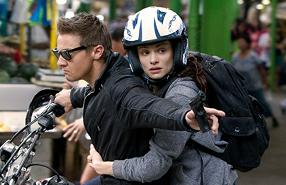
I wasn’t really concerned with whether or not it lived up to its predecessors. I harbored no delusion that it would be groundbreaking. I entered in hopes of seeing a guy who used to live on ramen noodles and unpaid light bills enjoy the fruits of a turnaround of fate. As the last survivor of a black-ops Super-Soldier Program made possible by the sinister forces of Big Pharmaceutical, Renner finds plenty of quiet moments for emotion and sincerity in between the running, chasing, punching, kicking, parkour, motorcycle stunts, and smash-cam closeups. His earnestness and lack of Hollywood sheen go a long way toward redeeming a role that, in the shallow end of the ’80s, would have been relegated to any number of direct-to-video martial-arts “stars”.

Also worth noting is Rachel Weisz as the requisite damsel in distress, trying on an American accent for a change, carefully modulating her fearfulness instead of aiming for full-tilt histrionics like others might in her place, and standing her ground as needed with her fully accredited science skills. Edward Norton stands out a tad as the evil overseer with the best-written lines (particularly his discomfiting description of the evil Program as “morally indefensible and absolutely necessary”). I spent the entire movie thinking Stacy Keach was Albert Finney as Evil Overseer #2, so I guess that’s a job well done. And after having coincidentally watched *batteries not included the other night, I was shocked to see that Dennis Boutsikaris, as the constantly upset Evil Overseer #3, has indeed aged a full twenty-five years over the last twenty-five years. Shocking but true.

I had to focus on the performances because the rest of the movie was a mixed bag. The “plot” is Our Heroes enduring one long chase scene while all the best villains hide in a faraway room. All armed henchmen working outside the main control room are one-note, including one Super-Duper-Soldier with no lines and no demonstrable evidence as to why his even-eviler Evil Program was superior to Our Hero’s. The climactic auto-wrecking dance is shot with such a claustrophobic eye that I lost all sense of setting and placement, and thought I was trapped on a merry-go-round. And the movie pauses all that chasing instead of actually ending, as if everyone involved simply stopped and called a truce so they could move on to their next projects.

But for my money’s worth, I achieved my goal of watching Renner hang out with interesting people in exotic locales while stunts are performed and entertainment is adequately concocted for my discounted dollar. Hopefully we won’t have to watch the sad sight of Renner selling out altogether in future years and demanding ten times his salary for an extra-bloated sequel called The Bourne Travesty.

Three final notes, in keeping with past movie entries:

1. The Bourne Legacy has no scene after the end credits. Once again for the true fans, the credits do roll to a reprise of the official Bourne theme, Moby’s “Extreme Ways”.

2. In terms of content, mostly it’s about the smashing and exploding, with very few curse words added so we know it’s still a Hollywood film. For those with the sensibilities of a great-great-grandmother, the end credits include a warning label about the scenes of smoking (*gasp!*) being “an artistic choice” rather than paid product placement. If that makes or breaks the deal for you, consider yourself warned.

3. I counted one veteran of The Wire onscreen: blink and you’ll miss Christopher Mann — a.k.a. one-time mayoral candidate Tony Gray — as a panicky guard desperately failing to smash his way through a locked door. Poor Tony just can’t catch a break.

Internet Commenters Demand Legislation Against Complex Sentences

Hello, readers. How are you? I am hunky-dory.

Today was a good day. I got to rest. I ate good food. I watched some DVD extras. One was a documentary. It was about A Night to Remember. That movie was about the Titanic. The documentary was not fun. The photos were okay. The narrators were all very old men. They talked a lot. Sometimes they talked for many minutes. They talked very slowly. Sometimes there were very long pauses. Then they talked some more. They were nice men. I felt like a great-grandchild. I did not see the last fifteen minutes. I stopped the DVD early. I was sleepy.

Then I got on the Internet. It has interesting pages. I wanted to read a movie review. It was about The Master. I have mentioned that movie before. Joaquin Phoenix is angry and confused. Phillip Seymour Hoffman is charming and maybe evil. Amy Adams is happy and unhappy. I may go see it. I have not decided. My city is not showing it yet. Maybe they will show it in October.

The review was written by a movie critic. Her name is Lisa Schwarzbaum. Her boss is named Entertainment Weekly. She has worked there for decades. She likes itty-bitty foreign films. She also likes movies about sexiness. Sometimes I do not agree with her. Sometimes I do. She uses big words and long sentences. I can usually understand her. Sometimes I also use big words and long sentences. Sometimes she mentions really weird movies. That does not bother me. Sometimes I also talk about weird things.

Ms. Schwarzbaum liked The Master very much. She gave it an A. Her review had big words and long sentences. This was the last sentence of her review:

The cubism of the concluding third of the picture allows a disoriented viewer to consider this singular movie not only as a character portrait, but also as a photographic travel diary, from the days before Instagram, by an important artist following the itinerary of Americans seeking salvation and prosperity when an exterior world war was over but interior psychological battles raged.

The word “cubism” threw me for a moment. I looked it up on the Internet. It has dictionaries and WikiPedia in it. I found Cubism in there. Now I understand the whole sentence. “Cubism” is a good word for a Paul Thomas Anderson film.

Some readers did not like her review. They really did not like her last sentence. A few readers said mean things about her. One reader said this direct quote:

…it is exhausting – why does she have to create super complex sentences with thesaurus worthy big words – it doesn’t impress me, it belittles me. and that last sentence, WTF? I’d hate to be stuck next to a cooler with her, attempting to carry on a conversation about the latest small town drama. Know your audience.

Her audience does not like long sentences or big words. “Entertainment” is a big word. Lisa’s words are mostly shorter than “entertainment”. They should rename the magazine Things Weekly. The audience would like them better.

Another unhappy reader said this direct quote:

“the cubism of the final third……….” this sentence is not only THE most pretentious piece of critical crap I’ve ever read, it also convinced me not see the probable load of “important” blarney that inspired it.

The Internet has many pretentious pieces of critical crap. I have read some of them. I usually do not rank them. Some reviews can be pretentious and not crap. Sometimes I like pretentiousness. That word is even bigger than “entertainment”. It does not scare me. I used to be an English major. Other English majors scared me. One time our class talked about “Murders in the Rue Morgue”. That is an old story about gross murders. One victim was stuffed inside a chimney. One classmate had a theory about the scene’s meaning. He used the phrase “return-to-the-womb motif”. I was very scared. I wanted to leave class immediately. Now I am older. I have conquered that fear.

Ms. Schwarzbaum probably writes how she wants. Maybe she even thinks that way. Her writing made other people sad. She should rewrite her last sentence. It should be many sentences. The sad people might like the new sentences. They could look like this:

The movie shows you things about each character. Some of those things are very different from each other. It takes place in the past. The old places tell one long story. It is better than random photos. The story comes after a war. People were not happy yet. They had a lot to think about. They tried to make money and be saved. The movie is very good. The director is neat.

Shorter sentences can be happier sentences. The biggest word in those sentences is “different”. That word should not be scary. I think Liza Schwarzbaum is a different writer. Maybe I am a very different reader.

Well, got to go. Have a nice day. I will see you all tomorrow. My next entry may have commas and more clauses in it because of pretentiousness. I hope you will not hate my important blarney. I promise I will not read it aloud to you with extra long pauses. That might make it worse.

“Premium Rush” Shows Why Bicycles Should Digitally Replace Cars in All Action Flicks Ever

Joseph Gordon-Levitt, "Premium Rush"After seeing the new Joseph Gordon-Levitt flick Premium Rush tonight, I’ve realized that bicycles are the greatest machine ever. I should already know this after multiple viewings of Pee-Wee’s Big Adventure and my mastery of the old arcade game Paperboy, but those are old and Premium Rush is new. To today’s young folk that means it’s more influential than either of those works by definition.

Consider the pros of bicycle ownership that I’ve learned tonight:

* Bicycles use no gas. Not only does this save average consumers money, it means movies that replace all their cars with bikes will overflow with carbon credits or go-green points or whatever currency this market uses.

* Bicycles fit through tight cracks in traffic jams. Related note: traffic laws only apply if bicycle policemen can catch you. Don’t get too overconfident, since bikecops do have the power of teleportation, based on how many places our hero’s bikecop nemesis (stuntman Christopher Place) shows up in the movie through magical point-A-to-point-B locale shifts. That power only gets bikecops so far, though — their advanced age and lack of BMX tricks makes them an easily evaded adversary.

* Bicycle parts are sturdy and survive any and all forms of undue stress, short of a head-on collision. In that event, temporary replacement bikes should be readily available for borrowing from your immediate vicinity.

* Bicycles are much faster than cars. They can dodge and weave through the thickest of traffic, especially if you have the power of instant super-calculus like Amadeus Cho. If a crooked cop is several feet behind you, just pedal really hard. Sure. he could put his pedal to the metal and flatten you, but he won’t. For some reason. Mental block, maybe, who knows. One exception to this rule: when a finale is coming up, cars are faster because they have to catch up with you before the last big set piece begins. You can’t just arrive in time to save the day while the bad guy is still several blocks away because of rush hour or construction delays. No audience wants to cheer the defeat of a villain in absentia.

* Bicycle-related jobs never have a dress code. Our hero’s pride in avoiding nice suits and ties is a large part of Who He Is. (Our hero clearly learned nothing from Pee-Wee.) Late in the movie, a montage of assorted bicycling professionals confirms that clothing, hair care, and hygiene are left to the employee’s discretion. Hopefully they disinfect their packages before handing them to the intended recipient.

* The bad guys never try shooting you during chase scenes. You’re a small moving target, and they’re probably lousy shots anyway, even if they carry a gun for a living. This facet remains largely unexplored in Premium Rush, but in other chase movies, judging by the average number of missed shots per movie, I get the impression that crooked cops and evil military men never have to fret about marksmanship on their performance review.

* Bicycle lanes are optional. Over the past few years, Indianapolis has spent millions renovating and redesigning numerous thoroughfares to add bicycle lanes — sometime widening streets, sometimes taking an entire lane away from cars and designating it as a bicycle lane instead (White River Parkway North Drive, I’m looking in your excessively named direction). As seen in Premium Rush, Manhattan bicyclists seem to do just fine without them. The closest they come to compromising is when they have to share a walkway in Central Park with wheel-deprived pedestrians.

With so much going for bicycles, I foresee a day when filmmakers and studios revisit their works George-Lucas-style and decide it’s time to tamper with them for the sake of a modern audience. Imagine The French Connection with Popeye Doyle free-styling it up, or The Bourne Supremacy filmed in you-are-there Bicycle-Smashing-Cam. Stephen King’s Christine would have been about twenty minutes long, once the possessed 1957 Schwinn American realized it wasn’t really equipped to kill. Best of all in my mind would be the late John Frankenheimer’s Ronin — narrow chases through all those claustrophobic European streets, still at breakneck speeds, and everyone’s still armed with bazookas. The mind reels at the cinematic possibilities, so much so that I have to stop myself from staying up overnight and brainstorming any more. (Maybe that’s tomorrow night’s entry. No one tempt me.)

Setting all that aside, this was a fun, footloose, albeit PG-13-languaged 91 minutes’ worth of popcorn-movie excuse to watch Gordon-Levitt play the same kind of tenacious, hard-luck, unlikely hero that worked well for him in (500) Days of Summer, except here he’s not a jerk and he gets to win. It’s also a showcase for anyone who wants to know what Michael Shannon looks like, before he appears in next year’s Man of Steel. I didn’t see Revolutionary Road, for which he was nominated for a Best Supporting Actor Oscar for what I read was a fairly tiny role, but here he dominates plenty of screen time as a foul-mouthed crooked cop (who naturally is the one to fill the movie’s one-F-word quota) with an amoral attitude and an unfortunate addiction to Pai gow. His tough New York sounds more like other movies than what we heard last year on vacation, but that only added to his scary intensity.

Other random, disconnected thoughts that flew through my head while watching the Greatest Bicycle Film of All Time:

* Fun geek note: Shannon continually hides behind the alias “Forrest J. Ackerman”, named after the famous sci-fi fan. (Yes, once upon a time, they used to have those. 105% of all sci-fi fans wish that were still the case.)

* Other than Gordon-Levitt and Shannon, the only other actor I recognized without research was Aasif Mandvi, my favorite correspondent in those rare moments when I have time to watch secondhand online clips from The Daily Show with John Stewart. Mandvi basically reprises his role as cranky boss Mr. Aziz from Spider-Man 2, but his presence is value-added good times.

* Listen carefully during one of Gordon-Levitt’s course-plotting moments, and you’ll be rewarded with a Wilhelm scream, to no small comedic effect.

* Do the kids these days still say “shred” in any bike-related context? It sounds like previous-decade slang.

* Gordon-Levitt’s motto, “Brakes are death,” sums up every bad commute I’ve ever harrumphed my way through.

* My favorite thing about the movie was recognizing Manhattan landmarks and locales that our family encountered on our 2011 road trip. Among the notable sights that nab screen time are Chinatown; Columbus Circle; a #1 subway station (the 116th Street Station, if the visuals match the story); the Ed Sullivan Theatre (blink and you miss it); Columbus Street alongside the Natural History Museum; and, of course, Central Park. Natives no doubt will recognize three times as many places as I did.

* No, there’s no scene after the end credits, but you can stick around and hear several more minutes of “Baba O’Riley” if you’d like. You can also recover from the shock of realizing that the entire movie flew right by without a single character using the phrase “need for speed.” Writing without that cliché in a movie all about speed may be its most skillful trick.

“Avengers” Labor Day Weekend Re-Release: Now You Can See it More Than Once, Just Like the Old Days

"Avengers" Labor Day theater re-releaseWhen our family saw The Avengers back in May — including sticking around for the famous shawarma scene after the end credits — we exited the theater starstruck and satisfied we’d received our money’s worth tenfold. My son and I even discussed the possibility of seeing it a second time. For a teenager whose generation doesn’t appreciate the concept of TV reruns, or the nerdist notion of watching a film enough times to memorize the dialogue, a request for an immediate encore marks his highest conceivable level of praise.

Between our hectic summer schedule and my preference for experiencing the unseen over rehashing the already-seen, I demurred and procrastinated. This Labor Day weekend, Marvel Studios reminded my son of our discussion by arranging a return to wide release for The Avengers as one last attempt at usurping Titanic‘s title as the second-highest grossing film in American box office history. For the sake of father/son quality time, we went for it.

Admittedly, I was pleased to be able to watch for a few new things I missed on my first go-around: the throwaway cameo by Dollhouse‘s amazing Enver Gjokaj as a flustered policeman; the indiscernible Alexis Denisof (yay Wesley!) as Thanos’ sidekick; the exact moments in which the “ST” and the “RK” are knocked off Tony’s precious monument to himself; Thanos’ gleeful reaction to the final line of dialogue (“To challenge them is to court death” — if you know Thanos, you know that’s one of his turn-ons); and the entire mountainside chat between Thor and Loki, which was had been ruined in my first viewing by an unwelcome, well-lit distraction from an uncouth cell phone user in the audience.

I rarely see a film more than once in theaters anymore. Except for dedicated cineastes and theater employees, I’m sure I’m not alone in this. Between high ticket prices and sometimes unpleasant theater conditions, it’s become challenging enough to attract some viewers for one showing of a new film, let alone encourage repeat business. It doesn’t help that the DVD/Blu-ray versions arrive on stores shelves faster and more furiously than they used to in the old days of home video. Gone are the times of pacing back and forth, waiting anywhere from six months to several years before being allowed to purchase copies of your favorite films. Today’s accelerated distribution system makes it easier than ever to sit through the same film as many times as you’d like, in as short a time span as you’d like after release. In the final analysis, even one Blu-ray is cheaper than six full-price movie tickets. (Living near a second-run dollar might help, if you don’t mind the celluloid deterioration after all those previous months’ worth of showings.)

I can recall several instances from my moviegoing past when I took opportunities to spend too much disposable income on multiple trips to the silver screen for the sake of a single work. For nostalgic brainstorming fun, I present a montage of films I saw more than once in theaters, and the rationalizations that enabled them.

Return of the Jedi — I was 11 in 1983 and had never been allowed to see a movie twice. I saw ROTJ once and thoroughly enjoyed it, even though I hadn’t seen Star Wars and had only read Donald F. Glut’s novelization of The Empire Strikes Back (a school book fair selection). While on vacation later that summer at my aunt’s place down south, we decided a movie outing was in order; our options were ROTJ again or Burt Reynolds in Stroker Ace. We won; Burt lost. Fourteen years later I also endured the 1997 “Special Edition” re-release, but I was older, less enamored, and had a hard time suppressing my snarky commentary. I’m pretty sure I had to be elbowed at least once before I shut up.

Independence Day — My best friend and I caught it opening weekend at the local drive-in. With such poor radio sound, sundown not yet finished, and the experience basically held away from us at arm’s length, it was all too easy to notice all the shortcomings and tally up all the references and swipes from other, better films. Not long after, I went with family to an indoor showing with a high-quality sound system that included super-powered subwoofers. With the vibrations and the thrumming and the EXPLOSIONS in full effect, suddenly it was the Greatest Disaster Movie of All Time. ‘Twas truly a film where effects made a massive difference.

Star Trek: First Contact — Because, frankly, it was all that.

Scream and Con Air — Two separate examples of me seeing a film on my own and enjoying it so intensely that I insisted on dragging my best friend to them, so she could see what I wouldn’t shut up about. We were still in that early stage of our relationship where I had no idea that her own movie preferences weren’t identical to mine. It took me some time and a few unfortunate occurrences before I learned an important lesson, one that I still observe today now that we’re married: just because I really, really like something doesn’t mean that I’m required to subject her to it, too, especially not over her strenuous objections. Learn this and learn this well, males.

Godzilla — I was so pumped up and ready for Roland Emmerich’s surely extraordinary reboot of the Toho legend, I saw it twice on opening day. First showing: I was alone and blown away. Second showing, with my best friend: I fidgeted a little more. Third time, with my mom: glaring issues began to appear to me like a kind of unhappy magic. Fourth showing, at a dollar theater, strictly for my five-year-old son’s benefit: I laughed through most of it, but he bawled when Godzilla died. It broke my heart and his, though he calmed down when the egg hatched at the very end. Today he loathes the film, as well he should.

The entire Star Wars prequel trilogy — Six showings of The Phantom Menace, a few apiece of the other two. Star Wars fever was in full swing for us in those days, but it ebbed as the quality of each successive movie ebbed. Some of those multiple screenings were just to spend quality time with the best friend who later became my wife, but I’ll admit that six showings of TPM was far too many. By the final attempt, I found myself dozing through most of the long, long stretch in Tatooine, including some of the podrace.

X-Men — First time was on opening night while attending a St. Louis sci-fi convention whose featured guests included four cast members from Mystery Science Theater 3000. After the prologue and opening, when we MSTies all read the transitional caption, “The not-too-distant future”, this absolutely, unintentionally brought down the house. Second time was back home for the benefit of my son, who didn’t get it.

Serenity — As a huge fan of Firefly, the first showing was A+++++++ but so devastated me, I hadn’t planned to see it again. Then I became offended at the weak box office returns. I became firmly convinced that all those free advance screenings they’d held in hopes of fostering Internet buzz probably just gave several thousand freeloaders an excuse not to pay for it. So I did what I felt was my duty and saw it once more. Wash’s final scene was no easier for me to weather.

Indiana Jones and the Kingdom of the Crystal Skull — First showing was courtesy of passes I scored to an advance sneak preview. I was so excited about the privilege of a sneak preview for such a high-profile film that I immediately went home, spent all night long writing an unpaid, pre-release, volunteer review for someone else’s gain, and went to work the next day at my actual paying job on three hours’ sleep…only to learn that the site had crashed for reasons unknown, and remained down all weekend long. Many aspects of this incident point to the myriad reasons why I don’t get to write for money. Oh, and my second showing was with family, after I slept for a couple of days first.

The Dark Knight — One mandatory normal showing, and one in IMAX just to see the difference. I was enthralled by the zillion-decibel sound system, but irritated by the switches back and forth from theatrical ratio to IMAX ratio, back and forth and back and forth, like someone playing with the “Zoom” button on a flatscreen TV. Not a fan of that jarring effect.

Toy Story 2 — Once in the original theatrical run; once in 2010 when my wife and I scored free passes to a Toy Story/Toy Story 2 3-D double feature. I’m no fan of 3-D, but I’ve yet to get sick and tired of either film.

Avatar — Once with my son; once as a kindness to my mom. I slept through some of the native alien-acclimatization montage, even in 3-D.

Chronicle — Because, frankly, it was all that. Ignore the denigrated “gimmick”, note the subtleties, and feel the harrowing.

Thus does Marvel’s The Avengers join their quasi-hallowed ranks. It didn’t need the extra cash flow nearly as much as Serenity did, but it was a pleasant use of the holiday weekend. I’m planning no more repeats this year, but Lord knows how next year’s fare will turn out. Best-case scenario: maybe Benedict Cumberbatch will give us a bravura, must-see-again-and-again performance in Star Trek II.2: the Wrath of Not-Khan.

Anderson’s “The Master” Final Trailer: No Similiarities to Persons or Groups Living or Dead, We Totally Swear

Readers who consider themselves unabashed Midlife Crisis Crossover completists (i.e., my wife and me) may recall my preoccupation with the trailers for Paul Thomas Anderson’s new film The Master, in which Academy Award Winner Phillip Seymour Hoffman plays a charismatic jack-of-all-trades who’s not named Hub L. Ronnard, who attracts followers to his self-invented belief system that’s not called Scientetics or Dianology, who has Academy Award Nominee Amy Adams as the wife by his side, and who’s trying to lure Academy Award Nominee Joaquin Phoenix to his side with vague platitudes and cryptic encouragement.

Recapping our first three installments for newcomers:

* Teaser Trailer #1: a reserved interrogation, a forgotten fight, some crawling through machinery, and adult sand sculptures, all set to spooky bass-‘n’-percussion from composer Jonny Greenwood, the Radiohead guitarist who also worked with Anderson on There Will Be Blood.

* Teaser Trailer #2: Hoffman takes center stage with his myriad talents and elliptical statements of purpose, all overlapping and fighting to surface in the consciousness of Phoenix, who chafes in a new, awkward chapter of his life. Adams loves her husband. The Greenwood score repeats.

* Full Trailer #1: an unbalanced Phoenix fails at life on the post-war homefront and instead follows a writer who’s big on doublespeak and revival tents. Adams is not at all happy this time around — glaring at doubters, questioning Phoenix’s sanity, and acting perfectly fine with her husband’s shenanigans. Greenwood is replaced at the 1:39 mark with Jo Stafford’s maudlin 1950 hit “No Other Love“.

And now, the four-part miniseries, “The Trailers of The Master“, concludes with the final, fragmented chapter:

Other than reruns from previous trailers, the core is a stilted speech about how human spirits trump the animal kingdom. A soft orchestra is drowned out by Joaquin Phoenix drumming like Buddy Rich on a locked window. Standard male viewers should now be excited by the prospect of fights, guns, motorcycle races, and sex scenes. (Yeeeey.)

The officially R-rated movie begins its limited-release rollout to American theaters on September 14th. IMDb lists release dates in several other countries over the next several months, mostly in Europe. (Is Scientology discussed or even heard of in Asia? I’d be curious to know.) My intrigue in the general concept has ebbed a bit, but we’ll have to see if Indianapolis’ only art-house cinema offers it before next Oscar season; how my curiosity, budget, and conscience are doing by then; and if I’m not yet tired of those involved repeating in every related interview like a holy mantra, “IT’S NOT ABOUT SCIENTOLOGY.” When I turn it over in my head, it’s funnier because I hear it in the voice of Arnold Schwarzenegger from Kindergarten Cop. In reality, it grows more disappointing every time I hear it.

My Own Meager Panegyric to the Tony Scott Oeuvre

As of this writing, police investigators and armchair pundits are no closer to fathoming the motivation behind the August 19th suicide of director Tony Scott than they were the moment it happened. Summarizing the bullet points from all the articles: age 68, wife and two children, no alleged terminal illnesses (despite early misled reports), and no zero-star reviews that should’ve been haunting him for any recent movies. (I could imagine a director with a film sitting at 0% on the Tomatometer questioning his life choices, though I would encourage them to persevere and love life anyway.)

In reviewing his directorial resumé, I learned one surprising fact: I’m not remotely qualified to deliver the ultimate critical essay on Scott’s artistic merits. Out of the 20+ films he helmed, I’ve seen six. I’m not sure if that says something about him or about me. On the other hand, I can think of many directors fewer of whose films I’ve watched than Scott’s (Kurosawa, Tarantino, Kubrick, Woody Allen, anyone working prior to 1960 except Hitchcock or John Ford…). There’re reasons why a search for “Tony Scott” on the Criterion Collection site yields only indirect results, but when I was successfully lured to one of his trademark high-octane action films, I usually appreciated the manic energy that infused them so thoroughly, and how the actors who worked best with him seemed to thrive on that energy.

These, then, are my memories of the late Mr. Scott where his works intersected with my viewing experience, for better or for worse. Not full-blown reviews — too soon, in a way — just my own memories, mostly drawn from times in my life when I would watch just about anything except 18th-century British TV dramas.

(Caveat for strict role-modeling purposes: just because I watched them at some previous time in my life doesn’t mean I’m recommending you catch them on Blu-ray immediately without regard for content.)

Top Gun — The film that put Scott on the map and is consequently name-checked in every single postmortem. I was a child of the ’80s, but I missed a lot of cultural touchstones the first time around (to this day, I’ve still never seen Pretty in Pink or Sixteen Candles, mandatory viewing for my peers). The first time I watched it was out of temporal context, in June 2000 as part of an online IRC chat in which several of us MST3K fans watched it simultaneously on cable while trading barbs back and forth. If I’d seen it when I was fourteen, I imagine my reaction and my world would’ve been very different.

The Last Boy Scout — Of the six films, this is arguably my all-time favorite, a showcase of Scott’s knack for hooking up with talented collaborators. Bruce Willis is basically John McClane at absolute rock bottom, and Damon Wayans succeeds in a rare attempt at a dramatic role, but what made it crackle for me was a Shane Black screenplay that knew it was just a big dumb odd-couple guy-flick, knew it wasn’t out to enlighten or change the world, and knew which buttons to keep pressing, holding, and slamming into the guy-flick control panel. When I was taping movies from cable TV in my college years, I liked this one so much, I recorded it on SP mode for the improved picture quality, even though that used up three times as much videotape. For me, that was serious appreciation.

True Romance — Like most guys of the time, I was drawn in by the credit “Written by Quentin Tarantino!” Unlike most guys of the time, I didn’t really care for it. I remember four distinct impressions from the one time I watched it at the theater:

1. A Mexican standoff? Again? Didn’t we just see that in the landmark that was Reservoir Dogs?
2. I never want to see Gary Oldman with dreadlocks again. Ever. Like, ever ever.
3. Heathers really was the pinnacle of Christian Slater’s career.
4. Is Sonny Chiba real, or did Tarantino make him up?

…but at least it wasn’t boring. I credited the directing for trumping the writing in that respect.

Crimson Tide — While I was putting the pieces of my head back together in my post-divorce years, I hung out with a friend regularly who would come over for frequent TV-show marathons and occasional movies. Gift-giving was hard because I was still in that young-male mode where I gave gifts I thought were cool, versus what the recipient might actually like. Dwelling on the criteria of (a) liked Das Boot, and (b) really likes Gene Hackman, I concluded (c) Crimson Tide would be the perfect gift! It wasn’t till some time after watching it together that I learned she really wasn’t a fan of strong language, or of films in which the plot consists of angry guys trying to out-macho each other. I thought it was high art, anyway. Fortunately she forgave me and married me several years later. That same VHS copy of Crimson Tide is still on our shelf, a token of times past.

Enemy of the State — In this corner, once again: Gene Hackman, ruler of anything he agreed to do. In the other corner: Will Smith, post-Fresh Prince and ruler of blockbuster sci-fi films at the time. Sadly I don’t recall their exchanges so much as I recall the two thousand different well-known supporting or character actors that overstuffed the film (Jack Black in a rare serious role!); the heavy use of state-of-the-art surveillance tech that seemed frighteningly sci-fi futuristic at the time, but which is now readily available in the form of Google Earth and the everyday gadgets in everyone’s pockets; and that one super-awesome crash where that black SUV kept flipping and flipping and flipping and just wouldn’t stop flipping. Where Top Gun was gung-ho Reagan-era zeitgeist, Enemy of the State was eerily prescient of a world where Big Brother not only rules, he also lets us have all the coolest toys.

Unstoppable — Scott made five films with Academy Award Winner Denzel Washington. I trust they got along famously. As nonstop adrenaline rushes go, Scott’s eye was in fine form here. Even more fun for me was the running theme of old man Denzel sparring with impudent punk Chris Pine about the younger generations supplanting their elders, before said elders are ready to exit and before said young’uns are truly ready to handle the reins. (I can only hope this wasn’t something close and personal to Scott’s own mindset…) I’m in-between their characters right now in terms of age, and fully able to sympathize with both sides of the argument. Watching past-Me debating future-Me had a certain intellectual allure to it. Also, there were EXPLOSIONS.

Seeing all those thoughts written out, the conclusion is easier to draw now: for me, the best Tony Scott films were all about the amazing adventures of the Man’s Man. For this achievement, I thank him and now have much to ponder about my own psyche.

It goes without saying that I really, really, really wish a better ending had been written.

Full Trailer for “The Master” Offers More Narrative Tidbits, Still No Mention of “Battlefield Earth”

I was previously intrigued by the first and second teaser trailers for The Master, the new film from writer/director Paul Thomas Anderson, whose psycho-oil-magnate character study There Will Be Blood remains indelible and haunting even though I only saw it the one time in its theatrical release. The Master is an alleged roman à clef, or perhaps a mere parable, about the introduction of Scientology to the masses by one man who at first glance doesn’t quite appear to be Moses or Mohammed.

A longer, less vague full-length trailer is now available, with new shots of Phillip Seymour Hoffman as the cagey author, Joaquin Phoenix as the agitated follower, and Amy Adams as the female.

The “cult” aspect is now unmistakably in the forefront. Hoffman has crowds at his disposal and detractors in the corners. Phoenix is all about the head-tilting, lip-curling, mule-headed arrogance. Adams has more than one line as the naive (?), supportive wife. Non-believers probably played by decent character actors will presumably either get on board with Hoffmanetics or suffer ignominious fates.

To be honest, I’m a little afraid to get too attached to this. If the movie turns out to be a three-hour sex scene and the only scenes with clothing are all in the trailer, I may have to bow out. If the plot takes a hairpin curve and ends with a surprise endorsement of Scientology in the form of an hour-long passionate hard-sell from the cast and crew, I promise I’ll pitch a fit. If we can tell early on that this was filmed during Phoenix’s bizarre rap phase, I’m out. If the next trailer is all about explosions and collisions, I’ll flip a coin.

“Dark Knight Rises”: in Three Hours Batman Will Rise, But Results Will Vary

The Dark Knight Rises was a flawed but perfectly apt capper on Christopher Nolan’s Batman miniseries, a true trilogy in the sense that it’s an integral continuation of developments and themes from the first two films and wraps up loose ends we didn’t even realize were unraveled. Its marathon length was no deterrent to me, but some of its minutes could have been used to better effect.

Continue reading

All “Dark Knight Rises” Reviews Must Assign at Least an A-Plus-Plus-Plus-Plus-Plus OR ELSE.

Internet flame wars are no rare occurrence, but I was surprised to see them in the headlines again, not just in a headline’s poorly moderated Comments section. Entertainment Weekly reported Wednesday on the decision of the colossal movie-review aggregator Rotten Tomatoes to revoke discussion privileges for any and all reviews of The Dark Knight Rises, opening nationwide this weekend. The drastic measure, whether temporary or not, was invoked after a few early negative reviews spurred a combined thousand-plus responses from diehard fans of either Batman or director Christopher Nolan behaving in a manner allegedly on the scale somewhere between junior-high-snotty and creepy-terrorist-threat.

The official statement of RT editor-in-chief Matt Atchity seems well-reasoned, polite, diplomatic, and firm about the situation. Clearly this man has no place on the Internets and should not be taken seriously unless he calls out his opponents using misspelled epithets from all the worst R-rated comedies.

The release of the final film in Nolan’s Bat-trilogy is doubtlessly a sensitive time for our nation. Batman Begins stood above all else as a remarkable turnaround from its Bat-predecessors. The Dark Knight was, regardless of its flaws, the apex of Heath Ledger’s film legacy. Between the two, they’re prime examples of what happens when a super-hero movie attempts to transcend such singular classification without necessarily failing at it. Geek America would love to see lightning strike a third time and herald the very first successful super-hero trilogy. Fantasy fans had Lord of the Rings. Animation fans had Toy Story. Horror fans had Evil Dead, and maybe George Romero’s Night of the Living Dead and its sequels (I only saw part of the original). Adventure fans had Indiana Jones. Spy fans had Jason Bourne, any three favorite Bond films of their choice, and Mission Impossible if you skip the second and include the fourth instead. Comic book fans have, at best, several records with two-hits-and-a-miss. Just once, a successful hat trick in our genre would be a wonder to behold.

I read through some of the preserved responses to the reviews by Christy Lemire and Marshall Fine, two of the most heinous criminals targeted in the War on Negative Bat-Reviews. I’m not convinced that assailing naysayers with playground tactics will somehow result in a better movie. I’m sure more than one fan wishes they could have the power of li’l Billy Mumy from that famous Twilight Zone episode and force everyone to agree with them on everything. Alas, God’s gift of free will and the nonexistence of super-villain cornfields permit otherwise.

I won’t have time to see DKR for myself until at least Sunday afternoon, but I plan to keep an open mind in every sense. Nolan has an impeccable track record with me thus far. Then again, once upon a time, so did Pixar. DKR may the Greatest Film of All Times. It may be Nolan’s weakest film to date. I may go home afterward and rethink my life. I may spend all three hours comparing Tom Hardy’s performance unfavorably to Gail Simone’s superlative version of Bane from DC’s Secret Six. I may or may not reevaluate my lifelong indifference to every version of Catwoman ever (yes, including even the great Julie Newmar’s rendition). I may hang on its every word and quote portions of it for days afterward, or I may have to suppress the internal MST3K track that clicks on in my head when a film begins to crash and burn before my eyes.

I truly have no idea what reaction to expect, and refuse to form my opinion until after I’ve seen the movie for myself. Whatever my personal results, I don’t plan to spend my free time heaping scorn upon others for their own reactions, questioning their credentials, besmirching their integrity, or scrutinizing their kinder reviews of other, lesser films for signs of hypocrisy. Not even those notorious critics that I consider to be the anti-Me.

I’d like to think I can be honest in my response without fear of being bullied in return. I would hope the Internet can sustain isolated safe zones where the notion of civil discourse isn’t more radical than any concepts DKR has to offer.

Prequelmania Continues in 2013 with “Oz the Great and Powerful”, a.k.a. “Before Munchkins”

I was away from home last week and privy to hotel Internet access of varying strengths ranging from Very Good to Intermittent to Sadly-DSL to Better-Off-Using-the-Unsecured-Hotspot-of-the-Hotel-Next-Door. Unwilling to squander minutes of family quality time on failed attempts at streaming video, I missed out when the rest of America had the chance to view the first trailer for Oz the Great and Powerful, director Sam Raimi’s vision of how Academy Award Nominee James Franco might transform into Academy Award Nominee Frank Morgan with the aid of a hat, a balloon, a storm, and younger, more hygienic versions of the three witches from MacBeth.

For those who likewise missed out:

I’m sure it’s visually stunning, but I may be seeing it alone in theaters. My son prefers L. Frank Baum’s original Oz novels and holds the loose 1939 film adaptation in contempt. He also hated Harry Osborn and thought he should have died much earlier in the Spider-Man series.

I’m mildly curious to see if this prequel can connect the dots without being too derivative. Maybe it’s just me, but writing a prequel sounds even easier than rebooting an existing franchise. Select one character from a previous work whose origin was never explained. Imagine them younger and the exact opposite of what made them famous. Design a simple plot framework that allows them to transform from one state to the other, either in two hours or in six. Add a few new characters to sell toys, plus a few in-jokes that will only be funny to several hundreds of millions of hardcore #1 fans. Presto! Instant beloved prequel with crowded San Diego Comic Con panel. Since prequels don’t yet suffer the same stigmata that sequels and reboots do, generating one seems more prestigious and less unoriginal. For now.

Under the right circumstances, any of the following potential prequels could be coming soon to a theater or Kindle near you:

Harry Potter Origins: James Potter — Once upon a time, Harry Potter’s dad was an individual in his own right. This ten-film prequel series would show how his seven painstaking years at Hogwarts helped him become a heroic student, husband, and father before his noble sacrifice reduced him to a supporting character in his own son’s life, as well as playing second fiddle to his wife Lily, about whom Harry would reminisce much more often. This would be the first of a plethora of Potter prequels, one series for each of the series’ several hundred characters. The final movie in the series, Harry Potter Origins: Colin Creevey, should begin filming by the time original actor Hugh Mitchell turns 80, though his contract will require him to reprise the role as a ten-year-old anyway. This may require some light makeup and a few hundred million in digital effects.

Crib Story — A rousing adventure about the hopes and dreams of the original toys that belonged to two-month-old baby Andy. Returning characters such as Wheezy, Hamm, Bo Peep, and the shark that once borrowed Woody’s hat will be joined by an all-new set of merchandised characters who react poorly when their ranks are joined by an age-inappropriate cowboy doll. Featuring the voices of Jon Hamm as Lots-o-Huggin Bear (a good, uncorrupted one this time), Ke$ha as a Beanie Baby kitty-cat, Patton Oswalt as a really cool sock monkey, the members of One Direction as a bunch of plastic animals dangling from a mobile, Ian McShane as a Fisher Price Corn Popper with a hidden agenda, and Ricky Gervais as a really annoying rattle who keeps trying to steal the movie.

Star Wars Episode Minus-2: the Hopeful Phantom — Why not prequels to prequels? Within five years I predict preprequels will be all the rage. The first chapter of a new trilogy (to be continued in episodes minus-one and zero) will chronicle the life of scrawny Cecil Palpatine, victim of many a bully in Coruscant Elementary School until he orders a self-help pamphlet from an old comic book that teaches him how to be a man, win friends, influence people, and electrocute opponents with his bare hands. A few scant elements will be cherry-picked at random from existing Star Wars Expanded Universe novels; any previous books not referenced in the movie version of Cecil’s story will be rendered instantly non-canonical and allowed to go out of print.

X-Men First Class Origins: Sebastian Shaw — See how a once-heroic man turned into a super-villain, who turned the once-heroic Erik Lensherr into a super-villain, who turned the once-barely-heroic Pyro into a super-villain, who turned some other guy into a super-villain, who went back in time and turned this one other guy into a super-villain, who turned Shaw into a super-villain. Or something. Fans will adore how quickly the movie continuity and timeline become even more convoluted and impenetrable than the original comics’.

God: Days of Genesis Future — All-powerful, everlasting, infinite in existence and consciousness…but what was he like before infinity began? This hypothetical examination will fancy itself an authoritative work in the hands of two Jewish screenwriters, an agnostic director, eight atheist executive producers, an endless parade of inter-faith focus groups who agree on nothing, and a handsome Scientologist starring as The God. For the sake of affirmative action, exactly one token Christian will be allowed on set, a makeup assistant who thinks that listening to Oprah is as good as reading Scripture. In order to avoid an R rating, the movie will be limited to a maximum of 2½ non-swearing uses of the name “Jesus”, though it’ll be a heart-stopping surprise if they even reach 1.

Lord of the Rings: the Silmarillion — No. Please, can we just not?

“Amazing Spider-Man” Reboot Likely Superior to What “Spider-Man 4” Might Have Been

Sam Raimi’s Spider-Man 2 remains one of my favorite super-hero films, but Marc Webb’s Amazing Spider-Man approaches the same old origin from such a unique perspective of its own, I’ve decided I don’t mind their mutual existence. If I can handle the separate-but-equal Marvel-616 Spidey and Ultimate Spidey holding their own concurrent series, I suppose it’s not too far a leap to afford the movies similar tolerance, regardless of the debates about “How soon is too soon?”

Honestly, after the corporate-mandated mishmash that was Spider-Man 3, I’m relieved that Sony had the gall to buck popular opinion and return to square one. If the downward spiral had been allowed to continue, Spider-Man 4 would have been the franchise’s answer to Batman and Robin (some would argue SM3 was just that — witness Peter crossing over to the Dark Side, where there’s soulless dancing and self-inflicted haircuts), and Spider-Man 5 would have been a two-hour QVC Spidey Merchandise Marathon with no actual story, just five villains as hosts and a 1-800 number flashing onscreen all through the movie, with the house lights still turned on so viewers could use their cell phones to order while they watch. In much the same way that Christopher Nolan’s Batman Begins eliminated the stigma from the Dark Knight Detective’s own series, Amazing Spidey restores honor to his own series by returning to the classic super-hero movie formula, by which I mean it only has one villain and fewer opportunities to push new action figures on us.

The web-swinging technology has improved to the point where I can no longer tell which Spideys were live stuntmen versus which were pure CG renderings (as opposed to the first film, which often switched to an animated Spidey only slightly more convincing than Kirk Alyn’s Superman cartoon-takeoffs). The speed-ramping effects to achieve super-cool slo-mo poster shots was annoying at first, until I realized that, for once, Spidey actually did look cool in action. Admittedly, some cityscape sequences felt more like cut-scenes from the Spider-Man: Shattered Dimensions PS3 game, but that may simply be because video game art has been catching up to movie effects in recent years. I opted for the 2-D version, but even without a set of Upcharge-o-Vision glasses, the visuals were dynamic and occasionally wondrous without being a complete blur.

As our new Peter Parker, Andrew Garfield brings a winsome vulnerability and a more impish demeanor to the role, while at the same time seeming fiercer when pushed to his limits during the mandatory scenes where he’s unmasked for the sake of Acting. While Cliff Robertson and Rosemary Harris nailed the original Stan Lee/Steve Ditko versions of Uncle Ben and Aunt May, I found the younger versions reinterpreted by Martin Sheen and Sally Field to be a worthy, loving old couple whom you could believe spent thirty-seven years together as a finely tuned family unit. As for Emma Stone’s version of Gwen Stacy — who’s far from helpless, yet just sensible enough to know when she needs to vacate the premises instead of playing victim-to-be — I’d be very content if this series allowed Gwen never to be murdered or usurped by Mary Jane as the original comic-book Gwen was.

I wasn’t exactly giddy at the choice of the Lizard as a villain, but his presence works in the context of the rewritten origin, which takes a cue from the Ultimate Spider-Man comics and gives Peter’s deceased parents a scientific backstory set at the blatantly nefarious OsCorp. Whereas the comics used this setup as an excuse to reinvent Venom, the movie offers a logical series of mad-science events that result in sufficient excuse for two animal-based characters to be spawned at once. Rhys Ifans does what he can with his few all-human scenes, but I wish that Dr. Curt Connors had been allowed to retain his wife and son from the comics. Poor li’l Billy Connors’ shocked reactions to the dad he loved unconditionally used to deepen the tragedy of Connors’ circumstances even more. Even so, at least the Lizard’s makeup and visual effects are well above Black Lagoon quality, though his stiff plastic-surgery grins reminded me of Jack Nicholson’s unsightly Joker makeup. Despite that, as the Lizard tore through the streets of Manhattan (and sometimes through its citizens), I couldn’t help wondering how much better the TV series V would’ve been if the Visitors had been this formidable.

I liked the modernized look chosen for this film, rather than Sam Raimi’s timeless, occasionally old-fashioned design, which was a great recapture of Lee and Ditko’s world, but not necessarily one that needs to be enforced in perpetuity. I’m glad J. Jonah Jameson was nowhere in sight, because replacing J. K. Simmons would be a fool’s game. Filling the gadfly role with Denis Leary as Gwen’s dad (constantly irritated, but a hard-working hero when needed) was a smart move to sidestep that issue. Flash Thompson was what he needed to be, albeit capped with a final scene that was a great nod to the comics, though I have to wonder how in the world an aggro basketball jock could gain admission to the renamed “Midtown Science High School” that Peter and Gwen attend in this version for some reason. Would a typical New York high school have been an inadequate setting here? Or was this a subtle plug for magnet schools?

In one or two places, I was irked. In some places, I was blown away. In general, I was content. Whether it counts as a reboot, remake, relaunch, reimagining, recycling, or whatever, I’m not much concerned at this point. After Spider-Man 3 I’m just happy to be able to call Amazing Spider-Man a comeback.

(For those who are wondering: there’s a bonus scene not too far into the end credits, none at the end of the credits. It’s the exact same kind of end-scene we had in the Avengers series — ominous foreshadowing of evil scheming by a shadowy man. His identity is ridiculously easy to guess unless this movie is your very first experience with a Spider-Man product. If you paid attention to the trailers or even read this entry closely enough, you can guess who he is without even seeing the movie.)