 Just as Star Wars fans spent weeks celebrating in the streets at the news that their beloved childhood franchise will return to theaters, so is another fan base breaking out the party hats this week…and, more importantly, their wallets.
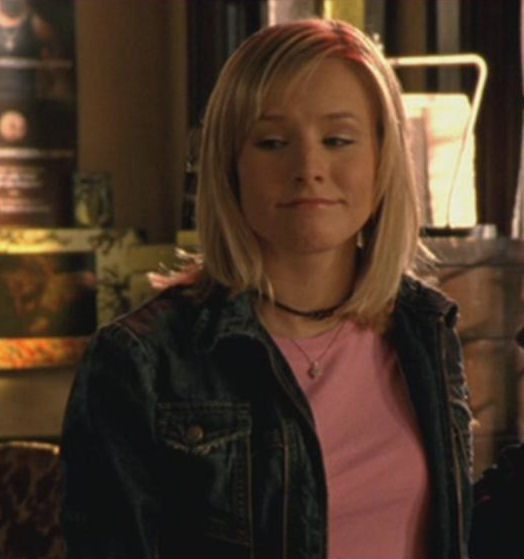
In a first for a major-studio intellectual property, Warner Bros. has allowed producer/creator Rob Thomas to use the power of crowdfunding to extract Veronica Mars from mothballs and feature her in a major motion picture. Thomas launched a Kickstarter campaign less than 48 hours ago with a lofty goal of $2,000,000.00. As Thomas describes the conditional deal with Warner Bros.:
Of course, Warner Bros. still owns Veronica Mars and we would need their blessing and cooperation to pull this off. Kristen and I met with the Warner Bros. brass, and they agreed to allow us to take this shot. They were extremely cool about it, as a matter of fact. Their reaction was, if you can show there’s enough fan interest to warrant a movie, we’re on board. So this is it. This is our shot. I believe it’s the only one we’ve got. It’s nerve-wracking. I suppose we could fail in spectacular fashion, but there’s also the chance that we completely revolutionize how projects like ours can get made. No Kickstarter project ever has set a goal this high. It’s up to you, the fans, now. If the project is successful, our plan is to go into production this summer and the movie will be released in early 2014.
Thomas worried for naught. Pledges from tens of thousands of fans reached that formidable goal in a record-setting, jaw-dropping twelve hours, leaving 29½ days for slower fans and curious bandwagon-jumpers to keep adding to the budget in hopes of upgrading the film from niche project to wide-release underdog, maybe even with action scenes and trained stuntmen. At the rate the pledges are accumulating, they’ll have enough money to set it in 2030 and equip Veronica and her dad with robot sidekicks.
 As much as I contemplated bowing out


 Whereas the first two editions of “MCC Q&A” were comprised of tongue-in-cheek responses to odd queries and sentence fragments that brought search engine users to my humble doorstep, this one is devoted to a single question from an MCC commentator. Far be it from me to allow the plaintive mumblings of nameless strangers to monopolize this slightly recurring feature.
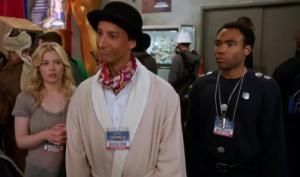 I had been looking forward to last week’s new episode of Community, “Conventions of Space and Time”, which invited us into the inner workings of an official Inspector Spacetime convention, a place where Troy and Abed could meet other fans of the obscure British TV series, indulge in a few hobby-related purchases, and generally be themselves. As someone who’s been to C2E2 twice, Wizard World Chicago four times, three GenCons so far, two Star Wars Celebrations, and several local Trek conventions, I was curious to see how the generally geek-approved series would approach such a setting. I tried to keep my expectations modest — without creator Dan Harmon around anymore, this season’s first two episodes were a little shaky. I’ve stuck with the show and keep hoping for the best.
 As my seventh annual foray into this personal fun ritual, presented below anyway is the timeline of events as I witnessed them during tonight’s ABC telecast of the 85th Academy Awards. All quotes are approximate as best as possible without benefit of rewatching, cribbing from national news outlets, or much proofreading. Our household does not own a DVR; all recollections are a combination of short-term memory and notes hastily handwritten on a legal pad, not a copy/paste reassembly of a distracted live-tweet flood. When I’m seated in front of a TV, I’d much rather watch than type.
 I already explained
