Ranking the Six “Sherlock” Episodes While Waiting to Judge “Elementary”

Sherlock, ElementaryMy wife and I were quite pleased to catch up with our peers recently by viewing all six episodes of the BBC’s fascinating Sherlock. Before diving in, I expected I’d at least enjoy some engaging moments from Martin Freeman, one of my favorite components of the original UK version of The Office, among other productions. Once our viewing began, I was struck more deeply by Benedict Cumberbatch’s performance as a truly intelligent character with a broken social compass. More succinctly put: he’s smarter than everyone around him and doesn’t care who that bothers. I’ve known more than a few Internet users with that same attitude, many of them mistaken in their position. I can see why the show would attract such a sizable Stateside fan base.

We owe sincere appreciation to the creators — Steven Moffat, Mark Gatiss, and some ancient writer named Doyle — for an intricate, adrenalized concoction of tension, intrigue, and emotional gamesmanship. I’d also like to thank the crowds of fans who recommended this to us. At the moment, I would rank the six episodes produced so far as follows, with spoilers ahead.

1. “The Great Game” (s. 1, ep. 3) — A bored Sherlock finds his spirits, and later his blood pressure, raised when a mad bomber taunts him with a series of life-or-death puzzles to solve, with victims as the prizes. Our Hero finally meets an opponent to equal or even rival his talents, and finally demonstrates that he actually has moral boundaries in comparison. Humor succumbs to terror as the challenges proceed relentlessly, concluding with a revelation that had me kicking myself for not guessing it sooner. (Mental note: when reading or watching a work about Holmes, any character named “Jim” needs to be heavily scrutinized. How could I not even have thought about it?)

2. “The Reichenbach Fall” (s. 2, ep. 3) — Moriarty drives Holmes and friends to the brink of insanity with the greatest game of all, one that destroys reputation, relationships, and lives with equal aplomb. The hyperintellectual brinksmanship was truly a wonder to behold. At times it was extraordinarily tough to disbelieve the lies. The main reason it has to settle for runner-up is because the last thirty seconds of the episode were no surprise. I already knew the show would be returning for season three. Granted, I have very little idea how Sherlock actually pulled off this astounding stunt (other than a nascent theory involving Molly), but we know that, somehow, someway, he did pull it off. When I’m supposed to be surprised and I’m not, I deduct points.

3. “A Study in Pink” (s. 1, ep. 1) — Where it all began, laying out the premise, putting all the pieces in starting positions, and setting the bar ridiculously high with an initial, disturbing stumper of a mystery. Tonally distinct, visually inventive, detail-oriented, funny, and enthralling.

4. “A Scandal in Belgravia” (s. 2, ep. 1) — For once, not only does Sherlock have to discern what the clues mean, he has to discern what the clues are. The Woman is such a formidable, superior Catwoman to Sherlock’s momentarily awkward Batman that I was a little disappointed that the solution to the locked MacGuffin phone depended on her being deep-down lovestruck. Otherwise, all performances were in top form, though Irene Adler’s risqué nature pushed the content boundaries a bit more than we’d expected.

5. “The Blind Banker” (s. 1, ep. 2) — Sherlock versus the Asian underworld, with a little help from British subculture and a little interference from Watson’s wish for a personal life. This would’ve been a very good episode of any other TV show, but the impersonal villain and the cutesy dating scenes felt inessential in the context of this series.

6. “The Hounds of Baskerville” (s. 2, ep. 2) — I would still call it good TV to an extent, particularly the scene in which an incensed Sherlock shows off to prove he’s still in control of his faculties, but it was the most predictable episode to date. Once you eliminate any possible supernatural causes on general Holmes-lit principle, the only remaining explanations possible for the demon dog are (1) the vulpine roomie from Being Human is a liar or a madman; (2) genetic tampering; or (3) hallucination. The excessively misty government property narrowed the possibilities for me fairly early into the episode. (If I was meant to think, “Oh, that’s just England for you!” it didn’t work.) The whodunit aspect also tipped its hand too early if you’ve seen too many mystery shows, which have taught us that the guest star who’s dying to be most helpful to Our Hero is almost always the guilty party. Sure enough, my wife and I had him pegged after his “chance” interruption of Watson’s drink-chat with the therapist. Alas, even the smartest kids in class are bound to trip from time to time.

The Internet says that Season 3 isn’t scheduled to begin production till January 2013, which means we have at least a year before my wife and I will be able to watch episodes as they air. Until then…well, we do have an option to keep us occupied. CBS’ new counter-interpretation of the Holmes milieu, Elementary, will premiere this Thursday evening, September 27th. Jonny Lee Miller and Lucy Liu are the prettier, Americanized versions of the detective duo who’ll be plying their trade in New York City and presumably encountering their own special Moriarty in the months ahead, though the early publicity info has a dearth of other Doyle staples such as Lestrade and Mrs. Hudson.

A schedule conflict will prevent me from watching the premiere as it airs, but I’d like to see it for myself at some point — partly because watching new things is a fun source of writing prompts for me, but mostly because I’d like to judge it firsthand rather than dismissing it outright. I’m willing to grant the benefit of the doubt, though I take slight issue with apologists who defend it on the grounds that plenty of actors have performed their own interpretations of Hamlet and other famous characters without being beholden to other versions. Though this is true to an extent, you rarely have two versions of Hamlet being staged in the same city at the same time. Usually a bit more space is left between them so they can stand or fall on their own merits, rather than competing against one another for the same audience. Also, if Elementary turns out to be nothing more than CSI: English Accent, I’m definitely done with it.

“Revolution” 9/24/2012 (spoilers): Mitigating Morality and Fussing Over Flags

The Rebel Alliance goes up to 11Last week’s premiere of the new JJ Abrams series Revolution achieved encouraging Nielsen ratings. Then again, so did the pilots for The Event and FlashForward. We’ll have to wait until Tuesday morning to discover how episode two fared. I’m sticking with it for now with some form of curiosity, but I can’t say the show is firing on all cylinders yet.

The interesting sword-fighting scenes in this week’s episode, “Chained Heat”, are mostly between Miles and special guest C. Thomas Howell as a generic bounty hunter. Unfortunately for Miles, all his other party members lack key adventuring skills. If they were Dungeons & Dragons characters, their class would be Hostage. Worse still in Miles’ mind, head hostage Charlie still adheres to old-fashioned, inconvenient, old-world beliefs such as Killing Is Wrong and Slavery Must Be Stopped. Through the course of the hour, Uncle Miles has to teach his niece that (1) life in the new world is basically a constant state of war, so killing is mandatory until someone reinvents the American legal and penal systems; and (2) they have better things to do than become a traveling abolition squad. The validity of either lesson remains open to debate.

At first Miles abandons his dead-weight companions and tries to carry the series solo, but Charlie refuses to let him because she believes she’s the main character, and also she wants to fight by his side with her crossbow that she’ll willingly use to wound animals or shield herself from swinging swords. Despite her inexperience and naivete, despite Miles’ considerable head start, and despite a scene where she plods around a playground for a while and has an intense childhood flashback, somehow she catches up with him anyway. One has to wonder if perhaps she possesses innate tracking skills not yet mentioned, if Miles somehow got lost, or if he was just testing her to see if she would follow him, and had been hiding in the bushes all this time.

Miles wouldn’t be alone in using shrubbery as camouflage. That’s exactly where “Nate” spent this episode, keeping himself, his conflicting motives, and his general brooding hidden but never far from the action. Basically he’s set up as a season 1 Angel to Charlie’s Buffy. Those are some big shoes to fill, “Nate”.

Of course, in order to follow Miles in the name of “only trying to help”, Charlie had to let Aaron and Maggie stay abandoned and fending for themselves. The duo reacts to this by not staying put, instead venturing forth armed only with the late Ben Matheson’s potentially world-saving flash-drive MacGuffin amulet, a dead iPhone that hopefully doesn’t experience memory degradation issues, and Aaron’s magic glasses that have survived fifteen years or more without collecting scratches all over the lenses. Maybe I shop at all the wrong optometrists, but after two or three years with the same pair of glasses, I’m usually half-blind and having to learn how to focus through the few clear spots.

Thus do Aaron and Maggie throw caution to the wind and advance in the direction of Grant Park, the hometown of Grace, the mysterious lady from last week that Danny met by pure happenstance, who then threw him to the wolves, and who for some reason has a working computer with a 56K modem with the old dial-up squawks and everything. We know little else about her so far except she had/has an asthmatic son whose inhaler had no expiration date; she’s not afraid to throw innocents to the wolves for the sake of saving her own skin or cause (too early to tell which of those means more to her); and her subplot ends in a cliffhanger involving a rude home invader named Randall. I like to think that a character with that name just has to be awesome, so I’m sure there was a perfectly courteous reason for him to smash her door down.

Funny thing about Grant Park, though: it’s fifty miles south of Chicago. That wouldn’t be a cakewalk for the Fellowship of the Ring, let alone for casual pedestrians. I can’t wait to see how that goes for Maggie and Aaron, who’s not exactly built like a cross-country runner. I also look forward to finding out how Charlie’s brother Danny, who was taken captive many miles west of Chicago in the pilot, somehow beat them to Grant Park by a full episode — accidentally and with asthma, at that. They do have one thing in their favor: Miles told everyone to meet in two weeks in Lowell, Indiana, which lies a measly fifteen miles east of Grant Park. That leg of their trip should be a breeze compared to the Chicago-to-Grant-Park marathon.

Miles’ side quest, as it turns out, is to recruit the last cast member, Nora (Daniella Alonso), who can hold her own in a fight, can allegedly blow stuff up, is willing to steal herself better weapons, and has a Rebel Alliance tattoo on her back, in the form of an eleven-star American flag. Apparently the rebels are so hardcore, they think North Carolina and Rhode Island don’t count as Original Colonies because they were too slow to get ratified. 11-OC in full effect, y’all.

Meanwhile, Giancarlo Esposito’s Neville, the most interesting evildoer in the show, saw reduced screen time, but taught us two key lessons: he’s some kind of religious (for me, the most eye-rolling revelation this week), and the original fifty-star American flag has been renamed the “rebel flag”. With the series taking place in northeast Illinois, it may be years before the characters walk far enough south for us to learn what a Confederate flag is now called. His superior, Sebastian Monroe, presidential monarch of the Monroe Republic, had even less screen time with only two scenes to call his own: one demonstrating that he’s against torture but not murder; and one revealing that Charlie’s mom is alive and captive.

Hopefully the future doesn’t see Charlie following her mom’s lead in every other episode. I’d like to see her grow as a character, preferably sooner rather than later. It was sad to see her innocence die a little when she experienced her first kill (and, seconds later, her second kill) while helping Nora steal the cool sniper rifle from the copter-hoarding Imperial forces. She doubtlessly has more trials ahead of her, so she’ll need to keep working on her backbone development, stop letting strong men back her into helpless positions, and start owning the fact that this entire journey was her idea.

If she keeps insisting on retreating to the background, I would recommend the show change focus ASAP so that Miles really is the one true main character. Along those lines, they’d do well to change the name of the show as well. My suggestions for a new name would include Miles to Go; Miles Down the Road; Crossing Miles; Miles and Nora’s Infinite Hit List; or We’re Walking, We’re Walking, We’re Walking.

My Geek Demerits #4: Not Watching “The Big Bang Theory”

[Being the fourth in an intermittent series covering assorted areas in which I feel resigned to live as a minority among geeks.]

The people who hang around us the most realize that my wife and I differ from them in key ways. In small-talk situations we find ourselves fielding questions about certain movies, TV, books, genres, and other topics that never arise at elegant dinner parties. We’re not know-it-alls and we’re immediately honest in admitting when we haven’t seen or become aware of a certain work or area. If the answer lies within one of our personal proficiencies, we cheerfully oblige. I do edit myself for length because no one ever wants or truly needs my complete, passionate answer in paragraph form. I’m merciful that way. It makes me look more introverted and antisocial than I really am, but it’s for everyone’s own good. Also, people tend to wander off after the first three sentences.

Every August like clockwork, someone will ask if we’re attending GenCon. Five to six weeks after a new super-hero movie is released, they’ll ask if we’ve seen it yet. When the subjects of Star Wars or Star Trek arise on occasion, my wife tags in to the convo while I sit ringside. Once every eight to ten years when someone asks me about comics, I have to remember to limit my answers to twenty words or less, and to confine my citations to Marvel or DC titles only, because explaining the fact that hundreds of other publishers have existed throughout comics history will only frighten and confuse them. Conversely, if someone mentions sports of any kind, we have nothing to offer them and wait patiently until they can find a normal, human, sports-loving conversationalist to rescue them from us.

In the last year or so, one question has begun popping up more frequently than any other: “Do you guys watch The Big Bang Theory?”

For my wife, it’s an easy question to answer. She has no use for 98% of all network TV shows produced after 1992. Her part in the conversation is done, and she’s ready to flow to the next topic. I have my response rehearsed and down pat: I fix my gaze upon any other point in the room except the questioner, pause with a strained expression, and mumble, “No.”

They’ll say, “Really? Oh, it’s so funny!” Then they’ll try to quote a line or antic that comes to mind, smile, and wait for me to be bowled over. The most common choice is a shout of “BAZINGA!” as if this will implant fake happy memories of the show in my head and win me to their side.

Instead I bounce my gaze to a point on the opposite side of the room from the first faraway point, smile sheepishly, wince, and mutter, “Heh. Yeah, I…just don’t.”

If they’re terrible at reading body language, they’ll finish their pitch with, “Oh, you should try it! It kinda reminds me of you guys!”

My first impulse is to imagine them dying gruesomely before my eyes. Since that’s a sinful thought, I try to capture it, suppress it, nod a little, replace my smile with a blank look, and wait out the rest of the scene in silence, just like Clark Kent used to do on Smallville whenever anyone confronted him with a question he didn’t feel like answering. If I’m to continue living in peace with others, then I have no choice but to muster up a humane response.

I watched the entire first episode. In 2007 a magazine graciously sent us subscribers a promotional DVD containing the premiere episodes of both BBT and How I Met My Mother. My reaction to the latter was easy to summarize: Neil Patrick Harris was in top form, but I’m generally not amused by comedies about people striving for sex and love in that order. My reaction to the BBT pilot was even more adverse, but tougher to articulate. Everything that bugged me about the pilot has only been exacerbated by further examples and new reasons developed over the years.

Right off the bat, I was disappointed that the pilot was entirely stocked with stereotypes. The classic dumb blonde was the central figure, surrounded by the emotional good geek, the unemotional bad geek, the worse geek who thinks he’s suave, and the token nonwhite geek. I was more disappointed that all five characters were conscripted in service to a comedy about people striving for sex and love in that order. Well, except the bad geek, who appeared to suffer from a Vulcan emulation disorder.

More problematic: I simply didn’t laugh. At all. I half-smiled at the periodic table shower curtain. That’s as good as it got. Most of the jokes didn’t feel written For Geeks By Geeks. It felt like classically trained sitcom writers dusting off the old clichéd jokes about geeks and taking them for a spin at the geeks’ expense, even in lines spoken by one geek berating another. If I might borrow Johnny Carson’s old shtick and pretend that someone just shouted, “HOW BAD WAS IT?”: it was so bad, I once watched an entire episode of According to Jim that made me laugh more. The gags at the dumb blonde’s expense only worsened the feeling that I was watching corporate-approved assembly-line sitcom product.

I came away from the single viewing experience with an offended impression in my head that I couldn’t properly label until a few years later when an Internet participant under the message-board username “Front Toward Everybody” coined the right summation and crystallized my conclusion for me: “nerdsploitation minstrel show“. If the frat jocks from Revenge of the Nerds suddenly became aware enough to create a TV show spoofing and mocking their arch-nemeses, BBT is the end result I imagine.

I’ve witnessed little evidence to reverse my position. The jokes that are quoted to me every so often, whether by well-meaning friends or by easily amused magazine writers, elicit no merriment from me, and fall a few notches below the everyday chatter that online friends proffer via social networks for free. Those same samples have failed to dispel my presumption that the show revels in laughing at — not with — the issues and weaknesses of some among our crowd. I find that more saddening than snicker-worthy.

On a different level, I’m also annoyed that the show does indeed kowtow to corporate interests. I’d suspected this at first when ads for the show (produced by Warner Bros.) began appearing in titles published by DC Comics (owned by Warner Bros.) with the cast all wearing DC super-hero attire. My suspicion was confirmed this weekend when I received my subscription copy of the new issue of that same magazine that sent me the DVD in 2007. This week’s cover story about BBT (apparently they still love it to pieces) confirms on page 33, “A rule that only DC Comics products can appear in the comic-book store was lifted in honor of Marvel legend Stan Lee’s guest appearance in season 3.” I’m surprised DC didn’t bar Stan the Man from appearing and insist that the show feature special guest star Dan DiDio instead. Openly corporate favoritism is, in my opinion, highly anti-geek.

Naturally, the Nielsen commoners can’t get enough of it. It’s now the highest-rated sitcom in current production, preparing to start its sixth season this coming Thursday, September 27th. I realize the industry has rewarded it with many Emmys, which mean about as much to me as Tonys do. (Hint: as I live nowhere near Broadway, the answer is near zero.) I get that I’m supposed to dig the theme by Barenaked Ladies, who’ve composed several great songs but have never sustained a fully satisfying album from start to finish for my taste. I realize the show has garnered many renowned guests hallowed and revered to our crowd — numerous Trek actors and actual scientists, among others. How nice for the show that it has powerful friends, allies, and fans. Good for it.

Perhaps the show has matured since then and stopped falling back on easy go-to shtick. “It’s funny ’cause geeks don’t get women!” “It’s funny ’cause geeks use real big words!” “It’s funny ’cause geeks like stupid stuff!” If those have disappeared, great. I’m glad it’s experienced a miraculous, hopefully repentant turnaround. The rest of the world can continue enjoying it at their leisure for the twenty more seasons sure to come.

Meanwhile, I’ll be fine over here without it. If I want to see or read works authentically FGBG, funny or even dramatic, I’ve had plenty of options past and present about our mindset — Scott McCloud’s Zot!, Evan Dorkin’s “Eltingville Club” stories, Sideways, Frasier, High Fidelity, Phonogram, Fringe, The Nerdist channel, and the amazing, colossal, heartbreakingly underrated Community, which in its three seasons has been more magnificently FGBG than I thought humanly possible, without stooping to the lower common denominators or compromising a great taste in reference points.

Even if the Nielsen commoners take Community away from me after the new showrunners fail to appease them, I guarantee shouting “BAZINGA! BAZINGA! BAZINGA!” at me won’t change my mind.

Trailer #2 for “The Hobbit” Starring Dr. Watson and Doctor Who

Longtime fans of Peter Jackson’s Lord of the Rings trilogy who’ve been watching last December’s two-minute teaser for The Hobbit: an Unexpected Journey on an endless loop every day for the past nine months can finally close that browser and tune in for the new, full-length trailer that was released to the Internet on Wednesday. It’s comforting to see our old friends Ian McKellen, Cate Blanchett, Hugo Weaving, and Andy Serkis all returned and on point, but I’m personally more interested in the new tidbits:

I’m delighted to see Martin Freeman portraying astounded exasperation with his usual finesse. Whether as Tim from The Office, Arthur Dent from The Hitchhiker’s Guide to the Galaxy, or the average-minded John Watson from Sherlock, Freeman specializes in men who can’t believe what he sees in the other men that surround them. To his credit, his Bilbo Baggins (at least in these scant samples) seems to retain at least a smidgen of confidence in stressful situations, a trait that his adopted nephew struggled to inherit in the trilogy.

New to our eyes this time around: Sylvester McCoy, erstwhile Doctor Who, as Radagast the Brown, a wizard colleague of Gandalf and Saruman who was name-checked in passing in J.R.R. Tolkien’s original novel. I remember reading it in seventh-grade English class, where our teacher Mrs. Price gave us extra credit if we completed our Hobbit homework and quizzes in green ink. I don’t recall Radagast’s name at all, but I’ll take everyone else’s word for it. Here his role has been broadened to compensate for his complete deletion from the LOTR trilogy, and set far apart from those other, mainstream sellout wizards by donning the world’s craziest winter hat and possibly threatening to invoke a divination method certain to make the Middle-Earth Humane Society cry.

Also integral to my seventh-grade Hobbit experience: the three trolls! I was hoping one of my favorite scenes from the book would be included in the first movie, instead of being relegated to The Hobbit Part 7 or however long this series ends up.

I’m especially curious to see more of Richard Armitage’s version of dwarf’s dwarf Thorin Oakenshield, the new face of 21st-century dwarfdom — to say nothing of his dozen companions. Compared to these nimble warriors, in hindsight Gimli son of Gloin looks like Volstagg the Voluminous.

You’ll also note the younger, cleaner Gollum who’s a little less sinister in his threats of hobbit cannibalism. Little does Prequel Gollum know he’s sparring with an opponent who’s a little less highstrung and morose than Frodo was. I don’t look forward to the moment when crafty ol’ Bilbo absconds with his Precious and shatters his heart.

In the grand tradition of The Return of the King and its endless parade of endings, Warner Bros.’ official movie site offers a total of five different versions of this trailer that end with different scenes, each one amusing in its own right, four of them at Bilbo’s expense. Laugh while you can, pesky dwarven bullies. Over the next three years, Bilbo will show you all.

“The Bourne Legacy”: 2½ Hours of Jeremy Renner Having the Time of His Life

Tonight’s entertainment was a discount showing of The Bourne Legacy, in which Academy Award Nominee Jeremy Renner enjoys the perks of action heroism without looking like a plasticine sellout. That’s all I wanted, and I’m happy that my expectations were cheerfully met. I was willing to let most of the deficiencies slide.
To understand my mindset, head directly the $5 DVD bin at your nearest Wal*Mart and pick up a copy of 2003’s S.W.A.T., which was chiefly a loud mash-up of the incongruous stylings of Samuel L. Jackson and Colin Farrell. When I watched it years ago, I couldn’t help noticing the showy bad-cop with all the best lines, played by a confident young guy who seemed to be enjoying himself a lot more than the marquee names were. Not long after, I caught him during my Angel DVD marathon in a season-one role as a gleefully evil vampire — once again, cockier and smiling a lot more than his opponent. After back-to-back favorable experience,s I made a mental note to keep an eye out for young Renner in the future.

Fast-forward years later: now his resumé includes The Avengers, The Hurt Locker, and Mission Impossible: Ghost Protocol — all grade-A films in my book, all this close to making Renner a household name. Also of interest: last November Entertainment Weekly published a lengthy article about him that detailed his lean years as a struggling actor living a life far from luxury while chasing his dreams. That struck a chord with me, and only served to upgrade my mental note into a full-fledged set of index cards. In the filing cabinet that is my mind, that’s a kind of praise.

Renner finally worked his way up to carrying a big-budget action film on his own (instead of as a sidekick or teammate) with The Bourne Legacy, in which his character is torn between a government that needs him dead and a skeptical audience that’s 95% certain he’s not Matt Damon. I liked the original trilogy, but not nearly enough to consider it sacrosanct. The same screenwriter, Tony Gilroy, is now in the director’s chair adapting his own words for the screen, and he even allows cameos from previous players David Strathairn, Joan Allen, and Scott Glenn. We still have the specter of the evil government programs named Treadstone and Blackbriar, begging to be joined by other new evil programs with ten-letter compound names like “Thumbscrew” or “Riverdance”. It’s in the same timeline as the trilogy, no reboot or disregard for what came before. (Granted, I have no idea how hardcore Robert Ludlum fans feel about what amounts to an apocryphal spinoff…)

I wasn’t really concerned with whether or not it lived up to its predecessors. I harbored no delusion that it would be groundbreaking. I entered in hopes of seeing a guy who used to live on ramen noodles and unpaid light bills enjoy the fruits of a turnaround of fate. As the last survivor of a black-ops Super-Soldier Program made possible by the sinister forces of Big Pharmaceutical, Renner finds plenty of quiet moments for emotion and sincerity in between the running, chasing, punching, kicking, parkour, motorcycle stunts, and smash-cam closeups. His earnestness and lack of Hollywood sheen go a long way toward redeeming a role that, in the shallow end of the ’80s, would have been relegated to any number of direct-to-video martial-arts “stars”.

Also worth noting is Rachel Weisz as the requisite damsel in distress, trying on an American accent for a change, carefully modulating her fearfulness instead of aiming for full-tilt histrionics like others might in her place, and standing her ground as needed with her fully accredited science skills. Edward Norton stands out a tad as the evil overseer with the best-written lines (particularly his discomfiting description of the evil Program as “morally indefensible and absolutely necessary”). I spent the entire movie thinking Stacy Keach was Albert Finney as Evil Overseer #2, so I guess that’s a job well done. And after having coincidentally watched *batteries not included the other night, I was shocked to see that Dennis Boutsikaris, as the constantly upset Evil Overseer #3, has indeed aged a full twenty-five years over the last twenty-five years. Shocking but true.

I had to focus on the performances because the rest of the movie was a mixed bag. The “plot” is Our Heroes enduring one long chase scene while all the best villains hide in a faraway room. All armed henchmen working outside the main control room are one-note, including one Super-Duper-Soldier with no lines and no demonstrable evidence as to why his even-eviler Evil Program was superior to Our Hero’s. The climactic auto-wrecking dance is shot with such a claustrophobic eye that I lost all sense of setting and placement, and thought I was trapped on a merry-go-round. And the movie pauses all that chasing instead of actually ending, as if everyone involved simply stopped and called a truce so they could move on to their next projects.

But for my money’s worth, I achieved my goal of watching Renner hang out with interesting people in exotic locales while stunts are performed and entertainment is adequately concocted for my discounted dollar. Hopefully we won’t have to watch the sad sight of Renner selling out altogether in future years and demanding ten times his salary for an extra-bloated sequel called The Bourne Travesty.

Three final notes, in keeping with past movie entries:

1. The Bourne Legacy has no scene after the end credits. Once again for the true fans, the credits do roll to a reprise of the official Bourne theme, Moby’s “Extreme Ways”.

2. In terms of content, mostly it’s about the smashing and exploding, with very few curse words added so we know it’s still a Hollywood film. For those with the sensibilities of a great-great-grandmother, the end credits include a warning label about the scenes of smoking (*gasp!*) being “an artistic choice” rather than paid product placement. If that makes or breaks the deal for you, consider yourself warned.

3. I counted one veteran of The Wire onscreen: blink and you’ll miss Christopher Mann — a.k.a. one-time mayoral candidate Tony Gray — as a panicky guard desperately failing to smash his way through a locked door. Poor Tony just can’t catch a break.

“Revolution” Pilot: From Slow Burn to Swashbuckling

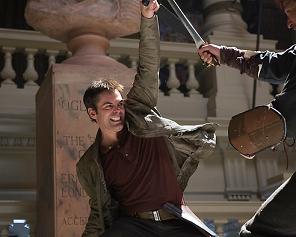
Billy Burke, NBC, "Revolution"Tonight was the broadcast premiere of NBC’s newest genre series Revolution, from executive producer JJ Abrams and creator Eric Kripke, best known as the original mind behind Supernatural. In a world where electricity has gone the way of the dinosaur and the physics of combustion engines have magically suspended operation, factions have arisen to make the most of a scary new world without advanced technology, lifesaving devices, or Angry Birds.
After a cursory intro peppered by distant, low-key plane crashes, the show’s setting begins fifteen years later after mankind has regressed to villages and an entire generation has grown up with only vague memories of ice cream and the Internet. Our heroine, Charlie (Tracy Spiridakos), is a more optimistic, less assured Katniss Everdeen who eschews regular bows in favor of a crossbow, which serves her poorly when she learns the hard way that reloading takes longer. At least, I hope she realizes her error. If she sticks with the crossbow simply to avoid trademark confusion, I’ve no doubt that future fight scenes will sadly gloss over this issue. Don’t be fooled by how easy the Huntress makes it look, kids.

After a tragic death and the passing of a family MacGuffin, Charlie reluctantly inspires a ragtag team of misfits to quest with her to Chicago. There’s her dad’s Australian girlfriend Maggie (Anna Lise Phillips), a doctor with sly methods for maiming a foe; Aaron (Zak Orth), a former Google exec who tags along because of comic relief; and Nate (JD Pardo), an archer with multiple weapon proficiencies and shifty priorities. They vow to walk dozens of miles together for justice, revenge, safety, and premise.

The reason for this quest? Charlie’s asthmatic brother Danny (Graham Rogers) has been taken captive by the most immediate Big Bad, Giancarlo Esposito (now departed from Breaking Bad and incarcerated on Once Upon a Time), a sinister militia captain named Neville who’s not thrilled with the orders he has to follow, but has no qualms about putting his crack-shot skills to use for his overlord, Sebastian Monroe, ringleader of the militia that rules the immediate surroundings within the landmass formerly known as the USA. Esposito firmly takes charge of every scene and won’t let go, particularly in a sequence in which he nimbly and unflinchingly mows down a row of uppity villagers, exactly one split-second bullet per villager.

Our Heroes’ not-quite-epic journey to save David — even though he’s a prisoner waaaay back home — trots them through O’Hare International Airport, fifteen miles east to Wrigley Field, a few miles south to the Magnificent Mile, then into the heart of the Loop, where an old hotel sets the stage to introduce Charlie’s long-lost uncle Miles (Twilight dad Billy Burke), who may be the lynchpin of their cause if only he can put down the bottle, stop hiding, and assume his role as the One True Main Character…who’s apparently expected to drop all his plans, trek with them back across twenty-odd miles of I-90 North, and save the day without an audition or an incentive beyond “Because family is important!”

When Evil Esposito isn’t onscreen, the first ¾ of the pilot skims through a lot of character meetings without many chances to get to know anyone at length. The energy level cranks up at the 45-minute mark (including network ads) when Miles, previously described in an offhand manner as a “killing machine” as if it weren’t nothin’, engages in the sort of well-choreographed, high-speed, one-man-army swordplay demonstration that was once the hallmark of bygone shows such as TV’s Angel. For a few minutes, I was on Action TV Cloud Nine.

If you’re patient enough to endure the setup and introductions, lying in wait after all that happy Errol Flynn-ing are two special surprises in the final five minutes: a revelation that threatens to undercut the show’s entire premise; and a better look at one of the show’s secret weapons barely noted in the preview materials — David Lyons, once known as TV’s The Cape! Somewhere out there, Abed Nadir is deliriously happy.

The pilot was released online early at NBC’s official site, but that’s not helpful to people like me who prefer larger TV screens, or to people also like me who somehow didn’t find out about the early release until after the fact. (For shame, Internet — you’re supposed to tell me these things!) Revolution isn’t quite A-plus material yet, but the pilot, as directed by Iron Man‘s Jon Favreau, climaxes with enough pizzazz and tantalizes with enough promise that I plan to check back next week for more, though I’m making no long-term commitment yet. After the sweat and tears normally poured into a pilot on big-budget double overtime, it’s usually the second episode that doesn’t try as hard to impress, and is a better indicator of the real quality control levels to be expected in the weeks ahead. Also, I’d like to see if Charlie wises up and ditches that awkward crossbow.

Internet Commenters Demand Legislation Against Complex Sentences

Hello, readers. How are you? I am hunky-dory.

Today was a good day. I got to rest. I ate good food. I watched some DVD extras. One was a documentary. It was about A Night to Remember. That movie was about the Titanic. The documentary was not fun. The photos were okay. The narrators were all very old men. They talked a lot. Sometimes they talked for many minutes. They talked very slowly. Sometimes there were very long pauses. Then they talked some more. They were nice men. I felt like a great-grandchild. I did not see the last fifteen minutes. I stopped the DVD early. I was sleepy.

Then I got on the Internet. It has interesting pages. I wanted to read a movie review. It was about The Master. I have mentioned that movie before. Joaquin Phoenix is angry and confused. Phillip Seymour Hoffman is charming and maybe evil. Amy Adams is happy and unhappy. I may go see it. I have not decided. My city is not showing it yet. Maybe they will show it in October.

The review was written by a movie critic. Her name is Lisa Schwarzbaum. Her boss is named Entertainment Weekly. She has worked there for decades. She likes itty-bitty foreign films. She also likes movies about sexiness. Sometimes I do not agree with her. Sometimes I do. She uses big words and long sentences. I can usually understand her. Sometimes I also use big words and long sentences. Sometimes she mentions really weird movies. That does not bother me. Sometimes I also talk about weird things.

Ms. Schwarzbaum liked The Master very much. She gave it an A. Her review had big words and long sentences. This was the last sentence of her review:

The cubism of the concluding third of the picture allows a disoriented viewer to consider this singular movie not only as a character portrait, but also as a photographic travel diary, from the days before Instagram, by an important artist following the itinerary of Americans seeking salvation and prosperity when an exterior world war was over but interior psychological battles raged.

The word “cubism” threw me for a moment. I looked it up on the Internet. It has dictionaries and WikiPedia in it. I found Cubism in there. Now I understand the whole sentence. “Cubism” is a good word for a Paul Thomas Anderson film.

Some readers did not like her review. They really did not like her last sentence. A few readers said mean things about her. One reader said this direct quote:

…it is exhausting – why does she have to create super complex sentences with thesaurus worthy big words – it doesn’t impress me, it belittles me. and that last sentence, WTF? I’d hate to be stuck next to a cooler with her, attempting to carry on a conversation about the latest small town drama. Know your audience.

Her audience does not like long sentences or big words. “Entertainment” is a big word. Lisa’s words are mostly shorter than “entertainment”. They should rename the magazine Things Weekly. The audience would like them better.

Another unhappy reader said this direct quote:

“the cubism of the final third……….” this sentence is not only THE most pretentious piece of critical crap I’ve ever read, it also convinced me not see the probable load of “important” blarney that inspired it.

The Internet has many pretentious pieces of critical crap. I have read some of them. I usually do not rank them. Some reviews can be pretentious and not crap. Sometimes I like pretentiousness. That word is even bigger than “entertainment”. It does not scare me. I used to be an English major. Other English majors scared me. One time our class talked about “Murders in the Rue Morgue”. That is an old story about gross murders. One victim was stuffed inside a chimney. One classmate had a theory about the scene’s meaning. He used the phrase “return-to-the-womb motif”. I was very scared. I wanted to leave class immediately. Now I am older. I have conquered that fear.

Ms. Schwarzbaum probably writes how she wants. Maybe she even thinks that way. Her writing made other people sad. She should rewrite her last sentence. It should be many sentences. The sad people might like the new sentences. They could look like this:

The movie shows you things about each character. Some of those things are very different from each other. It takes place in the past. The old places tell one long story. It is better than random photos. The story comes after a war. People were not happy yet. They had a lot to think about. They tried to make money and be saved. The movie is very good. The director is neat.

Shorter sentences can be happier sentences. The biggest word in those sentences is “different”. That word should not be scary. I think Liza Schwarzbaum is a different writer. Maybe I am a very different reader.

Well, got to go. Have a nice day. I will see you all tomorrow. My next entry may have commas and more clauses in it because of pretentiousness. I hope you will not hate my important blarney. I promise I will not read it aloud to you with extra long pauses. That might make it worse.

The Fall 2012 TV Season: Which New Shows Can I Kill Just By Watching Them?

The Flash. Brimstone. Clerks. Firefly. Threshold. FlashForward. Studio 60 on the Sunset Strip. Persons Unknown. Outsourced. Terra Nova. I watched these shows, I grew attached to them for various reasons, and they each lasted one season or less. This has happened to me often enough that I refuse to write it off as coincidence or horrible taste.

I am not simply unlucky in leisure. I am more than a mere jinx. I am the destroyer of new network programming.

Even as far back as my childhood, incidents occurred. Does anyone else remember the McLean Stevenson vehicle Condo? Its truncated run wasn’t another example of his own curse in action. That was me. When Isaac Asimov co-created Probe, I was there to ensure he failed in at least one creative venture in his entire life. What had two thumbs and watched the American version of Cracker? This young adult viewer, that’s who.

By comparison, consider a few of the shows I didn’t watch: Lost, Heroes, The Big Bang Theory, 99% of all reality shows — all of which I didn’t follow, all of which may have lived longer than they should have. Sometimes I’ve even saved the life of a show by walking away from it. I gave up on Grimm after several episodes about a cop with a greater destiny who insisted on remaining a boring old cop; lo and behold, without me around, the cop and his world of were-critters live on. If a bad time slot and the CBS site’s horrid streaming browser hadn’t caused me to lose track of Person of Interest halfway through its decently rated first season, surely something awful would’ve happened to it or its cast, guaranteed.

(Never mind examples that dispute my hypothesis. Once Upon a Time was either a magical fluke, or will nosedive in quality this season and join the small Two-Season Miracle Club alongside Pushing Daisies, Dollhouse, and Who Wants to Be a Super-Hero? You heard it here first.)

The 2012 fall season is now upon us, and I’m about to kill again. I can’t help myself. Sometimes I just like watching new things on TV. At the moment I’m considering trying several different shows this season. I apologize in advance for the livelihoods I may ruin and any budding fandom that will be crushed because of my attempted participation.

The death march consists of the following shows. I may watch a few others if I hear great things, or if I’m in need of more writing fodder.

Last Resort — A heavily armed submarine crew disobeys a direct order to begin nuking things and finds itself a Gilligan’s Lost Island on which to stand its ground, declare nationhood, and get to the bottom of a vast government conspiracy back in their former homeland. The unusual Tom Clancy-esque premise is bolstered with a cast that blatantly delves into the my mental catalog — Homicide‘s Andre Braugher, Dollhouse‘s Dichen Lachman, Robert Patrick the original T-1000, Persons Unknown‘s Daisy Betts, Karen from Falling Skies, and TV’s Scott Speedman (whom I’ve watched in almost nothing, but he seems to get around anyway). I’ve not seen any other shows from creator Shawn Ryan (The Shield, The Unit), but the buzz from them alone sounded out-of-the-ordinary, and he receives bonus points for having worked on one season of Angel.

Revolution — To be honest, I hate the premise of the show. Earth has all its electricity permanently turned off after a mysterious event, of the kind that made such winners out of FlashForward and The Event. Fifteen years later, the show picks up with the remnants of humanity making the best of a situation where apparently all generators and Duracells were instantly ruined and never reinvented. I’ve never been a fan of shows with primitive settings. I’m hardly a JJ Abrams completist. The cast is largely unknown to me, except for the never-boring Giancarlo Esposito and Elizabeth Mitchell from the new V…but part of me wants to know how they plan to patch this together into a viable series. Also, the pilot was directed by Iron Man auteur Jon Favreau. Whatever happens, at least that episode shouldn’t be boring.

Arrow — May Justin Hartley forgive me, but as a comic book reader, I feel it my duty to try at least one episode of the colorless Green Arrow series, even though it more closely resembles the morose Mike Grell post-Crisis reboot of the late ’80s than the dashing Smallville bright spot. When it comes to comic adaptations that the general public may not get, it can’t possibly be as bland as Sable, which I also helped bury in my youth after a handful of airings. Sorry, First Comics. My fault.

Elementary — My wife and I still have one more episode of Sherlock to watch before we’re caught up with the rest of the world. After that finale undoubtedly blows us away, maybe then I’ll be in a position to ask what in the world CBS is thinking. I thought the preview I posted a while back had potential. Then I began watching Sherlock. Now? I really hope Jonny Lee Miller, Lucy Liu, and the Star Trek: Voyager writer who developed this version know what they’re doing.

Go On — I’ve already seen the first two episodes. So far, it hasn’t been canceled yet. Knock on wood, I suppose. In his role as a sportscaster grieving for the loss of his wife who died while texting and driving, Matthew Perry balances snark and pathos better here than he did on Studio 60, where he was still trying to shake the “Chandler” label. Enough time has passed, and enough hair has grayed, that I didn’t think of Friends once during either episode. The determinedly quirky cast includes Tony Award Winner Laura Benanti, character actor Bill Cobbs, Sam Witwicky’s mom, the new Sulu, the Chris that Everybody Hates, friendly traitorous Skye from Terra Nova, and some comedians I don’t know, none of which I loathe yet. I’m a big fan of humor/heart fusions, and Go On seems to be working well toward finding the right mix. The “March Sadness” scene is what first drew me in, but the interplay between the variegated members of the support group will make or break it in the long run. I could see it happening…alas, if only I weren’t there to see it.

Wave goodbye to all the nice, well-meaning shows, folks. Perhaps I could save careers and lives by sticking to DVD sets or TV Land reruns, but I refuse to live with my head in the sand, or to turn on TV Land if I can help it.

Here’s hoping more than one of them isn’t terrible, and that at least a few of the Nielsen commoners can finally agree with me on anything. The power to stop my TV show killspree is ultimately in their hands.

Unrevised Fragments of a Day Lived on Four Hours’ Sleep

1. Last night’s entry took twice as long to construct in print as it should have, even though it was two-thirds written in my head before I sat down. I hate when that happens, even if I’m satisfied with the results.

2. When I have to be at work supernaturally early to compensate for a late afternoon appointment, next time I need to remember to go to bed earlier. Such responsibilities means less time for evening writing, not more.

3. My average for the last decade-plus has been six hours’ sleep per night. I don’t recommend it, but my body complains and groans in those rare evenings when I try to exceed seven.

4. I failed to mention 9/11/2012 also marked my twelfth anniversary with my current employer. I’m certain I’ll never forget my start date or my first anniversary there.

5. The only thing I like about driving to work supernaturally early is the sparse traffic. All straightaways and no logjams make me a happy driver.

6. Jerk turkey is no substitute for jerk chicken. For want of mayo, my food-truck lunch was less remarkable than I’d hoped.

7. My son does not approve of dental hygienists who stab at his gums without mercy.

8. Part of tonight was spent on a surprise visit to the vet. Our dog Lucky tore a rear paw-nail and left cute but revolting bloody prints in several different places. His poor, injured paw is now swathed in a blue bandage that covered an inner gauze bandage. His blue bandage remains firmly in place at the moment, but somehow he yanked the gauze out from inside it with his teeth, like a little Dog Henning.

9. My son and I aren’t finding Super Paper Mario nearly as charming as Paper Mario: the Thousand-Year Door was, though the former’s version of the Pit of 100 Trials was a more refreshing challenge. After completing all 100 levels, your prize is a magical sprite that allows Mario and friends to run faster than normal. In all other Mario games we’ve played, super-speed was one of Mario’s first abilities he has in the game, not one of the last.

10. I’m sad that Kieron Gillen’s epic Journey into Mystery run will be concluding, but the final arc/crossover “Everything Burns” is full of action, shocking surprises, and characters making disappointing decisions that I wish they’d reconsider, even though they’re thoroughly logical given the course of events. I’m already preparing for the days when I’ll have to live with fewer misadventures of Kid Loki, his frenemy Leah, his bird-half Ikol, and his lovable homicidal fire-breathing hound Thori, but the team is certainly going down in flames in style. It’s scary seeing Kid Loki slowly beginning to grow back into his previous, less awkward, far less innocent self.

11. So far Harbinger remains the best of the Valiant relaunch, though the sanguinary madhouse that is Bloodshot isn’t too distant a runner-up.

12. The only news story that caught my attention today was about Pat Robertson cracking anti-Muslim jokes in much the same way that my third-grade classmates would crack “Polack” jokes back in 1980. Our family doesn’t watch The 700 Club, but we attended an episode taping during our 2008 road trip to Virginia Beach. The show’s host Terry Meeuwsen was gracious and amiable, but Robertson kept his distance from the studio audience, all eight of us. It’s sad to see the distancing continue.

13. Even when I’m only half-conscious, apparently I can still write lists.

“Very Inspiring Blogging Award” Nominee Begins Saving Up for Full-Page “Variety” Ad

Very Inspiring Blogger AwardAfter a most unusual Labor Day Weekend enlivened by the responses to “The Day an Empty Chair Ruled the Internet“, I was humbled and flattered to be notified and nominated for a “Very Inspiring Blogging Award”. I’ve see similar awards passed around other blogs in the vicinity, but this is the first time one was pinned in my general direction. Suffice it to say, when someone presents me with the word “award” in it, I’m nothing less than honored and grateful.

Out of curiosity as a relative newcomer to the WordPress community, I tried researching the history of this blessed community achievement, but the roads were many and tangled. Who created this prize? Who was the original governing body or organization? Is there a Hall of Fame dedicated to past nominees and winners? Alas, the trail that I followed only went as far back as January 2012 before dead-ending, despite my resorting to viewing Google cached pages to connect a few broken links. Along the path I encountered many an exercise guru, photographer par excellence, fellow Christian, wizened sage, creative powerhouse, master chef, published author, and talking cat. I consider myself privileged to share the same datastream as these peers, predecessors, professionals, authority figures, and cats with an above-average command of spelling and grammar.

The official rules for accepting this nomination showed minute variations, as filtered through each respective nominee’s writing style, but always numbered at least four:

1. Display the nomination logo on your blog. See above.

2. Link back to the person who nominated you. Special, humbled thanks to Enchanted Seashells for the unexpected nod. To acknowledge this honor tonight, my planned tribute to Dial H for Hero has been postponed until a later date.

3. State 7 things about yourself. For those keeping score at home, consider these Bullet Points #101-107:

101. My best possible chance to participate in the National Spelling Bee was ruined by the word “fulsome”.
102. The first ‘D’ I ever received on a report card was in tenth-grade Debate class.
103. Despite dozens of recommendations from very well-meaning friends, I’ve never seen Fireproof because I’m afraid of how I’ll react.
104. I know all the words to “Bring the Noise”, but I prefer Public Enemy’s original to the later jam version with Anthrax.
105. The only soap opera I can say I ever really followed was Knots Landing.
106. I’m now collecting twice as many Image Comics series as I am DC Comics series.
107. One of my ears used to be pierced.

4. Nominate 15 other blogs for the Very Inspiring Blogging Award. And here we go:

1. Bucket List Publications, which I’m pretty sure is already deservedly festooned with awards a-plenty, but consider the fearless Mrs. Carter hereby named nonetheless.

2. Cristian Mihai; same deal here in terms of extra-awardedness. I first began following him early into my new-blog acclimatization period and found plenty of useful takeaways form his regular dollops of writing advice, even though he’s almost half my age and I don’t have an actual book fully planned in my head just yet.

3. Geeks Shall Inherit the Earth.
Recommended reading: “In Defence of Libraries

4. One Grain Amongst the Storm
Recommended reading: “The Last Salute

5. Canadian Hiking Photography
Recommended viewing: All of it. Grab a drink, give those sumptuous pages time to load, then marvel at the results.

6. Clotilda Jamcracker
Recommended reading: “Bring out your dead

7. Leanne Cole’s Photography Field Trips
Recommended montage: “Architecture in the Picture

8. Ms. Elena Levon Traveling. Great motto: “I choose to collect memories instead of things.” This is almost exactly why our family buys far fewer souvenirs than the average tourists, and why I’ve written online about our road trips every year.
Recommended reading: “Letter To My Father

9. retireediary
Recommended photo spread: “The Rainbow of Flowers in Biei and Furano, Japan

10. Simply Sage
Recommended viewing: “Weekly Photo Challenge: Growth

11. Together
Recommended reading: “Murder in the First” (It helps if, like me, you watched the movie years ago and can still remember the impression it left on you.)

12. Honie Briggs
Recommended reading: “Eighteen Hours in a Red Cross Shelter

13. The Smile Scavenger
Recommended reading: “‘Wow, That’s a Big Jump!’: a Fool’s Guide to Making Drastic Career Changes“.

14. LIFE is unwritten
Recommended reading: “How to Change the World Without Really Trying

15. Iconically Rare
Recommended reading: “Releasing Your Inner Superhero — Iconic Exemplars

As always, thanks very much for reading. Emphatic thanks once again to Enchanted Seashells for the nomination. For those of you still along for the ride, I hope at least one future post here will be worth your time.

Good night to one and all, stay well, drive safely, may God bless you, keep reaching for the stars, and don’t forget to tip your valet. That goes double for you talking cats, who really shouldn’t be driving anyway.

Using Time Loops to Dream-Cast the “Miss Peregrine” Movie

DON'T LOOK AT US! DON'T YOU LOOK AT US!

“Mmmm, box office receipts.”

I usually avoid reading recommendations from coworkers because few among them share my tastes. (Twilight? Not really aimed at me. The Shack? ) Not only did I recently make an exception, I’m glad I did so, when I was allowed to borrow a copy of Ransom Riggs’ first novel, Miss Peregrine’s Home for Peculiar Children. I’d read a review of it a while back in Entertainment Weekly that stuck in my head because of the unusual creative conceit behind it: Riggs amassed numerous bizarre, disturbing, or just plain head-scratching yesteryear photos of haunting-looking children and developed a narrative to string them together. Granted, anyone with bad vacation photos could muster at least a short story out of their own useless outtakes, but the photos in question elevate the project several levels above that.

On an overly reductive level, it’s a WWII-set X-Men vs. Groundhog Day. Jacob Portman is a present-day 16-year-old misfit who finagles his way to an obscure island near Wales to investigate his sketchy family history after his grandfather dies under violent circumstances. A trail of mystery and oddities leads Jacob into a place outside of time where a most unusual headmistress presides over a coterie of kids with impossible powers and features, here called “peculiars” instead of “mutants” — living in secret inside an endlessly repeating day for their own protection. There are super-powers, magical feats, disgusting things, poetic moments, terrifying evils, an open ending that begs for further journeys, and that mad, mad picture collection. I was left satisfied and ready for more.

According to the author’s official website, as of February 2012 the book has been optioned for big-screen adaptation, with big names attached such as director Tim Burton and screenwriter Jane Goldman, between whom I can easily see this being renamed Big Fish: First Class.

Please note the Courtesy Spoiler Alert at this point, where I’m about to delve a little further into character specifics. If this is still on your reading pile, now’s the time for a graceful exit, and I look forward to seeing you tomorrow.

Continue reading

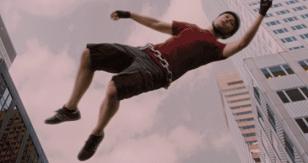
“Premium Rush” Shows Why Bicycles Should Digitally Replace Cars in All Action Flicks Ever

Joseph Gordon-Levitt, "Premium Rush"After seeing the new Joseph Gordon-Levitt flick Premium Rush tonight, I’ve realized that bicycles are the greatest machine ever. I should already know this after multiple viewings of Pee-Wee’s Big Adventure and my mastery of the old arcade game Paperboy, but those are old and Premium Rush is new. To today’s young folk that means it’s more influential than either of those works by definition.
Consider the pros of bicycle ownership that I’ve learned tonight:

* Bicycles use no gas. Not only does this save average consumers money, it means movies that replace all their cars with bikes will overflow with carbon credits or go-green points or whatever currency this market uses.

* Bicycles fit through tight cracks in traffic jams. Related note: traffic laws only apply if bicycle policemen can catch you. Don’t get too overconfident, since bikecops do have the power of teleportation, based on how many places our hero’s bikecop nemesis (stuntman Christopher Place) shows up in the movie through magical point-A-to-point-B locale shifts. That power only gets bikecops so far, though — their advanced age and lack of BMX tricks makes them an easily evaded adversary.

* Bicycle parts are sturdy and survive any and all forms of undue stress, short of a head-on collision. In that event, temporary replacement bikes should be readily available for borrowing from your immediate vicinity.

* Bicycles are much faster than cars. They can dodge and weave through the thickest of traffic, especially if you have the power of instant super-calculus like Amadeus Cho. If a crooked cop is several feet behind you, just pedal really hard. Sure. he could put his pedal to the metal and flatten you, but he won’t. For some reason. Mental block, maybe, who knows. One exception to this rule: when a finale is coming up, cars are faster because they have to catch up with you before the last big set piece begins. You can’t just arrive in time to save the day while the bad guy is still several blocks away because of rush hour or construction delays. No audience wants to cheer the defeat of a villain in absentia.

* Bicycle-related jobs never have a dress code. Our hero’s pride in avoiding nice suits and ties is a large part of Who He Is. (Our hero clearly learned nothing from Pee-Wee.) Late in the movie, a montage of assorted bicycling professionals confirms that clothing, hair care, and hygiene are left to the employee’s discretion. Hopefully they disinfect their packages before handing them to the intended recipient.

* The bad guys never try shooting you during chase scenes. You’re a small moving target, and they’re probably lousy shots anyway, even if they carry a gun for a living. This facet remains largely unexplored in Premium Rush, but in other chase movies, judging by the average number of missed shots per movie, I get the impression that crooked cops and evil military men never have to fret about marksmanship on their performance review.

* Bicycle lanes are optional. Over the past few years, Indianapolis has spent millions renovating and redesigning numerous thoroughfares to add bicycle lanes — sometime widening streets, sometimes taking an entire lane away from cars and designating it as a bicycle lane instead (White River Parkway North Drive, I’m looking in your excessively named direction). As seen in Premium Rush, Manhattan bicyclists seem to do just fine without them. The closest they come to compromising is when they have to share a walkway in Central Park with wheel-deprived pedestrians.

With so much going for bicycles, I foresee a day when filmmakers and studios revisit their works George-Lucas-style and decide it’s time to tamper with them for the sake of a modern audience. Imagine The French Connection with Popeye Doyle free-styling it up, or The Bourne Supremacy filmed in you-are-there Bicycle-Smashing-Cam. Stephen King’s Christine would have been about twenty minutes long, once the possessed 1957 Schwinn American realized it wasn’t really equipped to kill. Best of all in my mind would be the late John Frankenheimer’s Ronin — narrow chases through all those claustrophobic European streets, still at breakneck speeds, and everyone’s still armed with bazookas. The mind reels at the cinematic possibilities, so much so that I have to stop myself from staying up overnight and brainstorming any more. (Maybe that’s tomorrow night’s entry. No one tempt me.)

Setting all that aside, this was a fun, footloose, albeit PG-13-languaged 91 minutes’ worth of popcorn-movie excuse to watch Gordon-Levitt play the same kind of tenacious, hard-luck, unlikely hero that worked well for him in (500) Days of Summer, except here he’s not a jerk and he gets to win. It’s also a showcase for anyone who wants to know what Michael Shannon looks like, before he appears in next year’s Man of Steel. I didn’t see Revolutionary Road, for which he was nominated for a Best Supporting Actor Oscar for what I read was a fairly tiny role, but here he dominates plenty of screen time as a foul-mouthed crooked cop (who naturally is the one to fill the movie’s one-F-word quota) with an amoral attitude and an unfortunate addiction to Pai gow. His tough New York sounds more like other movies than what we heard last year on vacation, but that only added to his scary intensity.

Other random, disconnected thoughts that flew through my head while watching the Greatest Bicycle Film of All Time:

* Fun geek note: Shannon continually hides behind the alias “Forrest J. Ackerman”, named after the famous sci-fi fan. (Yes, once upon a time, they used to have those. 105% of all sci-fi fans wish that were still the case.)

* Other than Gordon-Levitt and Shannon, the only other actor I recognized without research was Aasif Mandvi, my favorite correspondent in those rare moments when I have time to watch secondhand online clips from The Daily Show with John Stewart. Mandvi basically reprises his role as cranky boss Mr. Aziz from Spider-Man 2, but his presence is value-added good times.

* Listen carefully during one of Gordon-Levitt’s course-plotting moments, and you’ll be rewarded with a Wilhelm scream, to no small comedic effect.

* Do the kids these days still say “shred” in any bike-related context? It sounds like previous-decade slang.

* Gordon-Levitt’s motto, “Brakes are death,” sums up every bad commute I’ve ever harrumphed my way through.

* My favorite thing about the movie was recognizing Manhattan landmarks and locales that our family encountered on our 2011 road trip. Among the notable sights that nab screen time are Chinatown; Columbus Circle; a #1 subway station (the 116th Street Station, if the visuals match the story); the Ed Sullivan Theatre (blink and you miss it); Columbus Street alongside the Natural History Museum; and, of course, Central Park. Natives no doubt will recognize three times as many places as I did.

* No, there’s no scene after the end credits, but you can stick around and hear several more minutes of “Baba O’Riley” if you’d like. You can also recover from the shock of realizing that the entire movie flew right by without a single character using the phrase “need for speed.” Writing without that cliché in a movie all about speed may be its most skillful trick.

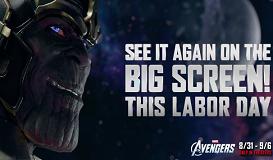
“Avengers” Labor Day Weekend Re-Release: Now You Can See it More Than Once, Just Like the Old Days

"Avengers" Labor Day theater re-releaseWhen our family saw The Avengers back in May — including sticking around for the famous shawarma scene after the end credits — we exited the theater starstruck and satisfied we’d received our money’s worth tenfold. My son and I even discussed the possibility of seeing it a second time. For a teenager whose generation doesn’t appreciate the concept of TV reruns, or the nerdist notion of watching a film enough times to memorize the dialogue, a request for an immediate encore marks his highest conceivable level of praise.
Between our hectic summer schedule and my preference for experiencing the unseen over rehashing the already-seen, I demurred and procrastinated. This Labor Day weekend, Marvel Studios reminded my son of our discussion by arranging a return to wide release for The Avengers as one last attempt at usurping Titanic‘s title as the second-highest grossing film in American box office history. For the sake of father/son quality time, we went for it.

Admittedly, I was pleased to be able to watch for a few new things I missed on my first go-around: the throwaway cameo by Dollhouse‘s amazing Enver Gjokaj as a flustered policeman; the indiscernible Alexis Denisof (yay Wesley!) as Thanos’ sidekick; the exact moments in which the “ST” and the “RK” are knocked off Tony’s precious monument to himself; Thanos’ gleeful reaction to the final line of dialogue (“To challenge them is to court death” — if you know Thanos, you know that’s one of his turn-ons); and the entire mountainside chat between Thor and Loki, which was had been ruined in my first viewing by an unwelcome, well-lit distraction from an uncouth cell phone user in the audience.

I rarely see a film more than once in theaters anymore. Except for dedicated cineastes and theater employees, I’m sure I’m not alone in this. Between high ticket prices and sometimes unpleasant theater conditions, it’s become challenging enough to attract some viewers for one showing of a new film, let alone encourage repeat business. It doesn’t help that the DVD/Blu-ray versions arrive on stores shelves faster and more furiously than they used to in the old days of home video. Gone are the times of pacing back and forth, waiting anywhere from six months to several years before being allowed to purchase copies of your favorite films. Today’s accelerated distribution system makes it easier than ever to sit through the same film as many times as you’d like, in as short a time span as you’d like after release. In the final analysis, even one Blu-ray is cheaper than six full-price movie tickets. (Living near a second-run dollar might help, if you don’t mind the celluloid deterioration after all those previous months’ worth of showings.)

I can recall several instances from my moviegoing past when I took opportunities to spend too much disposable income on multiple trips to the silver screen for the sake of a single work. For nostalgic brainstorming fun, I present a montage of films I saw more than once in theaters, and the rationalizations that enabled them.

Return of the Jedi — I was 11 in 1983 and had never been allowed to see a movie twice. I saw ROTJ once and thoroughly enjoyed it, even though I hadn’t seen Star Wars and had only read Donald F. Glut’s novelization of The Empire Strikes Back (a school book fair selection). While on vacation later that summer at my aunt’s place down south, we decided a movie outing was in order; our options were ROTJ again or Burt Reynolds in Stroker Ace. We won; Burt lost. Fourteen years later I also endured the 1997 “Special Edition” re-release, but I was older, less enamored, and had a hard time suppressing my snarky commentary. I’m pretty sure I had to be elbowed at least once before I shut up.

Independence Day — My best friend and I caught it opening weekend at the local drive-in. With such poor radio sound, sundown not yet finished, and the experience basically held away from us at arm’s length, it was all too easy to notice all the shortcomings and tally up all the references and swipes from other, better films. Not long after, I went with family to an indoor showing with a high-quality sound system that included super-powered subwoofers. With the vibrations and the thrumming and the EXPLOSIONS in full effect, suddenly it was the Greatest Disaster Movie of All Time. ‘Twas truly a film where effects made a massive difference.

Star Trek: First Contact — Because, frankly, it was all that.

Scream and Con Air — Two separate examples of me seeing a film on my own and enjoying it so intensely that I insisted on dragging my best friend to them, so she could see what I wouldn’t shut up about. We were still in that early stage of our relationship where I had no idea that her own movie preferences weren’t identical to mine. It took me some time and a few unfortunate occurrences before I learned an important lesson, one that I still observe today now that we’re married: just because I really, really like something doesn’t mean that I’m required to subject her to it, too, especially not over her strenuous objections. Learn this and learn this well, males.

Godzilla — I was so pumped up and ready for Roland Emmerich’s surely extraordinary reboot of the Toho legend, I saw it twice on opening day. First showing: I was alone and blown away. Second showing, with my best friend: I fidgeted a little more. Third time, with my mom: glaring issues began to appear to me like a kind of unhappy magic. Fourth showing, at a dollar theater, strictly for my five-year-old son’s benefit: I laughed through most of it, but he bawled when Godzilla died. It broke my heart and his, though he calmed down when the egg hatched at the very end. Today he loathes the film, as well he should.

The entire Star Wars prequel trilogy — Six showings of The Phantom Menace, a few apiece of the other two. Star Wars fever was in full swing for us in those days, but it ebbed as the quality of each successive movie ebbed. Some of those multiple screenings were just to spend quality time with the best friend who later became my wife, but I’ll admit that six showings of TPM was far too many. By the final attempt, I found myself dozing through most of the long, long stretch in Tatooine, including some of the podrace.

X-Men — First time was on opening night while attending a St. Louis sci-fi convention whose featured guests included four cast members from Mystery Science Theater 3000. After the prologue and opening, when we MSTies all read the transitional caption, “The not-too-distant future”, this absolutely, unintentionally brought down the house. Second time was back home for the benefit of my son, who didn’t get it.

Serenity — As a huge fan of Firefly, the first showing was A+++++++ but so devastated me, I hadn’t planned to see it again. Then I became offended at the weak box office returns. I became firmly convinced that all those free advance screenings they’d held in hopes of fostering Internet buzz probably just gave several thousand freeloaders an excuse not to pay for it. So I did what I felt was my duty and saw it once more. Wash’s final scene was no easier for me to weather.

Indiana Jones and the Kingdom of the Crystal Skull — First showing was courtesy of passes I scored to an advance sneak preview. I was so excited about the privilege of a sneak preview for such a high-profile film that I immediately went home, spent all night long writing an unpaid, pre-release, volunteer review for someone else’s gain, and went to work the next day at my actual paying job on three hours’ sleep…only to learn that the site had crashed for reasons unknown, and remained down all weekend long. Many aspects of this incident point to the myriad reasons why I don’t get to write for money. Oh, and my second showing was with family, after I slept for a couple of days first.

The Dark Knight — One mandatory normal showing, and one in IMAX just to see the difference. I was enthralled by the zillion-decibel sound system, but irritated by the switches back and forth from theatrical ratio to IMAX ratio, back and forth and back and forth, like someone playing with the “Zoom” button on a flatscreen TV. Not a fan of that jarring effect.

Toy Story 2 — Once in the original theatrical run; once in 2010 when my wife and I scored free passes to a Toy Story/Toy Story 2 3-D double feature. I’m no fan of 3-D, but I’ve yet to get sick and tired of either film.

Avatar — Once with my son; once as a kindness to my mom. I slept through some of the native alien-acclimatization montage, even in 3-D.

Chronicle — Because, frankly, it was all that. Ignore the denigrated “gimmick”, note the subtleties, and feel the harrowing.

Thus does Marvel’s The Avengers join their quasi-hallowed ranks. It didn’t need the extra cash flow nearly as much as Serenity did, but it was a pleasant use of the holiday weekend. I’m planning no more repeats this year, but Lord knows how next year’s fare will turn out. Best-case scenario: maybe Benedict Cumberbatch will give us a bravura, must-see-again-and-again performance in Star Trek II.2: the Wrath of Not-Khan.

The Day an Empty Chair Ruled the Internet

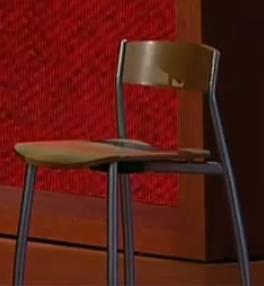
Empty Obama Chair, Clint Eastwood's arch-enemyBehold the face of America’s newest sensation. LOLcats, Kardashians, and the horrors of something calling itself “Honey Boo Boo” all took a back seat to the poor, defenseless chair that withstood a tongue-lashing from Academy Award Winner Clint Eastwood at the closing of the Republican National Convention, which in turn drew an awful lot of press to cover any number of foregone conclusions.

I refuse to watch the video on principle — the principle being, partisan politics don’t interest me. This keeps me shut out of a lot of online discussions and ensures no one will ever pay me a steady income to become a TV pundit. I’m fine with that, but it usually means I have to go slink off into a dark corner and find ways to entertain myself until politics go away.

My admittedly secondhand understanding of the situation, then, is that the 82-year-old director was invited to close the ceremony with no small amount of star power, somehow mistook the chair for President Barack Obama, and attempted to bully it until it cried. I’ve yet to confirm if anyone involved in the incident referred this peculiar condition to Dr. Oliver Sacks.

Maybe this merciless haranguing was the most hilarious improv set of the year. Maybe it was an unmitigated disaster, like the time Anne Hathaway and James Franco hosted the Oscars. Maybe I’ve misread and Obama was actually standing off-camera on the other side of the chair, or had been shrunk with Pym particles and was resting comfortably under the chair. All I know for sure is that this spirited but one-sided argument took over my Twitter feed Thursday night and effectively shut down all other topics and memes. On Facebook, the empty chair emerged from its humble beginnings in Nowheresville and became the talk of the town, superseding the usual daily barrage of Photoshop yuks and Zynga proclamations. This week, NASA launched a rocket bearing twin probes to study the Van Allen radiation belts (the real story here being: believe it or not, NASA is still in the launching business), but that link has now been kicked off all front pages in favor of headlines about verbally abused furniture.

Some people have joked about its unintentional symbolism. Others applaud the moment as Eastwood’s best comedy gig since the flicks he made with that annoying orangutan. Someone naturally registered “Invisible Obama” as a Twitter alias. Rest assured our nation’s crack Photoshop gag specialists rushed to fill the chair with repurposed images of Kermit the Frog, the Sad Keanu meme, and Lord knows what other variations I’ve missed. The Internet plans to milk this new, inanimate media personality for all it can, until the Chair gets greedy and begins demanding large paychecks to make forgettable cameos in terrible films.

Nothing I could write about anything right now could hold an audience’s attention a fraction as much as that now-legendary empty chair’s misadventure has. I’ll just shut up and let the video roll below for the truly, insatiably curious who missed this unique spectacle. I did watch a few seconds of it just to confirm that, of all the versions uploaded, the Wall Street Journal‘s version had the best screen resolution, but that’s as far as I went.

I salute you, empty chair. Enjoy your fifteen minutes, and try to be kind to us little people during your wild ride on the shaky wooden coaster of fly-by-night stardom. Remember, today’s celebrity is tomorrow’s Goodwill bargain.

Anderson’s “The Master” Final Trailer: No Similiarities to Persons or Groups Living or Dead, We Totally Swear

Readers who consider themselves unabashed Midlife Crisis Crossover completists (i.e., my wife and me) may recall my preoccupation with the trailers for Paul Thomas Anderson’s new film The Master, in which Academy Award Winner Phillip Seymour Hoffman plays a charismatic jack-of-all-trades who’s not named Hub L. Ronnard, who attracts followers to his self-invented belief system that’s not called Scientetics or Dianology, who has Academy Award Nominee Amy Adams as the wife by his side, and who’s trying to lure Academy Award Nominee Joaquin Phoenix to his side with vague platitudes and cryptic encouragement.

Recapping our first three installments for newcomers:

* Teaser Trailer #1: a reserved interrogation, a forgotten fight, some crawling through machinery, and adult sand sculptures, all set to spooky bass-‘n’-percussion from composer Jonny Greenwood, the Radiohead guitarist who also worked with Anderson on There Will Be Blood.

* Teaser Trailer #2: Hoffman takes center stage with his myriad talents and elliptical statements of purpose, all overlapping and fighting to surface in the consciousness of Phoenix, who chafes in a new, awkward chapter of his life. Adams loves her husband. The Greenwood score repeats.

* Full Trailer #1: an unbalanced Phoenix fails at life on the post-war homefront and instead follows a writer who’s big on doublespeak and revival tents. Adams is not at all happy this time around — glaring at doubters, questioning Phoenix’s sanity, and acting perfectly fine with her husband’s shenanigans. Greenwood is replaced at the 1:39 mark with Jo Stafford’s maudlin 1950 hit “No Other Love“.

And now, the four-part miniseries, “The Trailers of The Master“, concludes with the final, fragmented chapter:

Other than reruns from previous trailers, the core is a stilted speech about how human spirits trump the animal kingdom. A soft orchestra is drowned out by Joaquin Phoenix drumming like Buddy Rich on a locked window. Standard male viewers should now be excited by the prospect of fights, guns, motorcycle races, and sex scenes. (Yeeeey.)

The officially R-rated movie begins its limited-release rollout to American theaters on September 14th. IMDb lists release dates in several other countries over the next several months, mostly in Europe. (Is Scientology discussed or even heard of in Asia? I’d be curious to know.) My intrigue in the general concept has ebbed a bit, but we’ll have to see if Indianapolis’ only art-house cinema offers it before next Oscar season; how my curiosity, budget, and conscience are doing by then; and if I’m not yet tired of those involved repeating in every related interview like a holy mantra, “IT’S NOT ABOUT SCIENTOLOGY.” When I turn it over in my head, it’s funnier because I hear it in the voice of Arnold Schwarzenegger from Kindergarten Cop. In reality, it grows more disappointing every time I hear it.

Can the Final Season of “The Office” Out-Excruciate Season 8?

Rainn Wilson as Dwight Schrute, "The Office"After Steve Carell’s departure near the end of Season 7, and an uneven Season 8 marked by low ratings and much grumbling in our household about quality control, The Office returns for its final season on September 20th with original producer/showrunner Greg Daniels retaking the controls. I’m letting optimism get the best of me and taking this as a positive sign.

In a recent Entertainment Weekly interview, Daniels revealed some of the plot points in store for the last stretch of episodes, in which they’re free to go nuts and “blow things up.” Among other surprises in store, Season 9 will see Kelly’s defection to Fox’s The Mindy Kaling Project; two new characters taking over Customer Service; the return of Pam’s ex Roy (among other long-gone faces); an inevitable segue to Rainn Wilson’s Frasier-iffic spinoff The Farm, and at long last, a behind-the-scenes look at the documentary crew that sees, knows, and films all.

What about those other surprises in store? It’s too early to know for sure what ideas are locked in, what remains on Daniels’ wishlist, and what will end up as mere Season 9 DVD extras. It’s a good bet that whatever happens, it won’t be predictable, and in some cases it won’t be what we longtime fans want to see. Sometimes that’s a good thing, because we fans tend to imagine and ask for the safe, the easy, and the comforting from our favorite shows. When The Office is working as it should, it’s generally never safe, easy, or comforting — it’s the kind of awkward, messy, embarrassing series that can leave you laughing even while you cover your face in disbelief and keep peeking between your fingers at the TV.

If they really want to awkward things up, here are a few post-shark-jumping ideas for any number of episodes that will likely never be requested by fans, thus making them 50% more likely to happen than most of the typical fan wishlists currently viewable online:

* News arrives that Michael Scott has died offscreen. Totally, thoroughly, irrevocably, irretrievably dead, dead, dead, dead, DEAD. Thus is Steve Carell finally granted some semblance of peace, quiet, and reprieve from millions of fans who won’t stop pestering him to come back One Last Time to Save the Show. Carell instead relishes the chance to watch Season 9 from home as a fan while pondering his next dozen seven-figure-paycheck film roles.

* After buying the company, David Wallace gives Andy his blessing to run the Scranton office as he sees fit. Andy reassigns Nellie to the receptionist’s desk, has Erin take over the fictional role of office administrator, transfers Pam to Quality Control, and moves Creed down to the warehouse in the newly created role of Janitor Emeritus. Creed still never lifts a finger, except to devote more time to Creed Thoughts and its eight million imaginary followers. Most popular entries among the voices in his head include “Where’d All the White People Go?”, “What’s a Janitor, and How Does One Janit?”, and “I Must Kill The Baler Before It Kills Me”.

* Wallace also assembles his new officers. His new COO: Bob Vance, Vance Refrigeration. Phyllis is subsequently appointed to an executive VP position.

* Pam follows up Cece and Philip with a set of healthy quadruplets. Pam can’t convince any of her coworkers to look at their cute photos. The writers never even bother to name any of them.

* Jan brings her li’l toddler Astrid in for a visit, but is dismayed to find out that He Who Is Not Coming Back no longer works there. She spends the day hanging around anyway, pays Kevin a thousand dollars to babysit for her, then goes out for a lovely, wild evening with Stanley.

* After a disastrous incident with Angela’s state-senator husband that no one ever describes onscreen, Oscar decides he might not be gay after all and tries flirting with Angela, just because he’s curious to see what happens. There is no conceivable TV universe in which this begins or ends well.

* Ed Truck’s ghost returns to haunt Dunder Mifflin, approaching each of our characters one by one and asking if they’ll be his friend. Everyone hems, haws, and finds excuses to say no. David Wallace drives his son to the office and has him capture Dead Ed with a Suck It. When fans ask if there’s a remote chance of a super-special cameo by Michael Scott’s ghost, the very next episode features a team of priests, rabbis, shamans, and Ghost Hunters taking turns doing whatever they can to Scott’s grave to ensure that he remains dead, dead, dead, dead, DEAD.

* Mose rides a jet-ski over a shark pool. Turns out it’s his favorite hobby. No one knows why, and they’re afraid to ask where he got all those sharks.

* Toby resigns to become a full-time crime novelist. His first book is poorly reviewed, but sells like gangbusters in Latin America. Several months pass before anyone in the office notices he’s gone.

* Ryan begins to freak out when he realizes that all of his coworkers have been slowly pairing up over the last several years, that sooner or later he’ll be required to pair up with someone else now that Kelly’s gone, and that the only remaining candidates are Meredith and Madge down in the warehouse. When a desperate Ryan finds out the hard way that Madge has already hooked up with Gabe, he spends the last three episodes in his office closet, curled up under his desk and crying till the cameramen promise to go away.

* Darryl goes back to being really cool, just like he used to be, once upon a time.

* Some genius superfan kicks all his social-media accounts into hyperdrive and organizes an international “Bring Michael Back” campaign by convincing several million fans to mail buckets full of cheese puffs to NBC. In answer to their demands, Greg Daniels appears in the very next episode in a special cameo, dressed as the Munchkin coroner from The Wizard of Oz, holding a poster-sized death certificate, and singing: “As showrunner / I thoroughly can now confirm / That he’s not only merely dead / He’s really most sincerely dead!” All of fandom agrees to stop asking if Daniels promises never to wear the costume again.

* Instead of filing for bankruptcy and closing its doors forever in the final episode, Dunder Mifflin becomes a new power player in the publishing industry with its brilliant innovation that takes America by storm: electronic paper that exists only in virtual form, but which the company sells in virtual reams of 500 and in virtual cases of twelve reams apiece. This proposal makes no sense whatsoever, but crafty ol’ Jim finds a way to sell millions of cases to hundreds of gullible companies whose management are all over age 80. It is the greatest prank of his entire life.

* Final sequence: for the first time in his life, Dwight accidentally kills someone with one of his stashed office weapons — a delivery boy who didn’t check in at reception and has more tattoos than Dwight would prefer. His retreat to The Farm is borne not of a desire to focus on a different career, but to escape the long arm of Scranton law. Dwight imagines he’s an excellent refugee. The reality is that the Scranton police know Dwight pretty well and never did like that delivery boy, who had a rap sheet a mile long and was more terrible at delivering than Fry from Futurama. According to their final police report, the evidence was all too circumstantial for them to build a solid court case, so they’re prepared to let it languish in permanent cold-case status. As a practical joke they let Dwight live the rest of his life in hiding instead of telling him all of this.

Jamal Igle’s “Molly Danger” Aims to Remind: Comics Aren’t Just for Adult Males

Jamal Igle's "Molly Danger"Older collectors can recall a time when fans of all ages could find comic books skillfully produced as entertainment and inspiration for any and all comers. In ye olden times of my own childhood, kids like me were more than welcome to read the adventures of the Marvel and DC mainstream universes, to participate in the stories that “mattered” in the lives of their favorite heroes.

Today, not so much. In recent decades, creators have taken considerable pains in expanding the boundaries of the medium, crafting ostensibly sophisticated stories for a self-described “mature” audience, and convincing themselves that the one true path to literary respectability requires copious bleeding and nonstop pandering to the hormones. Some comics from the Big Two comic are a few steps removed from the average issue of Maxim. In the prevailing sales theory of our times, adult males are the only audience that matters, and this is obviously what all adult males need. Kids who naively or accidentally wander into a comic shop are discouraged from roaming the store freely, instead shepherded over to one designated rack filled with tons of cartoon-based comics, Archie Comics that the regular shoppers have learned to ignore, and thirty-year-old back issues — in short, not much for their generation to call their own. (If your child is lucky and your retailer is magnanimous enough, you might see a lone shelf copy of Strawberry Shortcake. Big if.)

Jamal Igle has something different in mind. After two decades of working for Marvel, DC, and several major independents, Igle is working outside the corporate scene on his own creation, a four-part graphic novel series called Molly Danger, taking full advantage of the shocking truth that some girls like action, adventure, super-heroes, and sci-fi, but should have at least one viable option beyond androcentric pabulum. Several years in the making, Igle described the premise in a recent interview like so:

Molly Danger is the world’s most powerful 10 year old Superhero. The catch is, she’s been 10 years old for almost 20 years. The public and Molly herself believe she’s an immortal, superhumanly strong alien being form a planet called Gamma 7, a world on the edge of the Galactic rim. She protects her hometown from the Supermechs, a collection of cybernetically enhanced villains. She lives in her own museum, lovingly referred to as the Mollydome. She’s respected and loved by everyone.

Unfortunately, Molly is a bird in a gilded cage. She doesn’t have any friends or family, she doesn’t have a secret identity or a life outside of being Molly. She’s kept sequestered from the public because she’s a target for her enemies and a danger to others because of her strength. She longs for a normal life.

Molly Danger should address a few lamentable shortcomings in today’s field: the lack of reading options for young but literate fans; the preponderance of sex toys pretending to be actual characters; and the derivative nature of so many heroines who are basically sidekicks or female versions of preexisting male heroes. (The underlying message therein: the best ways for a woman to succeed are to work for a great man, or to copy him Single White Female style. Plan C, of course, would be to settle for marrying a great man, leaving your five-year plan at that, and hoping really hard not to meet the same grisly fate as countless other wives and girlfriends in comics.)

Igle has a Kickstarter campaign in progress as of this writing, with three days and several dollars to go. The publishing plan is a four-issue miniseries of oversized hardcovers to be released by Action Lab Entertainment, purveyors of the excellent, award-nominated Princeless (fit for the same audience and pretty high-quality, judging by the first issue I read). Setting aside the mild language in the Maya Angelou quote that prefaces the Kickstarter video, this looks to be a winner on an all-ages level, in the sense of Pixar “quality for all fans at all levels” instead of the sense of “innocuous twaddle for ages four and under”. Igle has drawn comparisons to the likes of Astro Boy or The Powerpuff Girls in that sense.

The Kickstarter page offers plenty more art samples, typically top-notch from the artist whose favorite work of mine was an underrated run on Firestorm some years ago. Igle’s own blog also contains a recent press release with more details about supporting characters and other assorted tidbits.

For the jaded comic readers among you, consider the competitive advantages of Molly Danger for your reading dollar:

* Guaranteed not to be just one long, soulless ad for a corporate cartoon!
* Guaranteed not to be ruined by short-sighted editorial meddling halfway through!
* Guaranteed not to be wrested from Igle’s control and assigned to some hack writer who’s unclear on the concept, decides the series needs to be more “modern”, and has half the cast butchered!
* Guaranteed not to be interrupted ten pages from the end by a three-month-long crossover that requires you to buy twelve other Action Lab series!

I would like to say “fun” is also guaranteed, but fun is in the eye of the beholder and may vary by user. If Molly Danger isn’t fun after all, then Igle totally misrepresented and we should all sue him to death. But I’m betting fun will win out.

* * * * *

Department of Full Disclosure:

1. I’ve been an official Supporter of Molly Danger for a few weeks now. I’m not a paid shill here, just a happy reader who likes seeing nifty things published.

2. My only experience with Igle in person was watching him at a 2011 fan-awards presentation at C2E2, where he had the privilege of accepting several different awards. They were mostly accepted on behalf of other no-show winners, but still, I’m sure there’s a certain prestige to being Award Acceptor Jamal Igle, even if all our photos of that presentation turned out dismal beyond belief.

My Own Meager Panegyric to the Tony Scott Oeuvre

As of this writing, police investigators and armchair pundits are no closer to fathoming the motivation behind the August 19th suicide of director Tony Scott than they were the moment it happened. Summarizing the bullet points from all the articles: age 68, wife and two children, no alleged terminal illnesses (despite early misled reports), and no zero-star reviews that should’ve been haunting him for any recent movies. (I could imagine a director with a film sitting at 0% on the Tomatometer questioning his life choices, though I would encourage them to persevere and love life anyway.)

In reviewing his directorial resumé, I learned one surprising fact: I’m not remotely qualified to deliver the ultimate critical essay on Scott’s artistic merits. Out of the 20+ films he helmed, I’ve seen six. I’m not sure if that says something about him or about me. On the other hand, I can think of many directors fewer of whose films I’ve watched than Scott’s (Kurosawa, Tarantino, Kubrick, Woody Allen, anyone working prior to 1960 except Hitchcock or John Ford…). There’re reasons why a search for “Tony Scott” on the Criterion Collection site yields only indirect results, but when I was successfully lured to one of his trademark high-octane action films, I usually appreciated the manic energy that infused them so thoroughly, and how the actors who worked best with him seemed to thrive on that energy.

These, then, are my memories of the late Mr. Scott where his works intersected with my viewing experience, for better or for worse. Not full-blown reviews — too soon, in a way — just my own memories, mostly drawn from times in my life when I would watch just about anything except 18th-century British TV dramas.

(Caveat for strict role-modeling purposes: just because I watched them at some previous time in my life doesn’t mean I’m recommending you catch them on Blu-ray immediately without regard for content.)

Top Gun — The film that put Scott on the map and is consequently name-checked in every single postmortem. I was a child of the ’80s, but I missed a lot of cultural touchstones the first time around (to this day, I’ve still never seen Pretty in Pink or Sixteen Candles, mandatory viewing for my peers). The first time I watched it was out of temporal context, in June 2000 as part of an online IRC chat in which several of us MST3K fans watched it simultaneously on cable while trading barbs back and forth. If I’d seen it when I was fourteen, I imagine my reaction and my world would’ve been very different.

The Last Boy Scout — Of the six films, this is arguably my all-time favorite, a showcase of Scott’s knack for hooking up with talented collaborators. Bruce Willis is basically John McClane at absolute rock bottom, and Damon Wayans succeeds in a rare attempt at a dramatic role, but what made it crackle for me was a Shane Black screenplay that knew it was just a big dumb odd-couple guy-flick, knew it wasn’t out to enlighten or change the world, and knew which buttons to keep pressing, holding, and slamming into the guy-flick control panel. When I was taping movies from cable TV in my college years, I liked this one so much, I recorded it on SP mode for the improved picture quality, even though that used up three times as much videotape. For me, that was serious appreciation.

True Romance — Like most guys of the time, I was drawn in by the credit “Written by Quentin Tarantino!” Unlike most guys of the time, I didn’t really care for it. I remember four distinct impressions from the one time I watched it at the theater:

1. A Mexican standoff? Again? Didn’t we just see that in the landmark that was Reservoir Dogs?
2. I never want to see Gary Oldman with dreadlocks again. Ever. Like, ever ever.
3. Heathers really was the pinnacle of Christian Slater’s career.
4. Is Sonny Chiba real, or did Tarantino make him up?

…but at least it wasn’t boring. I credited the directing for trumping the writing in that respect.

Crimson Tide — While I was putting the pieces of my head back together in my post-divorce years, I hung out with a friend regularly who would come over for frequent TV-show marathons and occasional movies. Gift-giving was hard because I was still in that young-male mode where I gave gifts I thought were cool, versus what the recipient might actually like. Dwelling on the criteria of (a) liked Das Boot, and (b) really likes Gene Hackman, I concluded (c) Crimson Tide would be the perfect gift! It wasn’t till some time after watching it together that I learned she really wasn’t a fan of strong language, or of films in which the plot consists of angry guys trying to out-macho each other. I thought it was high art, anyway. Fortunately she forgave me and married me several years later. That same VHS copy of Crimson Tide is still on our shelf, a token of times past.

Enemy of the State — In this corner, once again: Gene Hackman, ruler of anything he agreed to do. In the other corner: Will Smith, post-Fresh Prince and ruler of blockbuster sci-fi films at the time. Sadly I don’t recall their exchanges so much as I recall the two thousand different well-known supporting or character actors that overstuffed the film (Jack Black in a rare serious role!); the heavy use of state-of-the-art surveillance tech that seemed frighteningly sci-fi futuristic at the time, but which is now readily available in the form of Google Earth and the everyday gadgets in everyone’s pockets; and that one super-awesome crash where that black SUV kept flipping and flipping and flipping and just wouldn’t stop flipping. Where Top Gun was gung-ho Reagan-era zeitgeist, Enemy of the State was eerily prescient of a world where Big Brother not only rules, he also lets us have all the coolest toys.

Unstoppable — Scott made five films with Academy Award Winner Denzel Washington. I trust they got along famously. As nonstop adrenaline rushes go, Scott’s eye was in fine form here. Even more fun for me was the running theme of old man Denzel sparring with impudent punk Chris Pine about the younger generations supplanting their elders, before said elders are ready to exit and before said young’uns are truly ready to handle the reins. (I can only hope this wasn’t something close and personal to Scott’s own mindset…) I’m in-between their characters right now in terms of age, and fully able to sympathize with both sides of the argument. Watching past-Me debating future-Me had a certain intellectual allure to it. Also, there were EXPLOSIONS.

Seeing all those thoughts written out, the conclusion is easier to draw now: for me, the best Tony Scott films were all about the amazing adventures of the Man’s Man. For this achievement, I thank him and now have much to ponder about my own psyche.

It goes without saying that I really, really, really wish a better ending had been written.

GenCon 2012 Photos, Chapter 4 of 4: Games People Played, and the Mascots Who Sold Them

For those who didn’t attended GenCon 2012 in Indianapolis last weekend and are beginning to wonder: yes, the gaming convention had games, for playing as well as for buying. Participation in most gaming sessions and tournaments requires extra ticket purchases above and beyond your admission fee, so your personal budget has to be drastically inflated accordingly. Foreknowledge of the game and its rules is a plus, thus shutting me out of a good number of opportunities. Also, I always worry that my first try will devolve into an hours-long heated debate about everyone’s variant rules they use back home versus what the rulebook actually mandates. And then there would be egos involved, followed by machismo, expressed through the throwing of dice and props at me, and then my whole weekend is in shambles and I have to forfeit the game and fees out of concern for my safety and mood. Rather than risk this ludicrous scenario coming to life, I leave the gameplay to others.

My wife and I did play-test one game in the exhibit hall. Luckily for us, the folks at Smirk and Dagger Games are always accommodating to inexperienced passersby who seek something that’s different instead of alienating. It helps that they never seem to have crowded tables. The last time I attended GenCon, I bought a copy of Run for Your Life, Candyman, a spoof of Candyland that adds a violent gingerbread-man-on-gingerbread-man combat system, after they impressed me with a demo of its then-upcoming sequel, Shoots and Ladders, in which the armed cookie-killers are transplanted into a familiar, interconnected, 100-square setting. This time around we tried Sutakku, in which those frustrating small and large straights from Yahtzee are given slightly relaxed rules, then adapted into a tower-building scenario using a handful of d6’s whose standard pips are replaced with Japanese kanji. The game master handily beat us, but I’m proud that it wasn’t a shutout. $24 seemed steep for a handful of designer dice, a cardboard circle, a rulebook, a scorepad, and a deck of tiny penalty cards that worked much the same as the “Share the Wealth” cards from Life, but it was fun while it lasted.

Beyond that, the following photo parade captures an assortment of sights and statues from our GenCon 2012 thumbs-up experience:

Dungeons & Dragons booth entrance

The centerpiece of the exhibit hall was naturally Dungeons & Dragons, one of the reasons GenCon was created in the first place back in 1968. The booth entrance looms large and bids you welcome!

Continue reading

“Bunheads” 8/20/2012: the Ringer Twirls While the Ballerinas Burn

"Bunheads: Rise of The Ringer"

The Ringer waits in the wings for her time to strike.

Important things first: ABC Family has wisely chosen to order more episodes of Bunheads, with a promise to return in the winter instead of making us wait till June 2013 for our next fix. Much appreciated, ABC Family execs!

That saving grace means that this week’s episode, “A Nutcracker in Paradise”, wasn’t the series finale after all, but a “summer finale” marking the end of the season in an astronomy sense rather than the TV-standard sense. I’m unused to this approach to TV time-marking since I’ve never watched any other ABC Family shows, unless you count the old reruns of Whose Line Is It, Anyway? that they dropped long ago, or one time our family visited the set of The 700 Club in Virginia Beach even though we weren’t fans. (Long story.) I look forward to the “winter premiere” when its time arrives, but one has to wonder if the summer season and winter season will together comprise the eventual Season 1 DVD set, or if Summer 2012 was Season 1 and Winter 2012-2013 will be Season 2, or if the DVD manufacturer will avoid “season” divisions and opt instead for “volumes” like some animated shows do.

I’m taking a DVD release for granted, of course. Now that the specter of cancellation has dissipated for the moment, unbridled optimism is the order of the day. While we’re dreaming big, let’s also wish for more fun cameos for the benefit of you Gilmore Girls fans, maybe a few higher-profile guest stars, and something involving the word “Emmy”. Call me a lunatic, but it feels a lot better than living in a constant state of fear and chanting, “Six seasons and a movie! Six seasons and a movie! Six seasons and a movie!” as if the Beetlejuice summoning method will make it so.

Regardless: we can breathe more easily, knowing that the show didn’t end permanently with this week’s cliffhanger. I knew the show was headed somewhere dark as soon as I realized that the first half-hour had far too many happy moments in it. Too much happiness always means doom and gloom are bound to arrive and restore much-unwanted balance to the scales. First happy event: the previous week’s feud between Ginny, Melanie, and Boo over the date-ability of icky Charlie and dashing Carl was forcibly negotiated with a gum-wrapper treaty and no small amount of badgering from an annoyed Sasha and a tentatively promoted Michelle, clearly high on the first of many power trips yet to come.

With everyone friends again, love was truly in the air! (Well, not for Truly, hereby dubbed Lady Not-Appearing-in-This Episode.) Michelle and Godot the bartending stud moved past the googly-eye stage and shared tender public moments, to a lot of bemused head-turning from the other tables. Fanny and Michael seemed happier than ever, and in talks for some extended quality time in Montana. Boo gave the most achingly self-deprecating speech of the season, threw herself on the mercy of the Nutcracker fundraiser, and won back the heart of Our Hero Carl at last. Hurray for happy endings that will certainly stay very happy forever and sure not be ruined by any horrifying turn of events or anything!

Not even Sasha was immune to Cupid’s well-oiled scattergun. Despite her wish for lesbianism to save them all from guy trouble, Sasha met-cute against her will with a potential suitor of her own at the Oyster Bar’s fundraiser. He begins the episode as Tyler, star of a sad basketball team on a Charlie Brown losing streak, and ends the episode as Roman, newborn rebel transformed by thirty-year-old goth-rock. I’m fine with the costume department’s eclectic decision — grateful, even, that they went with something besides ’80s hair metal or up-‘n’-coming corporate-rock product placement. I’m not sure how well “Bela Lugosi is Dead” would lend itself to modern dance, but they’re certainly welcome to try. (If that doesn’t work out, might I suggest “Detonation Boulevard” by the Sisters of Mercy?)

Outside the subplots of love, Sasha once again nabbed a solo routine, this time in a satirical anti-Wall Street number accompanied by the descendants of the dancers from Madonna’s “Material Girl” video. Michelle enjoyed a rousing musical moment, a dream rendition of “Maybe This Time” from Cabaret. Boo and Carl shared a blissful makeup dance to “The Rainbow Connection”, as covered by Weezer with Hayley Williams of Paramore. Hopefully the winter season/volume/session/whatever allows opportunities to shine the spotlight on Ginny, Melanie, or even twelve-year-old Matisse, who by my reckoning is owed something for enduring Ginny’s frantic will-I-or-won’t-I rapid-fire blathering that seemed to be fueled by one too many gallons of Red Bull. (Fun trivia: this episode isn’t actress/dancer Matisse Love’s first time performing The Nutcracker.)

Alas, everything came crashing down in the episode’s fateful second half, in which Michelle wreaked untold havoc with six of the deadliest words in the English language: “I was only trying to help.” After earning so many smiles from Fanny in the first thirty minutes, she found it was all frown-hill from there.

First she attempts to play Doctor Love for Fanny and Michael, now falling out over Michael’s alleged plan to move to Montana permanently and possibly solo. When Michelle tries to talk Michael out of doing what she thinks Michael is doing, Michael apparently accelerates his plans and vanishes ahead of schedule. Handy tip: when a schmuck of a male is trying to avoid commitment, telling him his Signficant Other’s surprise commitment plans may not be the best way to change his mind. Who knew.

And then there was the big night, The Nutcracker in all its intended glory, Paradise Dance Academy’s biggest show of the year, the one that keeps them solvent and on the map. It’s like tax season for H&R Block, or the Indianapolis 500 for the town of Speedway, or the annual Marvel crossover event. This. Was. Very. Important. And all of it came crashing down in an initially funny, suddenly terrifying sequence in which an inattentive Michelle reaches for some refreshing misting water for the overheated cast and instead whips out her can of “pretty mace” on all of them, even testing it on herself like a true Stooge. Hijinks, eye damage, and “Marco! Polo!” ensue. As blinded teens body-slam each other or crawl offstage to safety, The Nutcracker transforms into Rise of the Ringer as Sasha’s usurper seizes the day, takes the stage, and delivers the performance of her career to an appreciative audience of zero.

Yes, behind all this madness and mayhem lurked…the Ringer. The first-ever super-villain ballerina was cordially invited to infiltrate the dance studio at Fanny’s behest while Sasha was still under the spell of Bring It On. Though Sasha was obviously freed this week from the Cult of Sue-Sylvesterology and ready to assume the role of Clara per Paradise annual tradition, the Ringer was nonetheless unstoppable by the adults and unflappable in the face of Sasha’s attempt to fire her. The nameless Ringer was a lean, mean, dancing machine undaunted by multitasking, untempted by human niceties such as courtesy and emotion, and completely oblivious to everyone else’s constant movie references. “I don’t have cable!” she whined in pain as she revealed her one weakness and her secret identity in that moment: she’s obviously a Nielsen viewer. Expect this supernaturally talented adversary to become Bunheads’ answer to Sideshow Bob in the seasons/volumes/sessions/whatevers ahead.

Beyond a bittersweet yet enigmatic dream reunion between the widow Michelle and her departed one-time husband, the episode ended with a wrenching walk down the hospital’s White Mile, accompanied by the echoes of Fanny’s fury and the sounds of Paradise parents demanding something between justice and litigation. The final Dead Poets Society tribute may not have been original, but it was no less heartbreaking, especially when Michelle had to remind Blockbuster’s best customers how that particular movie ended. (Seriously, is there so little to do in Paradise that all the kids spend their entire lives sitting through eighteen hours of cable movie channels every day, memorizing them wherever possible, maybe even taking notes on index cards just for small-talk prep? Remember the time when Melanie cracked wise about Martin Scorsese’s Kundun? What human does that? Watch Kundun, I mean?)

In these next few months without Bunheads, many questions will haunt us. Can the parents of Paradise ever forgive Michelle? Can our queenly quartet devise a clever way to restore Michelle’s honor and somehow blame everything on the Ringer? Can Fanny forget that free-love cad of hers and move on with her life and heart? Even if she does, can the studio afford to go on? And is there some way Ghost-Hubbell can become a regular?

Until Bunheads returns, we bid farewell for now with this closing number — that Weezer/Williams cover of “The Rainbow Connection”, one of the best Oscar-nominated songs of all time, a close personal favorite of mine since childhood. Kermit’s fragile banjo hook strikes a nerve for me every time. This version opts instead for ethereal strings that don’t achieve quite the same authenticity, but a TV season/volume/session/whatever that included both this song and They Might Be Giants holds a pretty astronomical ranking in my book.