 TV animation fans are still coming to terms with recent announcements that Cartoon Network had canceled two Saturday morning series, both part of the DC Nation programming block — Young Justice after two seasons, and Green Lantern after a single season. Cancellation isn’t unusual for the basic-cable channel — their programming history is a long shopping list of short-term productions. In fact, if you set aside the frequent Ben 10 reboots (the Scooby-Doo of a new generation in its own way), their longest-running series outside the Adult Swim block (i.e., still producing new episodes and not existing solely as reruns) is Adventure Time, which will celebrate its third birthday next month. The minds behind Young Justice should probably count their blessings that they were allowed two entire seasons instead of being truncated after six episodes.
Typical Cartoon Network cancellations tend to come and go without a public post-mortem or much of a protest. However, the curious circumstances surrounding these shows’ unforeseen terminations was addressed last weekend at the Emerald City Comic Con in Seattle, where longtime Warner Brothers Animation producer Bruce Timm was asked about the cancellations at a Q&A. In the wake of a January article about Young Justice ending due not to low ratings but to anemic toy sales, multimedia news/rumor site Bleeding Cool followed up with Timm’s response regarding Green Lantern, referencing weak merchandise sales as the primary cause of death:
Since the Ryan Reynolds’ film, retailers were stuck with film merchandise that just wasn’t selling. This led to those retailers being very reluctant, if not downright refusing, to any carry merchandise from the Animated Series. Therefore, a lack of sales on that front lead to a lack revenue for an admittedly expensive CG series.
In reading the paraphrasing of Timm’s comments, I couldn’t help feeling a little naïve and a whole lot disappointed. Though the shows weren’t quite for me, I can respect the efforts that went into them and the fan bases they garnered. The part that struck me in the worst way was that, if those two articles linked above are to be believed — and I’ve seen no evidence that anyone in authority disagrees with them — then the crews of both shows essentially lost their gigs regardless of the quality of their own work. If the stories were engaging and the animation was suitably competent, it didn’t matter. Even though Nielsen commoners didn’t exactly boycott the show, ratings were seemingly a secondary consideration. The bottom line, as I understand it: they failed as toy commercials.


 Whereas the first two editions of “MCC Q&A” were comprised of tongue-in-cheek responses to odd queries and sentence fragments that brought search engine users to my humble doorstep, this one is devoted to a single question from an MCC commentator. Far be it from me to allow the plaintive mumblings of nameless strangers to monopolize this slightly recurring feature.
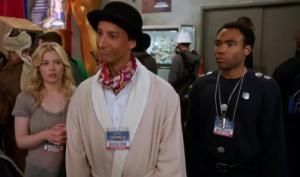 I had been looking forward to last week’s new episode of Community, “Conventions of Space and Time”, which invited us into the inner workings of an official Inspector Spacetime convention, a place where Troy and Abed could meet other fans of the obscure British TV series, indulge in a few hobby-related purchases, and generally be themselves. As someone who’s been to C2E2 twice, Wizard World Chicago four times, three GenCons so far, two Star Wars Celebrations, and several local Trek conventions, I was curious to see how the generally geek-approved series would approach such a setting. I tried to keep my expectations modest — without creator Dan Harmon around anymore, this season’s first two episodes were a little shaky. I’ve stuck with the show and keep hoping for the best.
 As my seventh annual foray into this personal fun ritual, presented below anyway is the timeline of events as I witnessed them during tonight’s ABC telecast of the 85th Academy Awards. All quotes are approximate as best as possible without benefit of rewatching, cribbing from national news outlets, or much proofreading. Our household does not own a DVR; all recollections are a combination of short-term memory and notes hastily handwritten on a legal pad, not a copy/paste reassembly of a distracted live-tweet flood. When I’m seated in front of a TV, I’d much rather watch than type.
 I already explained
  As mentioned previously, I’ve seen every Academy Award winner for Best Picture from Wings to The Artist, retaining varying degrees of recollection. I’ve also seen every Best Picture nominee from 1997 to the present, and have embarked on a slow, low-priority, extra-long-term quest to see how far backwards in time I can extend that date. Right now I’m stalled on 1996 because the DVD version of Secrets & Lies is out of print, secondhand copies are priced much higher than I’d prefer, and I’ve never caught it airing on a cable network. Someday I’ll overcome that obstacle and continue down the line in reverse order.
 Everyone who watches the Academy Awards has their disagreements with the Academy. Not one living person would look at the complete list of Best Picture nominees and argue that the right movie has won every single year since Wings. We all have our own ideas about what makes one movie better than other movies. The idea of separate, distinct works of art being forced to compete against each other in an expensive dog-and-pony show may seem crass, especially considering the plethora of talents, genres, budgets, studio systems, sweetheart agent deals, and marketing departments that are fundamentally incomparable in any reasonable aesthetic discussion. Big-budget award-grubbing machines and high-minded shoestring-budget indie flicks shouldn’t be fighting each other; they should be working side-by-side, providing viewers with a vast assortment of reasons for film lovers to remain invested in the medium, and maybe even teaming up for the occasional crossover.
 After
After  It’s that time of year again, the week before the Academy Awards ceremony, when anyone who pontificates online about movies to any degree is compelled to reflect on Oscar winners of years past and mine their history for writing material in lieu of relevant news updates and Oscar pool handicapping. I suppose I should add my two cents quickly, lest I risk being last in line, though I’m sure all mine are taken by other Oscar fans now, if not necessarily in matching quantity. Years ago I completed a lengthy quest to see every Best Picture winner from Wings to the present, just to see what would happen. Some I’ve long since forgotten, some were travesties I wish I could unsee, but many were worthwhile experiences.
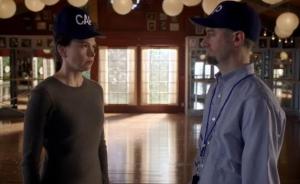 Tonight’s new Bunheads episode, “It’s Not a Mint”, begins with Sasha experiencing every new renter’s worst nightmare: a possible burglary. Maybe. She arrives home with groceries in arms and finds her front door standing wide open. She smartly opts not to go inside, clumsily drops her groceries, and calls for help. The other Bunheads’ phones all go to voice mail. Her neighbor Mrs. Weidemeyer won’t answer the door. Sasha even turns to Siri to dial 911 for her because dialing three whole digits is too much work. Unfortunately her iPhone comes preloaded with the standard sitcom version of Siri that’s equipped with the hearing of a senile grandmother. (To be fair, it’s for the best that every fictional version of Siri malfunctions. If it worked according to specs, I’d roll my eyes and accuse the show of product placement. Siri just can’t win.)
 I spent the first thirty-five years of my life in rented dwellings. As a child, making holes in the wall was a major no-no. The adults were allowed to hang a few nails for photo display purposes, and for one calendar. Otherwise, I was informed countless times that the big bad rental management frowned upon holes. Wall holes were bad. The way I was told left me with the impression that if the maintenance men ever came inside to repair something and discovered holes in the wall, we’d all be in big trouble.
  If you fear the aging process and aren’t remotely excited in seeing your possible future as a senior citizen writ large without any regard for your afterlife possibilities, chances are Michael Haneke’s new film Amour will be your scariest encounter of the year.
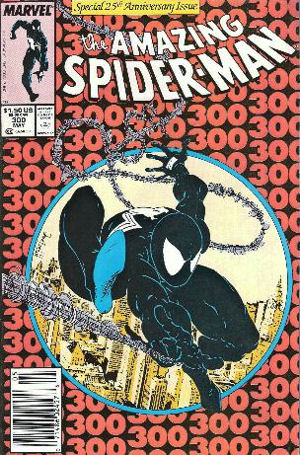 If my entire comic book collection were in mint condition, one of the more valuable modern-age collectibles would be Amazing Spider-Man #300. Not only was it part of the run that cemented Todd McFarlane as a bankable superstar, it also introduced Venom, who in my teenage eyes became one of Spidey’s scariest adversaries, up until Marvel later saturated the market with tons of Venom miniseries and crossovers. Though he wore out his welcome, I still hold a few fond memories of that era in the field.
 Midlife Crisis Crossover!