2012 Road Trip Notes on the Go, Day 5: Beauty and Breakdowns

Today we bade farewell to our hotel outside Denver. Unfortunately, we departed just in time for rush hour and spent twice as long in the car as expected. We stopped for gas in the town of Castle Rock partly to let the traffic die down, partly for snacking purposes (some of us were burnt out on three straight days of the same hotel breakfast), and partly because I was amused to see a town sharing a name with a Stephen King motif, even if the town predated the setting.

When the coast was clearer, we headed south to the Colorado Springs vicinity, veered west for a return engagement with the great and powerful Rockies, and paid a visit to the Garden of the Gods, a coincidental collection of naturally occurring rock formations in unusual shapes great and large — a few monoliths, a couple shaped like animal heads, and some towering in pairs. Our favorite was Balanced Rock, a large, precariously perched roadside boulder that remains inexplicably secured. In addition to the uniquely shaped geological specimens, one other sight was new to me: Mennonite tourists using cameras much nicer than mine, tricked out with zoom lenses and tripods.

Five minutes down the road was our next attraction, the Manitou Cliff Dwellings. Over a century ago, a collection of Anasazi homes was uprooted and relocated in the side of a mountain near the town of Manitou Springs for preservation and education purposes. Visitors can enter any door or window and snake their way through the passages connecting each facade or dwelling, including one two-story, multi-family unit. That is, you can do so if you’re not in line behind a youth group on a field trip who’ve already filled all the ex-domiciles to full capacity. Fortunately for them, no ancient Anasazi fire marshals were anywhere in sight to cite the kids for overcrowding.

Alternatively, you can check out their multi-level museum and gift shop, which together occupy somewhere between two and eight stories. The layout was confusing, far from straightforward, separated me from my family at least once, and led me to two or three dead ends, each one filled with quality merchandise such as feather-shaped lollipops displayed like a war bonnet, the same pile of inseparable magnetites you can buy in every gift shop nationwide, and lethal weapons such as the “Deerslayer Boomerang”, a cardboard children’s tool that would cost one dollar if ordered from a comic book ad in the 1970s.

On the other side of US Highway 24 was downtown Manitou Springs, a tourist town comprised of numerous small businesses (including one comic book shop!) and one Subway. With limited time before our afternoon appointment, we fetched lunch at one of the restaurants nearest the public-parking area, a bar-‘n’-grill called the Keg. I wasn’t sure this was a family establishment that would serve my seventeen-year-old son, but no one broached the subject. It was his first opportunity to watch his lunch being cooked by a tattooed chef wearing a concert T-shirt in lieu of a garish fast-food uniform. Nevertheless, I can testify that my Mile-High Roast Beef sandwich was authentically meatier than any Arby’s product I’ve had to date. All the Slipknot logos in the world couldn’t have affected my enjoyment of that.

High above the town is the Pikes Peak Cog Railway station, which offers a handy train ride from Manitou Springs (elevation: 6,571 feet) to the top of Pikes Peak (elevation: 14,110 feet). Your alternatives to reach the top are: (1) a long hike, for which our family is ill suited; (2) a three-hour daredevil drive, which my wife refused to let me attempt; or (3) invent a flying machine, for which our family is also ill suited. The Cog Railway isn’t cheap, but it’s a once-in-a-lifetime chance for about the same price as admission to a bad amusement park.

Our departure was scheduled for 1:20. We began boarding at 1:00. We steeled for takeoff at 1:20. After sitting for another half-hour or so, we learned another train somewhere on the track was experiencing technical difficulties, At first they moved our train onto an alternate track so the impaired train could return to the station. Then they moved us back onto the main track. Then we returned to the alternate track again. Throughout the merry rearranging games, our cheerful conductor did her best to keep us entertained with situational updates, good-natured bad jokes, and individual anecdotes about the nearby apple tree, the nearby bench, and any other random objects we could see through our windows.

After an hour of waiting in a train that wasn’t getting any more air-conditioned, finally they moved us even further forward into their official train repair shop, had us disembark and walk back to the station so trains could be swapped around and tourism service could resume. This awkward transition allowed the Railway time to issue customer refunds if desired, resell those seats to new customers, and sell off any seats that had been previously unsold prior to our aborted departure. I can’t fault them for wanting to maximize service on what would prove to be a totally off-schedule day, but when we boarded our substitute train, it was discouraging to find that the additional elbow room we had claimed from those formerly empty seats was now revoked, leaving us more cramped than we had been before.

A full ninety minutes after our scheduled time, our journey to the Pikes Peak summit commenced at long last, The trip is roughly seventy minutes in each direction, and includes numerous sights beyond the mere breathtaking scenery — occasional rambunctious marmots; one waterfall; the ruins of a century-old shack; obsolete spigots that were necessary when steam engines ruled the Railway; trees murdered by pine bark beetles; storm clouds threatening other cities and states; and more, more, more. We also had the pleasure of company provided by a family from Tennessee sitting next to us, to whom my wife did most of the talking because the train engine drowned out their conversation too thoroughly for my poor hearing to catch consistently.

The top of Pikes Peak was a greater place than I could have imagined. We could see clouds drifing below us. We could view other states from afar. We could venture onto one of several outcroppings and have our photos taken by relatives terrified for our lives. We could warm up inside the Pikes Peak Summit House, a gift shop whose offerings includes hot coffee and renowned fried cake donuts that were fresh, crisp, and tender, not doughy and stale like Dolly Madison shelf-cloggers.

The top of Pikes Peak was also a more painful place than I could have imagined. In our rush to finish lunch and board the train on time (all that hurrying in vain, in retrospect), we forgot our jackets in the car, The summit is a few dozen degrees colder than the base of the mountains, and made for some discomfort among us older folks, (My son thrives in winter temps and was unfazed by his surroundings.) Despite drinking plenty of water all day and during the ride, I still found myself light-headed for the first several minutes up high in the thinner reaches of the atmosphere. (Donuts and decaf seemed to help cure that, or perhaps it was mere acclimatization.)

Despite borrowing chewing gum from our Tennessee companions (a necessary defense according to some sites), I also encountered troubles with my ears popping multiple times during our ascent, then stuffing themselves shut during the descent. I was practically deaf throughout said descent, as the noises of the world were buried under the incessant drone of train-engine combustion, muffled even further by altitude maladjustment, with occasional interruptions from the conductor’s intercom instructions and from half-conversation excerpts as spoken to others by my wife sitting next to me. I didn’t enjoy the isolation.

We returned to the station richer for the experience in general, yet not quite whole. By the time we adjourned to our hotel in Colorado Springs, the stuffiness had subsided somewhat, but whenever we weren’t in the presence of machinery or background music, everything around me sounded as though I were listening to the world through a seashell ocean-sound filter. This isn’t my first experience with a temporary hearing issue (see also: a Metallica concert I attended in 1992, one super-amped They Might Be Giants gig a few years ago), so my tentative plan is to sleep on it and see what happens. Sometimes these things fade. If it’s my hearing that fades instead, we’ll escalate the issue to the next level,

Thus endeth the adventure of the American who went up a mountain but came down a wreck. This bout of pain and suffering naturally called for an obvious dinner choice tonight: Smashburger second encore!

We rightly assumed that Colorado Springs also has a few locations, After tonight’s above-average meal I’m now officially sick of them, but I acquiesced to the majority vote with the knowledge that this may be our last Smashburger visit until either they reach Indianapolis or we conveniently schedule a future road trip in one of their present states of operation. Maybe by then I won’t be tired of their awesomeness anymore,

2012 Road Trip Notes on the Go, Day 4: Dallying in Downtown Denver

After our big day up in the mountains, a day down in the city seemed an appropriate counterbalance.

As all Denver tourists are required to do, we checked in at the west side of their gold Capitol Dome, where one of the steps allows visitors to experience the sensation of standing exactly one mile (5,280 feet) above sea level. It’s not an impressive height compared to the mountains, the nearby skyscrapers, or even the several steps above that step. What makes it special is that moment when you know you’ve achieved math-geek precision in physical form. Unless you hate math or measuring, in which case it’s just an ordinary stair-step with a large label on it.

Our first indoor activity was a tour of the Molly Brown House, former home of a two-time boat disaster survivor. The century-old brick exterior blends in with the other houses compacted into the same block, but the interior was, for its time, a forward-thinking modern marvel of electrical wiring, indoor plumbing, and exotic-artifact-based decor. While feasting our eyes on her collection of unusual items (my favorite was a genuine bearskin rug, just like in cartoons), we also learned about her crucial involvement in the early development of the juvenile justice system, and in the creation of the Dumb Friends League (a common-knowledge name in Denver, far more amusing to us foreigners from other states).

We also saw the second floor, which has a wide space where Mrs. Brown would invite bands to come play, opening the window so their music could waft out the window for the neighborhood to share, or for large outdoor parties to enjoy. This same window offered a gorgeous view of the Rocky Mountains and the Capitol Dome before office buildings were inconsiderately built across the street in later years and ruined everything.

As her husband’s eventually considerable earnings afforded her the opportunity for private tutelage and intellectual pursuits, she also amassed quite the book collection. I managed to note the names on her large collections of Dickens, Thackeray, O. Henry, Balzac, Bret Harte, and Memoirs of the Courts of Europe before I dropped my pen and watched in horror as it rolled against the wall behind an antique plant holder. Fortunately the docent was gracious enough to help me navigate a path to it without contaminating anything priceless. She very nicely overlooked my faux pas, as did the other tour-group members — a mother and daughter from Austria, and two men from Bloomington, in our very own home state of Indiana. This isn’t our first what-a-small-world vacation moment, but they’re always one of our favorite kinds of surprise joy.

The tour ends with the obligatory backroom of Titanic commemoration. One interactive portion allows children to write down their answers to the question, “What do you think we can learn from the disaster of the Titanic?” The most sensible answer I read was, “To make more life boats.”

The gift shop is expectedly well-stocked with all imaginable Titanic books (including one fictionalized trilogy!), Titanic merchandise, Titanic documentaries, and several copies of Debbie Reynolds in The Unsinkable Molly Brown. If they had copies of that one James Cameron flick on hand, I overlooked them.

From there we headed several blocks due west to the Denver Art Museum. With limited time at our disposal, each of us picked one section for the entire group to visit. My son, fan of all things Japanese because of how much more awesome they are about everything they have ever done in every field in all of existence compared to us losers from any other nation, predictably selected the Asian section. Highlights included various hand-painted screens, ridiculously intricate bamboo carvings, and line-art pieces by 19th-century artist Tsukioka Yoshitoshi that reminded me faintly of the delicate works of early Frank Miller.

I picked the Pacific Northwest Native American section, because all museums east of the Mississippi seem to feature arts and crafts by the same five or ten tribes, and I was curious to see what else is out there. I wasn’t disappointed as I beheld totem poles, argillite tools, unique masks, and other samples from tribes such as the Tlingit, the Haida, the Inupiaq, and the Kwakwaka’wakw, which I dearly, truly hope isn’t pronounced “wocka-wocka-wocka”.

My wife randomly chose the pre-Columbian and Spanish Colonial art section — again, not sections we typically run across in our usual stomping grounds. Much of what I perused was all about Catholic imagery, but I had to raise an excited eyebrow at one room that positioned paintings of Christ next to Mexican paintings about chocolate. This was one of my new favorite museum rooms of all time.

We had to leave the museum early for a lunch reservation at the world-famous Buckhorn Exchange, century-old establishment, proud possessor of State of Colorado Liquor License #1, servers of exotic game dishes, and displayers of numerous stuffed animal heads. Restaurants like the Buckhorn, with or without grand taxidermy, are several levels above my pay grade under normal living conditions, but we decided to splurge just this once. Speaking only for my own meal, I can say that quail was a delicious main dish, especially in its pear/apricot glaze; the game tips in a sort of Stroganoff sauce were an appealing appetizer; and our server was courteous and very engaging. By and large, I personally was content. Outnumbered by those who agreed to disagree, but content.

The remainder of our afternoon was spent wandering Denver’s downtown 16th Street Mall. Basically, it’s a downtown just like any other large city’s, except several areas are zoned off for pedestrians only, and shuttle buses carry shoppers from one end of the mile to the other, with impressive frequency and for no charge. The shoppers themselves were a gratifyingly wide variety of all possible demographics racial, social, economic, or otherwise distinctly categorical — tattoos next to ties, business suits next to nightclub wear, and mohawks on all ages from six to sixty. We’re more accustomed to The Way Things Are in Indianapolis, where particular malls and shopping districts tend to be more about birds-of-a-feather than about all-just-getting-along. On the other hand, I’ve never witnessed an actual arrest in one of our shopping strips back home, but I’d like to think the high young man we saw being accosted by four officers next to a waiting ambulance was an aberrant exception.

The stores didn’t look radically different from back home, unless Japanese fast food or Filipino stands count. The only two buildings we entered were a Colorado gift shop, at which my wife fulfilled most of her souvenirs-for-relatives checklist; and the free tour at the Federal Reserve Branch Bank, which requires a thorough security exam before you can enter and view three minutes’ worth of exhibits. At least they were nice enough to offer visitors free bags of shredded out-of-circulation money. I was thinking they might make great pillow-filling, but my wife was thinking further ahead to their potential as Christmas stocking stuffers for our nephews.

After our legs were once again worn down to nubs, we returned briefly to the hotel, relaxed and regrouped, and then ended our tourism day with a crowd-pleaser of a dinner best summed up in two words: Smashburger encore! Having discovered their fine product on Day 1 in St. Charles, MO, by popular demand I searched online for more locations for the benefit of those who’d experienced lunchtime issues earlier. Imagine our surprise to discover Denver is the Smashburger’s hometown.

And they all ate happily ever after.

2012 Road Trip Notes on the Go, Day 3: Misty Mountain Marathon

We’ve never been so happy to have rain on our vacation. Our various Colorado clerks and service reps were even more joyous for any weather other than “hot with a chance of combustion.”

Our entire day was spent in, around, and hugging the Rocky Mountains, which we finally located once the storm system lightened up. Fortunately all roads dried quickly, and temperatures stayed in the low 70s all day long. As the driver, I was afforded the opportunity to navigate the winding, twisting mountain roads with half my mind paying attention to the road and the other half overwhelmed by dozens of miles of looming, gargantuan majesty.

We started at the Red Rocks Amphitheater, a concert venue built into a mountainside, reportedly with fantastic acoustics. Numerous joggers convene there early in the morning for workouts, zipping up and down the stairs, back and forth across the rows. A setup crew was working onstage for tonight’s scheduled concert (weather permitting), the Beach Boys, on their 50th anniversary tour and far from their natural setting. The reverberations were keen enough that I could overhear one-half of a conversation between two joggers standing fifty feet away, one of whom was facing the side wall.

The drive up Alameda Parkway to the amphitheater was scenic in its own right. Back at ground level, the same parkway leads in the other direction directly to Dinosaur Ridge, but Google Maps hadn’t taken into consideration that this straightforward route was permitted only for pedestrians, bicyclists, and shuttle buses. That meant we had to leave the parkway, drive back north to the interstate, drive to the very next exit, then drive back south to where we nearly began. The folks at the gift shop were among the friendliest we’ve met this week, but we made the mistake of taking a self-guided walk up the ridge rather than taking the optional shuttle bus with a helpful, informed tour guide.

Without the bus or the guide, our experience amounted to an uphill one-mile walk to view one set of dinosaur footprints, several examples of variegated stratification, some plant fossil imprints, and one or two very tiny, singular fossils embedded in the cliff walls, no full sets of skeletons. After missing out on whatever the tour guide told the paying customers, we found the subsequent one-mile downhill walk back to the car a little disappointing. The healthier, better equipped bicyclists zipping past us up and down the route each added just a few grains of salt to our wounds. That salt was then washed away when the rain returned for a few minutes. This was not our finest hour.

From there to Lookout Mountain was a jaunt of less than ten minutes, thankfully by car and not by foot. We weaved through a network of posh mountainside homes to reach the Buffalo Bill Museum and final resting place of the man, the myth, the legend, and his wife. Since the only other restaurant along the way had been shut down, our lunch wound up being at the museum’s Pataska Tepee cafe, decent diner food at gift shop prices. Mr. Cody’s gravesite, adjacent to a panoramic lookout, notes his accomplishments as a husband, an Indian fighter, and a Masonic lodge brother.

Even more fun than all of the above was the adventurous trip down the other, more dangerous side of Lookout Mountain. That led us northward through Boulder (which resembled some of our upper-class suburbs back in Indy, except Colorado has ten times as many bicyclists), up through Lyons and into Estes Park, where we later stopped to check out the famous Stanley Hotel, Stephen King’s inspiration for The Shining and filming location for the Steven Weber TV adaptation (not Kubrick’s version). Alas, its lot is gated, secured, at at first glance not welcoming to any busybodies without reservations. Also odd: whereas the fictional Shining hotel is isolated from civilization, the Stanley is a stone’s throw away from a dense, sprawling conglomeration of tourist shopping traps.

Estes Park is also the eastern gateway to Rocky Mountain National Park, a natural smorgasbord of mountains, more mountains, animals, and still more mountains. Mostly I remember miles upon miles of looking and staring and pondering and then staring some more, with an occasional sidelong glance the road in front of me to confirm I wasn’t colliding with anything. In addition to the Alluvial Fan falls and the bighorn sheep meadow (empty today, alas), we also saw several squirrels, one weird black-and-white bird, and two sleeping snakes we didn’t dare disturb. By this time our legs were all damaged to varying degrees, so we enjoyed God’s grand works more from the car than I would’ve preferred, but it was a direct consequence of overextending ourselves. Enjoyed immensely, sure, but overextended nonetheless.

This is not unusual for us. Every one of our road trips has had its share of setbacks, oversights, and moments of humility. We accept the situation, note the results mentally for future reference, and make sure we took plenty of photos anyway. Today’s lessons learned the hard way:

1. Mind your altitude changes. The drive up Alameda Parkway, the walk up to the amphitheater, the excited walk down its sixty-odd steps, and the beginnings of the walk back up said steps combined with the thinner atmosphere to leave my wife dehydrated and struggling to breathe. We had all expected me, the least healthiest of us three, to succumb to illness first. No one would have bet on her to draw the short straw. I made the trip back to the car, fetched two bottles of water, and returned to where she left off, thankfully without falling ill myself. After some resting and drinking, her condition improved, but we paid more attention to our physical statuses the rest of the day. (Rest assured the subsequent Dinosaur Ridge two-mile round trip was marched at an extremely slow pace, foolhardy though it might’ve been nonetheless.)

2. Let your credit card company know your travel plans. My wife faithfully notifies her provider every year. I’ve always interpreted this as a polite courtesy on her part, not a mandatory task. When we tried to check in Sunday night at our hotel, my card was declined without comment. I wrongheadedly dismissed it as a card reader error. When we stopped for gas today in Boulder, lightning struck twice. Sure enough, after one unhappy phone call to my provider, I found my card had been flagged for “suspicious activity” because I’m out of town. We’re all straightened out now, but I was not excited about having to make other arrangements. I should be grateful that they’re watching out for my interests, but those two awkward moments in hindsight feel more as though I were subject to the whims of an overprotective parent.

3. Remember your time zone at all times. I keep forgetting we’re in Mountain Daylight Time rather than Eastern Daylight Time, and consequently failed to do the math in time to realize that Bunheads started at 7 p.m. here, not 9 p.m. I’ve another item to add to my back-home to-do list, then.

4. If someone offers you a shuttle bus that’s inexpensive or free, you say YES.

2012 Road Trip Notes on the Go, Day 2: the Plains, the Plane, the Hills, and the Bill

Today was 270 miles of Kansas plus 160 miles of Colorado. The unifying visual theme was unseemly drought damage.

The rolling hills of eastern Kansas didn’t last long and gave way to a lengthy journey earmarked by occasional herds roaming freely around endless, sickly yellow waves of grain. Breaking up the post-hillside monotony were countless anti-abortion billboards and handcrafted signs, all dotting the charred, flattened landscape. So many heartfelt expressions targeting the same thoroughfare gave the impression that Kansas’ share of I-70 is a teeming powderkeg of wanton lust and convenient Planned Parenthood centers.

After a hotel breakfast of lukewarm buffet sandwiches, our first diversion was in Abilene at the Eisenhower Presidential Library and Museum. We don’t normally brake for every Presidential museum, but a combination of historical significance, convenience, and lack of competition made this the perfect follow-up to yesterday’s brief stop at the Truman Museum. The gift shops at both museums were even selling the same “Ike and Harry 2012” merchandise, which appears to tie in to a website that I’m too tired to read closely at the moment.

The Eisenhower complex consists of the visitor center/gift shop, a functional research library, a museum, his boyhood home (tours only, no freely roaming inside), and a chapel containing the final resting place of President and Mrs. Mamie Eisenhower, along with their son Doud, who passed away too soon at age four. A small church stage and modest pews provided visitors the opportunity for moments of reflection. It was as apt a place as any for us to be on a Sunday morning, hundreds of miles away from our home church.

The less apt follow-up was a stop at Abilene’s Russell Stover factory, whose storefront sells all the Stover candies and Whitman’s sampler that a family could want, whether or not any holidays are imminent. The intense smell of chocolate pervades their air and punches you in the nose when you enter, even if you like sweets. Their backroom is all clearance-sale items — bags filled with deformed factory rejects, and numerous pallets of holiday leftovers dating back to at least Halloween 2011. I spent fifty cents on a timeless sugar-free sampler, while my son splurged on a three-dollar eighteen-inch-wide heart-shaped Valentine’s Day gift box, the kind whose unwieldy size says, “I’m really, really sorry that you think my stalking you is creepy instead of charming.” After paying, he opened his goodies and found that half of them tasted precisely five months old, and the other half were cherry-flavored, which to him is even worse.

Another recurring motif in Kansas, besides suffering flora: military things. As we passed the exit for Fort Riley, we noticed a parking lot out back filled with ominous black helicopters. (As great a photo as it may have made, parking outside a military base to take photos may have sent a wrong message.) Kansas’ very own Manhattan wasn’t nearly as awesome as the Manhattan we visited last year, but it did have a sign proclaiming itself the future home of the National Bio- and Agro-Defense Facility, which sounds only slightly benign. Still further down the road, stationed in the town of WaKeeney was a small, decommissioned fighter jet for any and all looky-loos to come poke and prod. When we detoured for an impromptu photo op with it, an older couple of geocachers were peering into the holes and opening the hatches in search of their elusive quarry of the day, deposited somewhere within this one-vehicle roadside exhibit.

We also digressed through the town of Oakley, home of a large Buffalo Bill statue and Buffalo Bill Cabin, ostensibly a gift shop but closed for the day. I’m not sure if this was a one-day inconvenience or a transitional state. Behind it, another house was in mid-construction. A flyer told us the cabin itself is for sale, but not the property. Moving and foundational arrangements, per the flyer, will be left to the discretion and responsibility of the buyer. We passed on the generous offer.

Prettier and closer to the interstate was a towering easel in Goodland, upon which rests a giant-sized replica of one of Van Gogh’s sunflower paintings, part of an ambitious Canadian painter’s planned seven-continent project. The painting itself is lovely at any size. The construction crane parked underneath the mega-easel was less photogenic.

After Kansas, our first 160 miles of Colorado were vaster, slightly hillier, even yellower fields. We were disappointed that their fair state’s alleged mountains weren’t simply flocked at the border to impress and intimidate us immediately upon entry. It’s our understanding the mountains will present themselves tomorrow once we venture further west into Denver proper.

We couldn’t decide whether or not to be disappointed that our approach to the hotel was surrounded by storm clouds. In light of recent conditions and events, I wouldn’t blame the residents if they threw the storms a ticker-tape parade.

2012 Road Trip Notes on the Go, Day 1: Trumans and Burgers

[The next nine days’ entries will be typed on the fly with minimal copy-editing or rewriting as time, energy, and hotel wi-fi access permit. Our photos, of which there are typically too many each year, will be uploaded and posted sometime after our return home.]

After driving 570+ miles from Indianapolis we’ve arrived safely in Topeka for the evening at a six-story hotel with only one working elevator, a short-handed staff, a passkey that worked exactly once before malfunctioning, and a wi-fi network with an easily guessed password, for which I’m grateful so I don’t have to add one more phone call to the staff’s burdens.

Today’s drive was planned as a nine-hour burn-through rather than a series of sightseeing escapades. Our ultimate goal is Colorado, for which Kansas is our way station. That’s not to say Kansas won’t have its share of highlights, but most of those weren’t planned for today. Despite construction sites the first leg of the journey through west Indiana and all of Illinois went smoothly until we entered Missouri and had to compete with aggressive St. Louis drivers in their natural element. In Illinois we stopped once at its former capital Vandalia to see their Madonna of the Trail — one of several such monuments nationwide — and to lament the disrepair of what once must have been their former main street, too common a sight in formerly bustling small towns.

Lunch was in St. Charles at a small national chain we don’t have in Indiana called Smashburger, which specializes in cooked-to-order burgers on four different types of buns (including wheat and pretzel). My St. Louis Burger was just fine, and the Smashfries (topped with olive oil, rosemary, and garlic) were above-average for a burger joint. In a shocking turn of events, my finicky son declared their non-greasy fare the best burger he’s ever had. We relished this moment of positivity for all it was worth.

The second leg of the trip was marred by an I-70 accident in Columbia, MO, that bottlenecked traffic for a while and somehow ended with a delivery truck lying on one side and having its other side torn off. We pray no one was seriously injured in what must have been one horrific action sequence. We exited for a while and avoided the blockage momentarily, searching in vain for a roadside attraction whose directions were apparently obsolete. When we returned to the interstate, several more minutes of patient sitting were necessary until drivers resumed inching forward. We whiled away the minutes by watching a small girl in the van in front of us tearing tiny handfuls of stuffing out of her poor scapegoated dolly and tossing them out the window, letting them drift away like so much unwanted dandelion seed.

Fortunately Missouri allowed us one successful sightseeing stop in Independence at the Harry S. Truman Presidential Library and Museum. The obstructions in Columbia delayed our arrival until fifteen minutes before closing time, but the staff, going above and beyond in the name of courtesy, allowed us access to the central courtyard — burial site of President and Mrs. Truman, as well as their daughter and son-in-law — free of charge. I would’ve bought something from their gift shop in gratitude, but they didn’t seem to have a single “DEWEY DEFEATS TRUMAN” mock newspaper anywhere in stock.

Dinner in Topeka was at Bobo’s Drive-In, as seen on Guy Fieri’s Diners, Drive-Ins and Dives. Despite their brief TV fame, I was surprised that a Saturday night found only three other cars in the lot. Their sandwiches were acceptable and affordably priced, though we had to forgive them for forgetting one of our burger topping requests. Half my onion rings had fused in the fryer into one unified mega-ring. My son, already taken aback at the concept of eating dinner in a car like primitive cultures of the distant 1960s, began having unhappy flashbacks when he realized their side dishes were held in the same paper food baskets as his school lunches. I was fine with my own experience in general, but it was a far cry from the sky-high bar set by our own beloved Mug-‘n’-Bun Drive-In back in Indianapolis.

Today’s most irrelevant note: the Missouri Department of Transportation is abbreviated “MoDOT”. As a Marvel fan, I couldn’t help imagining an alt-universe version of MODOK whose sinister plans involved world domination through infinite road construction and the ability to blast killer potholes in any flat surface.

“Once Upon a Time” Season 2 Cast to Add as Many as 700 More Disney Characters

Once Upon a Time was originally written off by Internet comics fans as an alt-world version of Bill Willingham’s Fables, but felt no slings or arrows as it became ABC’s highest-rated new drama of the 2011-2012 season. The complex saga of fairy-tale characters trapped in the modern world without their memories was a nonstop roller coaster that leavened linear storytelling with non-linear flashbacks and delved into themes of identity, belief, vengeance, betrayal, and true love. The basic cast of Snow White, Prince Charming, their long-lost adult daughter Emma, her forsaken son Henry, his adopted mother Mayor Evil Queen, and her ally/nemesis/ally/nemesis Rumpelstiltskin were joined each week by a strong, nuanced supporting cast who each had a turn living out their origins and defining their roles in the scary new world of quaint little Storybrooke.

The happy news three weeks ago was that Meghan Ory’s Red Riding Hood (a.k.a. Ruby the world’s greatest detective who’d rather be a waitress) would be upgraded to full-time regular status in season 2. This week Entertainment Weekly brought announcements of two more recurring characters being added to the show, neither of whom I’ve ever watched in anything: Jamie Chung as Mulan and Sarah Bolger as Sleeping Beauty. Those two are in addition to already existing recurring characters Dr. Jiminy Cricket, Ruby’s grandma restaurateur, the Blue Fairy, Amy Acker’s other fairy, the madder-than-mad Mad Hatter, Sidney Glass the queen’s tool, August “Pinocchio” Booth, the tormented Belle, my personal hero Grumpy, the blondish doctor who has yet to reveal his true Disney name, and a handful of other one-shot Disney properties such as Maleficent and Pongo.

I trust the showrunners know what they’re doing and will be adding new characters organically as the flow of the season allows them, rather than cramming them in all at once as if the series were a virtual clown-car of corporate merchandise mascots, all suffocating each other as they vie for our attention and the approval of their Disney overlords. I can only imagine this trend taken to an extreme as we run out of princesses by season 4 and have to start scraping the Disney barrel for too many unnecessary live-action reboots. The possibilities for casting and subplots abound:

* A Hawaiian girl named Lilo with a most exotic pet.

* Chernabog from Fantasia as the season 3 Big Bad, having conquered and assumed control of Fairy Tale Land while Mayor Evil Queen has been in absentia.

* Pocahontas as a lawyer representing for Storybrooke’s minorities and/or environmental causes, switching specialties every other episode for plot needs as TV lawyers are wont to do.

* Dumbo’s mother incarnated as an overprotective plus-sized mother of Henry’s new mute, big-eared friend.

* Bob Newhart and Zsa-Zsa Gabor reprising their roles as Bernard and Bianca, now retired adventurers who bicker sweetly while their rambunctious brood carry on the family business.

* Don Novello resumes as the demolitions expert from Atlantis: the Lost Empire, except now clad in his old Father Guido Sarducci costume.

* Aladdin’s magic carpet as a hybrid sports car, purple with gold trim, and as alive as Herbie the Love Bug.

* While I’m thinking about it, Herbie the Love Bug wouldn’t be unwelcome, either.

* Zach Braff as a small, jaundiced paranoiac who won’t stop ranting about the sky falling.

* Goofy as the world’s worst sports instructor, still making that terrified “YAAAA-HOOIE!” cry that never fails to make me chuckle.

* Robin Williams as a live-action genie. If this never happens, the show and its promises are all LIES.

Of course, a cast this size would require a budget of several million dollars per episode, possibly as much as one-tenth the cost of an episode of George Lucas’ Star Wars dream show. Cuts will need to be made somewhere to accommodate producer mandates. CG effects may be toned down somewhat in favor of placards that advise the viewers at home to “just use your imagination.” More time for extra commercials may be necessary, cutting episode running times down from forty-five minutes per episode to about ten. I also wouldn’t be surprised to see Storybrooke open its very first Subway franchise.

The schedule for next weekend’s San Diego Comic Con includes a Once Upon a Time panel (Saturday the 14th at 11 a.m. — note it on your SDCC calendar app!) that will no doubt shed more light on what’s in store for season two, in addition to giving lucky fans a chance to express their gratitude to the cast in person. Personally, I’m crossing my fingers in hopes of a Grumpy and the Fairy spinoff. I’d claim myself a front-row seat for that, even if it was…for a price.

“Amazing Spider-Man” Reboot Likely Superior to What “Spider-Man 4” Might Have Been

Sam Raimi’s Spider-Man 2 remains one of my favorite super-hero films, but Marc Webb’s Amazing Spider-Man approaches the same old origin from such a unique perspective of its own, I’ve decided I don’t mind their mutual existence. If I can handle the separate-but-equal Marvel-616 Spidey and Ultimate Spidey holding their own concurrent series, I suppose it’s not too far a leap to afford the movies similar tolerance, regardless of the debates about “How soon is too soon?”

Honestly, after the corporate-mandated mishmash that was Spider-Man 3, I’m relieved that Sony had the gall to buck popular opinion and return to square one. If the downward spiral had been allowed to continue, Spider-Man 4 would have been the franchise’s answer to Batman and Robin (some would argue SM3 was just that — witness Peter crossing over to the Dark Side, where there’s soulless dancing and self-inflicted haircuts), and Spider-Man 5 would have been a two-hour QVC Spidey Merchandise Marathon with no actual story, just five villains as hosts and a 1-800 number flashing onscreen all through the movie, with the house lights still turned on so viewers could use their cell phones to order while they watch. In much the same way that Christopher Nolan’s Batman Begins eliminated the stigma from the Dark Knight Detective’s own series, Amazing Spidey restores honor to his own series by returning to the classic super-hero movie formula, by which I mean it only has one villain and fewer opportunities to push new action figures on us.

The web-swinging technology has improved to the point where I can no longer tell which Spideys were live stuntmen versus which were pure CG renderings (as opposed to the first film, which often switched to an animated Spidey only slightly more convincing than Kirk Alyn’s Superman cartoon-takeoffs). The speed-ramping effects to achieve super-cool slo-mo poster shots was annoying at first, until I realized that, for once, Spidey actually did look cool in action. Admittedly, some cityscape sequences felt more like cut-scenes from the Spider-Man: Shattered Dimensions PS3 game, but that may simply be because video game art has been catching up to movie effects in recent years. I opted for the 2-D version, but even without a set of Upcharge-o-Vision glasses, the visuals were dynamic and occasionally wondrous without being a complete blur.

As our new Peter Parker, Andrew Garfield brings a winsome vulnerability and a more impish demeanor to the role, while at the same time seeming fiercer when pushed to his limits during the mandatory scenes where he’s unmasked for the sake of Acting. While Cliff Robertson and Rosemary Harris nailed the original Stan Lee/Steve Ditko versions of Uncle Ben and Aunt May, I found the younger versions reinterpreted by Martin Sheen and Sally Field to be a worthy, loving old couple whom you could believe spent thirty-seven years together as a finely tuned family unit. As for Emma Stone’s version of Gwen Stacy — who’s far from helpless, yet just sensible enough to know when she needs to vacate the premises instead of playing victim-to-be — I’d be very content if this series allowed Gwen never to be murdered or usurped by Mary Jane as the original comic-book Gwen was.

I wasn’t exactly giddy at the choice of the Lizard as a villain, but his presence works in the context of the rewritten origin, which takes a cue from the Ultimate Spider-Man comics and gives Peter’s deceased parents a scientific backstory set at the blatantly nefarious OsCorp. Whereas the comics used this setup as an excuse to reinvent Venom, the movie offers a logical series of mad-science events that result in sufficient excuse for two animal-based characters to be spawned at once. Rhys Ifans does what he can with his few all-human scenes, but I wish that Dr. Curt Connors had been allowed to retain his wife and son from the comics. Poor li’l Billy Connors’ shocked reactions to the dad he loved unconditionally used to deepen the tragedy of Connors’ circumstances even more. Even so, at least the Lizard’s makeup and visual effects are well above Black Lagoon quality, though his stiff plastic-surgery grins reminded me of Jack Nicholson’s unsightly Joker makeup. Despite that, as the Lizard tore through the streets of Manhattan (and sometimes through its citizens), I couldn’t help wondering how much better the TV series V would’ve been if the Visitors had been this formidable.

I liked the modernized look chosen for this film, rather than Sam Raimi’s timeless, occasionally old-fashioned design, which was a great recapture of Lee and Ditko’s world, but not necessarily one that needs to be enforced in perpetuity. I’m glad J. Jonah Jameson was nowhere in sight, because replacing J. K. Simmons would be a fool’s game. Filling the gadfly role with Denis Leary as Gwen’s dad (constantly irritated, but a hard-working hero when needed) was a smart move to sidestep that issue. Flash Thompson was what he needed to be, albeit capped with a final scene that was a great nod to the comics, though I have to wonder how in the world an aggro basketball jock could gain admission to the renamed “Midtown Science High School” that Peter and Gwen attend in this version for some reason. Would a typical New York high school have been an inadequate setting here? Or was this a subtle plug for magnet schools?

In one or two places, I was irked. In some places, I was blown away. In general, I was content. Whether it counts as a reboot, remake, relaunch, reimagining, recycling, or whatever, I’m not much concerned at this point. After Spider-Man 3 I’m just happy to be able to call Amazing Spider-Man a comeback.

(For those who are wondering: there’s a bonus scene not too far into the end credits, none at the end of the credits. It’s the exact same kind of end-scene we had in the Avengers series — ominous foreshadowing of evil scheming by a shadowy man. His identity is ridiculously easy to guess unless this movie is your very first experience with a Spider-Man product. If you paid attention to the trailers or even read this entry closely enough, you can guess who he is without even seeing the movie.)

Road Trip Clip Show: a Salute to Vacation Days, Part 2 of 2

Continuing my stroll down Memory Lane to revisit the spirits of road trips past, while looking forward to the spirit of road trips yet to come.

2009: South Dakota and friends

Our longest drive to date, our first foray into the Mountain Daylight Time zone, and our introduction to South Dakota, land of a thousand casinos. There’s more to see than mere impressive Mount Rushmore.

The Badlands greet you on your way into Rapid City, major tourism hub.

Badlands of SD

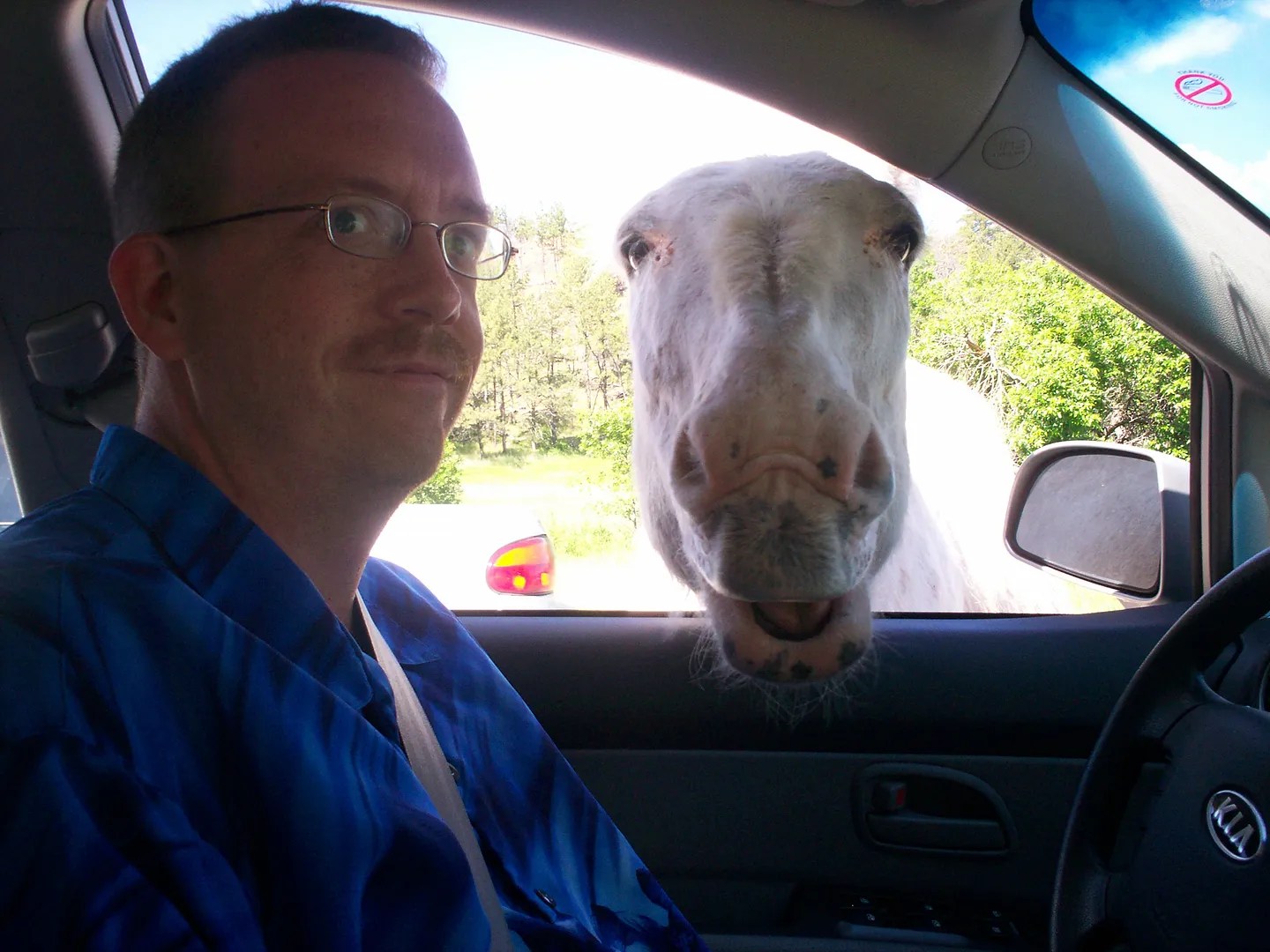
Custer State Park, located in the Black Hills, is inhabited by animals accustomed to being spoiled rotten by tourists. They have no compunction about invading your personal space, and may be the secret masters in charge of the park. Notice how Intrusive Burro is very intrusive.

Custer's Bad Burro

When you’re done with Rushmore, you can visit the other massive stone monument in the area, the perpetually in-progress Crazy Horse statue. The ongoing project is taller than Rushmore and funded entirely with private donations. The nearest approach is even more distant than Rushmore’s observation area, but you can do what I did for an extreme closeup: max out the digital zoom on your camera, pop a quarter into the stationary viewers, jam your camera lens into the viewer eyepiece, and snap away.

Crazy Horse, zoom within a zoom

Since we were only a few dozen miles away anyway, we spent one day on a diversion into neighborly Wyoming, home of Devil’s Tower, the free-standing mesa As Seen On Close Encounters of the Third Kind. Bring your own mashed potatoes.

Wyoming's Devil's Tower

2008: Virginia

Our primary destination was Virginia Beach, but I spent the week under the weather and trying my best not to dampen our spirits. The three of us also discovered something unanimous about ourselves on this vacation: none of us actually enjoy beaches. Consequently, many of our stops on the way to and from Virginia Beach were more interesting to us.

Largest of those was the U.S.S. Wisconsin, decommissioned and moored in Norfolk. Tours are guided by retired veterans proud to be serving as tour guides even when the weather is in the triple digits.

The USS Wisconsin

One of the nicest looking places in the area was Natural Bridge, great for scenic photos and some of the most unusual roadside attractions nearby. One caution: if you love animals, you might want to skip their zoo.

Us at Natural Bridge

All photos are excerpted from lengthy travelogues that I wrote for each of our last several vacations for fun and posterity. If it weren’t for humility and concerns about copyright issues (will theme parks really throw a tantrum if their mascots appear in your published photos?), I’d consider compiling them into a genuine Book, also for fun and posterity.

Road Trip Clip Show: a Salute to Vacation Days, Part 1 of 2

Once all the necessary errands are run and all defensive countermeasures are in place, we’ll be taking off this weekend for our annual road trip. Each year we drive hundreds, sometimes thousands of miles to other states to view their museums, witness amazing works of God and man, check out roadside attractions of varying degrees of imagination and quality, and generally see firsthand what lies beyond Indiana.

Our 2012 road trip will take us through Kansas to Colorado, including a circuitous route through Denver, Colorado Springs, and Pueblo. With the Waldo Canyon fire now 70% contained as of today and the other extant fires being beyond the scope of our plans, we’re feeling less intrepid and more emboldened to sally forth toward the Rockies and whatever they might surround. We’re challenging ourselves to find good points about Kansas as well.

In honor of Independence Day, one of America’s busiest traveling holidays of the year, and in honor of the fact that I have less free time this week because of vacation preparations and mandatory family-holiday quality time, I present a cursory look back at our road trips from previous years, select snippets of a few of my favorite faraway things.

2011: Manhattan

Our first time in New York City became my favorite vacation to date. The sights, the sounds, the subways, the cleanliness, the overwhelming density of activity options — it was like three vacations packed into one and then marinated in adrenalin.

Naturally we photographed Times Square too many times. We attended The Lion King, found ourselves blown away and wishing the other shows had been inexpensive enough to attend four or five more.

Times Square ad frenzy

Most people view the city from atop the Empire State Building. For a few dollars less, and with no haranguing from enthusiastic street guides, you can ride to the upper floors of 30 Rockefeller Center and see most of the same rooftops. At that height, the view plus or minus a few stories isn’t appreciably different, unless we missed something really cool on 30 Rock’s roof.

the view from 30 Rock

A couple of New Yorkers we know thought it odd that we included Grant’s Tomb on our itinerary. My wife the history buff insisted after reading his autobiography. This seemed like an awful lot of building just to provide a tomb for two, but I was happy to oblige.

Grant's Tomb: Conveniently on the Way to Harlem

2010: Pennsylvania via Ohio

Our primary destination was Philadelphia — again, because of history — but our attention wandered to numerous other sights along the way.

My personal favorite: Eastern State Penitentiary, a former famous prison that’s now a “stabilized ruin” you can visit and view from within. Most notable features include a cell once occupied by Al Capone and a self-guided audio tour narrated by Steve Buscemi.

Eastern State Penitentiary, second floor

Diverging from the Pennsylvania Turnpike for several miles allowed us opportunities for small-town roadside wonders such as this giant quarter in Everett, created as part of a local contest.

Everett's giant quarter

On the way to Pennsylvania, we stopped for lunch at the Thurman Cafe in Columbus, a certified As Seen on Man v. Food pit stop. Below is the Thurman Burger, which is larger than some house pets. Not even in my overeating college days could I leave a clean plate after this meal.

Thurman Burger, Thurman Cafe

More to come tomorrow!

Today’s Unrelated Things: the Stalker and the Stick

Basic-cable true-crime melodrama is my wife’s thing, not mine, but she noticed the description of one of tonight’s reruns of the Investigation Discovery docuseries Stalked: Someone’s Watching mentioned “a comic book author”. I’m easily excitable whenever our interests converge, so I dropped what I was doing and joined her for quality TV time that ended up disturbing me instead. The December 2011 episode titled “Signed, your Deadliest Fan” was a half-hour run-through of the experience of Colleen Doran, creator of A Distant Soil and artist of various commendable works (Sandman, Orbiter, the underrated Zodiac), who spent years at the mercy of a “fan” who subjected her to no small amount of devious psychological Hell.

As Doran recounted her story to the offscreen interviewer, I felt sure I wasn’t the only comics reader reminded of Harlan Ellison’s classic essay, “Xenogenesis”, about the real-life horror stories endured by science fiction writers at the hands of poorly raised readers oblivious to the pain caused by their own reprehensible actions toward their ostensible idols. I’m glad that Ellison was forthright enough to set “Xenogenesis” down in print, but I really don’t like to be reminded of it. I hate knowing that I share a hobby or a fandom with extremist malcontents who failed at paying attention to the good-is-better-than-evil motif portrayed in 90% of all comics ever. Understanding that other humans are not your toys shouldn’t be a challenging lesson to learn.

“Xenogenesis” doesn’t appear to be online in any reputable downloadable form. I think I still have the copy I clipped out when it was reprinted in Comics Buyer’s Guide many a moon ago. The Stalked episode is available to view via tvguide.com; alas, it costs money. Doran also wrote an even more distressing follow-up about the episode with links to her past writings about the ordeal, covering details that the producers omitted or glossed over, such as the part where the offender in question is now out and about on his own recognizance. I can see how this non-minor detail would interfere with the show’s need for closure.

(Less saddening aside about the show: I was jarred out of it for a moment during a dramatization in which “Colleen” apprehensively attended a New York comic con as a special guest circa 1987. In one brief shot, we see her cheerfully signing copies of The Unwritten. Anachronism and complete un-relation to Doran aside, the next time Peter Gross needs a month’s vacation, she would seem a great fit to me.)

* * * * *

On the brighter side of my day, the mailman finally delivered my tangible rewards for supporting Rich Burlew’s The Order of the Stick Kickstarter campaign. It still boggles the mind how a project that started as a quixotic quest to reprint a few old collections became a record-breaking runaway train of generosity gone wild. My pledge level permitted me a graphic novel I didn’t have, along with far too many additional stationery-section goodies that were added as prizes later in the campaign.

I’m especially tickled pink by the OotS coloring book, which includes coloring pages for each of the major stick-figure cast members, plus value-added puzzles and drawing challenges. I’m tempted to color a page and post an example for all to see, but then my coloring book wouldn’t be a mint-condition collectible anymore that I can use to fund my post-retirement world traveling.

(Caveat emptor: intense typo Nazis should think twice before purchasing a copy if the opportunity arises, because one section in the answer key misspells “situations”. I’ve seen your kind act as wet blankets in the name of proofreading in many a venue, but do realize Burlew is under tremendous pressure to fulfill his part of the deal and has a lot on his plate. It would be most gracious of you to forgive, forget, and refrain from insisting that the mere existence of “situtions” sullies his good name and ruins everything. Please do not declare the whole thing a sham or demand triple your money back and your next ten graphic novels free. As Stalked taught us, fan entitlement is an ugly, destructive force of evil.)

Questioning My Reality after Preferring “Madagascar 3” to “Brave”

After seeing Brave and Madagascar 3: Europe’s Most Wanted within a week of each other, I was surprised to conclude that this is the second year in a row in which I’ve liked a DreamWorks CG-animated film more than a same-year Pixar release. Last year’s narrow victory of Kung Fu Panda 2 over Cars 2 was…well, a paltry competition, but still.

For the most part, Brave was still very good for what it was. I could appreciate the uneasy conflict between a mother and daughter who fail to see eye-to-eye, but who eventually learn to accept each other’s differences through a series of intense situations. However, swap their gender and you find yourself with the same uneasy conflict last seen in How to Train Your Dragon. Whereas the latter was more epic in scope, Brave by comparison was a more intimate struggle whose own four-legged antagonist was a bit smaller. Both were also set in long-ago Scotland, had characters with limbs amputated by beasts, and beefed up their supporting cast with a healthy dose of Craig Ferguson. I didn’t want to keep comparing the two so unfairly, especially since Dragon is presently my favorite DreamWorks CG film, but my mind wouldn’t stop.

Madagascar 3, on the other hand, benefited tremendously from how forgettable I found the first two. I remember the main and supporting characters, and a few flourishes from the original that are referenced in this one for effective callback resonance, but not my actual overall opinions of them. It was a pleasure hearing Ben Stiller and Chris Rock riffing to their heart’s content for a general audience. I was practically giddy from overdosing on the manic wit that propels the film forward at breakneck speed. I’m enamored of the moral of the story, that nostalgia can prevent us from seeing how confining our former boundaries were until we confront them and realize the power of moving on to wider stages. I also enjoyed turns from incoming performers such as Bryan Cranston (a Siberian tiger with a tragic story), Martin Short (a fawning, barely talented sealion), Academy Award Winner Frances McDormand (an unstoppable French animal control specialist on a vendetta), and X-Men 3‘s Juggernaut as a miniature circus dog with a ‘tude. This may also feature the best performance by a mute circus bear in cinema history. I entered the theater expecting no effect on my apathy; I exited with a smile on my face and the very few lyrics to “Afro Circus” stuck on Repeat in my head.

I’m having a very hard time reconciling these two opinions. In pondering my blasphemous imaginings of a world where Pixar is no longer the automatic king of everything, I wondered if any statistical comparisons have been drawn between the two. As luck would have it, such comparisons have been done and overdone. I decided to compile figures anyway for my own amusement, chronologically for all CG releases from each of the two companies — not of American box office grosses, but of ratings on the world-famous Tomatometerâ„¢.

Those results to date:

1995: No Dreamworks CG department to speak of; 100% for Toy Story, the grand pioneer of the medium.

1996-1997: No entrants. Each studio lay dormant, making plans and revving up their engines.

1998: 95% for Antz; 92% for A Bug’s Life. This flawed comparison is a prime example of how the Tomatometer fresh/rotten binary system lacks nuance. I didn’t hate Antz, but I’d be surprised if anyone favors or even remembers it to this day. I’m also mystified as to why Pixar hasn’t allowed an encore yet for Flik and friends. Were their merchandise sales really that anemic?

1999: No Dreamworks CG releases; a rightful 100% for Toy Story 2.

2000: No entrants. Remember when each studio used to craft one film at a time, no matter how long it took? Pixar has obviously expanded their staff and resources to sufficient capacity to maintain a steady pace of one new film per year as productions overlap. Meanwhile at DreamWorks, their WikiPedia page lists an alleged, ambitious overkill slate of twenty-two projects in various stages between ideation and completion. That either speaks to their success, foreshadows an animation glut in our future, or includes direct-to-DVD fodder to be distributed by DreamWorks but created by other, smaller animation houses.

2001: 89% for Shrek; 95% for Monsters Inc. I enjoyed the cleverness and performances in Shrek up until the exact moment where the plot pivoted because of a Three’s Company-style stupid misunderstanding because of ill-timed eavesdropping. Those are an automatic fail in my book. While that meant a forfeit in favor of Pixar, I thought some of Billy Crystal’s ad-libs weren’t exactly among his best. Given the choice, I’d rather watch clips of his past Oscar-hosting gigs.

2002: the last mutual skip year. Going forward, the mission statement for both studios was to crank out new movies every year or die trying.

2003: Still no new Dreamworks CG releases; 98% for Finding Nemo, the greatest Ellen DeGeneres film of all time.

2004: 89% for Shrek 2, which I thought was the best of the series; 36% for Shark Tale, which seemed like a case of casting famous faces first, then writing a script around them later. DreamWorks thankfully took notes from Pixar’s methodology and has relied on this poor creative formula a lot less than they used to. Meanwhile, The Incredibles, my all-time favorite Pixar film sans Woody or Buzz, impressed with 97%.

2005: 55% for the first Madagascar, whatever it was like. I do remember it looking crudely drawn. Cars was originally scheduled this year but delayed to 2006 for any number of rumored reasons, from quality control to internecine corporate shenanigans.

2006: 74% for Over the Hedge, shrewder and funnier than I expected in its barbed consumer-culture satire. 74% for Cars, which I thought was just fine. I suspect some negative reactions were Mater’s fault. He didn’t bother me. I know people here in Indiana not too different from him.

2007: 41% for Shrek the Third (no argument here); 51% for Bee Movie, proof that not everyone loved Seinfeld as much as some entertainment magazines did; and 96% for Ratatouille, Pixar’s first attempt at something besides an epic adventure, and a blessedly successful one at that.

2008: 88% for Kung Fu Panda, which I tried to tell everyone around me was seriously awesome (especially in super-sized all-powerful IMAX), but no one would listen to me because of either Jack Black or disdain for kung-fu flicks. Their loss. The 64% for Madagasacar 2: Something Something Animals improved on its predecessor in ways I no longer recall. 96% for WALL-E, which I really liked but didn’t fall head-over-heels in love with, as some of my peers did. Can’t really put my finger on why. Maybe it’s a subconscious thing about environmental lectures.

2009: 72% for Monsters vs. Aliens, which was quite a nifty League of Extraordinary B-Movie Creatures; 98% for Up, which made me bawl before the end of the first half-hour, but knocked itself down from an A+ to a mere A because of doggie biplanes. No one steals Snoopy’s shtick and gets away with it, not even Pixar.

2010: 98% for How to Train Your Dragon (thank you, critics, for validating me); 58% for Shrek Forever After (which I avoided after hating the third one); 73% for Megamind (not a fan of Will Ferrell movies, but was pretty happy with this despite sad reliance on AC/DC); and naturally 99% for Toy Story 3, weakest of the trilogy but hardly a weak film.

2011: 81% for Kung Fu Panda 2, okay but not nearly as seriously awesome as the first; 83% for Puss in Boots, which I also avoided because of Shrek the Third (my loss, perhaps); and 38% for Cars 2, certifiably the Worst Pixar Film of All Time. If you think of it as three back-to-back episodes of Cars: the TV Series, it’s really not so disappointing in those terms. If this had been released direct-to-DVD, it might have attained the same kind of regard that Disney fans hold for The Lion King 1½. Again I blame the Mater-haters.

2012: As of this evening, 76% apiece for Madagascar 3 and for Brave. It’s a tie!

On average, the DreamWorks track record has improved in the years since its Shark Tale nadir. Pixar isn’t exactly churning out third-rate filler just to pad the Disney release schedule, but no longer seems bulletproof, either. I look forward to future works from both, as long as none of them is Flik vs. Antz, which I would view as a sign of creative bankruptcy, unless Flik wins.

Additional notes:

1. List does not include Aardman productions released through DreamWorks, as much as I recommend the majority of them.

2. List excludes non-Pixar Disney CG fare because it is presumed inferior due to lack of Pixar authorship, with the exception of Tangled. The jury can’t wait to deliberate on Wreck-It Ralph.

3. List obviously excludes productions from other well-known studios such as Blue Sky and Robert Zemeckis’ ImageMovers because my free time for late-night writing is not unlimited. Their inclusion would also distract from the whole two-sided rap-rivalry vibe of the competition.

4. I lament that the list excludes traditional animated films, just as movie executives do nowadays. Recent works in this medium have been flawed in ways that could not necessarily be blamed on said medium (e.g. mediocre stories; unfunny jokes; reliance on star power over creativity); and yet, when those flaws hurt them at the box office, the medium was blamed and practically scuttled as a whole in America. This, in my mind, is an even greater shame than Shark Tale.

My Geek Demerits #3: Speaking and Writing Without Cursing

Full disclosure: I wrote 75% of the following piece in March 2012 in response to a question from a good online friend who finds it odd that I don’t use profanity, except in very rare cases when milder ones appear in proper nouns such as Hellboy.

I was raised in a household whose adults never used them in front of me. Like all children raised in such atmospheres, I learned them anyway from the neighborhood kids. I tried them out occasionally, and eventually developed a finely tuned on/off switch inside my head that worked instinctively whenever I entered or exited polite company. All throughout my young-stupid-male years, from high-school until my mid-twenties, they occupied one of the largest compartments in my communication toolbox.

When I changed career tracks in 2000, it didn’t take long for them to disappear from my spoken-word vocabulary. Not only did I want to project a more professional image, whether on the clock or off, I also found I was much more relaxed and less angst-ridden once the frustrations and disappointments of my previous job were lifted off my shoulders. In the twelve years since, I’ve uttered precisely one profanity aloud — one day as I walked around Monument Circle and came mere centimeters away from being flattened by a speeding white kidnapper van barreling around a corner flagrantly disregarding us pesky pedestrians. Losing momentary control of my tongue seemed a preferable alternative to losing control of my bladder.

For a time, my online interactions were a different story. Harsh language remained a part of my online communication because, frankly, it seemed like everyone else around me was doing it. Whether on Usenet or on message boards, it served as a necessary defense against the other dysfunctional participants and/or a badge to prove you were part of Team Internet. After spending much of 2002 rethinking my life in a number of serious philosophical ways (to put it with gross inexactitude), eventually I phased Carlin’s Seven Words and many of their lesser sidekicks out of my online responses and works as well.

The why of it all is a combination of thoughts and decisions accumulated over time.

When explaining this to my online friends, I started with the simple standard of the words labeled “profanity” as comprising the specifically designated section of the English language that is the immediate go-to choice of the ungodly and the unprofessional. Also from the Department of Other People’s Typical Responses, there are Bible verses to be cited. I’m actually terrible at memorizing Scripture for a convoluted reason that could comprise a short essay in itself, but Colossians 3: 8-10 comes closest to nailing what occurs to me from the basic Christian standpoint.

Beyond those, I naturally added bullet points about why I don’t cuss anymore:

* People use it too often when they want themselves to be taken SERIOUSLY, when in fact they’re basically just being hostile. They use contempt as a cheap substitute for confidence.

* People admire them, especially the F-word, for their ridiculously flexible use in nearly every part of speech, to describe, modify, or reductively summarize just about anything that comes to mind, regardless of whether they’re being complimentary or derogatory. I’m of the opposite mind. A word with unlimited uses effectively becomes meaningless and cries out to be replaced by more vivid descriptors. The English language is a sophisticated system with plenty of alternatives, especially if it’s being used as a needless synonym for “very” or too shorthand a dismissal of a bad person, place, or thing. If I’m fully conscious of what I’m writing (as opposed to blithely typing on the fly for everyday back-and-forth with others), I try to avoid ubiquitous multi-purpose words like “make”, “do”, or “get” on similar principle.

* They’re an easy way to cut yourself off intentionally from a wider audience. If you only want to be read by people exactly like you, it’s your privilege as an artist to cater to them as you see fit. If you want to be read by anyone not like you, realize that there’s a cultural demographic out there whose thoughts on this subject are more simplistic than mine, but who’re less likely to cut you the necessary slack to tolerate your indulgence. Puerile direct-to-DVD family movies turn a tidy profit for a reason, and it’s not because they’re being used for skeet shooting.

* Conversely, no one worth paying attention to will reject a given work for not having enough cursing. I’ll grant you that substitutes like “frag”, “frick”, “frig”, et al., are aesthetic abominations, but most works — well-liked classics, even — managed for decades without resorting to lowest-common-denominator-speak. I’m not convinced All About Eve would’ve been twice as epic if Bette Davis had talked more like Sarah Silverman. Or take something as recent as Mission: Impossible: Ghost Protocol, which had more colons than profanities. Amazingly, it didn’t suck and moviegoers flocked to it. I can also add an extra paragraph about the adult virtues of the average exemplary Pixar film as generally quality material that never lacks for emphatic dialogue.

* I would be lying if I said I limit myself to reading or watching G-rated material. And yet, it’s one thing to recreate a harsh reality (The Wire, Saving Private Ryan) or achieve a specific artistic effect (Glengarry Glen Ross, Reservoir Dogs). Sadly, not everyone is David Mamet or David Simon. Precious few people are, in fact. It’s another thing altogether to use it just because it’s ostensibly “funny” (see: countless R-rated comedies that don’t understand the concept of the punchline) or just, y’know, expected. “Everybody does it” is not only one of the worst excuses for doing anything ever, and among the absolute best methods for perpetuating stupidity, it’s also inaccurate. When overused in a movie or other work, each word becomes like a jarring CD-skip to my ears. After too many CD-skips, I tend to lose my concentration and interest. I prefer not to provide the same disservice to others, whether they share that issue or not.

Bottom line for me personally: nowadays I’ve found I can accomplish my aims well enough with tone, expression, vocab, craft, and occasionally volume if need be. I’m not forced at gunpoint to use profanity as a crutch any more than I’m required by law to work the words “esophageal” or “blunderbuss” into conversation every day. But that’s just me.