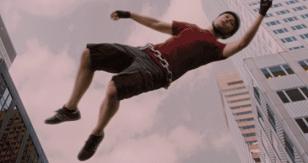
 After seeing the new Joseph Gordon-Levitt flick Premium Rush tonight, I’ve realized that bicycles are the greatest machine ever. I should already know this after multiple viewings of Pee-Wee’s Big Adventure and my mastery of the old arcade game Paperboy, but those are old and Premium Rush is new. To today’s young folk that means it’s more influential than either of those works by definition.
Consider the pros of bicycle ownership that I’ve learned tonight:
* Bicycles use no gas. Not only does this save average consumers money, it means movies that replace all their cars with bikes will overflow with carbon credits or go-green points or whatever currency this market uses.
* Bicycles fit through tight cracks in traffic jams. Related note: traffic laws only apply if bicycle policemen can catch you. Don’t get too overconfident, since bikecops do have the power of teleportation, based on how many places our hero’s bikecop nemesis (stuntman Christopher Place) shows up in the movie through magical point-A-to-point-B locale shifts. That power only gets bikecops so far, though — their advanced age and lack of BMX tricks makes them an easily evaded adversary.
* Bicycle parts are sturdy and survive any and all forms of undue stress, short of a head-on collision. In that event, temporary replacement bikes should be readily available for borrowing from your immediate vicinity.
* Bicycles are much faster than cars. They can dodge and weave through the thickest of traffic, especially if you have the power of instant super-calculus like Amadeus Cho. If a crooked cop is several feet behind you, just pedal really hard. Sure. he could put his pedal to the metal and flatten you, but he won’t. For some reason. Mental block, maybe, who knows. One exception to this rule: when a finale is coming up, cars are faster because they have to catch up with you before the last big set piece begins. You can’t just arrive in time to save the day while the bad guy is still several blocks away because of rush hour or construction delays. No audience wants to cheer the defeat of a villain in absentia.
* Bicycle-related jobs never have a dress code. Our hero’s pride in avoiding nice suits and ties is a large part of Who He Is. (Our hero clearly learned nothing from Pee-Wee.) Late in the movie, a montage of assorted bicycling professionals confirms that clothing, hair care, and hygiene are left to the employee’s discretion. Hopefully they disinfect their packages before handing them to the intended recipient.
* The bad guys never try shooting you during chase scenes. You’re a small moving target, and they’re probably lousy shots anyway, even if they carry a gun for a living. This facet remains largely unexplored in Premium Rush, but in other chase movies, judging by the average number of missed shots per movie, I get the impression that crooked cops and evil military men never have to fret about marksmanship on their performance review.
* Bicycle lanes are optional. Over the past few years, Indianapolis has spent millions renovating and redesigning numerous thoroughfares to add bicycle lanes — sometime widening streets, sometimes taking an entire lane away from cars and designating it as a bicycle lane instead (White River Parkway North Drive, I’m looking in your excessively named direction). As seen in Premium Rush, Manhattan bicyclists seem to do just fine without them. The closest they come to compromising is when they have to share a walkway in Central Park with wheel-deprived pedestrians.
With so much going for bicycles, I foresee a day when filmmakers and studios revisit their works George-Lucas-style and decide it’s time to tamper with them for the sake of a modern audience. Imagine The French Connection with Popeye Doyle free-styling it up, or The Bourne Supremacy filmed in you-are-there Bicycle-Smashing-Cam. Stephen King’s Christine would have been about twenty minutes long, once the possessed 1957 Schwinn American realized it wasn’t really equipped to kill. Best of all in my mind would be the late John Frankenheimer’s Ronin — narrow chases through all those claustrophobic European streets, still at breakneck speeds, and everyone’s still armed with bazookas. The mind reels at the cinematic possibilities, so much so that I have to stop myself from staying up overnight and brainstorming any more. (Maybe that’s tomorrow night’s entry. No one tempt me.)
Setting all that aside, this was a fun, footloose, albeit PG-13-languaged 91 minutes’ worth of popcorn-movie excuse to watch Gordon-Levitt play the same kind of tenacious, hard-luck, unlikely hero that worked well for him in (500) Days of Summer, except here he’s not a jerk and he gets to win. It’s also a showcase for anyone who wants to know what Michael Shannon looks like, before he appears in next year’s Man of Steel. I didn’t see Revolutionary Road, for which he was nominated for a Best Supporting Actor Oscar for what I read was a fairly tiny role, but here he dominates plenty of screen time as a foul-mouthed crooked cop (who naturally is the one to fill the movie’s one-F-word quota) with an amoral attitude and an unfortunate addiction to Pai gow. His tough New York sounds more like other movies than what we heard last year on vacation, but that only added to his scary intensity.
Other random, disconnected thoughts that flew through my head while watching the Greatest Bicycle Film of All Time:
* Fun geek note: Shannon continually hides behind the alias “Forrest J. Ackerman”, named after the famous sci-fi fan. (Yes, once upon a time, they used to have those. 105% of all sci-fi fans wish that were still the case.)
* Other than Gordon-Levitt and Shannon, the only other actor I recognized without research was Aasif Mandvi, my favorite correspondent in those rare moments when I have time to watch secondhand online clips from The Daily Show with John Stewart. Mandvi basically reprises his role as cranky boss Mr. Aziz from Spider-Man 2, but his presence is value-added good times.
* Listen carefully during one of Gordon-Levitt’s course-plotting moments, and you’ll be rewarded with a Wilhelm scream, to no small comedic effect.
* Do the kids these days still say “shred” in any bike-related context? It sounds like previous-decade slang.
* Gordon-Levitt’s motto, “Brakes are death,” sums up every bad commute I’ve ever harrumphed my way through.
* My favorite thing about the movie was recognizing Manhattan landmarks and locales that our family encountered on our 2011 road trip. Among the notable sights that nab screen time are Chinatown; Columbus Circle; a #1 subway station (the 116th Street Station, if the visuals match the story); the Ed Sullivan Theatre (blink and you miss it); Columbus Street alongside the Natural History Museum; and, of course, Central Park. Natives no doubt will recognize three times as many places as I did.
* No, there’s no scene after the end credits, but you can stick around and hear several more minutes of “Baba O’Riley” if you’d like. You can also recover from the shock of realizing that the entire movie flew right by without a single character using the phrase “need for speed.” Writing without that cliché in a movie all about speed may be its most skillful trick.
Share this with your friends and followers!


 Midlife Crisis Crossover!