 TV animation fans are still coming to terms with recent announcements that Cartoon Network had canceled two Saturday morning series, both part of the DC Nation programming block — Young Justice after two seasons, and Green Lantern after a single season. Cancellation isn’t unusual for the basic-cable channel — their programming history is a long shopping list of short-term productions. In fact, if you set aside the frequent Ben 10 reboots (the Scooby-Doo of a new generation in its own way), their longest-running series outside the Adult Swim block (i.e., still producing new episodes and not existing solely as reruns) is Adventure Time, which will celebrate its third birthday next month. The minds behind Young Justice should probably count their blessings that they were allowed two entire seasons instead of being truncated after six episodes.
Typical Cartoon Network cancellations tend to come and go without a public post-mortem or much of a protest. However, the curious circumstances surrounding these shows’ unforeseen terminations was addressed last weekend at the Emerald City Comic Con in Seattle, where longtime Warner Brothers Animation producer Bruce Timm was asked about the cancellations at a Q&A. In the wake of a January article about Young Justice ending due not to low ratings but to anemic toy sales, multimedia news/rumor site Bleeding Cool followed up with Timm’s response regarding Green Lantern, referencing weak merchandise sales as the primary cause of death:
Since the Ryan Reynolds’ film, retailers were stuck with film merchandise that just wasn’t selling. This led to those retailers being very reluctant, if not downright refusing, to any carry merchandise from the Animated Series. Therefore, a lack of sales on that front lead to a lack revenue for an admittedly expensive CG series.
In reading the paraphrasing of Timm’s comments, I couldn’t help feeling a little naïve and a whole lot disappointed. Though the shows weren’t quite for me, I can respect the efforts that went into them and the fan bases they garnered. The part that struck me in the worst way was that, if those two articles linked above are to be believed — and I’ve seen no evidence that anyone in authority disagrees with them — then the crews of both shows essentially lost their gigs regardless of the quality of their own work. If the stories were engaging and the animation was suitably competent, it didn’t matter. Even though Nielsen commoners didn’t exactly boycott the show, ratings were seemingly a secondary consideration. The bottom line, as I understand it: they failed as toy commercials.
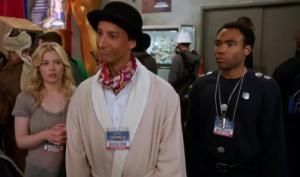 I had been looking forward to last week’s new episode of Community, “Conventions of Space and Time”, which invited us into the inner workings of an official Inspector Spacetime convention, a place where Troy and Abed could meet other fans of the obscure British TV series, indulge in a few hobby-related purchases, and generally be themselves. As someone who’s been to C2E2 twice, Wizard World Chicago four times, three GenCons so far, two Star Wars Celebrations, and several local Trek conventions, I was curious to see how the generally geek-approved series would approach such a setting. I tried to keep my expectations modest — without creator Dan Harmon around anymore, this season’s first two episodes were a little shaky. I’ve stuck with the show and keep hoping for the best.
 As my seventh annual foray into this personal fun ritual, presented below anyway is the timeline of events as I witnessed them during tonight’s ABC telecast of the 85th Academy Awards. All quotes are approximate as best as possible without benefit of rewatching, cribbing from national news outlets, or much proofreading. Our household does not own a DVR; all recollections are a combination of short-term memory and notes hastily handwritten on a legal pad, not a copy/paste reassembly of a distracted live-tweet flood. When I’m seated in front of a TV, I’d much rather watch than type.
 Tonight’s new Bunheads episode, “It’s Not a Mint”, begins with Sasha experiencing every new renter’s worst nightmare: a possible burglary. Maybe. She arrives home with groceries in arms and finds her front door standing wide open. She smartly opts not to go inside, clumsily drops her groceries, and calls for help. The other Bunheads’ phones all go to voice mail. Her neighbor Mrs. Weidemeyer won’t answer the door. Sasha even turns to Siri to dial 911 for her because dialing three whole digits is too much work. Unfortunately her iPhone comes preloaded with the standard sitcom version of Siri that’s equipped with the hearing of a senile grandmother. (To be fair, it’s for the best that every fictional version of Siri malfunctions. If it worked according to specs, I’d roll my eyes and accuse the show of product placement. Siri just can’t win.)
 On tonight’s new episode of Bunheads, “There’s Nothing Worse Than a Pantsuit” (that’s the episode title, not the main clause of this sentence), our heroine Michelle is forced to cope with two (2) formidable challenges. First up, as spoiled in the episode title: pantsuits! With Fanny MIA from an episode once again, Michelle is left alone to work with Milly on the next step of the Millicent Stone Performing Arts Center process: zoning approval from the town committee. Michelle nearly tries to go it alone, but Milly scolds her for not keeping her in the loop on any important issues. (“Anything that can’t be answered by reading a Judy Blume novel? CALL ME.”) Such formal requirements, in Milly’s estimation, cannot be completed while wearing anything except a pantsuit. Leave it to Truly and the magic of Sparkles to provide Michelle with options, all equally businesslike and hard to tolerate, even with meatball-sized beads and whatever “color blocking” is. Later in the episode she comes to terms with this temporary fashion detour and recognizes the inherent advantages — fewer wardrobe malfunctions; more pockets than dancewear has; and, on a metaphysical level, the pantsuit is “binding, so it keeps all your powers in.”
 Sasha’s parents may be divorcing and deserting Paradise in separate directions, but judging by the evidence presented in tonight’s new episode of Bunheads, “Take the Vicuna”, their forgotten credit cards are keeping their daughter company in their absence. Their magically limitless credit line is enough to secure her new luxury apartment, cover the utilities bills (and hopefully the learning curve that goes with those), provide two carts’ worth of startup food and accessories, and still have thousands left over to throw a righteous housewarming party for her core friends, several classmates, the grownups who didn’t abandon her, and for reasons unknown Aubrey (Victoria Park), her onetime cheerleading captain. The snacks are plentiful, the guests receive parting gifts, and the decor is so over-the-top ornate, you’d think Sasha shares an interior decorator with Tom Haverford from Parks and Rec.
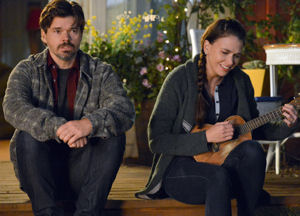 If you’re among those fans rooting for Michelle to remove foot from mouth and get back in good graces with her surfer bartender oceanographer near-beau Godot, this week’s new episode of Bunheads, “The Astronaut and the Ballerina”, may have been a disappointment for you. Michelle approaches, makes bad jokes, digs her hole a little deeper, gifts him with a copy of Finding Nemo because of oceanography, but then watches her baby steps to forgiveness interrupted by a surprise visitor: her deadbeat brother Scotty!
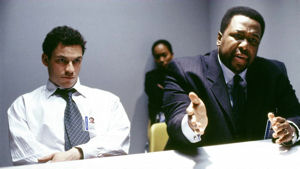 After months of squeezing in an episode here and there whenever time permitted (which was rarely), tonight I finally finished watching all five seasons of The Wire. It’s sixty episodes of the most politically charged, complicated, incisive, meaningful, profane, discomfiting, provocative, challenging television I’ve ever seen. It’s not a show for everyone, but following the storylines of its roughly eight thousand different characters (give or take three) became an unprecedented adventure that part of me secretly hopes has left me scarred and ruined for any other TV show or fictional tale that dares to try impressing me in the future. Its multifaceted examination of life on the streets of Baltimore at every level made my own lower-class upbringing look like the life of a prince, put my comparatively benign hometown in perspective, and has made it hard for me to read any local crime news without wondering how much they’re not telling us.
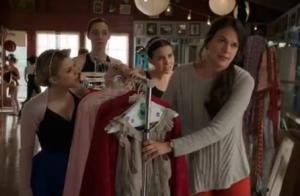 Tonight’s new episode of Bunheads, “I’ll Be Your Meyer Lansky”, saw the return of one of Michelle and Fanny’s most dreaded mutual enemies: their accountant, Eric (Ron Butler). Though they ostensibly “run” a dance studio as an awkward partnership, neither of them is big on bookkeeping, finances, profit margins, simple math, or numbers in general. Consequently, the studio is tanking hard, thanks to the Nutcracker fundraiser disaster, Fanny’s reluctance to bill many of her poorer students, and both instructors’ penchant for canceling classes on a whim and/or plot device.
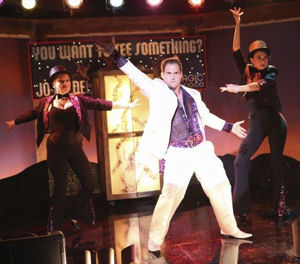

 “It’s been a long trip.”
 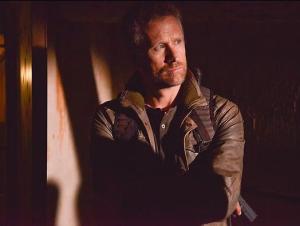 As this week’s new Revolution episode “Kashmir” opens, Our Heroes have commuted a full 280 miles from last week’s endpoint in Ford City, PA (or wherever the Allegheny rapids dumped them south of that), all the way east to West Chester, twenty miles west of destination Philly, and home of a Rebel Alliance faction led by special guest star Reed Diamond. The costar of TV’s Dollhouse and Homicide: Life on the Street was a welcome change of pace from the long line of guests I haven’t been recognizing. I presume this means the show’s mighty ratings have finally earned it a higher casting allowance.
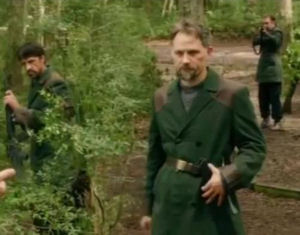 In this week’s new Revolution episode, “Ties That Bind”, it’s finally Nora’s turn in the flashback spotlight. Intense situations evince memories of her post-blackout childhood in Texas. Her mother was murdered by home invaders in San Antonio; her father was last known to be in Galveston; and her younger sister Mia was close by her side. Throughout the ensuing years of chaos after the blackout, the two orphans would learn to rely on each other and no one else, not unlike last week’s gaggle of gun-toting independent orphans.
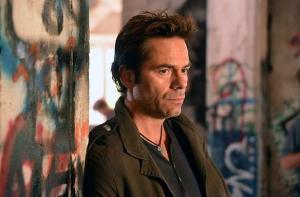 The moral of this week’s new episode of Revolution, “The Children’s Crusade”: nothing weighs more heavily on a conscience than watching others suffer for our sins. Nowhere is this more radically demonstrated than when our man Miles finally finds himself moved by something other than Charlie’s harping about Doing the Right Thing. He realizes that his duties as former evil assistant overlord of the Monroe Republic included unwitting orphan-making. When Our Heroes encounter ragtag Lord of the Flies refugees, something inside Miles’ head asks: won’t someone think of the children?
 Midlife Crisis Crossover!