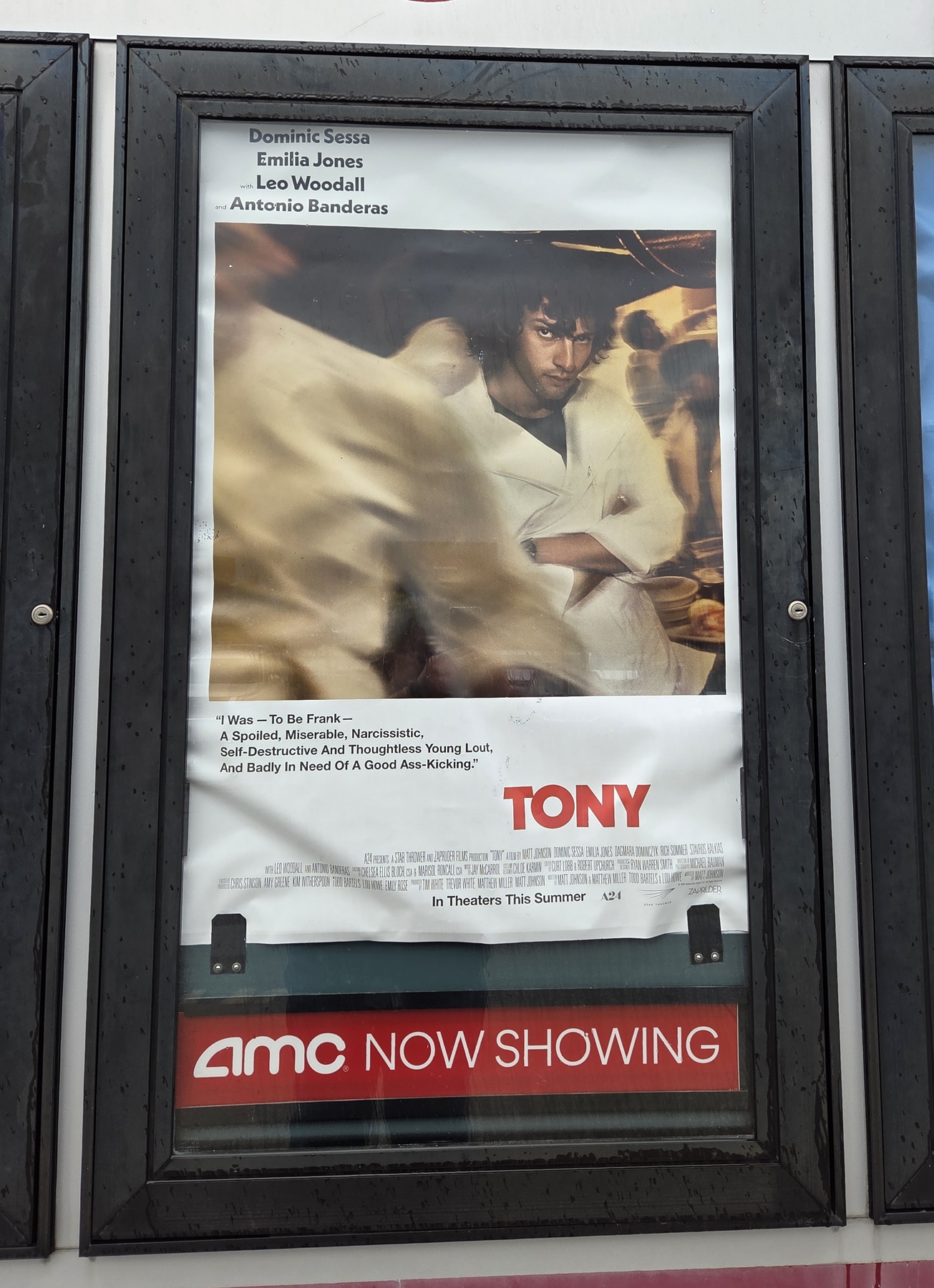
Uhh, this entry is rated PG for the impolite word in its poster.
Previously on Midlife Crisis Crossover: The period-piece dramedy The Holdovers was one of my favorite films of 2023 for numerous reasons, including but not limited to Dominic Sessa in his charismatic feature-film debut as a cocky boarding-school senior whose family abandons him for Christmas and who learns humility and maybe a few manners as he eventually realizes smart-mouthing everyone around him can only get him so far in life.
Ever since, I’ve been itching to see what else he can do. I wasn’t compelled to endure the third Now You See Me, mind you, so I’ve had to bide my time. Sessa finally resurfaced on my radar as the star of Tony, a narrowly focused biopic of the late author, chef and TV documentarian Anthony Bourdain. Full disclosure: I didn’t follow him closely enough to be a “fan” — nothing against him personally, but humanity has spawned tens of thousands of creators and celebrities within the past century and I can’t possibly track them all. Years ago I watched one episode of Anthony Bourdain: No Reservations, his season-3 trip to Cleveland featuring American Splendor comics creator Harvey Pekar and legendary drummer Marky Ramone — i.e., possibly its most me-targeted episode ever. I was fascinated, but I failed to stick around for more. I’ve also read two of the three graphic novels he co-wrote with novelist Joel Rose. And I was aware of his online presence from a distance, tangentially, until his untimely and horrifying passing at age 61.
By no means did I see Tony with any kind of thorough Bourdain-head foreknowledge or preconceptions beyond awareness of his forceful personality, his radically diverse palate borne of decades of culinary experience, and his passion for international travel that made our family’s annual road trips look like neighborhood errand-running. That’s all I brought with me into the theater.
The Gist: Rather than tackle his bio full-scale, director Matt Johnson (BlackBerry, Nirvanna the Band the Show) and three other co-writers (including frequent collaborator Matthew Miller) explore only a few chapters of Bourdain’s formative years. We join the future apex-foodie’s life-in-progress in 1976 at Vassar, where he’s the sort of student who says he’ll be a writer but talks about writing more than he actually writes. He’s a smarmy poseur who peppers his banter with ten-dollar vocab like “splenetic” and “insouciant” (I’ve never even heard “insouciant” spoken aloud before, but I’m pretty sure he mispronounces it) and wears his literary awareness like a leather jacket with no self-awareness. One particularly subtle running gag has him conflating “province” with “providence”, Michael Scott style.
Teen Tony is so smug that it’s refreshing when he gets knocked down a peg at home by his erudite mom (Succession‘s Dagmara Dominczyk), who corrects his mangling of “Bildungsroman“, a term he’s probably never heard spoken aloud. And then this foible disappears for the rest of the film, unless he did keep speaking like a walking Michael Chabon novel and I missed it because he dialed it down to using words I commonly use that no one else does. (I don’t really think about it. You can ask my wife, I guess?)
He schemes to win a writing fellowship without doing any actual writing, so he can live off the funds in exotic NYC without doing any actual writing, but a panel of perceptive professors triple his age can spot a lying liar who lies, because they are not the stupid deans in a teen sex comedy. He’s fully foiled, but lies to his family about it and quickly hatches a Plan B: he ditches any more career planning and decides to go chase some random girl he met this one time in a college bar. Emilia Jones (CODA, Locke & Key) is a fellow Vassar student named Nancy who can spot a lying liar who lies, for at least the film’s first 30-40 minutes, until his horny relentlessness wears down her defenses and she nearly becomes the trophy at the end of a teen sex comedy’s second act.
When he learns she’ll be spending the summer in Cape Cod, of course that’s where he needs to be. Several stupid decisions later, he makes it there but winds up penniless and beholden to kindly Chef Jose (Antonio Banderas!), who takes pity on him and lets the pathetic, beaten-up out-of-towner live on his porch for the next couple months…but at a price: his outdoor tenant has to earn that beachside room-‘n’-board by working in his seafood restaurant. It isn’t the grandly starred establishment of most culinary movies: it’s the sort of real-world, grungy dive where any sober health inspector – not just in Cape Cod — would walk into their kitchen, take one look around, and immediately radio for a bulldozer. Messes and stacked dishes are everywhere. Every male employee is a foul-mouthed chest-thumper. One hungover cook pauses during his mise en place to throw up in a trashcan, then resumes chopping. Johnson and the set designers manage to make it too real and brought back my own fast-food memories circa 1988. Sometimes we desperately needed bodies on the clock whether or not they were vetted for standards. We may also have fought the occasional mouse and roach.
Tony the “intellectual” spoiled brat has clearly never worked a day in his life, but of course he lies and says, sure, his dad totally taught him how to cook. Chef Jose takes about ten minutes to realize Tony is a lying liar who lies, but begins showing him the basics anyway, with the faraway gaze of a learned mystic who sees something magical in Tony that not even Tony himself can sense. Maybe that’s because Tony is a lying liar who lies to himself just as convincingly to himself as he does to anyone else. As we watch the Secret Origin of Chef Tony Bourdain unfold at each kitchen station — from dishwashing guttersnipe up to ambitious menu planner — we wonder: just how far can he get living on lies alone?
The familiar faces: Leo Woodall (Nuremberg, The White Lotus) is Chef Jose’s most skilled and most charming cook, Sal, who’s first to assault Tony before taking him under his wing and teaching him a few things, and not just about cooking. Other restaurant crew include Stavros Halkias (Bugonia‘s clueless cop), Michael Jibrin (American Fiction) and Chicago Fire‘s Monica Raymund as their lone waitress, who takes about two minutes to shut down Tony’s feeble flirting.
Meanwhile back at home, Mad Men‘s Rich Sommer is Tony’s cheery dad, supportive to a fault.
The Impressions: Even viewers like me with a mere passing grasp of Bourdain can spot Tony‘s adherence to the origin/prequel template same as most other films of its kind. In addition to the Secret Origin of Tony’s Cooking Skills, we cringe a bit harder as his new mentor Sal walks him through the Dark Side — the hygiene shortcuts, the casual bedpost-notching, and, most hauntingly, the Secret Origin of Tony’s Drug Addictions. Tony seems pretty clean through the first act — he rides on a perpetual high from his own enormous ego — but he withers under the high-pressure stresses of the restaurant biz until Sal shows him a few forms of relief, up to and including heroin. And then those habits disappear for the rest of the film, without any withdrawal symptoms as if he’s kicked them all through sheer willpower or distractions. Anyone who knows more about the adult Bourdain may not forget those moments quite so easily.
But his identity is important here: strip Bourdain’s name off the press kit and it’s an ‘80s teen-sex caper formula, the plot of various sitcom episodes in which a young main-cast bachelor chases a girl, tries dazzling her with a flimsy facade, gets his hilarious comeuppance, and learns a lesson about honesty that he’ll immediately forget when the next episode’s Hottie of the Week comes along. He’s future bistro owner Jack Tripper, but slightly less klutzy, and, by Johnson’s insightful design, far more cringe than funny. The candid Bourdain quote on the movie’s poster is the front-and-center theme in Tony‘s first frames: this warts-and-all once-upon-a-time reveals the pitfalls of suffering what my first boss used to call Stupid Young Male Syndrome. I get the impression Bourdain would’ve demanded nothing less from any depiction of him.
Once again Sessa shines as a strutting braggart who learns humility and maybe a few manners as he eventually realizes smart-mouthing everyone around him can only get him so far in life, but he’d be insufferable if he weren’t surrounded by a supporting cast who bring depth to their roles. Woodall all but reprises his White Lotus uninhibited smooth-talker who can win friends at any party until you hang around him long enough for his darkest secrets to frighten you off. In her understated performance, Jones embodies a smart young woman who slowly begins ignoring her instincts, as do other characters, because deep down we really want to take everyone around us at face value. Sometimes we’re easily wowed by intellect and can’t tell the difference between confidence and overconfidence, between wisdom and braggadocio, between candor and tall tales.
My favorite, though, is old pro Banderas as a soft-spoken man with a deeper, richer past than we’ll ever know. His resort-adjacent dive might be grungy, but it’s where his dreams led him, his happy place away from what might’ve been greater things had his life gone differently. He only enforces a handful of hard rules, might back down the first couple times they’re violated, and will avert his eyes from a litany of sins committed right in front of his face as long as his customers get served. He grants the rapscallion on his porch bottomless charity and infinite second chances, and it takes a lot of boundary-crossing to invoke his ire. Maybe he’s not so much a pushover as he is a wistful survivor of his own once-fatal case of Young Stupid Male Syndrome.
Regardless, Tony’s lies keep going and going and going and going, and by the time he plateaus and plunges, he’s long overdue for a few moments of breakthrough sincerity. One self-effacing soliloquy about all the people and places he thinks he’ll never travel to see gets a little heavy-handed with the irony trowel. And after his rock-bottom turnaround, I couldn’t help chuckling as we hear “Anthony” for the first time (this entry’s title was not a joke). Some patience is recommended as his prequel-origin wraps up with an epilogue at the Culinary Institute of America, but at least we’re spared a vacuous “To Be Continued” tag.
Johnson tries not to hammer us with allusions to his death, leaving it as an unspoken, extratextual burden that you’ll either miss altogether or bear uncomfortably, depending on how you felt about Bourdain going in. Then again, if he’d been scrupulous from Day One, he might never have developed his predilection for walking life’s rockier roads and making the poor choices that led, the long way around, to better choices that would make him who he was, for as long as he was here.
The end credits? No, there’s no scene after the Tony end credits, but as you’d expect, all the catering chefs are credited. Also, anyone who thinks the actors did all their own prepping may be disillusioned at the credit for a Chef Hand Double. Because sooner or later, you realize that every filmmaker, at one step in the process or another, is a lying liar who lies.
Discover more from Midlife Crisis Crossover!
Subscribe to get the latest posts sent to your email.
 Midlife Crisis Crossover!