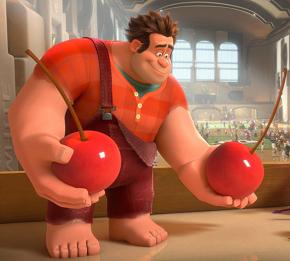
 Important things first: Wreck-It Ralph is the best non-Pixar Disney film in years, proof positive that both divisions are up to the task of delivering solid results when the right talents are lined up and the marketing department is kept in check. The end credits confirm Ralph was wrangled by four different writers, two of which are omitted by IMDB — Jim Reardon and director Rich Moore, both veterans of the glory days of The Simpsons. (Of the other two, one, Phil Johnston, was responsible for last year’s indie Midwest comedy Cedar Rapids.) From where I sat, I couldn’t see the seams.
Academy Award nominee John C. Reilly is an unloved palooka who chafes in his day job as the villain of Fix-It Felix, Jr., one of several old-school cabinet games at Litwak’s Family Fun Center (elderly owner voiced by Ed O’Neill). Ralph’s major beef isn’t necessarily that he hates his job, but that he hates how shabbily he’s treated because he does it so convincingly. Even when Litwak’s is closed and all gaming characters are allowed to go home for the night, Ralph’s coworkers — the titular hero Felix (30 Rock‘s Jack McBrayer) and the townspeople he saves every day — relax and party in their high-rise apartment building while poor Ralph is forced to live and sleep outside on a mound of loose bricks. Perversely, in their neighborhood Ralph is the 1% and the well-to-do are the 99%. The manufacturer clearly didn’t program these civilians to recognize the sight of homelessness.
Ralph tires of being treated like a monster whether he’s on or off the clock, fails to respond to group therapy, and decides he can change his fate by impressing his neighbors in the only way that occurs to him: by embarking on an epic quest to win a shiny medal in some other game. Ralph’s journey leads him through a sort of Call of Halo Effect FPS game called Hero’s Duty, loaded with millions of killer aliens and overwhelming HD graphics surpassing his quaint own. Mixed results drive him to a crash landing inside a snack-based racing game called Sugar Rush, where every character is subject to saccharine nomenclature, and one peculiar racer named Vanellope von Schweetz (Sarah Silverman, a font of potty humor) endeavors to reverse her own misfortunes, but holds a secret that threatens to unravel her life, if not all of Sugar Rush itself. As Ralph and Vanellope form their own misfit alliance, Felix Jr. joins forces with Hero’s Duty officer Sergeant Calhoun (Jane Lynch, doing Coach Sylvester plus war bravado) to drag Ralph back to his game, lest it suffer the cruelest fate of all: a paper “Out of Order” sign, sure to be followed by unplugging and removal from Litwak’s, the gaming equivalent of a company-wide shutdown with permanent downsizing.
(In all the movie, only two items stuck out oddly to me: the gratuitous use of a Rihanna song, usually a telling sign of corporate meddling; and the paper “Out of Order” signage. In our day, such signs were a very rare courtesy. If you couldn’t tell by looking that a game was broken, the attendants usually felt no remorse about divesting you of your quarter anyway, assuming you could even find their hiding place to complain to their face.)
The movie is predictably loaded with Easter eggs a-plenty, though not nearly as many as I’d expected. The Who Framed Roger Rabbit? approach to carefully negotiated mass cameos is indeed an expensive way to populate entire backgrounds, but several known quantities sneak into sight, all carefully labeled in the extensive copyright page embedded in the end credits. Spotting familiar faces from your own childhood is part of the joy of seeing the film for yourself, but my personal favorites were the bartender from Tapper and Peter Pepper from Burger Time. I was also excitedly convinced that one of Ralph’s therapy buddies was a Malboro King from the Final Fantasy series, but an IGN article quotes Disney’s official stance that it’s just a generic fantasy creature. This may or may not be diplomatic PR-speak for “Square Enix said no.”
A film cannot subsist on cameos alone, but Ralph thankfully rises above simple flashcard narrative. While Ralph ponders the meaninglessness of mere medals and the true role of a Good Guy, Vanellope finds herself stonewalled at her attempts to achieve main-character status like her equally irritating peers (including a head Mean Girl voiced by TV’s Mindy Kaling) over the strenuous objections of the boisterous but shifty King Kandy (the always awesome Alan Tudyk, here sounding straight out of a vintage Fractured Fairy Tale). The diametric duo is forced by circumstance into an unworkable partnership that struggles to find common ground, but has to persevere if either of them wants a chance to live beyond their limitations. Secrets and lies unfold like an intricate puzzle; emotional chords are struck; a bona fide Final Boss Battle is deftly set up by a confluence of story factors; and a strong reminder of The Iron Giant at a crucial juncture is a tear-jerking capper on this rousing, inspiring adventure.
As if that weren’t enough, the end credits were also a treat to sit through. There isn’t a full bonus scene after the credits per se, but the value-added extras were fine by me, as described below. If you’d rather experience them for yourself in a future showing, now’s your chance to Quit Game and return to the main menu.
…
…courtesy spoiler alert in effect…
…
Before you can abandon your seat and rush for the exit, you’ll already note Ralph ends with a montage of our four main characters romping through assorted game backgrounds of varying pixel qualities. Anyone who’s ever beaten a modern-day game will be more than familiar with watching concept-art slideshows over end credits.
While you’re waiting for the final frames, the soundtrack takes the opportunity to pelt you with three catchy tunes:
* A new Owl City track called “When Can I See You Again?”, the official video for which is enclosed below. Owl City is one of the few musical acts on which my son and I agree, though I preferred hearing it over the Ralph credits to watching the video’s LazyTown dancers.
* A number by J-pop collective AKB48 called “Sugar Rush“. My son is well enough into Japanese culture that he actually recognized their name. He describes them as an overproduced, overcrowded factory manufacturing entire crowds of assembly-line pop singers and singles alike — think Menudo by way of American Idol times twenty. I thought it was a cute, fluffy earworm anyway.
* “Wreck It, Wreck-It Ralph“, the first new collaboration after epic-length hiatus by the long-lost songwriting team of Buckner and Garcia. If you’re old like me, you might remember them as the one-hit wonders responsible for the inescapable 1982 single, “Pac-Man Fever”. Thirty years later, here they are again as if no time had passed at all.
As your extra-special reward for staying for the final frames of film (in case your cheapskate dad is yelling at you, “That was ten bucks worth of movie! Someone gonna watch all of that!”), you can see the Walt Disney Pictures logo dissolve into a malfunctioning game screen, complete with disconcerting split-screen and random character images. This is exactly what real out-of-order games looked like in my youth.
Discover more from Midlife Crisis Crossover!
Subscribe to get the latest posts sent to your email.
 Midlife Crisis Crossover!
Great review! I haven’t seen the movie yet, but I so want to!
LikeLike
Forgot to mention: the new animated short before the movie, “Paperman”, is award-worthy, heart-tugging fare that ranks up there with the best Pixar shorts. More incentive to see it!
LikeLike