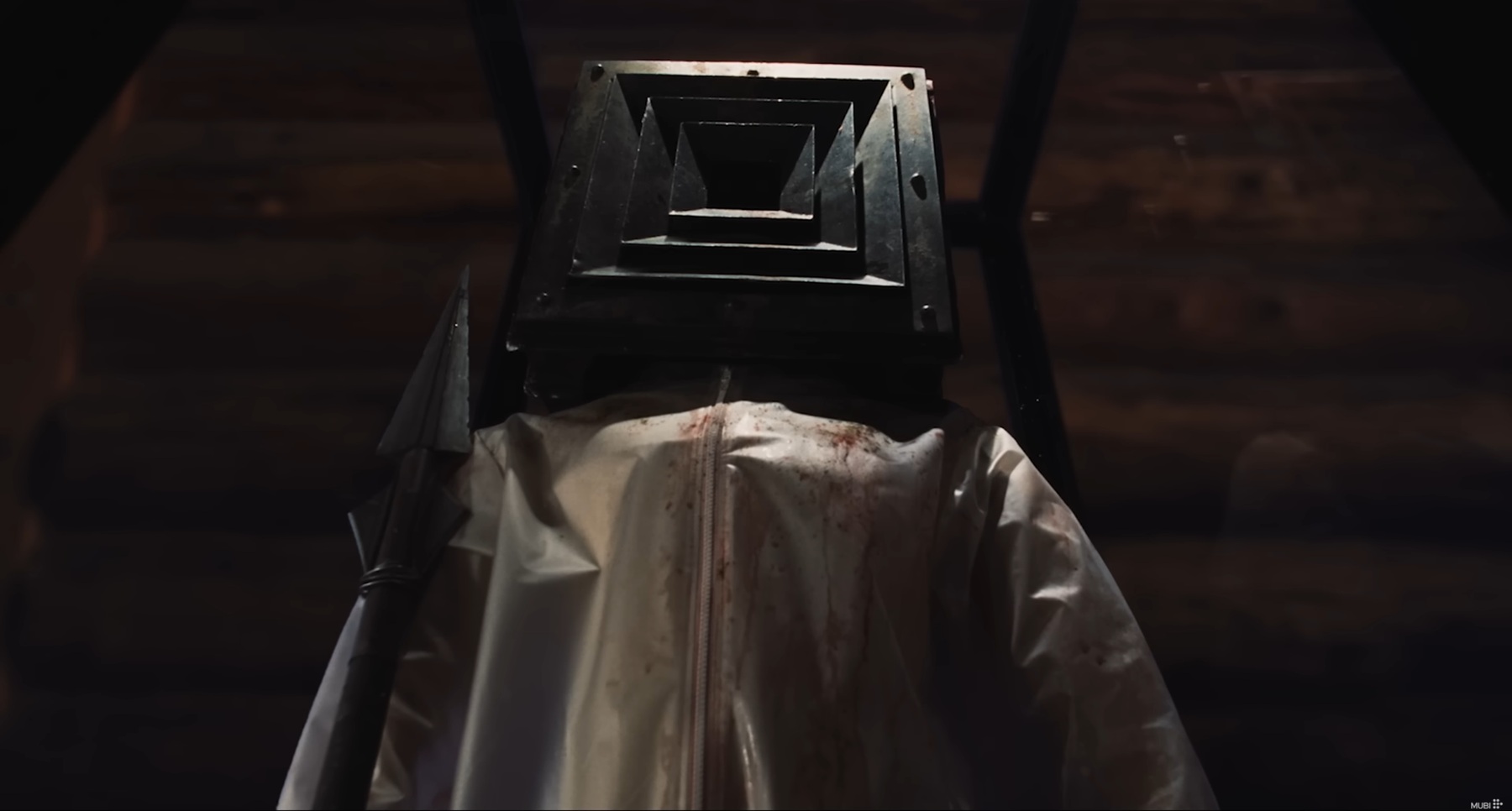
Little Death is watching you watching them!
Hats off to writer/director Jane Schoenbrun for contributing to one of the most convoluted entry titles in MCC history! Not that I’m complaining — tortured syntax is among my numerous writing vices, and I’ll take whatever unwitting aiding and abetting I can get in my syntactical torturing. To clarify: Teenage Sex and Death at Camp Miasma is the full name of Schoenbrun’s third film, after We’re All Going to the World’s Fair and I Saw the TV Glow. I’m a big fan of creative film-titling and increasingly unimpressed by one-word titles that tell you absolutely nothing distinctive about the work, especially if six other unrelated films had that name first.
This is also only the second time in our 14-year run that the word “sex” has appeared in an entry title. (The first was, shall we say, not about “sex positivity”.) As a self-admitted prude, I’ve been pretty okay with that particular dearth. But after reading a few reviews of this most unusual film — one part meta-horror satire of slasher-flick revivals, one part slippery-reality self-discovery vision quest — I was curious to experience it for myself. I correctly guessed parts of it would be Not My Thing, but Camp Miasma‘s blood-soaked, mind-bending campground has plenty to unpack.
The Gist: Hannah Einbinder, one of the Emmy Award-winning stars of HBO Max’s inside-showbiz dramedy Hacks, plays up-and-coming filmmaker Kris Williams, whose debut effort was a deconstructionist riff on Psycho that probably earned more BlueSky cred than box office grosses. Rather than immediately helming the next Marvel project, Kris has been invited to reboot a moribund slasher-flick franchise called Camp Miasma — basically a Friday the 13th ripoff, complete with backwoods summer-camp setting, lousy counselors, a bullied teen who becomes a supernatural vengeance machine, and so on. All our real-world horror flicks also exist in-universe, presumably including all the other Halloween knockoffs, but Jason Voorhees is Schoenbrun’s most fondly regarded template.
Miasma spawned its own sequels, cult fandom, merchandising empire, comic-con actor appearances, internet-era thinkpieces, and ultimately grounds for progressive cancellation. TV Glow‘s subsequently renamed star Jack Haven (who was also in Bill & Ted Face the Music and Bombshell) is Little Death, the series’ iconic slasher who wields a mean spear and wears a retracted Technicolor movie camera for a helmet, which out-of-context looks like an industrial ceiling vent. The character’s original “twist” was unorthodox parenting that fostered acute gender dysphoria and/or accommodated perceived genderfluid tendencies and/or — more likely given Miasma‘s late-20th-century origins free of today’s academia euphemisms — convinced them they could just change sexes every day and live perfectly okay like that, but then came bullying, death, ghostly incarnation, and endless gory vendetta.
Diminishing returns on the sequels likely would’ve buried the IP more deeply than Tumblrs about B-movie transphobia, but the latter is fresh in mind when studio execs decide a Little Death comeback might refill their coffers. They give Kris marching orders to make her take more “woke”, under the impression that this’ll balance out all those “problematic” polemics and prove more profitable than, say, farming it out to Angel Studios. Kris grew up a huge Miasma fan and believes she’s up to the task of rescuing Little Death from those ostensibly regressive aspects — well, not the cartoonishly grisly murders, of course. Those were always Kris’ favorite parts…far more deeply than she realizes.
We only witness two of Kris’ major epiphanies for the project: grabbing a notepad and writing “DESIRE” at the top of it in all caps, and then underlining that several times (it’s an old Simpsons joke and an actual scene in this movie); and bringing back the series’ original Final Girl, an actress named Billy Presley (Amanda Fix from Orphan Black: Echoes) who gave up the biz after she exited the series and refused any and all offers to reprise her role, attend conventions, or otherwise capitalize on her fifteen minutes of bloodied fame. Played in the present by paranormal-TV queen Gillian Anderson, she’s a happy recluse living on the first film’s campground set, which hasn’t gotten any less creepy. The largest remaining cabin is her big, cozy house; the lake where Little Death died is still right there, and another cottage was converted into her own personal theater. She stocks up a winter-long supply of concession-stand candies and rewatches her own movie(s) as many times as she wants, sometimes with different cuts from the theatrical version. After her limelight went dark decades ago, Billy literally never left Camp Miasma. (The film references Sunset Boulevard twice for any younger viewers oblivious to the resemblance.)
Kris hopes she can convince Billy to transition from living in a veritable movie to actually acting in a movie again. From Billy’s existential perspective, her life never stopped being a movie; Kris is just its newest cast member.
The familiar faces: Jasmin Savoy Brown (The Leftovers, the last three Screams) is Kris’ partner, who isn’t quite on the same laissez-faire page, romantically speaking. SNLer Sarah Sherman is Kris’ typical agent. Dylan Baker (from the first Spider-Man trilogy, among countless other sightings) is a cranky studio exec who seems to think “woke” means “whatever gets the teens to love it and not crucify us”.
Schoenbrun devotes a stretch of the runtime to excerpts from the original Camp Miasma (bleak colors, VHS aspect ratio, the works), whose film-within-a-film cast includes Severance‘s Zach Cherry as the secret-origin campfire storyteller; Arthur Conti (the Beetlejuice sequel‘s deranged boyfriend) as the ’70s hunk trying to bed the Final Girl; Quintessa Swindell (Black Adam) as the Black Best Friend; Sorry, Baby‘s Eva Victor as the Tough Girl Who’ll Be Punished for Being Too Tough; Kids in the Hall‘s Kevin McDonald as the Useless Cop, and character actor Patrick Fischler (Angel! Mad Men! Veep! Barry! American Fiction! more!) as the mandatory crazy-old-coot who tries to warn horny teens away from the haunted campsite.
(Anyone following along at home with LGBTQ+ scorecards may note Miasma features the most nonbinary actors ever to costar in a single film released in more than a dozen theaters outside NYC, L.A., or film festivals.)
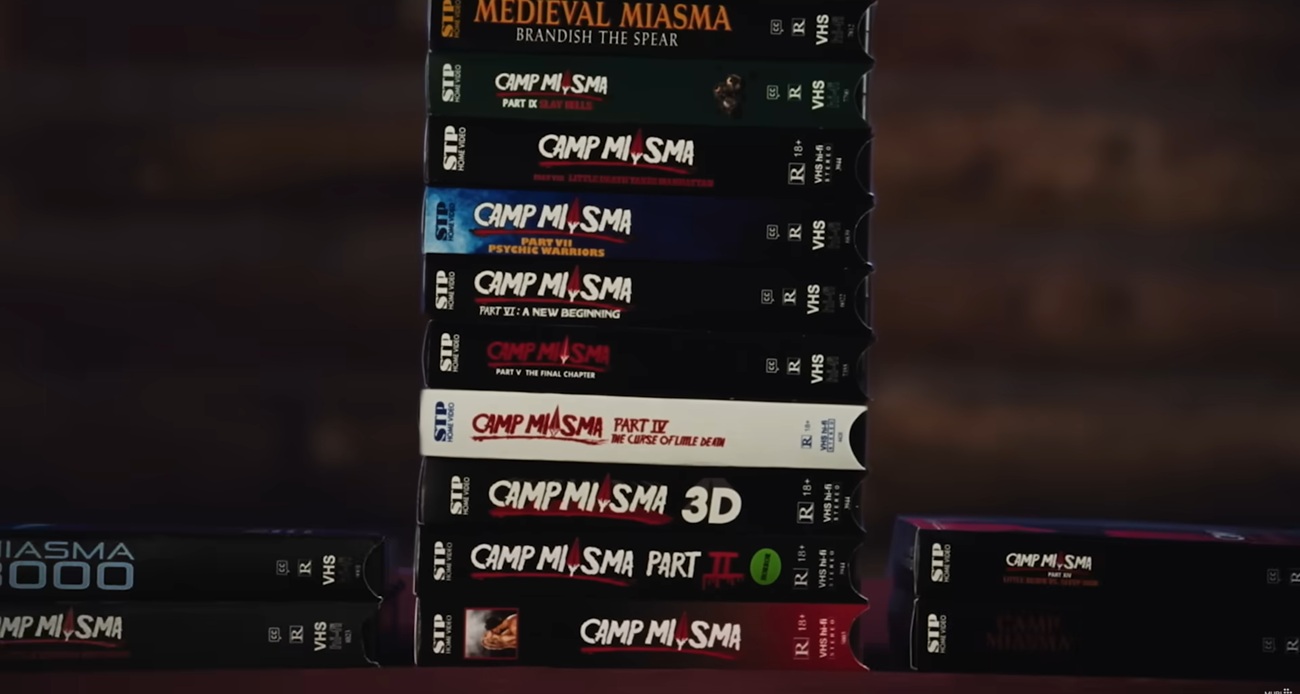
So you’re a Camp Miasma fan, huh? Name five of its sequels.
The Impressions: In interviews Schoenbrun has positioned Miasma as a trilogy finale in conjunction with their previous films, which each had their own screen-based interactive terrors. The micro-budgeted, pandemic-era World’s Fair limited its obsession to a bizarre social-media challenge with no specific source. TV Glow went period-piece with its central idol The Pink Opaque, a syndicated Buffy Xerox that had multiple seasons, some unique monsters, and dozens of episode titles — brilliantly credible and quickly tossed-off — but kept the show clips to a manageable minimum. Along with the aforementioned scene excerpts, Miasma escalates its world-building with a delightful opening montage of tie-in merch throughout the fictional decades, stacked with rewarding gags that’ll pay off even more with home video freeze-framing. (Someone wrote an entire set of rules for a Camp Miasma board game.)
The enthusiastically brainstormed setup establishes considerable breadth for the object of Kris’ focus. What seems at first like a career stepping stone at the edge of a shallow indie-film pond — she’s still finding her way into the entertainment biz, same as Einbinder’s Hacks character Ava — in fact means more than she’ll admit to her contacts or to herself. Billy welcomes this fangirl into her deserted environs, indulges her horror nostalgia, and ever-so-gradually guides the descent into a very different head-space, where the walls bleed between their reality and the Little Death Cinematic Universe, where the Blockbuster clearance bin was never emptied out and splatterpunk-lit is probably still “in”. As TV Glow‘s duo let their favorite TV show subsume their reality, so does Miasma‘s world swallow Kris and Billy whole…and yet, they’re diving full-speed down the belly of that whale.
To a certain extent, the fiercer Schoenbrun explores Kris’ queer-geek perspective, the further Miasma marches into the prudish Not My Thing territory, a boundary I’ve mentioned to longtime MCC viewers in the past. (I fast-forwarded through a few similar Hacks scenes, too.) Miasma uncompromisingly delves into the perpetually linked sex-and-violence tag-team themes that pervade a fair quadrant of adult pop culture, but not quite as a celebration of it here. The “sex” part isn’t exactly pervasive, but that connection is intrinsic to plumbing Kris’ psyche as we come to understand the “awakening” eventually inspired by her Miasma fandom — not entirely unlike what happens far and wide across the geek spectrum in other respects, whether inspired by benign worlds like My Little Pony or by far more transgressive universes, whether it’s an epiphany that pierces a mental fog or an ameliorative response to lived traumas or what-have-you.
A lot of extracurricular dissertations on slasher-flicks’ sex-v.-violence dichotomy take a dispassionate scholarly vantage that concludes one or both are Bad For You and leave it at that. Negative things are negative unless I think they’re positive, thanks for coming to my TED Talk. But our glimpses into the Miasma mythos are more thoughtful, subtler amid the Grand Guignol flourishes, starting up front with “Little Death”, whose name would translate into French as la petite mort, which has a very specific connotation there. (I waited in vain for any character to reference this. They feel compelled to name-check Norma Desmond but let that clever tidbit fly under the radar?)
Lest we get too comfy from our side of the fourth wall, more than once Miasma threatens to burst through the screen and drag us inside. Among the wildest bits is a Little Death killing spree that keeps the camera tightly focused on that expressionless face of concentric squares — through which we can just barely glimpse Haven’s oblique throes — as we watch LD watching us watching the bodies piling up around the periphery to the anti-apropos crooning of, of all things, a Counting Crows ballad. (Easy listening during mass murder: yet another symbol of The Duality of Man!) Farther down the line, at a certain point Schoenbrun takes a page from World’s Fair as Kris suffers either a breakdown or a breakthrough, yelling at other characters but making eye contact with us.
It’s in such eye-opening moments, not always flattering to its characters, that I found my own interests intersecting with Camp Miasma‘s candid post-geek reexamination of the complicated evolution of formative pop-culture experiences into a devoted fandom, of the thin line between unconscious fixations and fetishes, and of the subconscious influences that we let our art consumption choices have on defining our adult selves, for better and worse. At least, that’s the undercurrent that fascinated me, though Your Mileage May Vary. It’s a lot more than I ever got out of giving the relationship between Jason and his vengeful mom a second thought. On the other hand, its meta-slasher critique means my new dream of a Ghostface vs. Little Death crossover is a total nonstarter.
The end credits? To answer the burning question that MCC is always happy to verify: yes, there is indeed a scene after the end credits. For those who tuned out prematurely and really want to know, and didn’t already click elsewhere…
…
…
[…insert space for courtesy spoiler alert in case anyone needs to abandon ship…]
…
…
…back at the general store set, Patrick Fischer and Kevin McDonald hang out at the cash register while chatting — not in character as their Camp Miasma eccentrics, but playing the actors who play them (as opposed to simply playing themselves in our reality). The two of them agree Kris’ reboot is sure to spark another wave of sequels. They never figured they’d come back for more Miasma, but then again, they imagined they’d have bigger careers and better things to do by now. And yet here they are, accepting that Miasma might’ve been their peak.
Before that tiny epilogue, the end credits themselves scatter the names and job titles left, right, and all around the screen, rather than in the traditional center-justified column. They’re the least straight credits possible.
Viewers who stick it out all the way are also treated to an extremely on-the-nose closing number: “Supernatural Superserious”, R.E.M.’s catchiest post-creative-slump single about transformative happenings at summer camp. It’s almost as if Schoenbrun is mocking on-the-nose musical cues in films, which in turn would also explain the dreadfully largo cover of “Nightswimming” at the other end of the movie.
Discover more from Midlife Crisis Crossover!
Subscribe to get the latest posts sent to your email.
 Midlife Crisis Crossover!