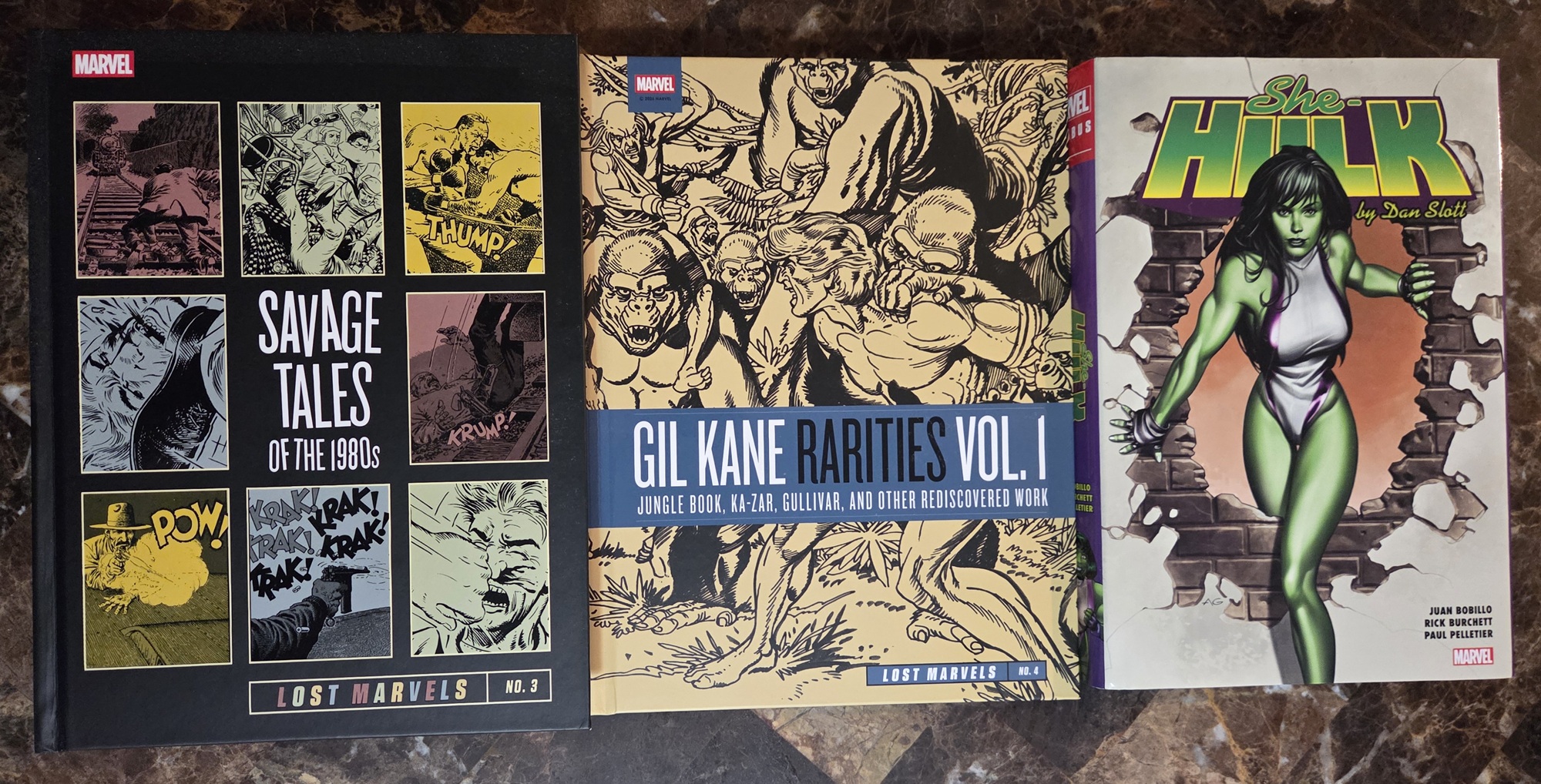
Oversized hardcover omnibuses also make great melee weapons!
Previously on Midlife Crisis Crossover:
Welcome once again to our recurring MCC feature in which I scribble capsule reviews of everything I’ve read within the past year that was published in a physical format over a certain page count with a squarebound spine on it — novels, original graphic novels, trade paperbacks, infrequent nonfiction dalliances, and so on. Due to the way I structure my media-consumption time blocks, the list will always feature more graphic novels than works of prose and pure text, though I do try to diversify my literary diet as time and acquisitions permit.
Occasionally I’ll sneak in a contemporary review if I’ve gone out of my way to buy and read something brand new. Every so often I’ll borrow from my wife Anne or from our local library. But the majority of our spotlighted works are presented years after the rest of the world already finished and moved on from them because I’m drawing from my vast unread pile that presently occupies four oversize shelves comprising thirty-eight years of uncontrolled book shopping. I’ve occasionally pruned the pile, but as you can imagine, cut out one unread book and three more take its place.
I’ve previously written why I don’t do eBooks. Perhaps someday I’ll also explain why these capsules are exclusive to MCC and not shared on Amazon, Goodreads, or other sites where their authors might prefer I’d share them. In the meantime, here’re some reading results…
…at shorter length this time, covering the physically heaviest books I’ve read so far this year. Two of them took much longer to read than the third, and are the main reasons why my total book count won’t reach 50 this year unless I really step up my speed and/or set other hobbies aside.
11. Dan Slott, Juan Bobillo, Rick Burchett, Paul Pelletier, Ty Templeton, et al., She-Hulk by Dan Slott (2022). It’s yet another comic-con bargain find from the good folks at Gem City Books out of Dayton, a staple at our Midwest shows. Even as a lifelong fan of lighthearted superheroics, I recall skipping Slott’s first Jade Giantess run because it was released when Marvel was escalating cover prices from $2.99 to $3.99 and I adamantly drew a line in my budgetary sand. (I’ve not gone lightly into the past couple years’ industry jump to $4.99, either.) I think I already bought some or all of his second run, which of course restarted from #1 because zero cheers for Marvel marketing ploys, but this mighty omnibus collects both runs comprising 36 issues plus a Two-Gun Kid one-shot — a time-displaced coworker in Jennifer Walters’ office at the time — all of which forms a surprisingly cohesive, self-contained continuum that distills Shulkie’s various interpretations into a singular sensation. His Silver Surfer run remains my all-time fave, but this was a longform reading joy too, especially considering it was the primary basis for the MCU’s She-Hulk, Attorney at Law miniseries, which our household enjoyed much more than certain internet corners did.
12. John Severin, Don Kraar, Wayne Vansant, Will Jungkuntz, Chuck Dixon, Herb Trimpe, Doug Murray, et al., Lost Marvels no. 3: Savage Tales of the 1980s (2026). For those just joining us: Marvel has been outsourcing certain projects to other companies lately, the most unexpected of which is this hardcover series from Fantagraphics Books, which aims to collect never-before-reprinted works from the oddest corners of their publishing history. I bought the first two volumes last year, which presented the obscure Tower of Shadows horror anthology (except for stories that were reprints from previous anthologies, plus two Lovecraft adaptations they had to skip due to rights issues) and oddly curated selections from Howard Chaykin’s work-for-hire bibiliography from the ’70s and the 2000s. I almost never buy newly released hardcovers, but I dug the concept, decided to commit, and was curious to see which oldies they’d exhume from the vaults that I’ve never read before.
Next up is Savage Tales, a remnant of Marvel’s black-and-white magazine line that wasn’t meant to fit into the “Hey, Kids! Comics!” spinner racks and thrived in the good-ol’-days of bustling newsstands. Well, okay, Savage Sword of Conan thrived — other titles not so much, including this “men’s adventure” anthology launched in 1985 that only ran eight issues. A mix of present-day crime dramas, wartime stories, and the occasional near-future shoot-’em-up, the series sported plentiful macho action violence, a modicum of profanity, and virtually no nudity despite the ostensibly titillating “babes-‘n’-bullets” cover aesthetic that was unsurprisingly left off this tome’s cover. Apparently the beer-swillin’ hairy-dude demographic didn’t buy multiple copies to toss in the bathroom next to their porno mags.
I was 13 at the time and grabbed the first issue — whose gun-totin’ lingerie-modeling biker-chicks cover was slightly less embarrassing than subsequent ones — for one reason alone: new artwork by the fantastic John Severin, whose career dated back to the original pre-Code EC Comics era, but whom I knew best as the greatest contributor to Cracked Magazine, MAD‘s biggest competition for a time, as well as for his work as an inker on Incredible Hulk (which I’d read reprinted in Marvel Super-Heroes). From childhood to the present I’ve always loved his distinctive linework and sound-effects lettering…but in 1985 war comics weren’t my thing. The rest of it kinda bored me, so I never bought another. In some respects that’s for the best, though at the time all eight issues would’ve only cost me a total of $12.25 plus tax. Forty years later, this 544-page compilation set me back quite a bit more.
I did get what I wanted, at least; Severin was in top form and drew several tales, all of them thrilling and crackling in their visuals. Also worthwhile is the introduction’s illuminating reflections from then-editor Larry Hama. Other contributors are likewise highlights — Severin’s old Hulk teammate Herb Trimpe (not a great writer, but did his career-best here as he clearly loved loved loved drawing airplanes and aerial combat), two-fisted man-of-action Chuck Dixon (an indie creator just breaking into the Big Two), the late Will Jungkuntz (who died at 29 while the series was in progress), future SpongeBob animator Vincent Waller, once-hot artist Michael Golden (no relation), WWII veteran and frequent war-comics illustrator Sam Glanzman, and assorted underrated late-’80s talents like Ron Wagner, the seemingly forgotten William Johnson, and a young Val Semeiks, who’d find acclaim drawing Conan and DC’s The Demon. It goes without saying that some efforts have aged more poorly than others, and the art quality got more inconsistent as the months wore on and they burned through their inventory. But at least it’s a complete package of what the cover promises, in terms of reading experience. They even threw in the original back-cover subscription ads and the letter columns.
13. Gil Kane, Roy Thomas, Jo Duffy, P. Craig Russell, et al., Lost Marvels no. 4: Gil Kane Rarities, Vol. 1 (2026). The most recent volume switches back to the artist-spotlight format and celebrates the co-creator of Green Lantern Hal Jordan, who also spent years at Marvel and co-created future movie-and-TV headliners such as Iron Fist, Morbius, and Guardians of the Galaxy Vol. 3 costar Adam Warlock. (Uhhhhh, one out of three ain’t bad?) His memorable Amazing Spider-Man stint brought us the original deaths of Gwen Stacy and Norman Osborn in the classic saga that shattered the hearts of fans nationwide, as well as the famous anti-drug story published in defiance of the Comics Code Authority. Too bad none of those show up here. At all.
As a kid I could take or leave his chunky-faced, manly-man figures and his trademark worm’s-eye-view up-the-nostrils shots. As an adult, I grew to appreciate his eye for dramatic camera angles and old-school fight-scene dynamics. All of that is here to varying degrees, complemented by several different inkers. The most unusual piece, straight out of the Department of Marvel Stories That Were Definitely Never Gonna Be Reprinted On Their Own, is a four-part adaptation of Mowgli’s three stories from Kipling’s original Jungle Book. It ran in Al Milgrom’s great, direct-sales-only Marvel Fanfare anthology, with later chapters written by Jo Duffy possibly after Kane’s solo verbosity in Part 1 proved a bit clunky. The delicate handiwork of P. Craig Russell might be the most incongruous possible choice for inker, who drastically winnowed Kane’s thick, wrong-end-of-the-brush lines down to the minimum width visible on Baxter paper. It’s not Russell’s best, but older fans of his numerous opera adaptations might appreciate this curiosity, though his name isn’t on the cover and the eye-searing colors were calibrated for the dimming effect of newsprint.
Otherwise, this volume’s curation is maddeningly random. After a succinct Kane biography by comics historian Jon B. Cooke, the lead reprint is “Gullivar Jones, Warrior of Mars”, adapted by Kane and longtime pal Roy Thomas from a 1905 novel, which may or may not have been ripped off by Robert E. Howard for his own “John Carter of Mars” books and which had just been recently reprinted. The duo only completed two chapters before it was turned over to other hands, whose clean-up on Aisle Mars was of course disqualified from inclusion. But Kane’s covers for the next three issues are here, followed by a text confirmation that their version of Jones’ story ended happily ever after and that Jones’ 1905 creator can SUCK IT.
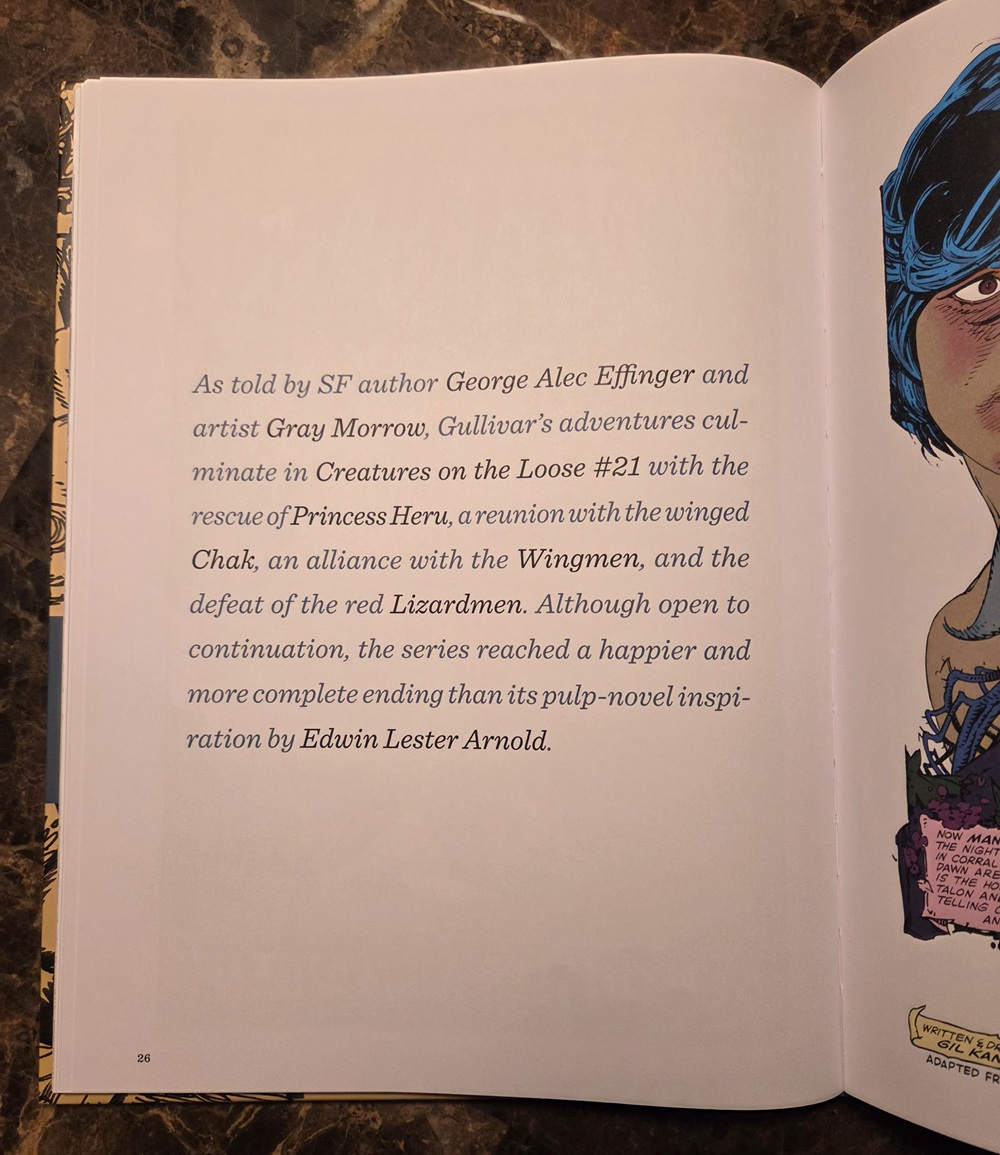
This “closure” is maybe one or two ZIP codes away from “Poochie died on his way back to his home planet.”
The only other narratives enclosed are two nonconsecutive issues of Astonishing Tales starring Ka-Zar the Savage, Marvel’s cult-favorite Tarzan ripoff. The second of those, #15, ends on a cliffhanger. But fear not, anxious reader: Fantagraphics releases you from your tenterhooks!

I promise this is a photo of the actual page and not Dave Barry’s latest generative-AI art gag.
I can’t remember the last time a book annoyed me this deeply.
For your own closure: yes, that cliffhanging tale pitted the heroic, blond-maned custodian of the Savage Land and his trusty saber-toothed tiger Zabu against The Pusher, a drug-dealing super-villain borne very much of the kung-fu movie era: Black, musclebound, bald, shirtless, wearing a single gold earring, prone to erudite braggadocio such as, “These hands can slice brick — they will find your flesh no obstacle!” As of this writing, the issue’s editor Roy Thomas has yet to issue any formal press releases declaring himself proud co-creator of The Pusher.
Filling out the rest of the book is a gallery of over 100 different covers drawn by Kane for assorted lesser-selling series, none of his more iconic pieces — lots more Ka-Zar, Sub-Mariner’s solo title, a plethora of monsters, and dozens upon dozens of Westerns. The latter show the most intensive efforts on Kane’s part, richly textured pieces that he certainly spent more hours on than he did some of the interiors collected here. For sharp-eyed older readers this gallery unfortunately comes with an ironic party game: see if you can spot how many cover characters clearly had their faces redrawn by Art Director John Romita. I’m pretty sure there’re well over a dozen.
So this Gil Kane exhibition adds up to more of a coffee-table art book suitable for casual buyers in a museum gift shop than a satisfying vintage reading experience for comics-histor aficionados. Possibly related: Fantagraphics has yet to announce a fifth Lost Marvels volume, begging the questions of whether sales have justified any more, whether I’m the only one disappointed with the inconsistent execution, and whether they brainstormed enough ideas for multiple volumes before they launched this initiative, and exactly what’s their working definition of “lost”. I’m not sure I’ll preorder any future installments quite so quickly.
More to come!
Discover more from Midlife Crisis Crossover!
Subscribe to get the latest posts sent to your email.

