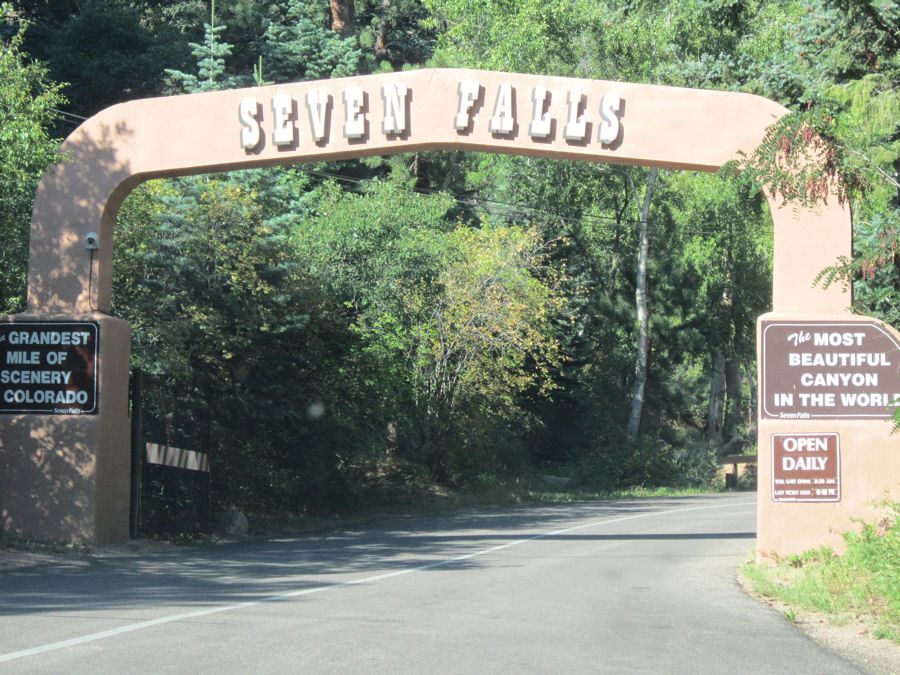
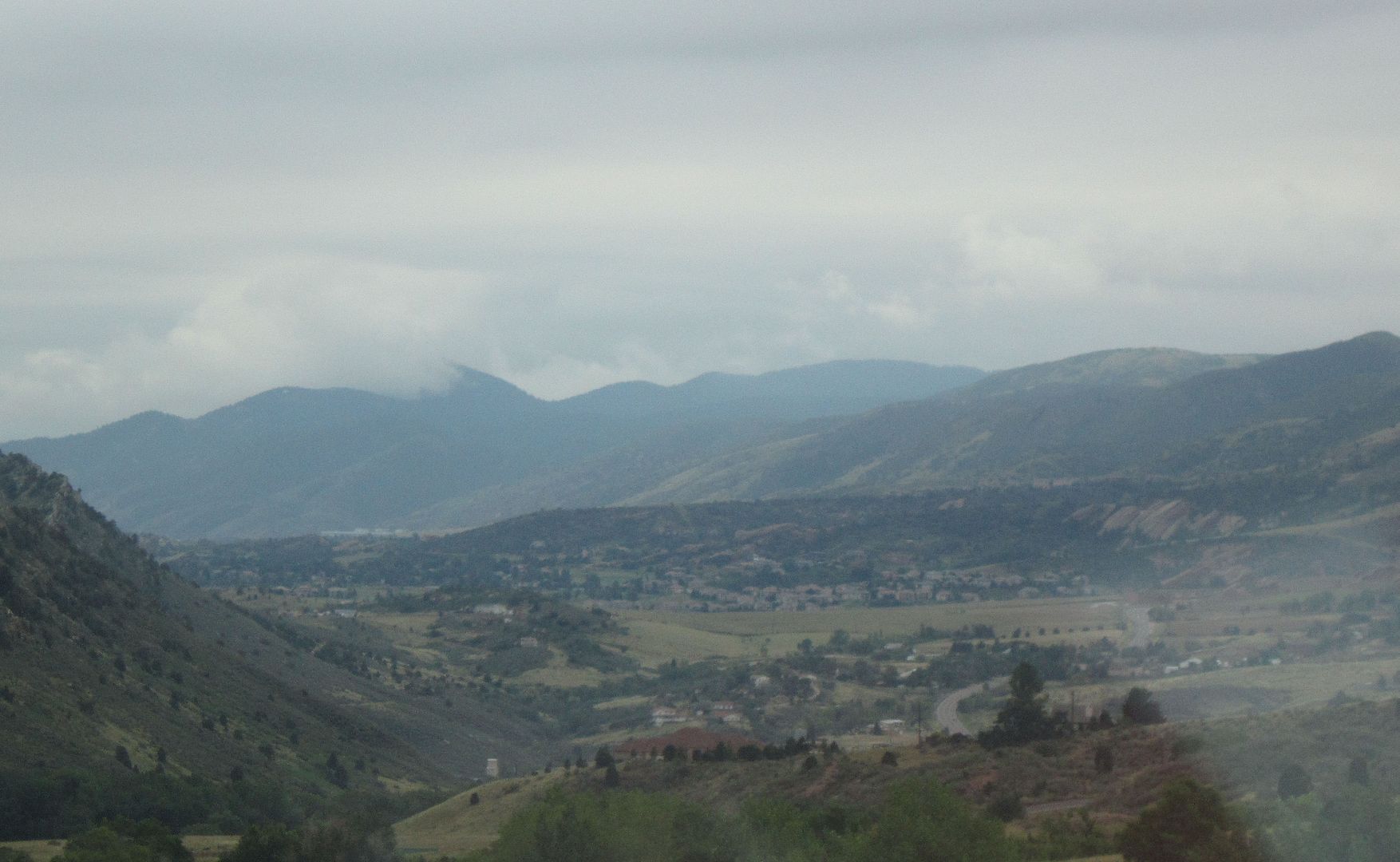
Day Six of our nine-day vacation began in Colorado Springs, traveling from our east-side hotel to the Rockies on the west side of town, where resides the attraction called Seven Falls. The septet of vertically stacked waterfalls begin eighteen stories above ground, each one a direct tributary to the next one down. They’re not especially loud or powerful, merely peculiar in their natural occurrence.
They’re also apparently contained within a critically acclaimed canyon. They did it! They finally did it! They found the world’s most beautiful canyon! Congratulations, God!
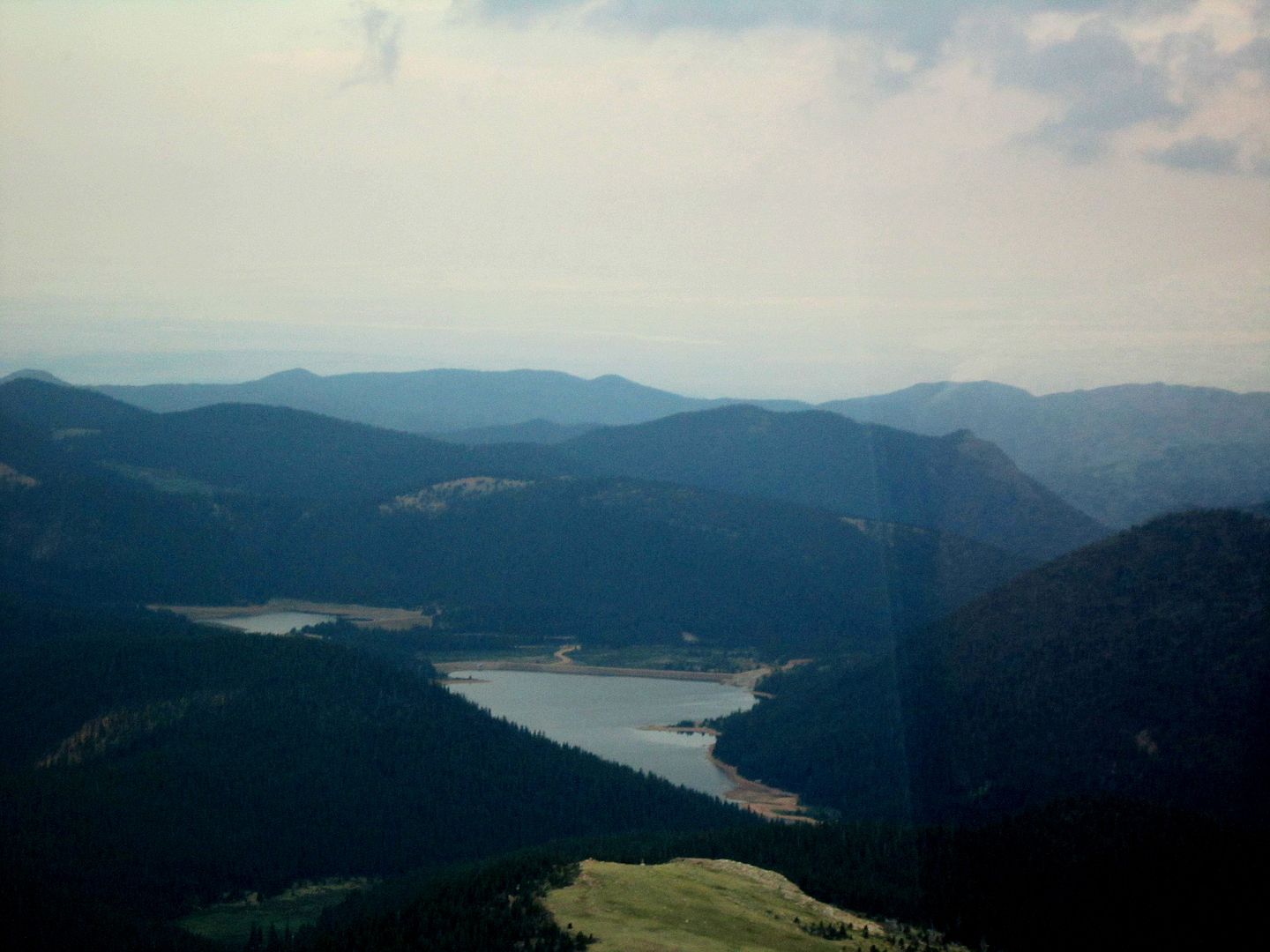
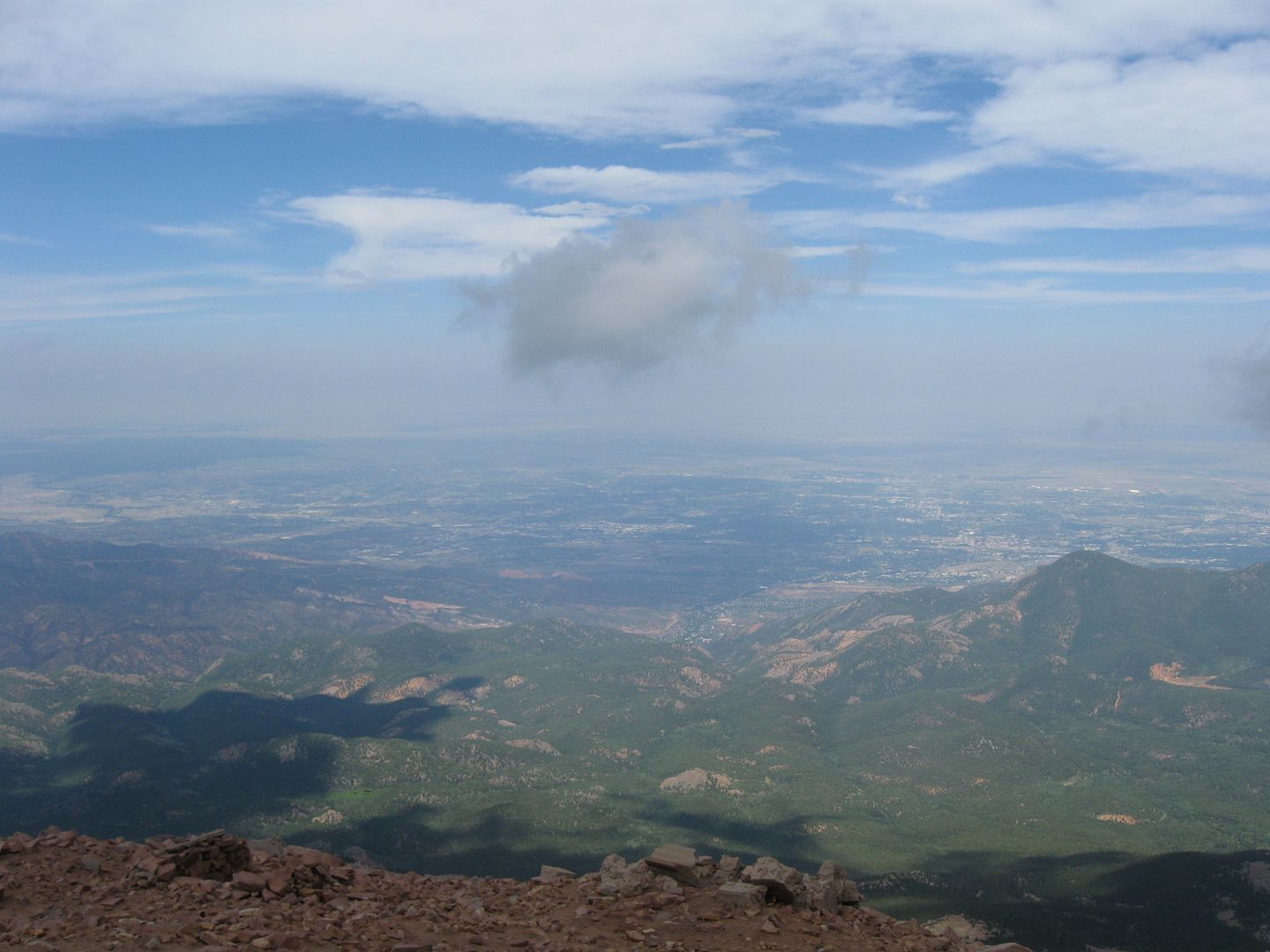
With only forty-five minutes to enjoy the top of Pikes Peak as much as possible, we tried to savor the view, the thin air (for the uniqueness of the experience, not because we liked gasping), and the near-freezing temperatures that perfectly counteracted the summertime heat that had been hammering us at ground level. Alas, forty-five minutes flew by in about ten minutes flat.
Once the Pikes Peak Cog Railway deposited us at the top of Pikes Peak, 14,110 feet above sea level, it was clear to all of us that Day Five had just won the vacation, if not our entire vacation history.
The views from all directions effectively narrate themselves.
The Manitou Cliff Dwellings are on the north side of Highway 24. On the other side of the highway is Manitou Springs, a cozy. woodsy town that thrives on Pikes Peak tourism. You may recall how last summer’s nightmarish wildfires made them a household name. Thankfully the coast was clear, embers were nowhere in sight, and the evacuations were called off days before our arrival. In fact, local news reports earlier that week had interviewed the townspeople about the impact of the wildfires on their economy. I like to think we did our part to reverse a little of that damage, if nothing else.
Lunch was at a restaurant called the Keg. I thought it was a mere bar when my son chose it from among several competitors, but we were starving and no one complained about his teenage presence, so I’m proud to label it as good family dining. I’m still not sure why he chose it, of all the many options surrounding us. Perhaps their wooden mascot captured his imagination with its trustworthy sign promising superlative cuisine. Maybe later we could also find a shop selling the Best Coffee in the World. I rolled with it for the sake of adventure and not-starving, and wasn’t disappointed in the least.
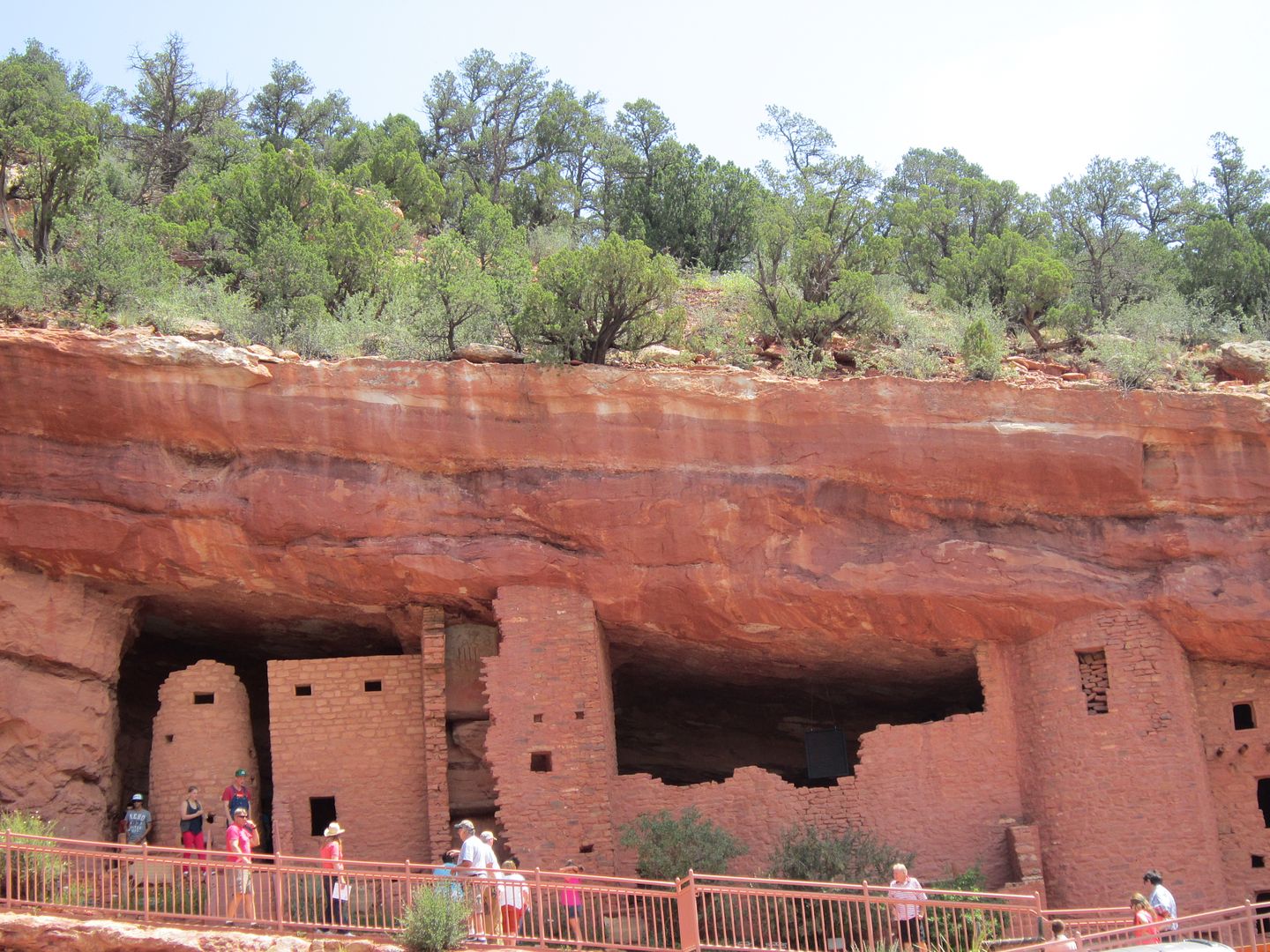
The south exit from the Garden of the Gods is five minutes away from Manitou Springs, where we spent the next several hours of Day Five. West of the Garden on Highway 24 are the Manitou Cliff Dwellings.
Built ages ago by the Anasazi tribe in southwest Colorado around the Four Corners area, the Dwellings were carefully lifted by their foundations and transplanted further northeast in the 1900s under the care and coordination of a well-meaning anthropologist who rightly noted that they’d been abandoned anyway.
With sweet sorrow we parted with Denver on Day Five and headed south toward Colorado Springs. The tragic wildfires had been extinguished barely a week before our arrival, but we steered clear of Waldo Canyon and other affected areas. Those affected didn’t need voyeuristic out-of-towners traipsing around for scrapbook subjects.
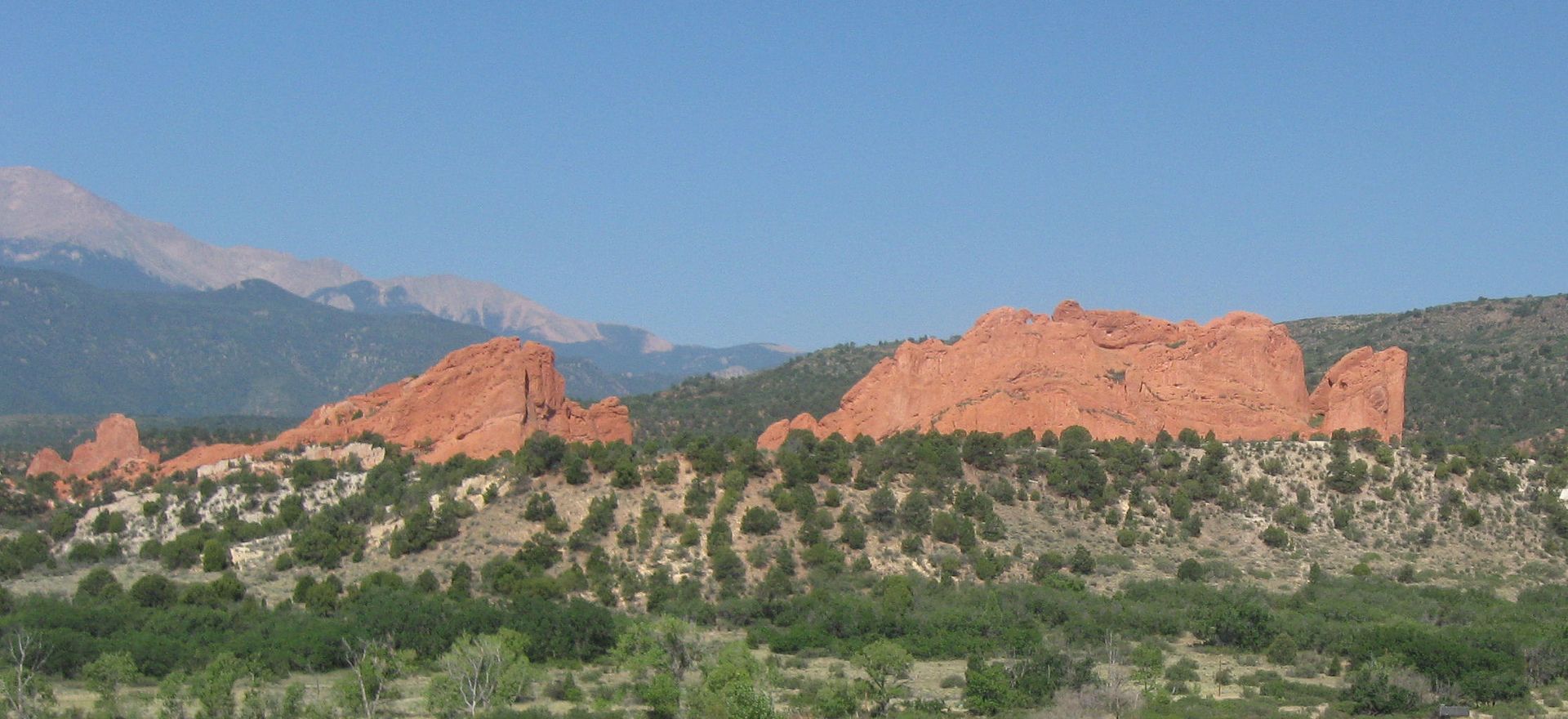
Our first major stop was a park west of the city called the Garden of the Gods, whose claim to fame is a collection of geological oddities that don’t remotely blend in with their surroundings. Once you reach the Visitors Center, where I stood while snapping this, you can just tell which part of the landscape is the actual Garden.
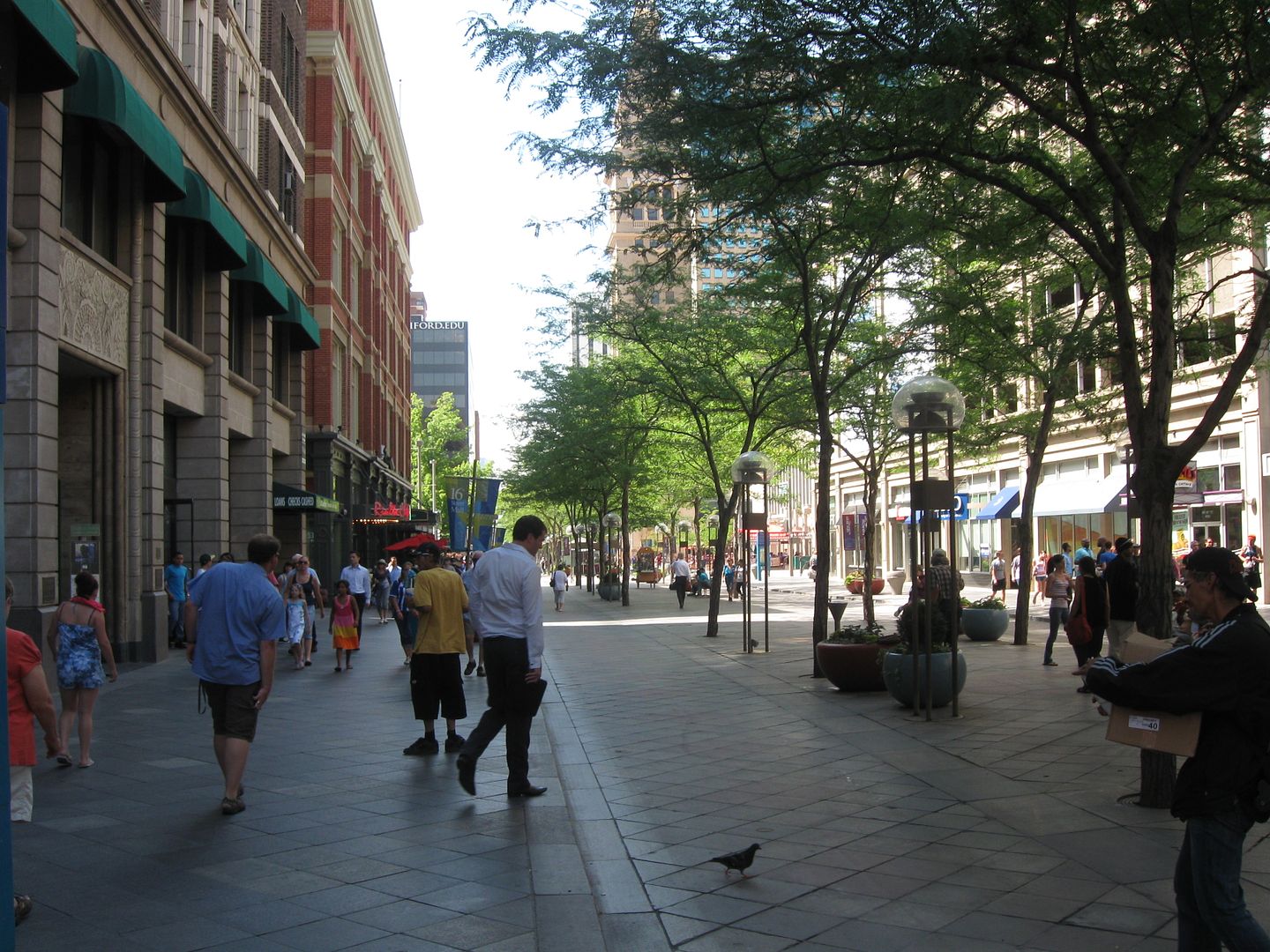
After our extended lunch at the Buckhorn Exchange, we spent the late afternoon of Day Four in and around the 16th Street Mall, a 1¼-mile-long stretch of street tiled over for use exclusively by pedestrians and free shuttle buses. This sounded like a novel concept to us, but in person it wasn’t too different from the “lifestyle centers” (the new euphemism for outdoor malls) that we have back home in Indy, despite being four times their size. The constant (and free!) shuttle buses were a wonderful touch, though.
The other half of our brief visit to the Denver Art Museum was largely spent in the Japan portion of their Asian section, my son’s exhibit of choice. We knew this without even having to ask. He dreams of going to Japan someday so he can confirm in person what he already tells us every other day, that everything they do or have is better than anything we do or have. The “grass is always greener on the other side” argument is useless against him. They probably have an appropriate metaphor that tops that one, too.
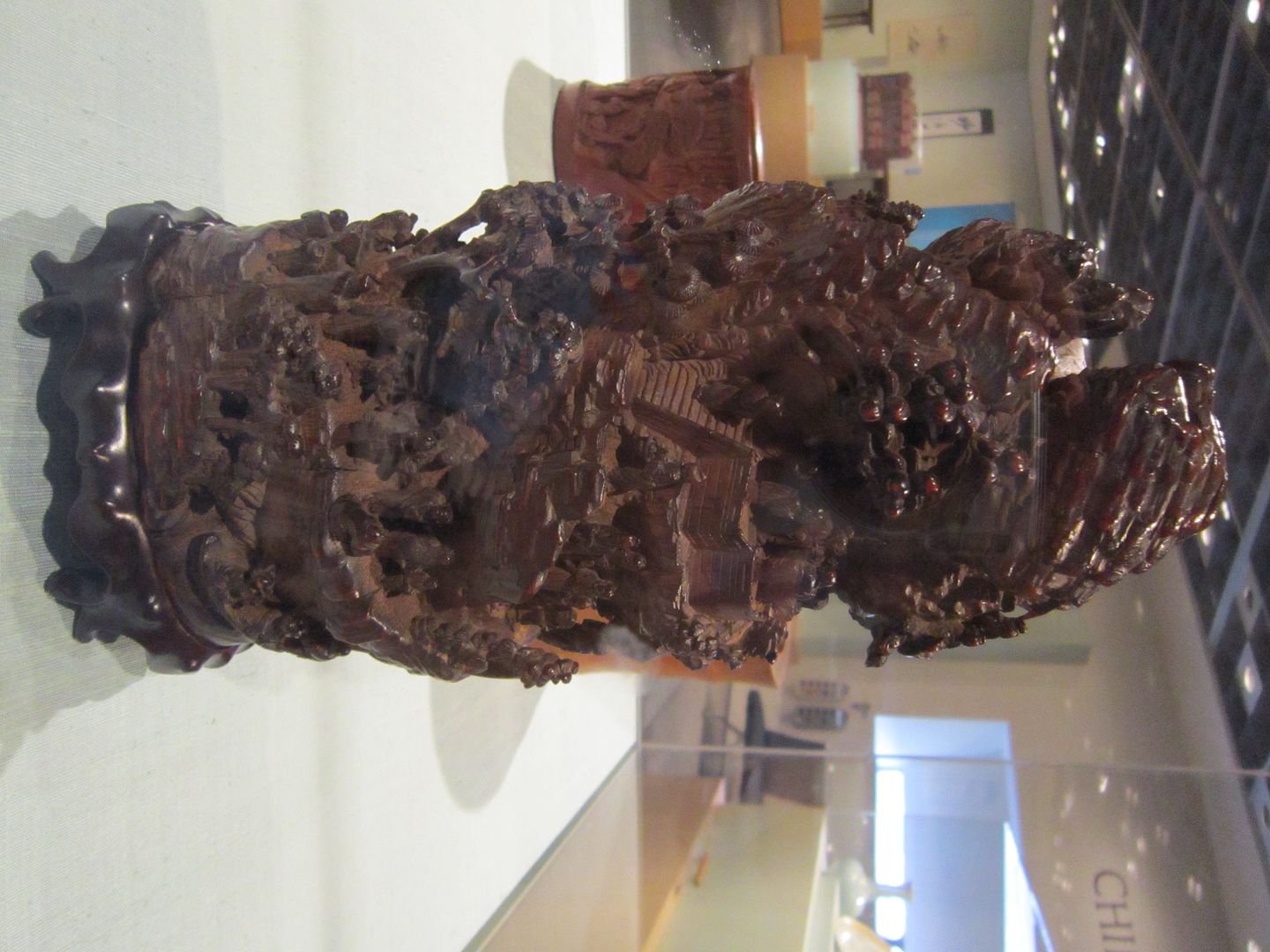
My favorite of the collection: a sculpture so intricate, it must have taken the carver’s entire lifetime and/or driven him mad.
Our itinerary for the first half of Day Four didn’t feel overbooked when we first arranged it. By the time we finished touring the Molly Brown House and standing next to the Colorado State Capitol, we had a little over an hour to walk a few blocks east to the Denver Art Museum, walk a few blocks back to our parking space, and arrive at the Buckhorn Exchange in time for our 1:30 reservation. After allotting for the hot round-trip walk through the artsy part of town, we found ourselves pressed for time on our whirlwind self-guided tour of the Denver Art Museum.
Further complicating matters: my camera batteries died, and my spares were safe and sound in our hotel room back in Aurora. Fortunately my wife is diligent in keeping her camera’s built-in battery recharged nightly. Between Molly Brown and the museum, we found not a single shop of any kind that sold batteries. Even the Art Museum gift shop was of no help — theirs isn’t the kind of place that stocks up on incidentals for inconvenienced tourists. At best, they might’ve carried a commemorative spoon with a painting of a battery on it. Once again, as with the GenCon costume contest, the day is saved thanks to my wife and her superior camera.
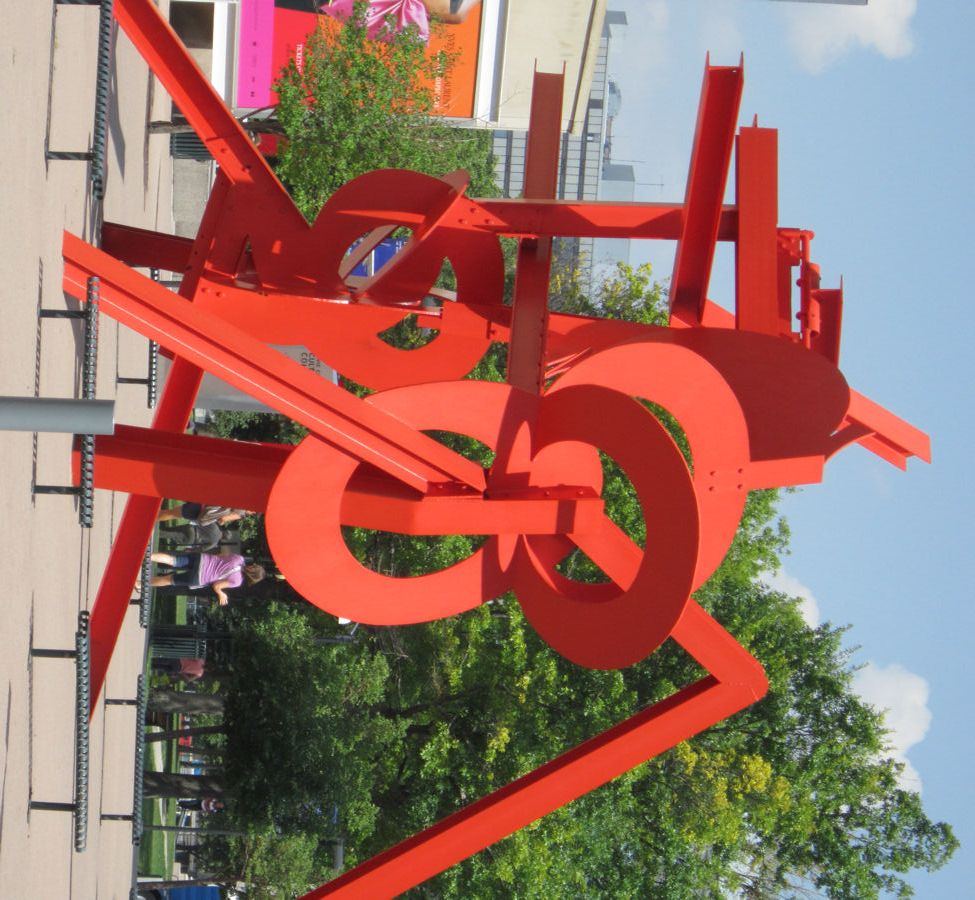
A few outdoor sculptures greet you as you approach the Art Museum from the east. Between the museum and the Denver Public Library is Acoma Plaza, in which stands Mark di Suvero’s sculpture “Lao Tzu”, named after the author of the Tao Te Ching. I read the latter in college, but wasn’t prepared to interpret the artist’s meaning here, unless some of these shapes represent Chinese pictographs.
Our game plan, once inside: we three each selected one museum section for the group to peruse. I chose the Pacific Northwest section, featuring art from the U.S. and Canadian tribes who dominated that particular coast. Our museums in Indiana and the surrounding states have more than their share of Native American art and artifacts, but I was curious to know if other tribes had their own individual styles unavailable for display in the Midwest. I’ve seen all the maize-based manufactured goods I’ll ever need to see in our museums, but this exhibit was successfully different from those, highlighting the works of the Haida, the Tlingit, the Inupiaq, and the Kwakwaka’wakw (I’m not sure which letters are silent, if any).
After our extensive daylong sojourn through mountains’ majesty, we spent Day Four of our vacation on a metropolitan retreat in Denver. It was nice to get away from nature for a while and relax in the urban hustle-‘n’-bustle.
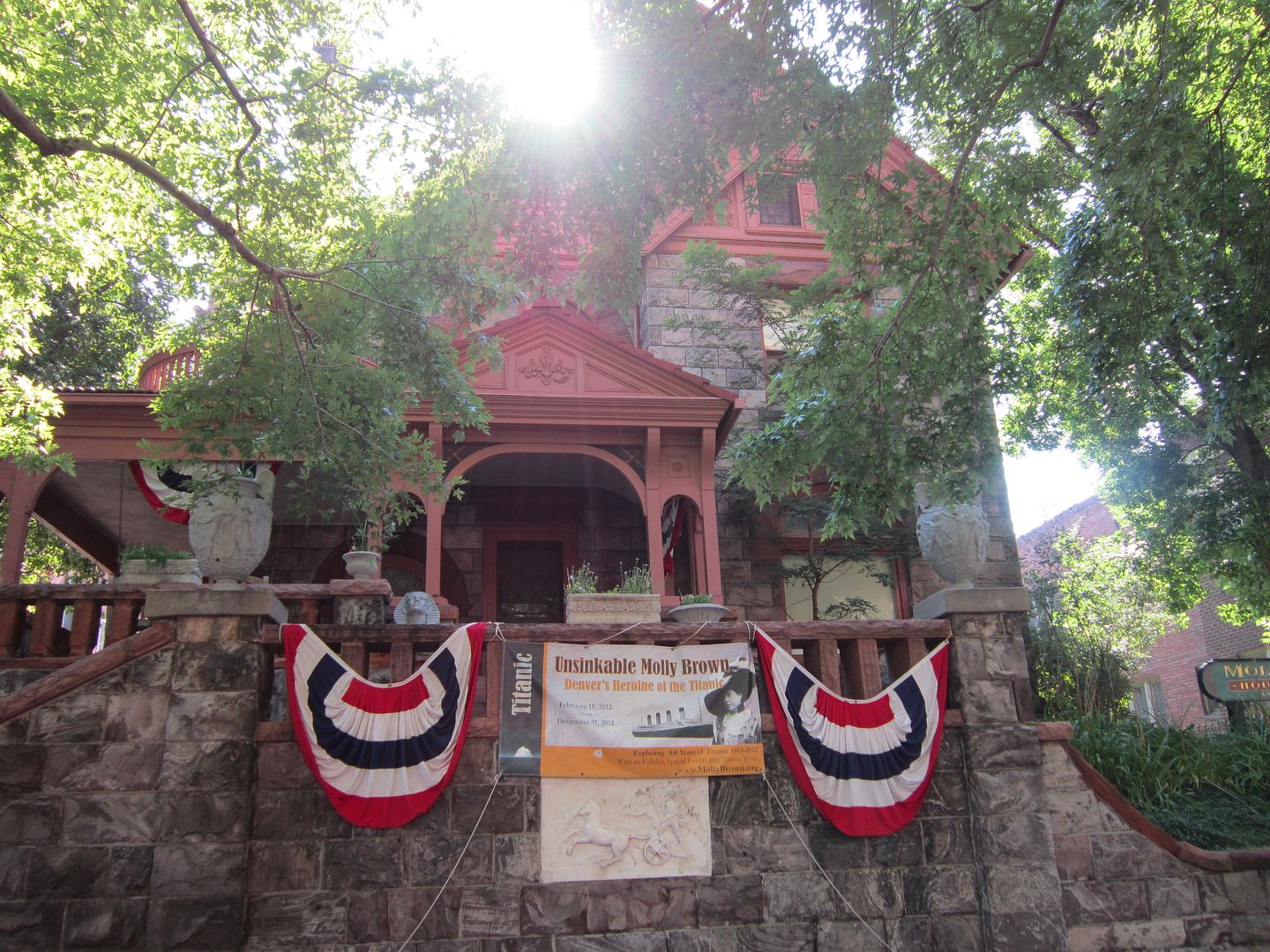
Our first major attraction was the Molly Brown House, the well-to-do abode of the famous socialite and boat jinx from 1894 until her passing in 1932. It exchanged a few times after that and was put to less fabulous uses until a 1970s restoration effort renovated it into a historical highlight not far from downtown Denver. Photos were unfortunately forbidden inside the house, but the exterior has its own quirks, least of which is the house being decades older than its surrounding neighbors. You’ll notice under the ad banner for the Titanic tour is an unusual place for a relief out of time.
Previously on “Rocky Mountain National Park: the Miniseries Within a Maxiseries”: the second half of Day Three of our road trip was spent in and on the way to Rocky Mountain National Park, amidst a splendidly arranged mountain collection that shames the pitiful hills of our Indiana homeland.
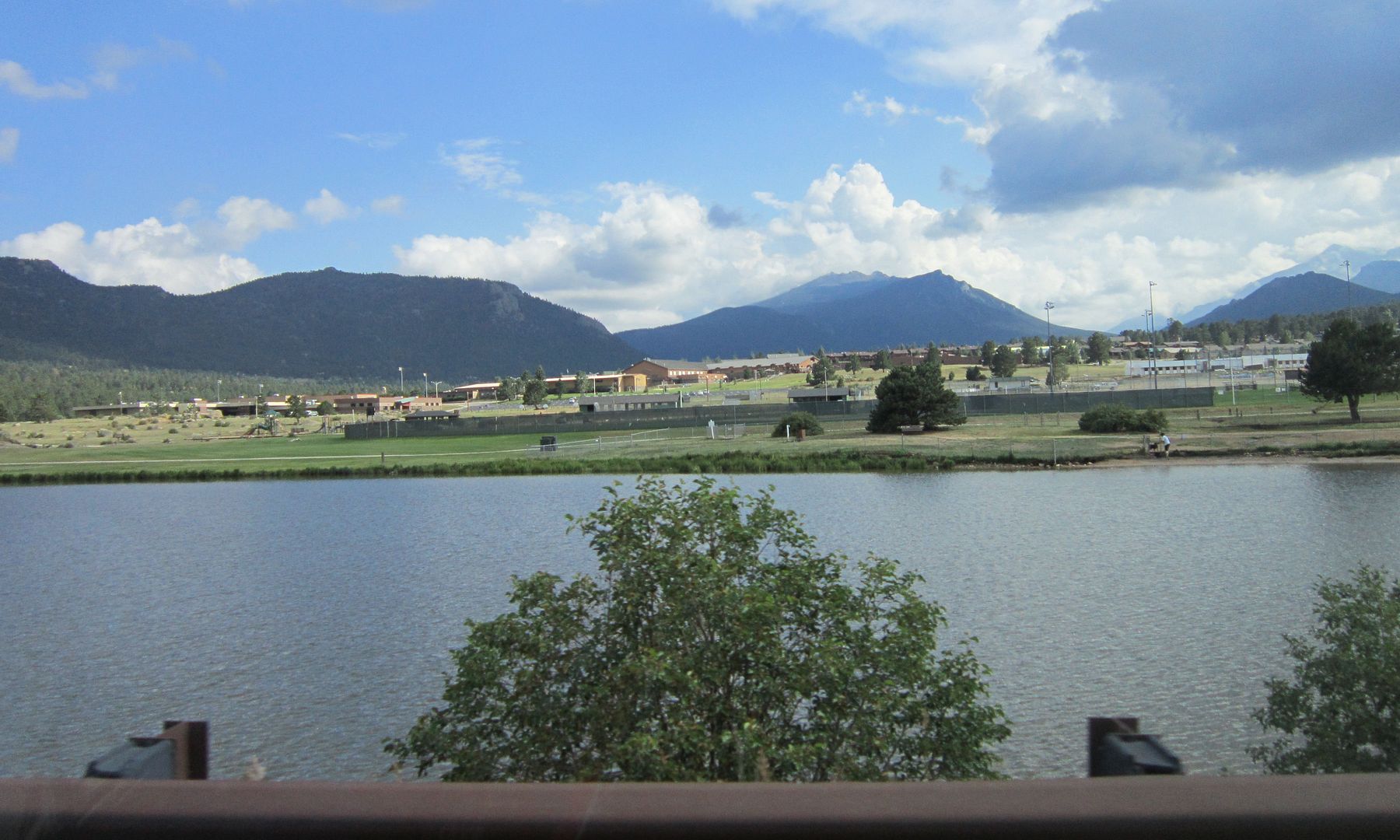
The most conveniently paved entrance to RMNP from the southeast is US Route 36, through Lyon and into the town of Estes Park, crossing here over scenic Lake Estes.
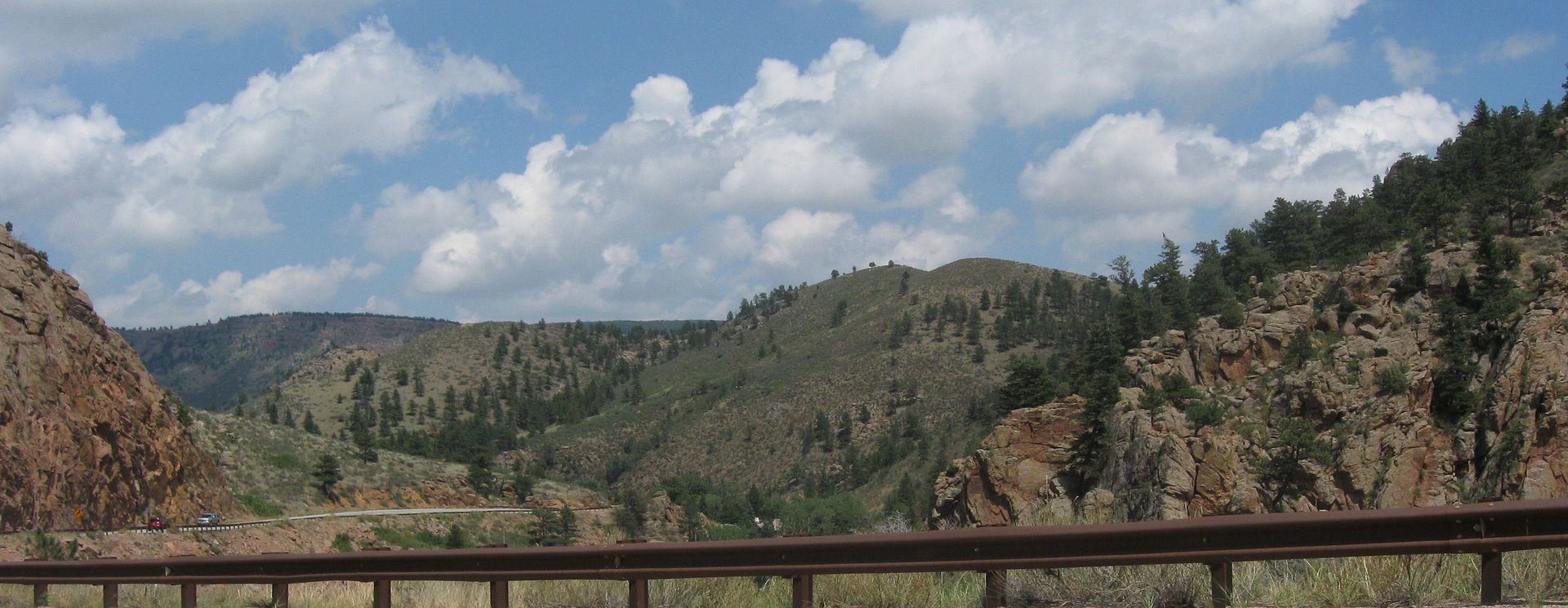
After I acquiesced to my wife’s demand for a slow, careful descent down Lookout Mountain, our scenic Day Three continued north with a two-hour drive along the east side of the Rockies, through Boulder (very fancy and well-manicured, though not a single Mork & Mindy statue in sight) and northwest to the cozy, wooded town of Estes Park, home of Rocky Mountain National Park.
The drive can be accomplished in less than two hours if you keep your eyes focused on the road and ignore your surroundings. That’s a terrible way to experience the Rockies, though. I had a hard time deciding how often to stop, which views might stand out the most on camera, and which ones to pass by without stopping. Along that entire stretch, beautiful vistas were as common as mile markers. We thought highly of them, anyway. I don’t know if people who live near mountains take them for granted or genuinely wake up appreciating them every day, but we’re used to the topography of Indiana, where the nearest mountains are in West Virginia and all those rolling hills in the southern half of the state stopped impressing me around age 5. Then again, I can imagine Kansans driving up and down State Road 37 between Bloomington and the Ohio River, oohing and aahing at how not-flat everything is. It’s all about your geographic context and personal perspective, I suppose.
I have to admit to myself here that God’s majestic monoliths don’t really beg for puny human captions. This is me stepping back, shutting up for the space of several pics (some taken inside the park, some on the way to the park, all clickable for plus-sized goodness), and letting you enjoy the kind of views that have inspired many a landscape painter, poet, mountain climber, and cinematographer.
Just as Dinosaur Ridge was mere minutes from the Red Rocks Amphitheatre, so was our next stop ten minutes or so from Dinosaur Ridge, down the slope of Alameda Parkway, across the interstate, and up the forested residential side of Lookout Mountain. We were elated to suffer no ill effects from the changing altitudes this time. The real estate on the way was curiously maintained, as most of the home along Lookout Mountain appeared well-to-do, as if the local upper-class had all sought refuge together in case of another worldwide flood. At the very least, I imagine their homeowners’ association prides itself on strict upkeep.
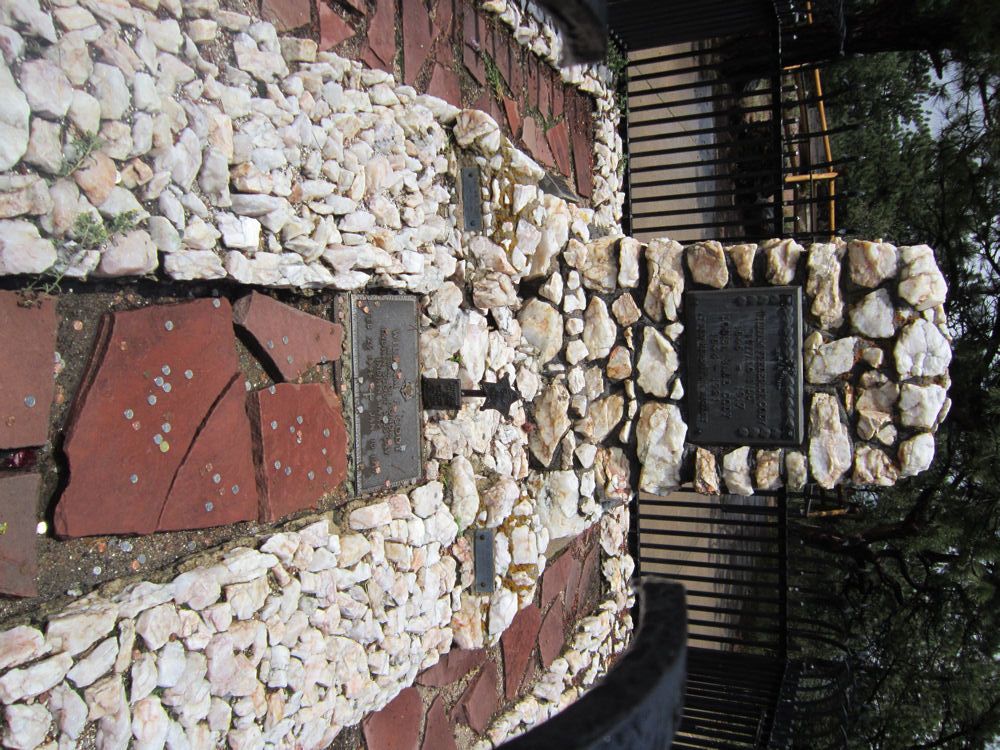
Past the mountainside suburbs and one abandoned restaurant was our next stop, the Buffalo Bill Memorial, final resting place of Old West legend William F. Cody himself. I’m not sure why visitors feel compelled to throw pennies at him. Perhaps famous people’s graves are like wishing wells if you toss them just right. Perhaps they’re meant as tributes to Charon. Perhaps they’re a down payment from those who think Buffalo Bill’s ghost is a detective who helps the helpless and gives hope to the hopeless…for a price. Perhaps they’ve somehow mistaken his grave for Benjamin Franklin’s. The world may never know.
Our itinerary for Day Three continued from the Red Rocks Amphitheatre to nearby Dinosaur Ridge, less than a mile down the road as the crow flies. We’ve seen dinosaur fossils before at the Children’s Museum in Indianapolis, as well as the Natural History Museums in Manhattan, Chicago, and Washington, DC. Truth be known, simple fossil exhibits aren’t as exotic to me now as they were in my youth. The displays at Dinosaur Ridge offer a different take on the subject — their fossils and samples are outdoors and still embedded in solid rock, exposed ever so slightly for visitors to see them in their natural habitat instead of being reassembled on a dais or sealed inside a glass cabinet.
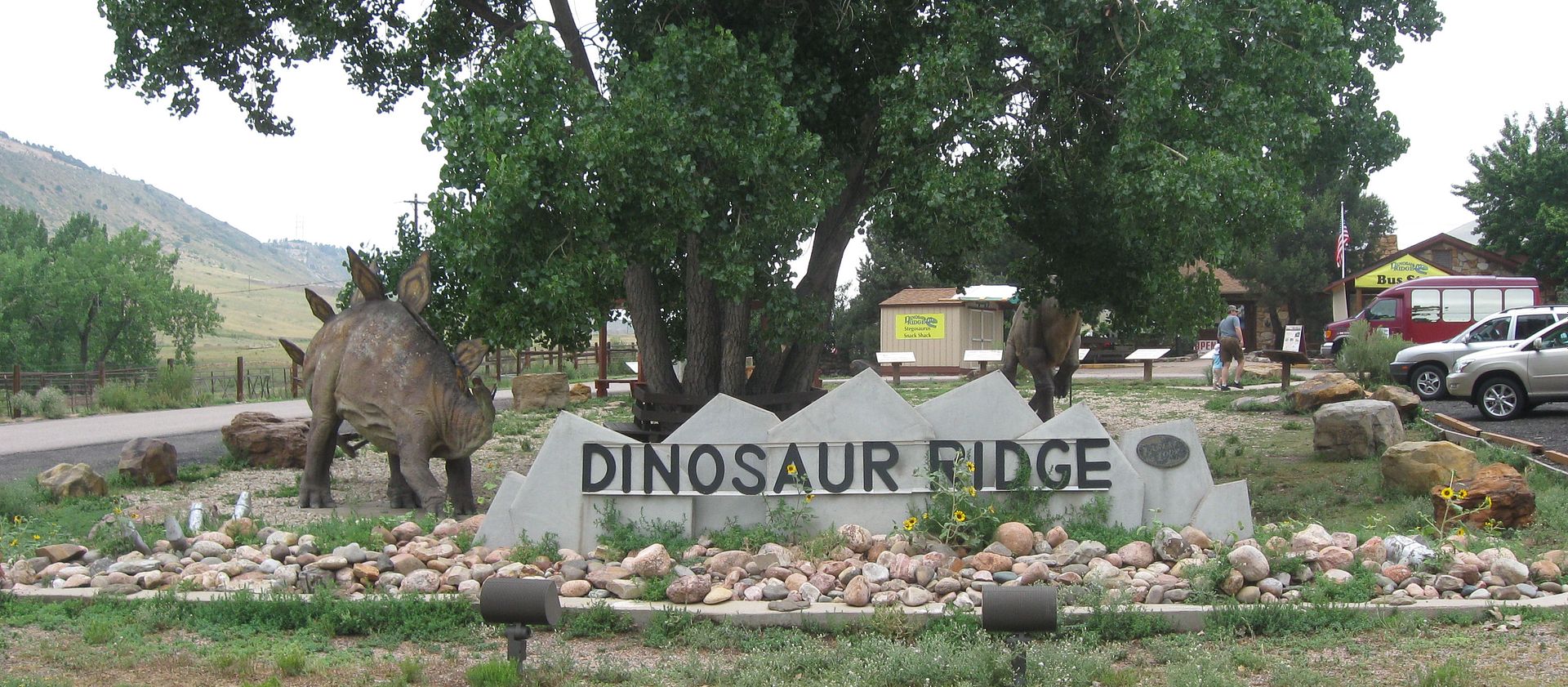
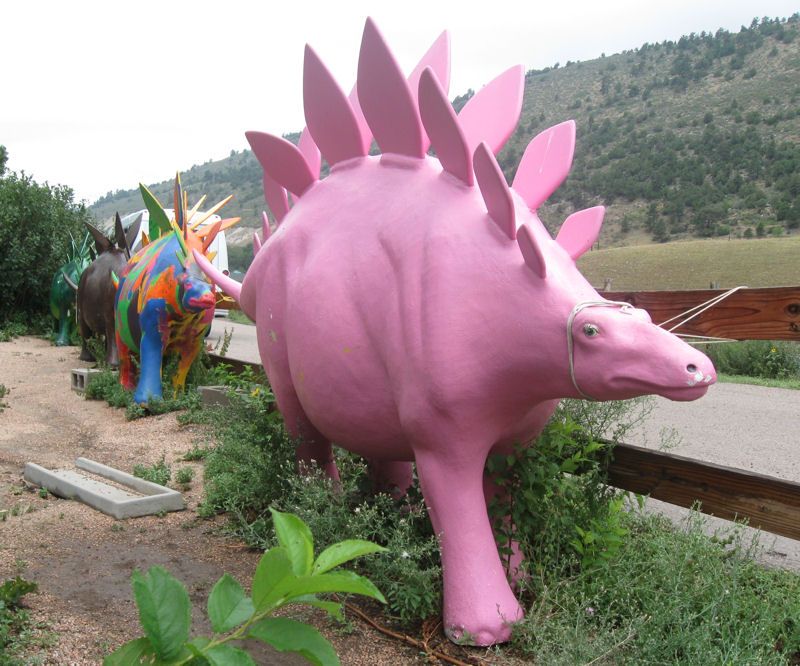
When I first learned of the Dinosaur Ridge premise, I imagined entire walls filled with a panoply of complete, recognizable skeletons. That’s not quite the reality. The entrance and welcome center set the stage just like any standard museum, with the prerequisite dinosaur statues and shelves of dinosaur toys. For an added flourish, off to one side is a stegosaurus pride parade.
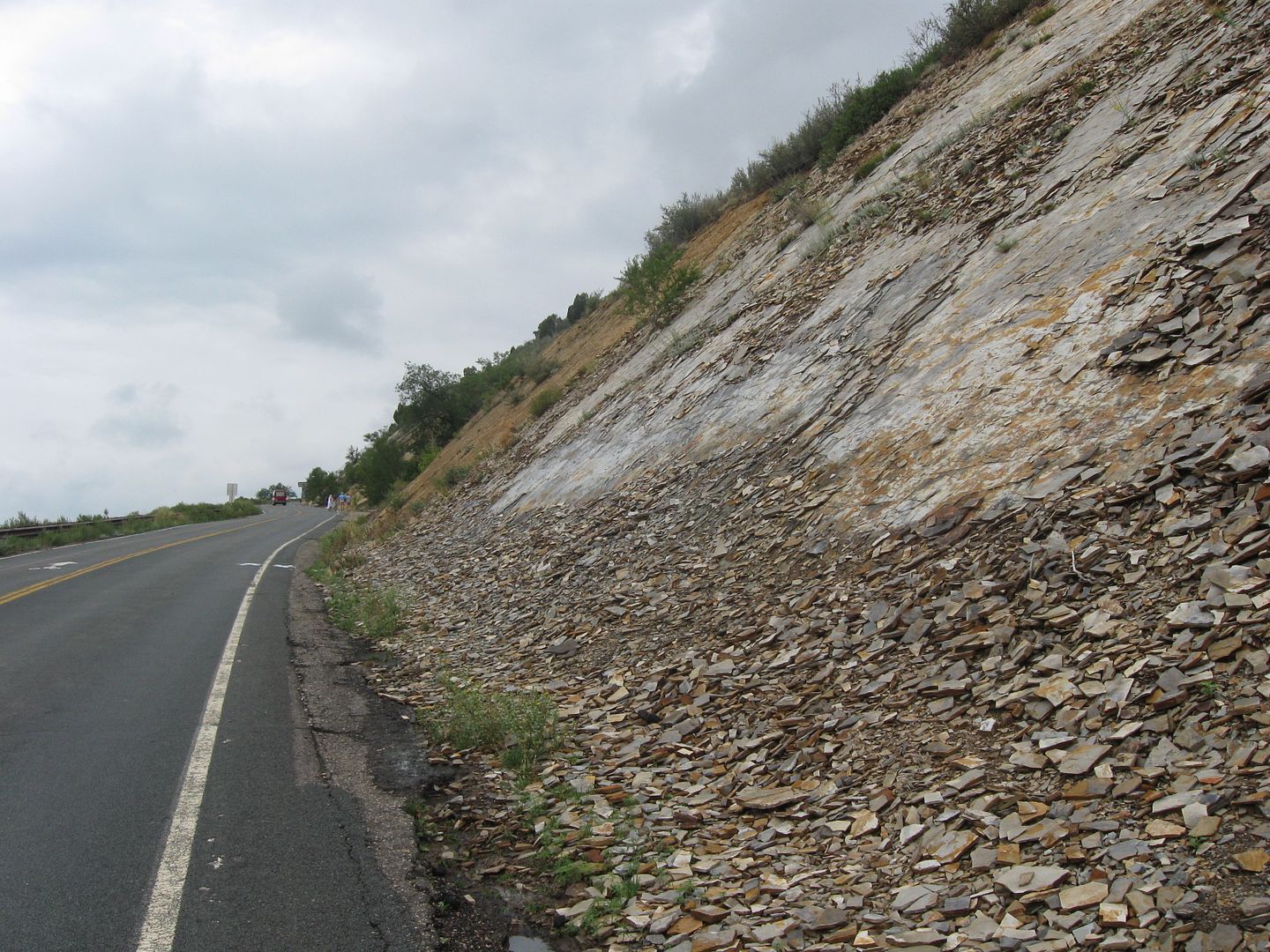
The natural exhibits comprise the wall along a curvy, uphill mile of Alameda Parkway heading west from the visitor center. No cars are allowed up the ridge except the official Dinosaur Ridge shuttles. The shuttle ride is free, as is their tour guide who elaborates on any points of interest and keeps you focused on the marvels you’d hoped to witness. If you’d prefer to chart your own destiny, pedestrians and bicyclists are permitted to traverse the ridge as they see fit. Our family policy is we prefer to set our own pace and avoid trapping ourselves in other tourists’ schedules or paces. In some situations this can be advantageous if you know what you’re doing and have all the same exhibit access that the tour groups do.
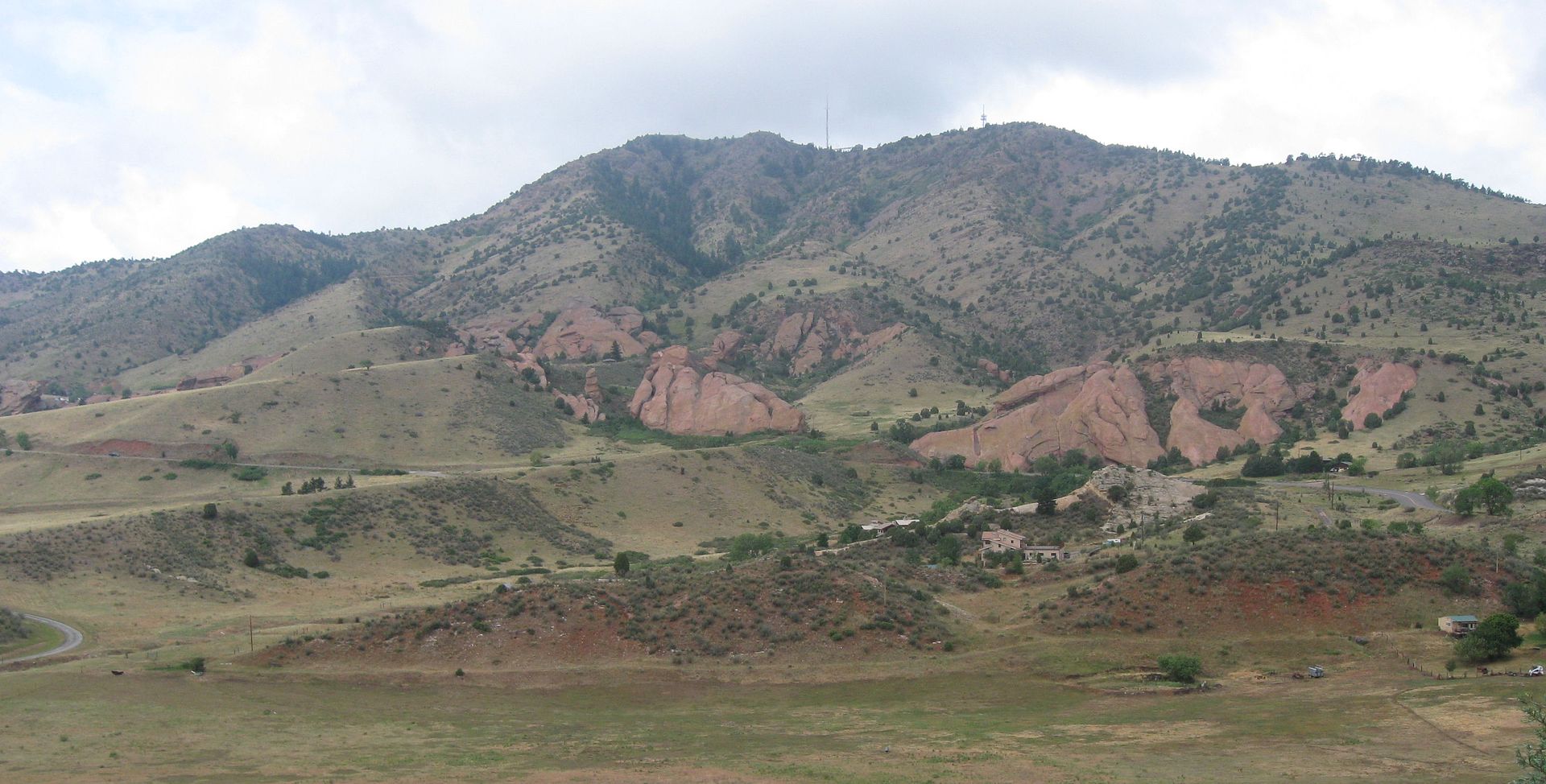
In this situation, it meant a stubborn one-mile walk uphill, which mostly looked like this. Open highway plains to the left of us, rough terrain to the right.
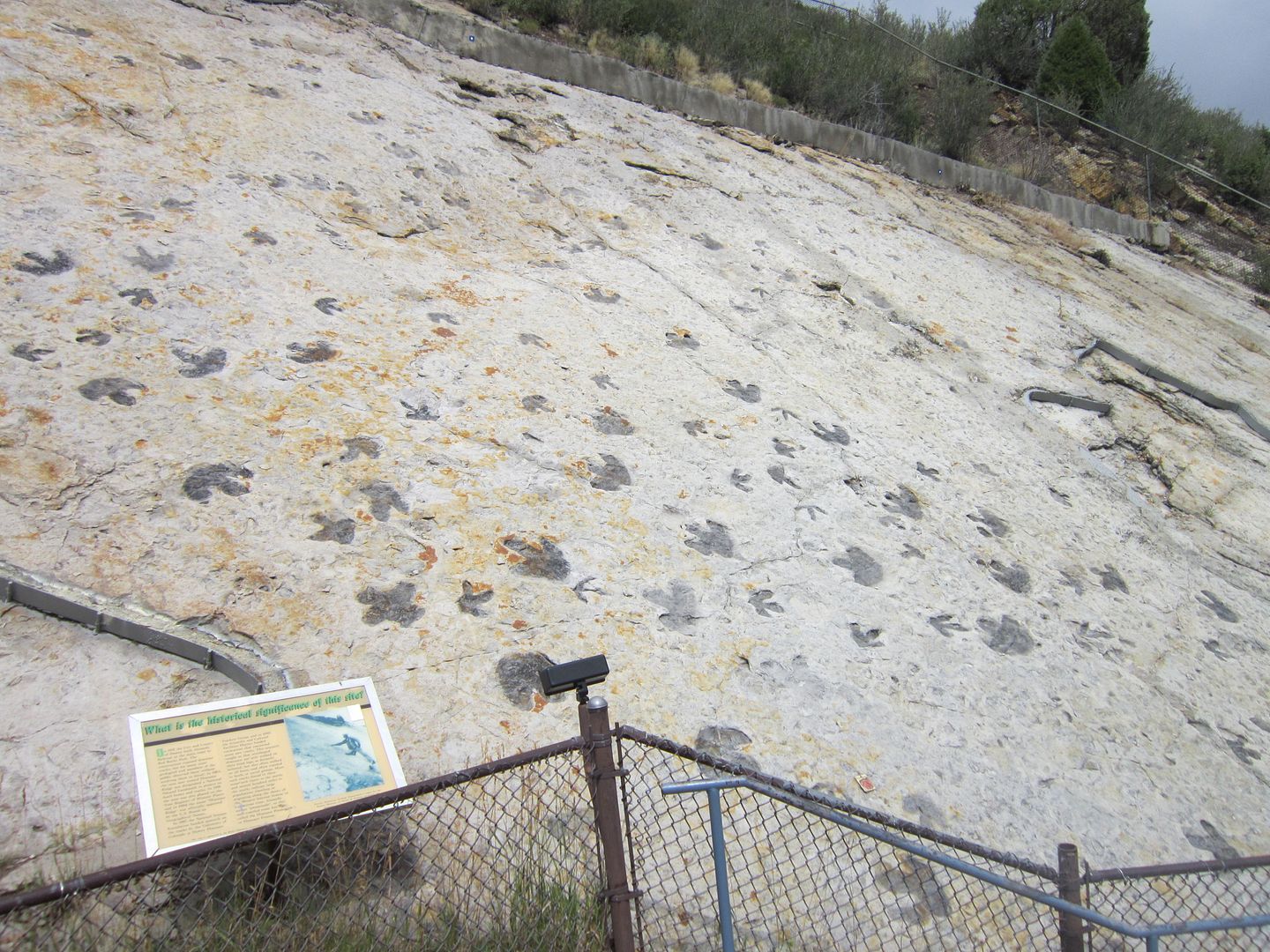
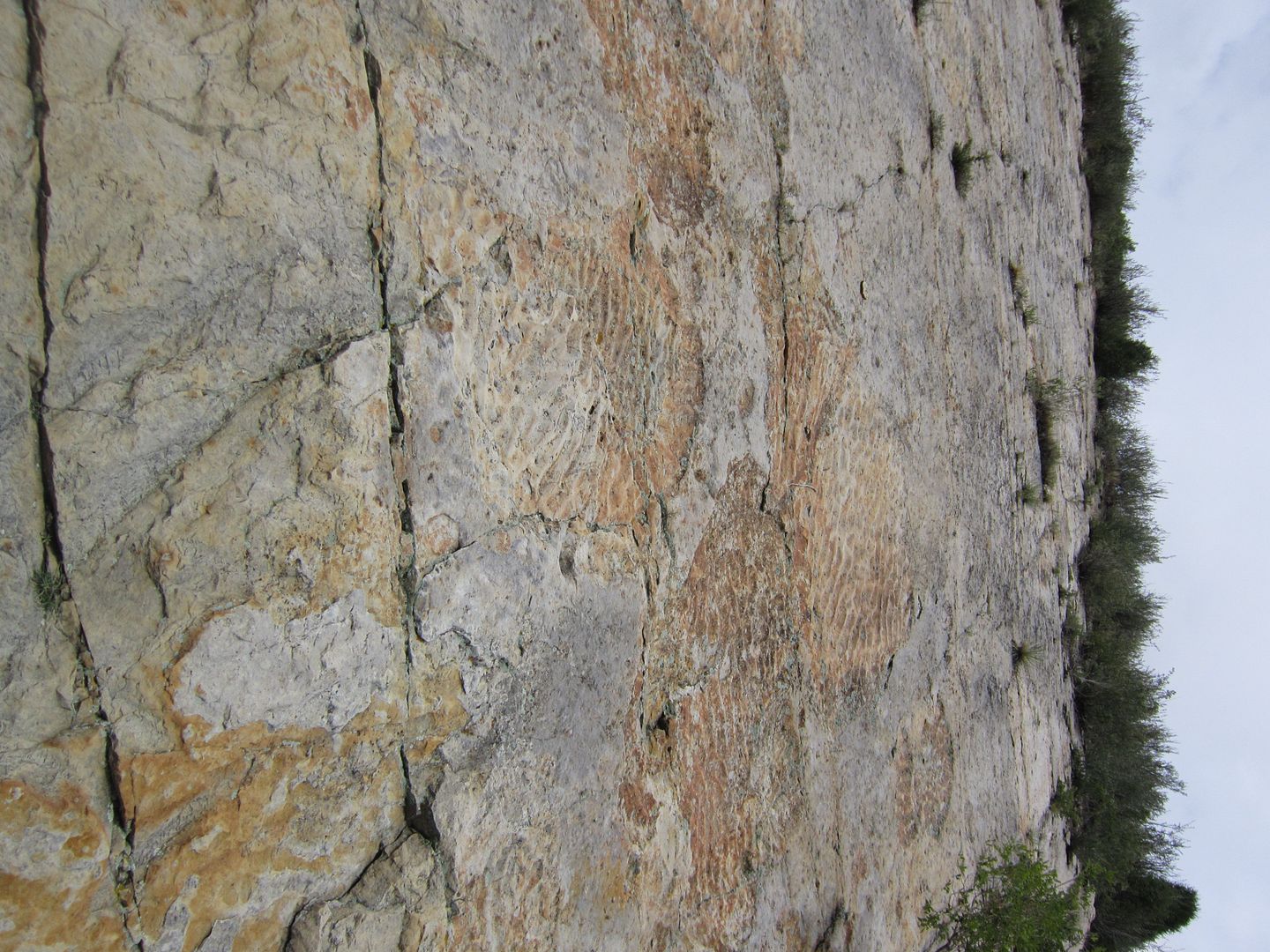
Every several hundred feet, we’d arrive at something of note. This collection of preserved footprints wins Best of Show, Dinosaur Ridge Exhibit category.
If your child thinks ancient plants are as cool as dinosaurs, this selection of imprints may make an interesting poster.
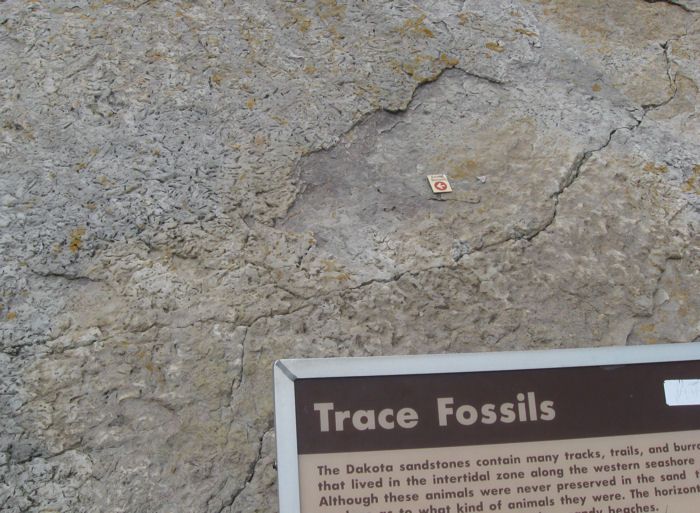
Most of the long walk was decorated with naught save rocks, stones, pebbles, boulders, and suffering grass. In a few spots, helpful signs invited more specific attention to traces that are scientifically noteworthy, easily overlooked, and nearly invisible to the untrained eye.
Closer inspection could reveal greater detail, or stump the more impatient onlookers.
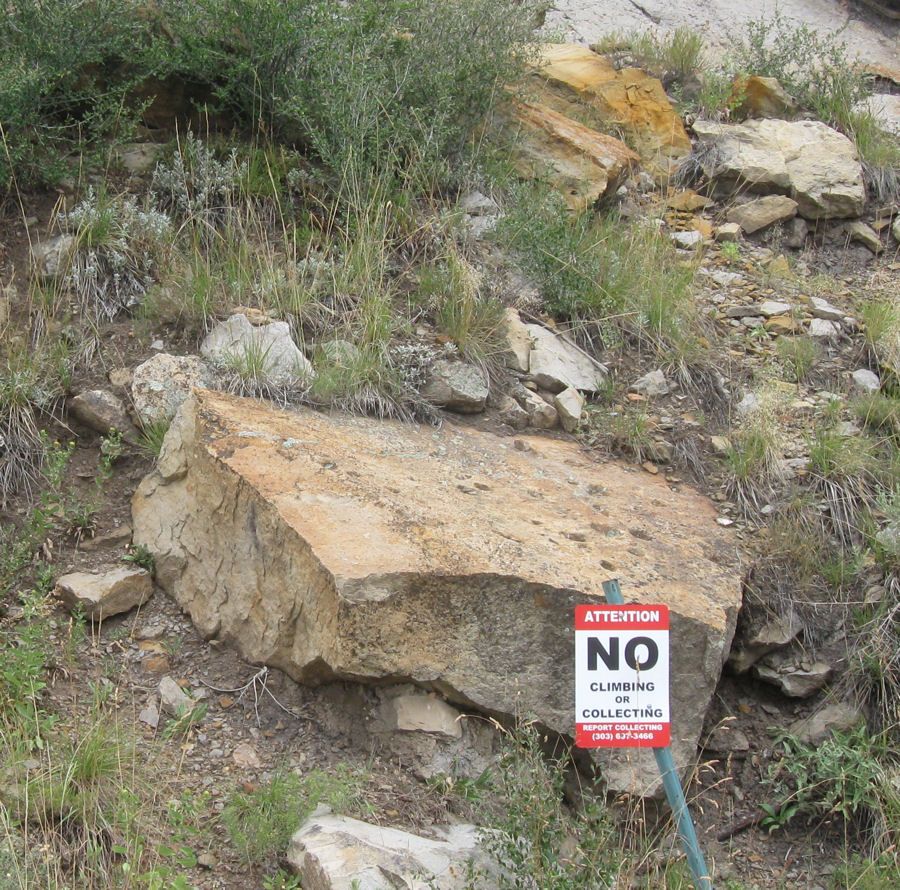
Thinking about chiseling your own souvenirs out of the walls? Think again! Guests are strongly encouraged to tattletale on other guests. Big Paleontology is Watching You. Amateur geology is ungood. We have always been at war with Eastdakota.
If you survive your one-mile uphill calisthenics, congratulations! Your reward is a breathtaking sight of other Rocky Mountains in your area. If you’re a seasoned hiker (which describes none of us), this was a cakewalk. If you’re my wife and you’re still acclimatizing to the thinner air at this elevation, a nearby bench offers a broad landscape view and a moment to reflect on your husband’s boneheaded decision to skip the shuttle.
The return trip downhill was thankfully easier and faster. The rematerializing storm clouds that dogged our heels certainly encouraged a brisker pace and inspired us to catch our second wind. By the time we reconvened at the car, the threat of downpour subsided and it was still only 11:30 a.m. MDT. Our long day in the Rockies was far from over. As you can imagine, walking requirements were negotiated down to a bare minimum at subsequent stops.
To be continued!
[Link enclosed here to handy checklist for previous and future chapters, and for our complete road trip history to date. Thanks for reading!]
When we arose on Day Three, the sky remained cloudy and scary throughout the morning. As we headed west from our Aurora hotel through Denver, eventually we were privileged to cast our eyes at long last on the grandeur of the Rocky Mountains. Even with overcast weather, we were still in awe. Please enjoy the first of several clickable photos, uploaded in higher resolution than previous entries for extra mountainous goodness:
Other than the hour-plus we spent in Abilene, all other stops on Day Two were momentary diversions from the infinite plains of western Kansas and eastern Colorado. The early miles were brownish-green hills, less verdant than usual thanks to this year’s drought.
Day One continued onward from Vandalia, out of Illinois and into Missouri. We’ve seen bits and pieces of St. Louis in the past, so we didn’t schedule a stop within city limits. Instead we headed west to St. Charles, where we stopped for lunch at a chain unfamiliar to us called Smashburger. It took us a few minutes to discern their road sign from afar because it looked like a GameStop. When we noticed that the strip mall had two such logos, we looked more closely and realized only one of them was a GameStop.
Each year our family takes a road trip to a different part of the United States, takes photos, and provides a travelogue for friends. In the past, my procedure has been to spend months assembling the stories in my head; actually write it once the right set of mental circumstances fall neatly into place (usually about the same time my wife starts asking me, “How much longer?” every other day); and refuse to share a single word of it with any other soul until the entire piece was a complete work from start to finish. The process was arduous and drawn out, but often fun and usually worth it.
Note how the careful use of adverbs in the previous sentence belies my reasons for trying a fresh approach this year. This year, with laptop in hand I wrote on the go, spending the last few hours of every evening capturing our day’s journey in print as thoroughly as I could, then posting them here on a nightly basis for nine consecutive entries. It meant sleeping a lot less than I normally do on vacation and temporarily relinquishing the entertainment/news aspect of my brain that sparks my writing impetus more often than not, but I enjoyed the immediacy of the experience and appreciated the support of those readers who graciously followed along.
In several non-consecutive entries, I’ll be sharing the photos of our experiences from our nine-day semi-adventure, which took us from Indiana, via Illinois and Missouri, to Kansas and our primary destination of Colorado. The trip had its ups and downs just as any road trip does. Even in the worst of times, we thought some of the pics were keen.
The photos will largely be presented in chronological order, but not slavishly so. Front-loading this with all the shots of breathtaking mountain scenery is tempting, to be sure. We’ll get there.
* * * * *
Day One was a nine-hour marathon from home to Topeka, with only one certified sightseeing stop in the small town of Vandalia, Illinois. My wife had one particular item on her agenda: their Madonna of the Trail statue.
For our last day on the road, we had almost no stops planned to break up the expected monotony from Webb City to Indianapolis. We didn’t have the luxury of free time for a full-length visit to, say, the St. Louis Zoo because of mandatory chores that had to be squeezed in Sunday evening regardless of discomfort level. Every interesting short-visit southern-Missouri attraction we’d read about was either closed on Sundays or farther from I-44 than we felt compelled to stray. We threw caution to the wind and hit the open road anyway.
We did see one attraction in Webb City before heading out to the interstate, a giant statue of praying hands, positioned on an isolated hilltop. Our other sights and stops were mostly surprises, and fell in line with motifs from the first eight days, each recurring as follows:
Disappointing restaurants. Despite a lovingly provided breakfast, by late morning I found myself fatigued and starving anyway. I left the interstate on the west side of Springfield in search of additional breakfast protein and coffee, my usual cure-alls for such morning conditions. I approached a McDonald’s drive-thru at 10:35 knowing that our stores back home serve breakfast until 11:00 on Sundays. Before we reached the speaker, two young employees ran up to each menu board and concealed the breakfast section. At the speaker, I was informed that breakfast had just ended. My mood failed to improve in light of this news. Thankfully the Hardee’s across the corner was more than happy to serve me breakfast. Not long after, I regained total control of my safe driving skills. I wish I could’ve left them a tip.
Restaurants we don’t have back home. All our nearest Shoney’s locations were shut down two decades ago. Although they had a great breakfast buffet, I didn’t mourn the loss because the last time I’d visited them, their spoiled bleu cheese dressing left me sick for a day. I’m pleased to report the Shoney’s in Rolla induced no such physical trauma, though I wish I’d ordered something more creative than a burger. After this week, I’m kind of done with burgers for a while.
Gift shops. Thirty miles before you reach Redmon’s in Phillipsburg, the billboards begin boasting of the “World’s Largest Gift Shop”. The store in question is a full-size warehouse, filled with a combination of Route 66 merchandise, local arts-‘n’-crafts booths, and tons of leftover toys manufactured to the highest Dollar General standards. It may well be larger than world-famous Wall Drug, but it lacks their intensive signage, peculiar huckster’s charm, and free ice water. Redmon’s has a separate “Candy Factory” building that’s also prominent in those same billboards, but we were disinclined to investigate it.
Replicas. On the campus of the Missouri University of Science and Technology in Rolla, MO, is a small-scale recreation of a portion of Stonehenge, carved from granite with a super-science water jet. I’m unsure why the job was never finished. Perhaps the sculptors were punished for too much frivolous water usage during a time of drought. Unfortunately parking is scarce and inconvenient around the curve where it’s exhibited, so we had to settle for a fleeting glimpse on the go.
Vehicular accidents. Traffic was slowed on I-44 in mid-afternoon due to an accident at MM 151 that somehow resulted in a tractor-trailer being split in twain and set afire. Later at MM 200, we passed a car flipped on its side atop an embankment fifteen feet above the interstate. Still later in a construction zone near St. Louis, a hubcap flew off a westbound car and landed on our side of the median. I’m not sure I’ve ever witnessed so many drivers sharing the same bad day in separate incidents.
Encores. At my wife’s request we stopped a second time in Vandalia, Illinois, to check out something she noticed on our first visit but failed to view up close — a tiny area labeled Lincoln Park, sandwiched between two decrepit former businesses. It’s a small patch of grass and foliage with a statue of Lincoln seated on a bench, as well as an expository sign that my wife read but I didn’t.
Befuddling political signs. If anyone can tell us what was meant by a lone sign in the middle of an empty field proclaiming “OBAMA GAS USE (POND SLIME)”, we’d love to know. We think.
In all, the day was hardly a total bore, but I felt a deeper sense of appreciation in hindsight for what splendid diversions Kansas had offered us. As with the other lengthy driving bouts earlier in the trip, our visually unstimulating moments were balanced with audio entertainment, courtesy of my son’s MP3 collection. My Plan A had been to rely on the luxury of satellite radio, but I was touched that he’d gone to great lengths to create the digital equivalent of a series of mixtapes for us, and just for the occasion. Besides, radio was more interested in keeping “Call Me Maybe” in heavy rotation for preteens instead of catering to us. Our marathons were assembled like so:
Sunday the 8th, from Topeka to Denver: movie scores from all the popular favorites. Driving through western Kansas was disconcerting at times when the most recognizable segments from Jurassic Park — those originally accompanied by miraculous, majestic dinosaurs cavorting across lush greenery — were instead providing background music for miles of empty brownish fields populated by the occasional moo-cow.
Friday the 13th, from Pueblo to Hutchinson: The nearly complete oeuvre of Linkin Park. The tonal disconnect between miles of low-key pastoral settings and, say, “Bleed It Out” was an effective way of keeping me awake and on my toes. This really didn’t bother me as much as it would other listeners my age. I could sense my wife’s eyes glazing over at times, though.
Saturday the 14th, from Hutchinson to Webb City: Over five hours Owl City, including the latest EP, Adam Young’s older works under the stage name Sky Sailing, and a few solo efforts from the nice lady who sings with him on album tracks. It was a veritable comprehensive boxed-set that kept our spirits up through the long backroads of southern Kansas (including one genuine dirt road) and the skeletal remains of Route 66.
Today the 15th, from Webb City to Indianapolis: Nine-hour Japanese pop/rock marathon. Much of it was over my head or outside my fields of interest, but I’ll cop to bopping along to infectious tunes by Momoiro Clover Z, Stance Punks, Noanowa (their insanely contagious “Have a Good Day!” is the anti-“Call Me Maybe” in my book), Orange Range, Stereopony, Psychic Lover, and JAM Project. When my son first proposed the music schedule, I wasn’t sure this was the right soundtrack to conclude a vacation. On the other hand, I couldn’t help feeling a little extra triumphant reentering Indiana at long last while escorted by SUPER SONIC FULL SOUL DYNAMITE.
We arrived home about 8 p.m., elated to find our possessions intact, avoiding direct eye contact with the poor lawn, annoyed at the package left on our porch Lord-knows-how-many days ago, and physically ready for immediate bedtime. Alas, chores and tasks needed to be done, least of all this conclusion to acknowledge that we’re alive, home, and hoping to work our way back up to “well” in short order.
Nine days. Five states. 2,887 miles. 828 photos to sort. One mountaintop. Fourteen stops for gas. Ten tons of San Diego Comic Con news-skimming to catch up. Innumerable sights and memories.
Thanks for reading. I appreciate the encouragement. 🙂