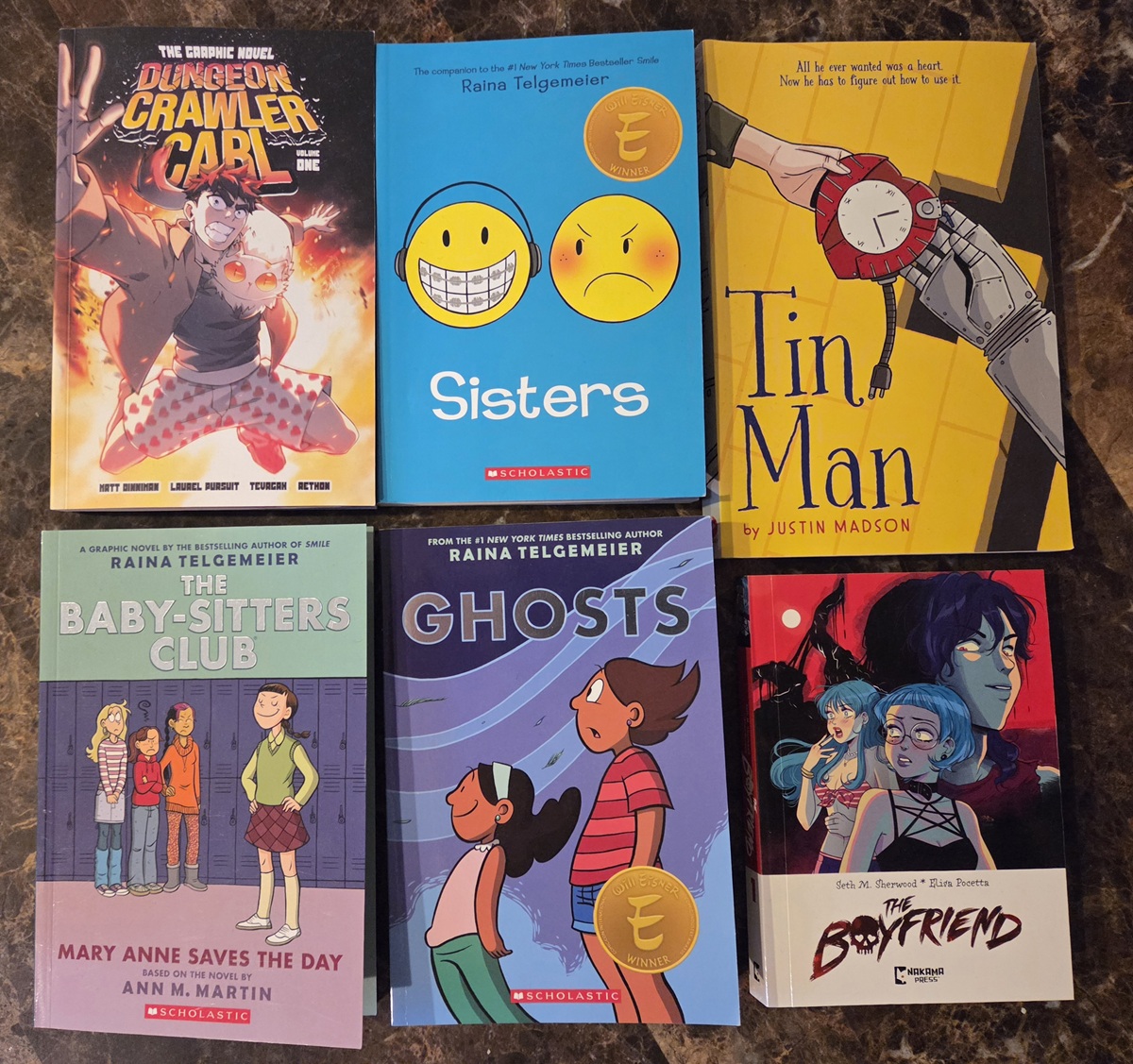
Good things that came in manga-sized packages.
Welcome once again to our recurring MCC feature in which I scribble capsule reviews of everything I’ve read within the past year that was published in a physical format over a certain page count with a squarebound spine on it — novels, original graphic novels, trade paperbacks, infrequent nonfiction dalliances, and so on. Due to the way I structure my media-consumption time blocks, the list will always feature more graphic novels than works of prose and pure text, though I do try to diversify my literary diet as time and acquisitions permit.
Occasionally I’ll sneak in a contemporary review if I’ve gone out of my way to buy and read something brand new. Every so often I’ll borrow from my wife Anne or from our local library. But the majority of our spotlighted works are presented years after the rest of the world already finished and moved on from them because I’m drawing from my vast unread pile that presently occupies four oversize shelves comprising thirty-eight years of uncontrolled book shopping. I’ve occasionally pruned the pile, but as you can imagine, cut out one unread book and three more take its place.
I’ve previously written why I don’t do eBooks. Perhaps someday I’ll also explain why these capsules are exclusive to MCC and not shared on Amazon, Goodreads, or other sites where their authors might prefer I’d share them. In the meantime, here’re some reading results:
1. Matt Dinnaman, Laurel Pursuit, and Tevagan, Dungeon Crawler Carl: The Graphic Novel, Vol. 1 (2026). The first time I saw the book series’ name dotting Dragon Con 2025‘s panel schedule, I thought it was just another of their splendidly goofy cults. Technically that’s not entirely untrue, but not until last May’s Free Comic Book Day did I find a secure toehold on the side of the bandwagon and pulled myself aboard. This fun-sized version collects the first several chapters of the Webtoons adaptation, which I also hadn’t seen because I don’t read webcomics unless someone prints them out for me. Now I’m on Level 1 of the pop-culture-riffic epic about a hapless dork who survives alien invasion only to be thrust into the conquerors’ worldwide reality show satirically embedded in RPG video-game trappings. I laughed so hard that I’ve taken this dalliance one step further: I went out and bought the actual first novel as well and gave it priority-one placement on the reading stack. More, please, thank you.
2. Seth M. Sherwood and Elisa Pocetta, The Boyfriend, Vol. 1 (2026). What if Curry Barker’s Obsession but instead of Sarah from Superman and Lois, the mystically compelled stalker was Absolute George Glass? Horror screenwriter Sherwood (Hellfest, Hulu’s Light as a Feather) tweaks the Final Girl role by making our heroine one of two twins, who share grudges as well as appearances. When the socially awkward Chloe makes up a paramour to make herself feel better and makes a wish at exactly the wrong time, her imaginary suitor comes to life and real people around her start losing theirs. Some of the kills are curiously quick and truncated, more like storyboard placeholders than scenes (maybe a concession for the publisher’s “Teen 13+” rating?), but — same as in Hellfest — Sherwood excels at realizing characters firmly enough in a short span that it’s a bit upsetting when he kills off the better ones. The sisterly love/hate snark between Chloe and her angrier, more confident sis Gina especially crackles. It’s tough for a loner to stand her ground when the bullying is coming from inside the house.
3. Raina Telgemeier, Sisters (2014). The celebrated YA graphic novelist’s works consistently outdo my weekly comic-shop singles in terms of both sales and emotional depth, and yet I’ve relegated catch-up to a long game on account of hobbyist inertia. After previously enjoying Drama, Guts, and especially the dental-horror memoir Smile (absolutely her most relatable to me), my journey continued with yet another tale from her childhood — recounting that time her mom and siblings took a road trip (also relatable!) to a family reunion (I just attended one last weekend!), fought most of the way and fretted over the intrusion of a new baby brother. As if things weren’t fraught enough, I got a lump in my throat later when Li’l Raina learns there’s a reason why Dad traveled separately. When one family bond weakens, it’s heartening to see the other bonds strengthen in response.
4. Raina Telgemeier, Ghosts (2016). Her next all-ages dramedy switched from personal memoir to fiction inspired by real-life acquaintances. Also starring a family with two sisters, this time the older sister Catrina chafes and stresses when they’re uprooted and moved to a faraway California coastal town for the sake of fresher air for her younger sister Maya, who was born with cystic fibrosis. The disgruntled yet protective Catrina isn’t as spellbound as Maya is when they learn their new home makes a big deal of Dia de los Muertos and actual ghosts accept their summons. If you’ve ever known someone with CF — as my wife and I did — you know full well where this tale could’ve gone and understand why Catrina doesn’t rush to embrace specters of death. That dread hit me even harder than Sisters did, but I was relieved when things resolved with peaceful acceptance rather than with finality.
5. Ann M. Martin and Raina Telgemeier, The Baby-Sitters Club: Mary Anne Saves the Day (2007). Yes, I find Telgemeier’s work so sharp and amusing that I’ve just read my first Baby-Sitters Club book at 54, because well-told stories don’t have to be restricted to their target demo. I did not expect my BSC intro — the third of Telgemeier’s four adaptations — to begin with the group’s breakup, but there it is, thanks to a confluence of poor communication and junior-high sensitivities. Can the four girls’ friendships be repaired, especially when a fifth girl moves to town and infringes on their turf? Or should we worry that A War Is Coming? I expected to write this off as “CW teen melodrama”, but again Telgemeier has a flair for taking youngsters’ turmoil seriously and finding humor in its extremes without belittling anyone’s angst. The misunderstandings are less contrived than Smallville‘s and less aggravating than the back half of Gilmore Girls…though for all I know maybe the later books succumbed to soap-opera entropy. I’ll never know unless Telgemeier returns and adapts those, too.
6. Justin Mason, Tin Man (2022). As a middle-aged comics collector I can’t help noting the evolutionary line running from Jose Munoz to Keith Giffen to Ted McKeever to Jeff Lemire to our author here, but that’s not necessarily a knock. The Lemire influences in particular are undeniable in this Land-of-Oz riff about a disgruntled teen in a ramshackle working-class town who discovers a confused tin woodsman with a gentle spirit and a removable core, but it gets less derivative as it paves its own brick road, and refreshingly more optimistic. The Baumian Easter eggs are inescapable but aren’t the whole of the piece, which warmly concerns dislocated hearts and dreams that aren’t as impossible as they seem.
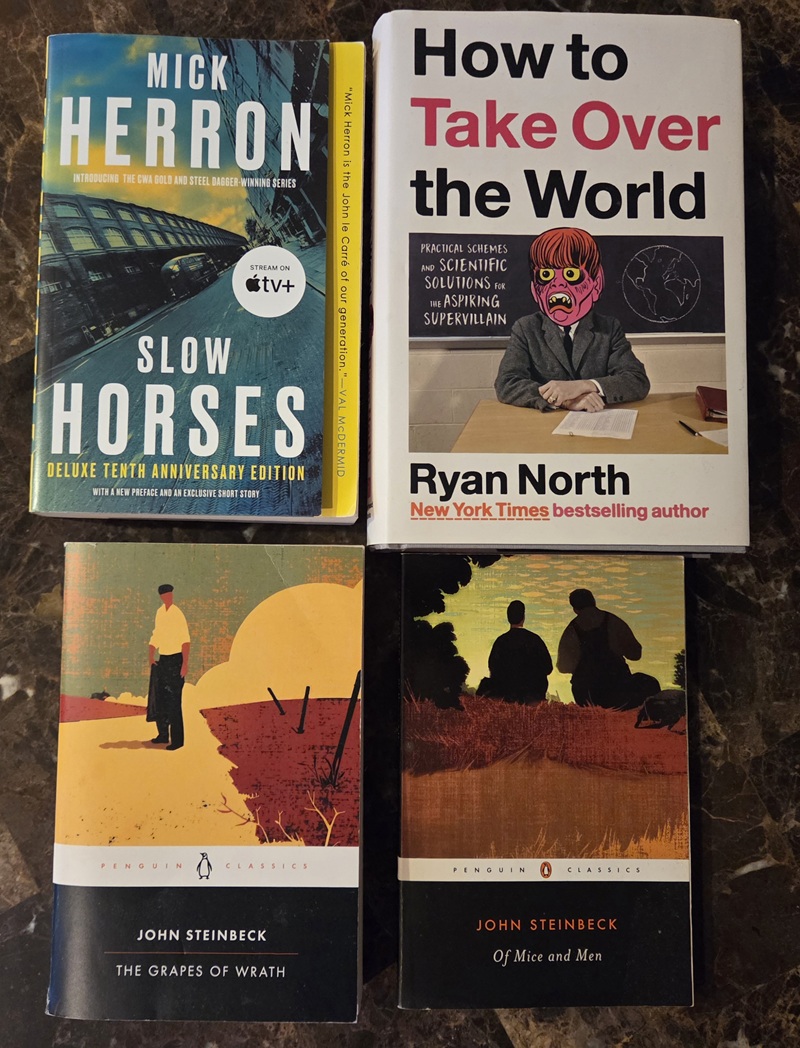
See, I don’t have to have pictures in all my books. Never mind that three of these have been adapted for screens.
7. Mick Herron, Slow Horses (2020 edition). If I ever get back to writing about my TV habits someday, among my myriad unexpressed thoughts is that the Apple+ spy series, about a motley crew of washed-up MI5 employees consigned to thankless busywork only to keep getting embroiled in dangerous incidents anyway, is my favorite show of the moment, assuming the just-started sixth season isn’t botched. (This week’s premiere is in top form and has the funniest funeral scene I’ve witnessed in ages.) I stumbled across the first book, naturally the basis of season one, tucked into the neglected end of a Tupelo bookshop shelf and wondered: if Herron’s biting dialogue carries over so snappily, how entertaining are the unspoken portions? As I suspected, yes, his narration can be just as fun. This tenth-anniversary rerelease also includes a bonus short story, “The Last Dead Letter” — a Jackson Lamb flashback that doesn’t position him quite where one would expect, until one realizes one should’ve paid closer attention to the corners. At the end is an excerpt from the next book, Dead Lions, but I’d rather go get the whole thing.
8. Ryan North, How to Take Over the World (2022). The Canadian humorist with degrees in Computational Linguistics and Unadulterated Hilarity regularly tops my weekly new-comics hauls whenever his new issues are out (currently Fantastic Four, The Flash, and the Doomquest miniseries), but somehow this illustrated non-graphic-storytelling tome got trapped at the bottom of my front-most unread stack due to sloppy piling. The celebrated creator of Dinosaur Comics (okay, so I read one webcomic) and co-conspiratorial genius behind Unbeatable Squirrel Girl still loves finding unorthodox applications for real-world science (see also: How to Invent Everything) and flagrantly contemplates, with little regard for any authorities who might buy a copy, just how many ways one could take over the world if one were a billionaire with unlimited resource access. With a little persistence and the right henchpeople, North offers tongue-in-cheek yet inspired-by-true-developments guides — with pricing estimates! — for making your own floating Dyson sphere, forming your own country with very few unclaimed spaces remaining, picking which governments are most susceptible to election-rigging (hint: the ones that don’t use paper backups), pursuing the most promising research avenues for immortality, and more. Also, there’s a placeholder for a time-travel tell-all to be completed and inserted retroactively once he figures it out. Once that’s done, then I can plot my next steps.
9. John Steinbeck, Of Mice and Men (1994 Penguin Classics edition). Anne has taken a hiatus from our local library system’s history books and devoted her 2026 reading time to catching up on all the classic novels we were “supposed” to have read by now, preferably while we were still in school, which only would’ve worked if our teachers had bothered all several hundred of them to us. I accommodated her by plunging into the farthest reaches of my unread piles and extracting a handful I’d picked up from college onward, but never got around to myself. Then I figured, hey, why not read a couple of them myself? I started with the misadventure of Lenny and George because (a) it’s really short, and (b) I saw and appreciated the 1992 film version with Gary Sinise and John Malkovich decades ago, so now’s as good a time as any to learn for myself what they left out. Now I know!
10. John Steinbeck, The Grapes of Wrath (2006 Penguin Classics Edition). They’re basically in the same literary universe, so it was a logical next read. It’s the sort of complex tapestry that still resonates to this day of underpaid laborers versus oppressive employer overlords, with a richness to its multiple tragedies that shames me for devoting so much free time to non-classic reading, including but not limited to the copious hours spent on this very internet pretty much daily since May 1999. Nearly everything Anne’s read so far this year has been adapted into one or more movies, though she keeps avoiding those on our Saturday movie nights. In this case we did see the film after we’d both finished it — the 1940 version with Henry Fonda, John Carradine, and so on. They cut a few arcs and the book’s original ending was better, despite its abruptness.
More to come!
Discover more from Midlife Crisis Crossover!
Subscribe to get the latest posts sent to your email.
 Midlife Crisis Crossover!