2025: The Year I Began Tracking Down All the Mark Russell Works.
Previously on Midlife Crisis Crossover:
Welcome once again to our recurring MCC feature in which I scribble capsule reviews of everything I’ve read lately that was published in a physical format over a certain page count with a squarebound spine on it — novels, original graphic novels, trade paperbacks, infrequent nonfiction dalliances, and so on. Due to the way I structure my media-consumption time blocks, the list will always feature more graphic novels than works of prose and pure text, though I do try to diversify my literary diet as time and acquisitions permit.
Occasionally I’ll sneak in a contemporary review if I’ve gone out of my way to buy and read something brand new. Every so often I’ll borrow from my wife or from our local library. But the majority of our spotlighted works are presented years after the rest of the world already finished and moved on from them because I’m drawing from my vast unread pile that presently occupies four oversize shelves comprising thirty-three years of uncontrolled book shopping. I’ve occasionally pruned the pile, but as you can imagine, cut out one unread book and three more take its place…
…and the same holds true for my li’l ramshackle hobby-blog: cross one subject off my to-do list, five more get added to it. We’re long overdue to catch up and I’m tired of staring at all these stacks in our living room next to our PC desk. Let’s do some of this for the sake of spring cleaning! We’ll start with the two creators with more works in those stacks than any other.
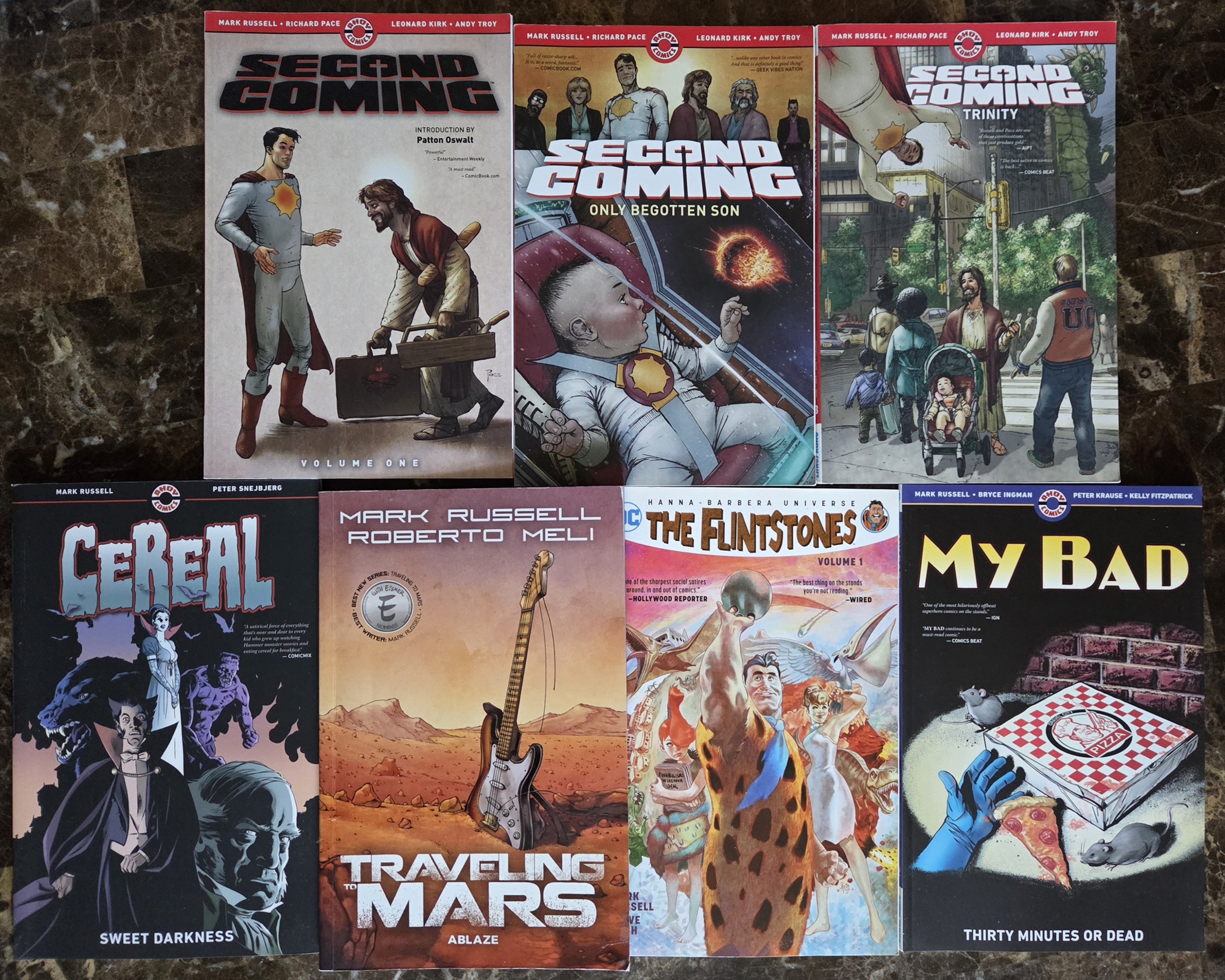
3. Mark Russell and Steve Pugh, The Flintstones, vol. 1 (2017). For one of my favorite current writers in the comics biz, the buzz began when DC Comics fostered this reboot of the modern Stone-Age family with a blasphemously non-Hanna Barbera art overhaul, a seemingly ridiculous stunt I couldn’t fathom at the time. It set the standard for Russell’s works to come — a subversive corporate satire taking altruistic stock of humankind’s collective errors and pondering maybe how not to continue the collective death spiral. Russell and Pugh merrily dig into the oppressive quarry biz, the conformist water-buffalo lodge, their first primitive religion, and the meteor that might end the entire era as they know it — following the show’s Honeymooners-spoofing veneer and cheesy gags to their logically absurdist conclusions, all while racking up just as many perfectly terrible puns.
4. Mark Russell and Roberto Meli, Traveling to Mars (2024). Tracking down Russell’s works is quite the hopscotch game — he’s landed gigs at nearly every major publisher and numerous indie companies that my local comic shop won’t stock unless I pre-order them. IMHO his best series to date might be this contemplative sci-fi travel saga — whose publisher Ablaze turned to Kickstarter to finance the collection — about a terminally ill, thoroughly average working man who’s selected to become The Very First Human on Mars, mostly because he might not be missed if he never returns home. Russell postulates some candidly dispiriting answers to our unspoken questions — i.e., just how much naked greed would it take for our monied overlords to finally pay to reach Mars? — but never loses sight of our sole astronaut’s intrinsic human worth, revealing through his self-reflections what we carry inside us even we’re isolated literally millions of miles away from everyone we know.
5. Mark Russell and Peter Snejbjerg, Cereal: Sweet Darkness (2023). Not every IP in 20th-century pop culture needs a pretentiously grimdark reboot, which is entirely the joke of this loopy reimagining of our childhood breakfast-cereal mascots — Count Chocula! Frankenberry! The Quaker Oats Quaker! — with all the gothic gravitas of ye olde Universal Monsters movies. If only the makers of the upcoming Masters of the Universe movie had read this first, then gone home and rethought their lives.
6. Mark Russell, Bryce Ingman, Peter Krause and Kelly Fitzpatrick, My Bad, Vol. 2: Thirty Minutes or Dead (2023). Further superhero-lampoon misadventures with ridiculous powers, silly costumes, and dumb character choices, but unlike your average superhero strips, here it’s delightfully on purpose!
7-9. Mark Russell, Richard Pace, Leonard Kirk and Andy Troy, Second Coming, Vol. 1; Vol. 2: Only Begotten Son; and Vol. 3: Trinity (2019, 2021, 2023) At first I skipped the controversial trilogy based on the high concept “What if Jesus returned and was roommates with Superman?” because irreligious takedowns of mainstream Christianity are generally Not My Thing, partly on principle and partly because such self-high-fiving works tend to swap all the same edgelord atheist jokes amongst themselves that’ve been hoary since long before social media. Russell has kinder, more thoughtful objectives than “lol conservatives suck” — sure, it’s more humanist than Christian, and isn’t entirely aligned with New Testament Scripture (e.g., Jesus’ Father as a bitter absentee dad), but he’s clearly done more reading and engaging with the texts than many of those in charge of certain corrupted structures who purport to rep for The Way, The Truth and The Life. And sometimes we need to have our perceptions, lazy assumptions and reading gaps challenged.
Another round of books from Vermont’s acclaimed cartoonist laureate.
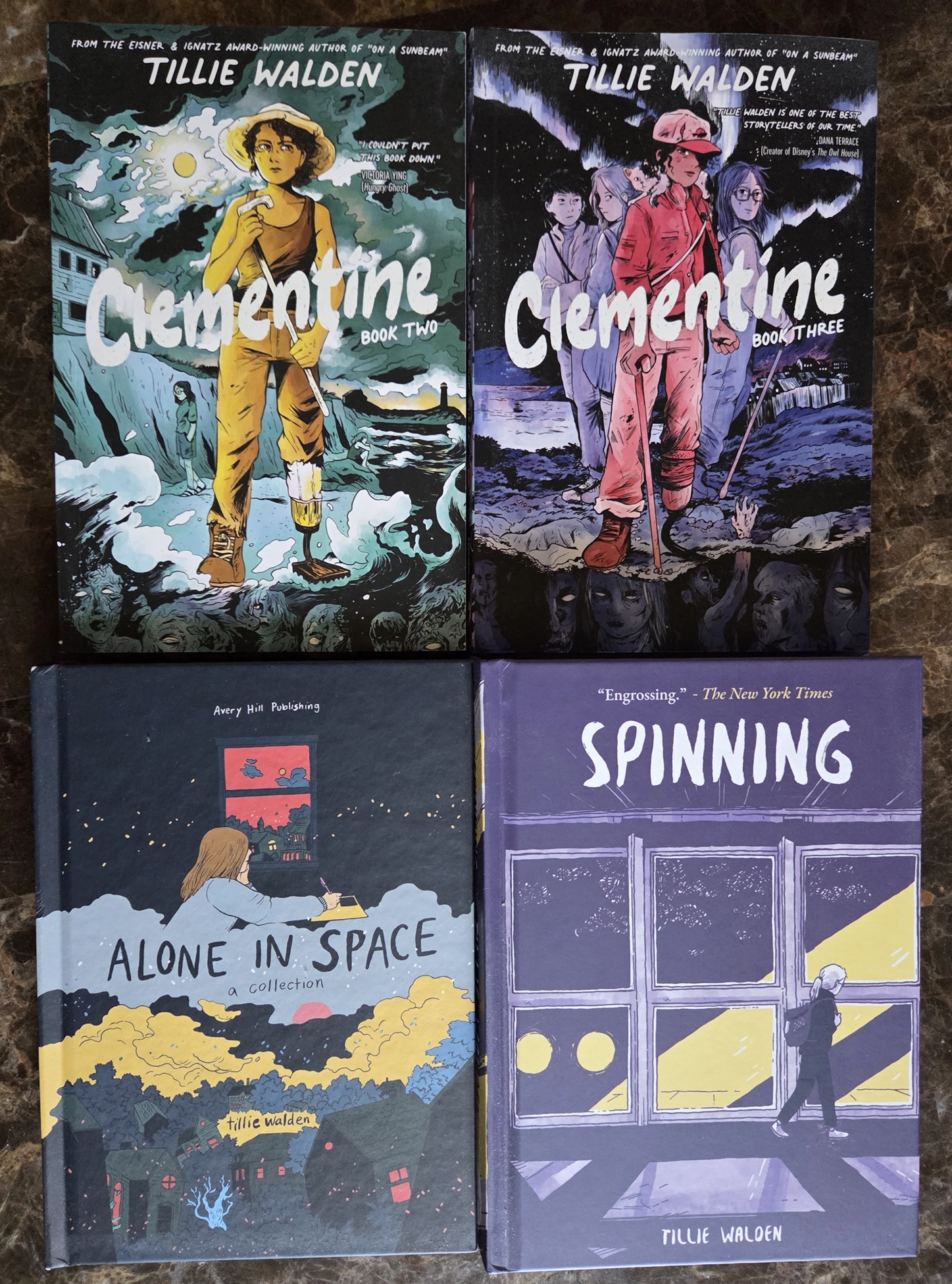
10-11. Tillie Walden, Clementine Book Two and Book Three (2023, 2025) The first original YA graphic novel starring a character from The Walking Dead video games was one of my favorite reads of 2022, but nobody told me the second one was out until I saw advance solicitations for the trilogy’s finale. Our Heroine — a teenager with a makeshift prosthetic leg, precious little pre-apocalypse knowledge, and zombie-based psychological scars — follows the TWD flagship pattern of traveling with a small cadre of survivors in search of havens they can call home until their respective inevitable collapses. Walden’s artistic strengths and the smaller cast allow for more introspective tales of Clementine sorting her awkward relationships, her worst fears, and her increasing reliance on violence for either catharsis or avoidance, depending on the situation. Like most TWD tales, it all ends with tragedy and hope for a better future despite the surrounding wreckage.
12. Tillie Walden, Spinning (2017). The Eisner Award-winning memoir earned a 2024 Kickstarter’d hardcover reissue so we latecomers to Walden’s pond could catch up. As a New Jersey preteen on her way to becoming a professional ice skater, her family packs up and moves to Texas, where “fish out of water” doesn’t begin to describe the shock of struggling to adapt to a new environment, unwelcoming new classmates, and new rules and standards imposed on what she’s been practicing for years. Coming-of-age tales are the hardest when they deal with one of life’s most miserable challenges: questioning the realization that it might be time to give up a long-cherished dream.
13. Tillie Walden, Alone in Space (2021). A thick collection of her first three books (the Little Nemo SF homage The End of Summer, the all-splash-page gay romance I Love This Part, and a lyrical intersection between those two, A City Inside) bundles them with a cornucopia of extras — pre-published works dating back to age 16, as well as an intro by comics historian Warren Bernard that illuminates some of her formative influences, most tellingly Hayao Miyazaki and Winsor McCay, which really helped unlock why I’ve taken to her works. (I once did a paper on McCay, one of the few bright spots in my college memories. Call it a soft spot.)
To be continued!
Discover more from Midlife Crisis Crossover!
Subscribe to get the latest posts sent to your email.

