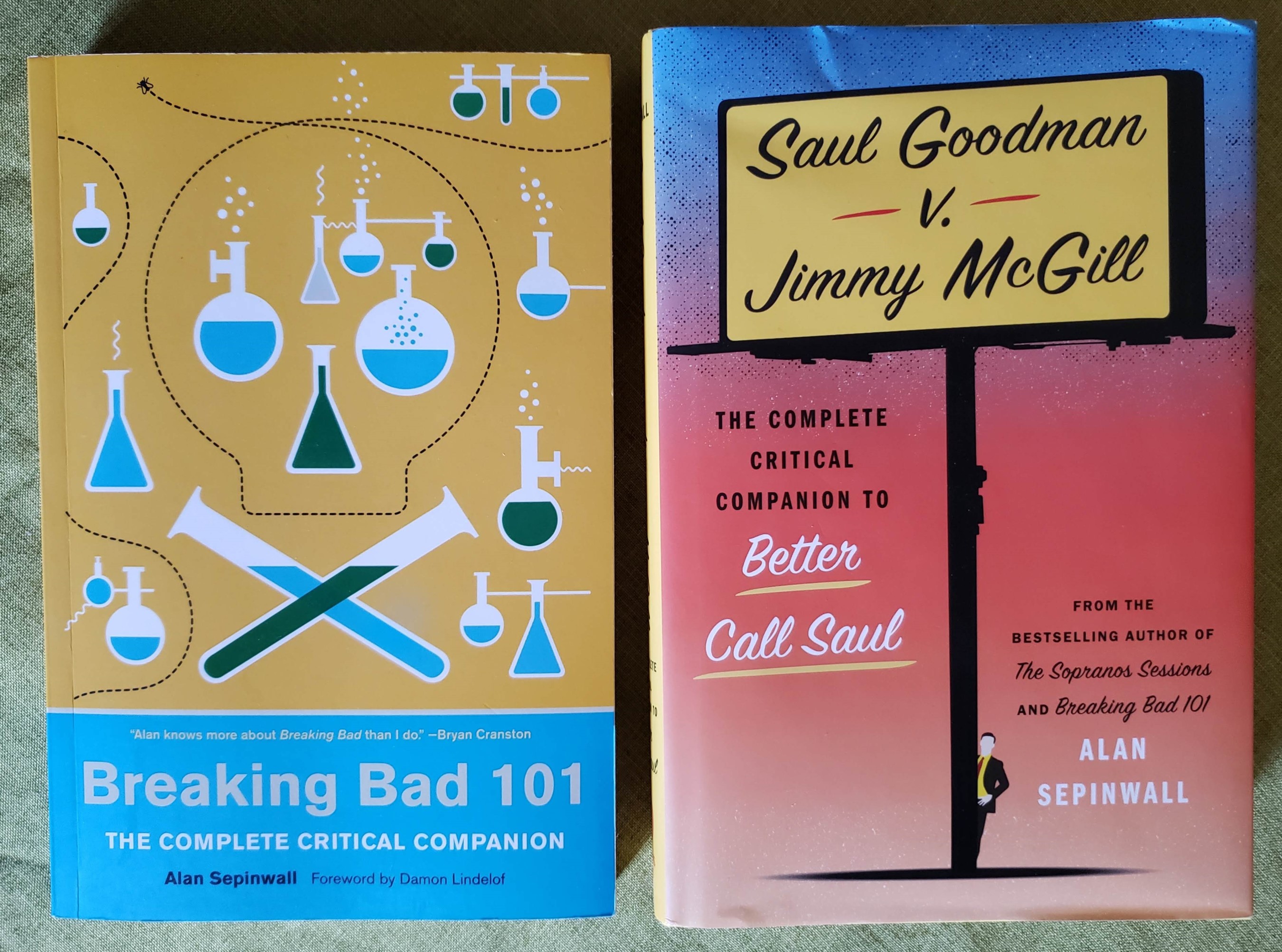
The one on the left is autographed!
Welcome once again to our recurring MCC feature in which I scribble capsule reviews of everything I’ve read lately that was published in a physical format over a certain page count with a squarebound spine on it — novels, original graphic novels, trade paperbacks, infrequent nonfiction dalliances, and so on. Due to the way I structure my media-consumption time blocks, the list will always feature more graphic novels than works of prose and pure text, though I do try to diversify my literary diet as time and acquisitions permit. This installment is all prose, though.
Granted, I haven’t even finished “My 2024 Reading Stacks” yet. Trust me, forgetting them is impossible — the literal stacks of books are still cluttering the living room, waiting for encapsulation here before they go to their next home in our library. I’ll get to those in the near future, but for calendar-related reasons I’m taking a quick timeout from Oscar Quest ’25 to praise a pair of recent reads that captured my attention at the intersection of reading and binge-watching.
1. Alan Sepinwall, Breaking Bad 101: The Complete Critical Companion (2018). I was so late to the Emmy-winning series’ party, the first and only episode I ever watched live during its original AMC run was the finale. (Yes, really, I can be that kind of villain.*) I watched “Felina” with only a faint grasp of the show’s few surviving characters, having skimmed their mentions in Entertainment Weekly. I missed every single callback and nuance, but the craft level was exceptionally high. I figured I’d return to the show in its entirety someday. I had to avoid every message-board and comments-section discussion in its prime, and lived with the consequences of that choice (i.e., the dreaded Missing Out).
Fast-forward to the pandemic and the years ever since**: now I’ve seen the whole series as well as the spinoff Better Call Saul and agree with the relentless, justified hype. My favorite episode is “Box Cutter”, directed by ye olde They Might Be Giants music-video director Adam Bernstein; my favorite character might be Gus Fring, but wait ten minutes and ask me again; and I don’t get all the Skyler hate. No, she wasn’t a saint, but on that show, who was?***
Not long ago I was reminded an entire book existed about Breaking Bad. It was the perfect excuse to revisit the series — not through another 50-hour run-through****, but through literary dissection in my mind’s eye with a knowledgeable tour guide to point out the attractions I might’ve missed along the way. Alan Sepinwall is an established TV critic whose TV reviews and analyses have graced many a site over the years, now homed at Rolling Stone since 2018. Obviously I missed those columns in real time, but the collection let me catch up with him and them, all in one handy volume, rather than squander even more time tracking down the originals one-by-one in the Uproxx and HitFix archives.*****
I learned the stubborn way from my own amateur blogging experiences that TV recaps and episode analyses require a lot of elements to come together to make them worthwhile supplemental material.****** Of utmost importance: the show in question must be complex enough and/or have enough moving parts to merit and withstand prolonged scrutiny; it should be one you actively want to watch, not a forced chore, like Roger Ebert enduring a Rob Schneider movie; and the writer should have the skills to deliver insight and trivia in an entertaining, efficient style while pulling threads together through their observations and contributing to the discourse at large. Dry, perfunctory “and then this happened, and then this happened” book reports are for Wikipedia editors.*******
None of this is a problem for Sepinwall. I wouldn’t be following him on social media if it were. Every episode’s highlights are mused upon and cross-referenced with other episodes, including recurring characters or motifs I overlooked. Some are touched up or rewritten at his discretion, indiscernible to us latecomers. He’s candid about the occasional weak spots, in the early seasons and even later on post-canonization (e.g. the contrivances in Jonathan Banks’ final episode). New sidebars are added, drawing largely from interviews he conducted with the cast and crew throughout its run. Another one usefully clarifies the convoluted chain of custody for “Chekhov’s Ricin”.
At no additional cost, he adds a foreword by well-known TV showrunner Damon Lindelof, back-cover blurbs from the show’s own staff, and, in what I’m sure was an instant internet classic, a reprint of his original review of the amazing “Ozymandias”, which he watched while in the hospital with appendicitis, then posted about online in forty minutes flat over his nurses’ strenuous objections. If you watched the show years before I did but haven’t read this, it’s your turn to catch up with me.
But wait: there’s more! Coming soon!
2. Alan Sepinwall, Saul Goodman v. Jimmy McGill: The Complete Critical Companion to Better Call Saul (2025). Sepinwall, you’ve done it again! The logical sequel applies the same treatment to Breaking Bad‘s prequel — commentary on all 63 episodes over six seasons, some far longer than others as further developments merit extra deliberation. The showcase for Bob Odenkirk’s wantonly conscience-free shyster — the same guy who once advised Walter White he should murder his partner Jesse Pinkman — avoids the worst symptoms of prequelitis in examining his secret origin as a simple con man named Jimmy McGill and his journey from mailroom gofer at his brother Chuck’s prestigious law firm into the most corrupt and cynical lawyer this side of Maurice Levy or Troy McClure, all while cataloguing multiple casualties along the way.
For a show that was often planned no more than one or two episodes ahead, co-creators Vince Gilligan and Peter Gould — along with one of the all-time great writing staffs — kept laying down minimal guardrails, tossing in seemingly meaningless minutiae, backing themselves into corners, and MacGyvering their way out of every fix in manners so elaborate and emotionally layered, they absolutely could’ve kept claiming “We meant to do that!” at every turn and we never would’ve suspected otherwise. Sepinwall’s critiques lend equal time and weight to every major character and several less-major ones,********* delve into how the show’s obsessively detail-oriented sequences of step-by-step processes pay off so well later on, and pose valid arguments for why some consider it the superior of the two shows.
A bevy of extras round out the package, such as another round of high-profile back-cover blurbs (including one from Odenkirk himself!) and reprints of Rolling Stone interviews with various principals published during the show’s run. In one joint interview with Gould and Michael McKean, it’s fun to spot the moment when McKean accidentally lets a subtle yet major spoiler slip, prompting Gould to leap in front Secret Service-style with a quick cover of ambiguity.
Sepinwall also confesses his own amazement at the generous (and newly provided for this volume!) responses from Rhea Seehorn about her thoughtful approach to playing Saul’s colleague/better half Kim Wexler — my favorite Saul character, no contest — down to her signature “power ponytail”. I could read an entire book of just Seehorn expounding for paragraphs and paragraphs about how she and the writers developed and grew an entire character from the original conception that was literally a single sentence: that Saul should have a woman in his life. That was the entire blueprint before the next six years’s evolution.
Another major draw for Sepinwall’s Rolling Stone subscribers who’ve already kept up on his works is an all-new, 37-page interview with Gould (which RS recently excerpted to promote the book), who took over full-time showrunner duties in the later seasons with nary a noticeable change in quality control. For the first time Gould goes on record at length without having to worry about revealing spoilers or as-yet-unwritten plot developments. Now that the Breaking/Better universe is a finished work unto itself (well, for now), he’s more relaxed and open to Sepinwall’s comprehensive questions which reveal quite a few post-game surprises, including but not limited to the complete lack of a Plan B if Odenkirk’s on-set heart attack (in 2021, while filming an already intense scene in “Point and Shoot”) had ended as darkly as any of the show’s fictional characters.
Part of me wishes each book came with indexes so I could more easily refer to various points as they pop back into my head, though I get that maybe these aren’t that encyclopedic to justify the extra task. Regardless, Saul Goodman v. Jimmy McGill hits stores on February 4th, this coming Tuesday********** — an engaging encapsulation of an outstanding show, summarizing and justifying its greatest hits. If you order a hard copy from your favorite discerning bookseller, it’s guaranteed not to be yanked off your bookshelf by any greedy streaming services.
Sepinwall’s next longform work-in-progress is a tome about Rod Serling, which will be of immense interest to my wife Anne, a Twilight Zone superfan. (We’ve even visited his hometown of Binghamton, NY!) I look forward to seeing what comes next from his TV experiences, beyond what he shares every Friday in his Substack.
…
* Look, I grew up on comics and broadcast TV in the late-’70s/early-’80s when it was impossible to begin every TV or comic-book series with the first installment. We didn’t have streaming, DVD rental, home video, trade paperbacks, libraries with a robust 741.59 section, or even the internet to catch everyone up on anything. We’d watch whatever was on TV regardless of how many seasons we’d missed, and sometimes at the grocery I’d try random comics, in the era when writers and especially editors enforced the rule of thumb, “Every issue is someone’s first.” The theory was, for the sake of attracting more eyes and therefore profit, each individual unit of entertainment ought to provide a worthwhile experience in and of itself. If it encouraged you to want further adventures of those characters, just stick around and wait for the next one. And sometimes the last issue of an epic tale could be an awesome read even without any of the preceding chapters. Same thing happened for me with Daredevil‘s monumental “Born Again” arc, among others. Ditto TV, sometimes.
** During the COVID era my wife Anne and I restructured our weeknight schedules to allow for more binges than I could manage throughout the 2010s. Thanks, corruptors of social media, for ruining the internet and nearly eliminating it from my hobbies! A major time savings, that.
*** I’d argue Walt Jr. was an innocent, not a saint. Not the same thing.
**** Seriously, I missed a plethora of other shows. With a to-do list as gargantuan as mine, who has time for rewatches? Other than basic-cable reruns while I’m cooking or folding laundry?
***** Assuming they’re still there, anyway. Again: not spending the time to investigate only to come up empty-handed.
****** Longtime MCC readers may recall my past efforts in this niche, which were easier when I was a decade younger, enjoyed taking to the PC immediately after a show had aired live that evening, could bang out an entry on the spot, and could live on five hours’ sleep or less.*********** My peculiar show-recap choices taught me much. Bunheads taught me it helps to be a subject matter expert (ballet was new to me, but I picked up a few things), your traffic might increase if no one else is recapping the same show, but it helps if more than six people are watching it. NBC’s post-apoc Revolution confirmed there’s value in committing to a show and sticking with it to the bitter end, even if viewership vanishes, but maybe not if you’ve given up on it and have to make yourself watch it.************ Sleepy Hollow taught me to be prepared to devote a lot of extra time and energy to fan interaction if one of your recaps becomes the flag-bearer for an army-sized backlash when the show backstabs its own fandom, as happened with the disastrous season-3 finale. With The Sandman I realized it was perhaps unwise to cram ten episodes’ worth of ruminations into a single, 7,000-word infodump.*************
******** I have a Wikipedia account, but 98% of my contributions are just italicizing the titles in other people’s sloppy edits. ITALICS ARE NOT HARD, PEOPLE. IF YOU CAN HANDLE HTML, YOU CAN SPEND AN EXTRA FIVE SECONDS TO ADD ITALICS TAGS, WHICH THEIR CODE MAKES EVEN MORE BASIC THAN HTML! LIKE THIS! SEE?
********* By the end my second-favorite among the new characters was Nacho Varga, played by Michael Mando, which is why season 6’s “Rock and Hard Place” is among my favorite eps. I’ve rewatched his closing speech on YouTube more times than any other moment from either show — a bravura performance seething with rage, serving one last delicious comeuppance and exiting on his own terms. Honorable mention goes to Lalo Salamanca, the merriest cartel warrior around, played by Tony Dalton, who went on to appear in Marvel’s Hawkeye as Kate Bishop’s almost-stepdad. I wish Sepinwall had been able to interview him for this as well, but I imagine the book could only be so long, and only so many cast members were probably available. Nevertheless, it was cool to relive their respective arcs anyway, whether in the main text of the chapters or in the copious footnotes, a fixture of Sepinwall’s columns carried over into both books.**************
********** Due to unforeseen error, some copies of the book were shipped a few weeks early to those who preordered, including myself. Hence the advance review, which is something I rarely get to do for works in any medium. It was fun to feel like a pro for the space of one entry.
*********** Nobody sends advance-review copies to us ordinary fans so we can have a head-start over casual viewers. Advantage: Sepinwall and all other accredited pros in the field.
************ After awhile I wasn’t tracking Revolution‘s arcs, plots, or character changes (apart from praising its MVPs Billy Burke and Giancarlo Esposito) so much as I was slipping into my favorite writing mode: MST3K-riffing in prose form. When its unconditional diehard fans tried tagging me into a “Save Revolution!” campaign, I, uh, I hope I was polite in dismissing their overtures.
************* As for the recent controversy regarding its creator’s proclivities, sins, crimes, and revolting misapprehension of interpersonal power dynamics…I’m interested to see how showrunner Allan Heinberg, the cast and the rest of the crew follow up that strong first season, but whether or not I’ll devote a follow-up entry to it is up in the air. Will Netflix subscribers tune in for one last dream, or will the ratings drop to Bunheads levels?
************** Yes, I’m now footnoting within footnotes. That’s how I roll with my homages: no half-measures.
Discover more from Midlife Crisis Crossover!
Subscribe to get the latest posts sent to your email.

