If you love pointing at ’80s stuff or iconic NYC places, have we got a film for you!
Previously on Midlife Crisis Crossover: Oscar Quest ’24 continues! We do our best to see how many freshly nominated works we can catch before ABC’s big, indulgent Academy Awards ceremony ends the viewing season.
Each year there’s at least one nominee for Best Animated Feature that’s completely unknown to mainstream audiences because they don’t come with a massive corporate brand stamped on the front. This year is no exception: Pablo Berger’s li’l Spanish dramedy Robot Dreams kept me waiting for any kind of release, whether streaming or in theaters. My patience finally paid off: Indianapolis’ own Kan-Kan Cinema was among the few theaters holding exclusive, one-night-only screenings the Wednesday before the Oscars. I showed up alongside three or four dozen other folks at various stages of their own Oscar Quests. Oscar Quest is often such a solitary activity for me that it was nice not to be alone for a little while.
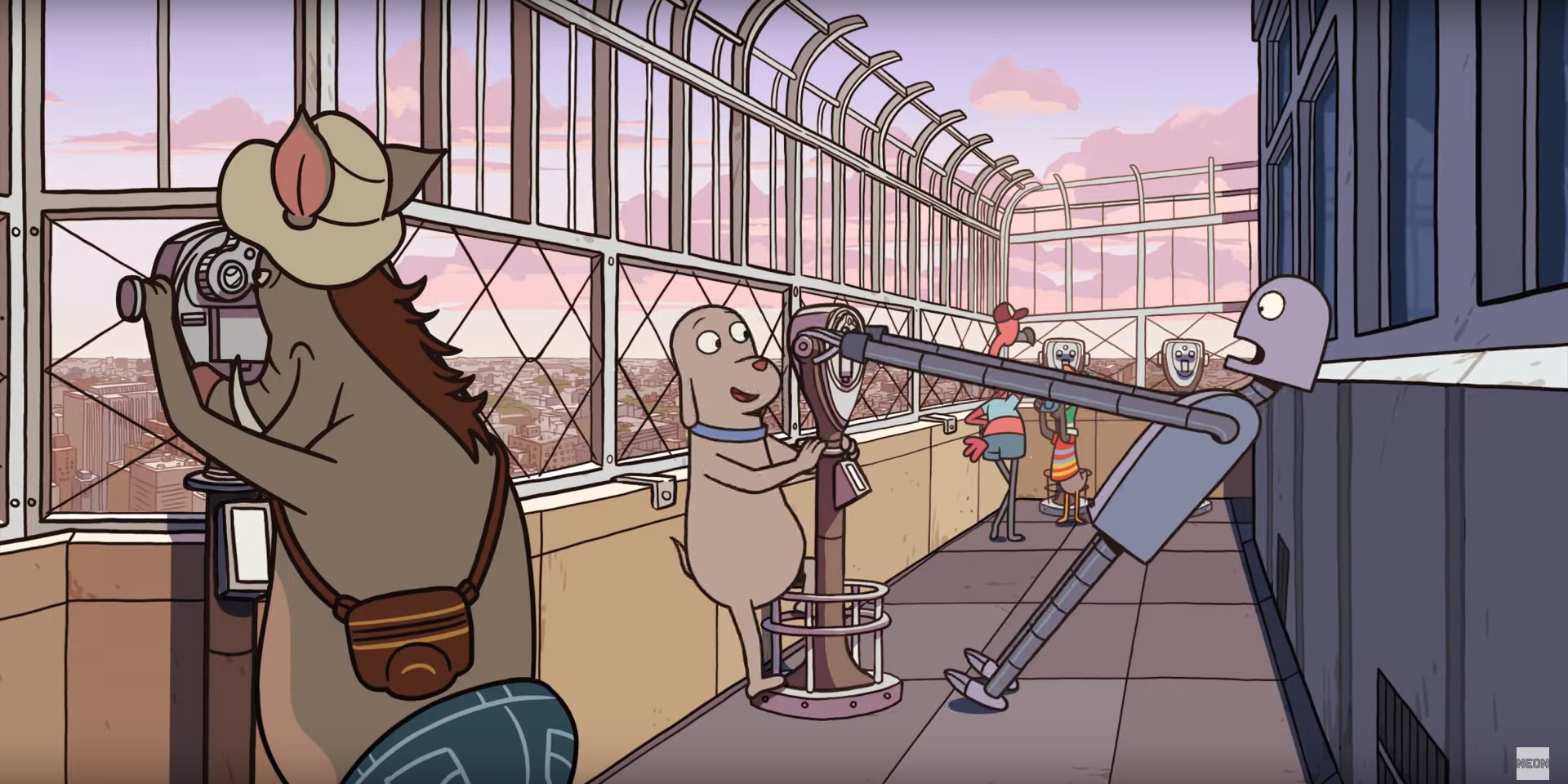
Unlike its four competitors, Robot Dreams has virtually no dialogue, much like the past several years’ worth of Animated Short Film nominees that tend to explore universal themes and aim for international audiences. The neon-poppy 2-D visuals communicate everything we need to know in this gentle tale set in those super-beloved ’80s (1984 at the earliest, judging by one Elm Street reference) rife with touch-tone landlines, four-wheeled skates, VHS rentals, and stuff you could order from TV commercials that wasn’t necessarily instant garbage. Our hero, whose first name is actually Dog (voice of no one), is a New York City bachelor living comfortably in an East Village apartment despite having no discernible job (a third-shift gig he works when we aren’t looking? trust-fund baby? passive income from a novelty tune he wrote?). ’80s callbacks vie for screen space and background gags with an endless array of bipedal animals living and bopping around assorted Big Apple landmarks and traditions. Boggle at the Twin Towers! Central Park! Authentically drawn Chinatown with real addresses! Strand Book Store! Street drummers! That one bench below the Brooklyn Bridge we just saw in Past Lives! Pizza with gooey cheese! Some scenes and moments are so packed that it’s hopefully forgivable when the viewer ignores Dog to look for Simpsons-style throwaways.
See what I mean? I’m ignoring Dog already. Anyway, he tires of nightly loneliness and orders himself a robot companion As Seen On TV called the Amica 2000. As one does. Robot (voice of no one) is never named, or perhaps he keeps it secret, but he’s like a happy-go-lucky ancestor of Bender, Version Negative-600.1, wired for extra naivete so his owner can delight in constantly correcting him and mansplaining the entire world. Or maybe that’s what typical Amica 2000 buyers do, we don’t know. Robot and Dog become fast friends and begin doing everything together in sunny harmony! Sometimes in montages! And for some reason they never take a walk through pre-Giuliani Times Square! In one scene they do stroll through what I sense was the Lower East Side, but that isn’t the same thing and Dog doesn’t linger.
The delighted duo also get out to the beach — for some reason Ocean Beach if I read the signs correctly, which is a heck of a haul-out from the East Village. This raises questions about Dog that are never answered. Regardless, they frolic in the sun and we see Robot doing things few ordinary ’80s pop-culture robots do. He smiles! He eats! He swims and submerges! He doesn’t terrify judgmental innocents! Berger lures us into thinking this will be 100 minutes of childlike joy and Easter eggs, which Lord knows we can all use in this godforsaken election cycle.
Hours later, things go horribly wrong as a direct consequence of one of those very activities, which could’ve been avoided if Robot had been aware of his weaknesses, or if Dog had bothered reading all the instructions, which we know Robot came with because he arrived in his heavy box with Some Assembly Required, which Dog in fact flawlessly connected part by part. In his excitement he must’ve stopped short of skimming the Troubleshooting section in the back. Regardless, events and poor choices conspire to separate our new friends Dog and Robot. The second half of the film could’ve been Dog embarking on a series of failed Wile E. Coyote attempts to overcome the new, awful gulf between them…but he tries, like, twice and then decides to postpone his quest to a later date.
Meanwhile, Robot definitely has a more vivid imagination than Dog. In between bouts of disenchanting real-world ennui and harsh elements, his mental circuits keep him occupied or outright delude him, whatever fills the Dog-less void in his electronic life. Alternate timelines, passing animals, potential saviors, and a Busby Berkeley extravaganza on the public-domain Yellow Brick Road are just some of the flights of fancy and frustration that keep Robot going in lieu of friendship.
Around this time, I was very, very cross with Dog. “YOU WERE JUST WATCHING A FILM ABOUT A RUSTED TIN MAN FIVE MINUTES AGO!” I screamed in my head so as not to disturb the family of three sitting next to me. “YOU TRIED, LIKE, TWICE AND GAVE UP! JUST LIKE THAT! I THOUGHT YOU WERE ROBOT’S BEST FRIEND!” And so on. The film follows Dog and Robot on their separate life journeys, leaving the audience to wonder whether we were too quick to place our trust in Dog and invest in the happiness of these two BFFs, even though the acronym “BFF” wasn’t a thing in the ’80s.
The whimsical imagery keeps on coming in the style of their creator, graphic novelist Sara Varon (she and her Chicken and Cat books get nods within the film), and would’ve been right at home in the old Fantagraphics anthropomorphic anthology Critters from that exact era. As Our Heroes’ divided fortunes keep changing, their thoughts wander back to each other at times…but the longer that absence goes on, the more it’s filled with other characters coming and going, each with their own impacts and sometimes even their own offers of friendliness. After a time I had to admit to myself Dog’s mild rescue attempts mirror what can happen to real-life friendships when one person could bridge a gap that’s formed between them, kindasorta tries and fails, and then just…stops trying and lets go. I’ve known such friends. I’ve been such a friend. Maybe that’s the real reason I wished someone would teach Dog a lesson about not surrendering.
I correctly suspected Robot Dreams was Oscar-nominated for more complex reasons than mere cuteness. The bittersweetness caught me off-guard, as did the depth and wealth of details all around the frames, the era-specific riffs that went beyond the same tired idols, the tiny touches of low-lying wit (their rendition of the cover of Pet Sematary had me rolling), and the rich ambiance that very much channels the 21st-century NYC I’ve visited and avoids any semblance of John Hughes upper-class suburban ’80s that I never identified with and feel zero nostalgia to revisit.
All told, the film has far less in common with, say, DreamWorks’ Robots than it does with Frances Ha — a series of connected vignettes about the friendships we used to have and the friendships we could make next.
…
Meanwhile in the customary MCC film breakdowns:
Hey, look, it’s that one actor!: No dialogue (other than guttural noises and interjections) means virtually no real-world actors, only moving illustrations. The closest we get to polysyllabic voices are singers on the soundtrack — i.e., a handful of obscure American musicians of the era such as the Feelies, Reagan Youth, and soul singer William Bell. Much farther up the ladder of fame are Earth, Wind & Fire, whose chart sensation “September” is the film’s most pervasive motif. It’s repeated in more than one form as a key symbol of the glory days of Dog and Amica, and technically means the person with the most lines in this film is Philip Bailey.
How about those end credits? No, there’s no scene after the Robot Dreams end credits, but they’re weighed down near the end by copyright notices for three or four dozen of the brands and IPs littered throughout the film. Apropos of an indie animated feature light-years from Disney/Pixar staffing levels, the obligatory Production Babies section only lists the names of two (2) newborn babes.
Discover more from Midlife Crisis Crossover!
Subscribe to get the latest posts sent to your email.
 Midlife Crisis Crossover!