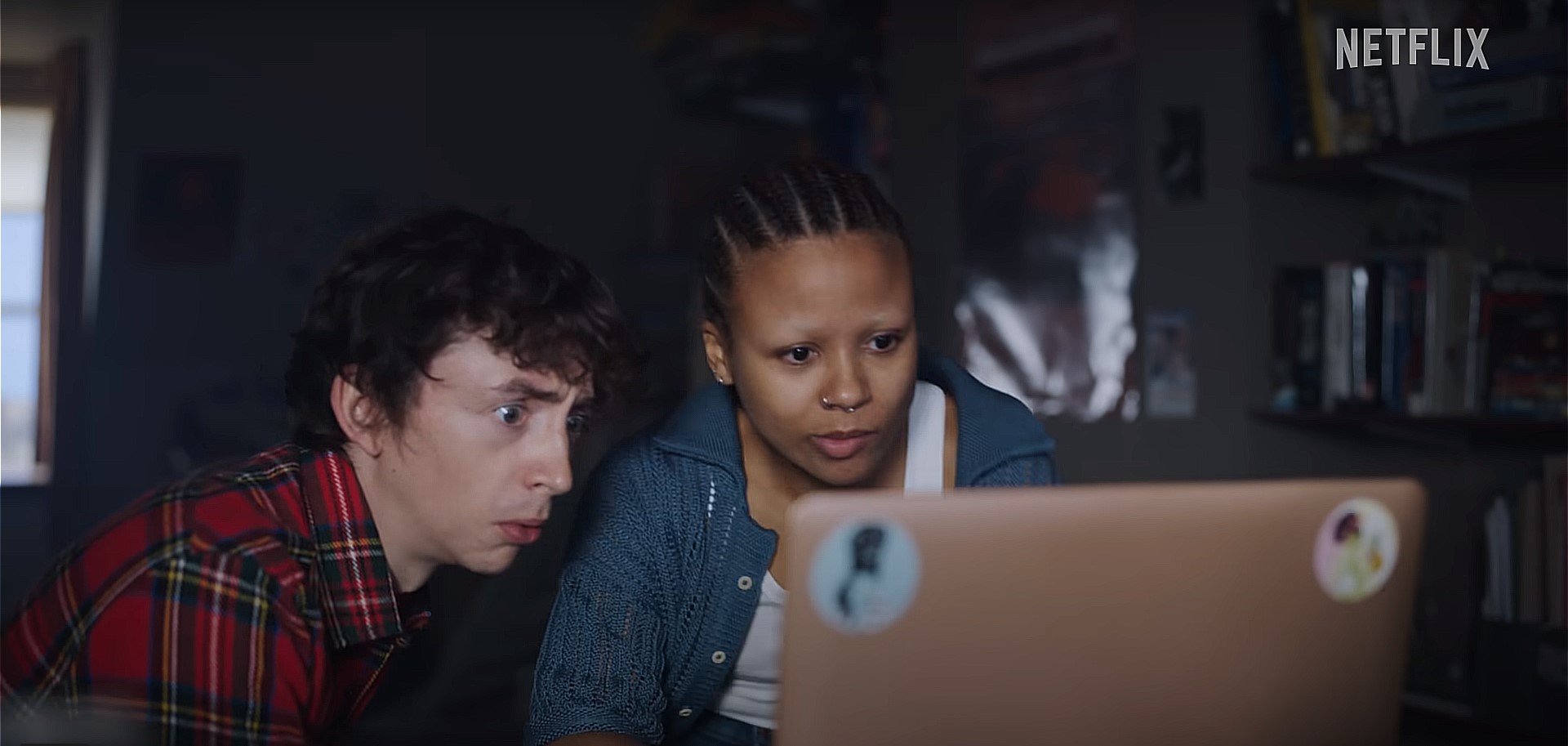
Down in the dales of “Loch Henry” everyone gathers ’round the ol’ viewing device for another round of tales of terror.
Previously on Midlife Crisis Crossover: four years ago I finally took the plunge into Charlie Brooker’s Black Mirror dystopunk series well after the rest of the world had already finished it and moved on. I wrote an untimely listicle seven episodes into my binge, more of a writing exercise than a useful post, but never circled back around once I’d finished everything available, up to and including the gamified “Bandersnatch”, which to this day remains the only feature-length I’ve ever watched entirely on my phone. (A clever experiment, granted, but our TV is large and current-gen enough that I hate watching anything longer than a .gif on a screen the size of a deck of cards.)
In their vast selfishness, Netflix released Season 6 a week before Anne and I went on vacation. I had time for only one episode before takeoff, made time for one more while we were out of town and supposed to be relaxing together (edgy bleakness is not her thing), and sped through the rest after we returned home. Now I’m caught up with the BM fandom that’s only two weeks ahead of me this time.
The professional reviews I’ve skimmed have been mixed, which is understandable given how the new batch diverges from the usual grand theme of how humanity’s zealously self-imposed tech-symbiosis has historically ruined, ruins up-to-the-minute, and in as-yet-uninvented forms will continue ruining, everything and anything we hold dear and/or take for granted. Three of the five episodes line up with the established Mirror universe, but the other two broaden the scope toward more of an anything-goes anthology whose only unifying theme is Whatever Stories Brooker Wants to Tell. Hence some peculiar detours from near-future SF into the mostly wireless realms of the supernatural. I’m not quite complaining — his show, his rules, to the extent that Netflix execs are sated — but I’d be more magnanimous about it if the two old-school horror outings had been more solid efforts rather than tentative proof-of-concept submissions outside his forte to justify more magick-dabbling in future seasons.
Before we stop the obligatory prefacing and get on with the countdown, one last aside: the show now has a much more generous budget to recruit familiar faces from other projects, which we’ll be noting as we go because the sprawling interconnectedness of all entertainment is a longstanding MCC preoccupation. Onward!
1. Joan is Awful, directed by Ally Pankiw (Hulu’s The Great, Netflix’s Feel Good). A snooty company woman (Schitt’s Creek‘s Annie Murphy) is appalled to discover the next big thing is a streaming series based on her own life. Each new episode is AI-generated daily based entirely on what she just did hours ago. She’s not as flattered as you’d think to see herself played by a deepfake Salma Hayek simulacrum (gamely represented by Hayek herself, on more than one level) and unfortunately for her she’s an objectively awful person — hence the show’s name, which didn’t even bother to anonymize her. Right off the bat, Brooker gently nibbles at his Netflix feeder-hand (with their corporate blessing, of course) while mostly ducking around today’s AI-art hot-topic controversies in favor of satirizing easier targets (onerous Terms and Conditions fine-print surprises, morally sketchy true-story adaptations). It’s still this season’s funniest entry as it levels upward to an Inception-spiraling meta-meta-META screwball caper.
Other recognizable faces: Avi Nash (the star-watching IT guy from Apple TV+’s Silo) as Joan’s boyfriend; Rob Delaney (Pete from Deadpool 2) as a hunky old flame; and Ayo Edibiri from The Bear (my current favorite series) sighted too briefly as a coworker. Higher up in the meta-framework we add Himesh Patel (Tenet, Enola Holmes 2), Wunmi Mosaku (Loki‘s Hunter B-15, one of Luther‘s numerous short-lived partners), Ben Barnes (the eponymous Prince Caspian, Jigsaw from The Punisher), and a scrawny special guest whose quick self-parody might be the biggest laugh.
2. Loch Henry, directed by Sam Miller (Luther, HBO’s I May Destroy You). My personal MVP of this season is Samuel Blenkin, who was in one of Atlanta‘s best season-3 episodes (where he held his own against Paper Boi’s interrogation about his missing phone) and had a cameo in The Sandman as William Shakespeare (a role that should expand if that show lives long enough to delve further into the saga). Here he’s a young filmmaker who’s returned to his Scottish hometown on his way to go make a dry documentary about some countryside antihero, only to be talked by his American girlfriend (Myha’la Herrold from HBO’s Industry) into switching to a more intriguing subject: the local serial killer who died after a showdown with his late dad and whose ghastly notoriety turned the place into a ghost town. Social media didn’t exist at the time to amplify his notoriety or empower looky-loos to Google Map their way to disgusting crime scenes.
True-crime docudramas are ripe for spoofing, but the chuckles are fleeting as the nihilism of early Mirror is soon revived at full strength and their search for The Truth and creepy new footage (not always in that order) leads them down unexpected tunnels to a grimdark ending that feels like the wrong party receives the worst punishment. Blenkin is at first an engrossing storyteller as he recaps ancient history for us, but by the final scenes his increasingly haunted expressions are a stark reminder that gift-wrapped Tales from the Crypt morality plays are rarely where Brooker aims his Mirror.
But! I learned something from this episode! When one character describes the bygone murderer as not counting among the more famous ones “like Ted Bundy or Fred West”, I stopped short because I’d never heard of Fred West. That inquiry sent me down a Wikipedia rabbit hole far more horrifying than this episode. I may in fact have spent more time reading up on him, his second wife Rose, and their respective atrocities than I did watching the episode itself. As if reality needed to confirm to me that it was not making up any of their labyrinthine nightmare tales, the next morning I described all this to Anne, whose eyes widened as she recognized those names: as it happens, Rose and the family were featured in a 2009 episode of Investigation Discovery’s Deadly Women.
More fun meta-trivia: the Wests were also the subject of a 2011 British miniseries titled Appropriate Adult, in which Fred was played by Dominic West from The Wire and Rose was played by Monica Dolan…who was in season 5’s “Smithereens” and appears here as Sam’s widowed mom. (That award-winning role and this one’s final act have other things in common.)
Other recognizable faces: John Hannah (The Mummy‘s comic relief and deliverer of Four Weddings and a Funeral‘s biggest speech) as the town drunk, for lack of competition and with fair reason; and Daniel Portman (Game of Thrones) as a BFF of Sam’s who runs the only bar left in town.
3. Demon 79, directed by Toby Haynes (Doctor Who, Sherlock, Jonathan Strange & Mr. Norrell). The season finale chucks out SF altogether and introduces the show’s first taste of non-metaphorical fire-and-brimstone Hell. It’s also the only one of this bunch with a credited co-writer, Bisha K. Ali (Loki, Ms. Marvel). In late-’70s Britain at its most flagrantly racist, a British Indian department-store shoe-seller named Nida (Anjana Vasan from Peacock’s We Are Lady Parts) endures everyday bigotry in varying sizes till one day she comes across a cursed Mah Jongg tile that summons a demon named Gaap, played by Paapa Essiedu, whose flamboyance and disco costume (a la Bobby Farrell from Boney M. — don’t ask) is a looooong way from his Gangs of London bespoke crime-lord understudy. Gaap is a sort of Evil Clarence trying to earn his forked tail and horns by coaching Nida through an absurd ultimatum: upon activating his token, she’s now required to murder three people in three days or else the world will end. As in, the entire planet and all of humanity included. It’s a bit much to put on a peaceable young lady, but that’s what she gets for rooting through musty storerooms, apparently.
This oddly specific challenge, whose mechanisms and supporting lore are never explained, curiously implies no previous recruits have ever flunked it before. Any questions of “why” are never answered, and the grainy-filmed shlock-horror aesthetic homages promised in the opening credits (cutely redubbed “Red Mirror”) are limited to a few daydream slivers, but Vasan and Essiedu find a bizarrely watchable coach/rookie chemistry in their exasperated teamwork which very nearly obscures how this is all a sitcom-ish riff on The Dead Zone, especially in the mad march toward a high-profile final victim, till the gonzo ending boogies off into its own dimension.
Other recognizable faces: Shaun Dooley (Broadchurch season 2; a Doctor Who episode I barely remember) as the police detective hot on Nida’s trail; and two guys whose bit parts in The Crown I won’t pretend to recall.
4. Beyond the Sea, directed by John Crowley (The Goldfinch, Best Picture nominee Brooklyn). In an alt-timeline where the moon landing wasn’t NASA’s sole achievement in 1969, two other astronauts (Breaking Bad‘s Aaron Paul and Pearl Harbor‘s Josh Hartnett, who looks so old now) are cooped up in a tiny satellite on a six-year mission, but with one amenity the Apollo 11 crew lacked: they can wire their consciousnesses into lookalike android bodies back on Earth and spend quality time with their respective families. (Yes, they’re all aware, and yes, there’re biological shortcomings.)
Before anyone can bring up why NASA didn’t just send the robot bodies into space and have the real McCoys access them safely from Earth, a shocking calamity occurs that compromises one of those “amenities” (not to mention reminding us what else made 1969 headline news besides spaceflight) and leads to hard feelings and harder decisions between the space coworkers. I expected the results to head down one predictable path (in, say, a Death Wish vein), but instead they veered toward another, differently predictable and hoarier path. Aaron Paul hasn’t lost his subtleties or his capacity for rage in the years since Jesse Pinkman’s anticlimactic ending, but he’s ultimately rendered impotent by Brooker’s fetish for watching his characters suffer and further gobsmacked by an abrupt non-ending that begs the question of “And then what?” as it cuts to black. The episode dead-ends where Vince Gilligan would’ve had the nerve to keep going and teach Brooker a thing or two about properly satisfying grimdarkness.
Other recognizable faces: Kate Mara (House of Cards, Fantastic Four) as Paul’s Concerned Wife; and Rory Culkin, doing a variation on the long-haired, wild-eyed cultist I already caught in Showtime’s Waco and Hulu’s Under the Banner of Heaven. If I attend two more gigs, I can mail in all five UPC codes and get his world-tour souvenir T-shirt.
5. Mazey Day, directed by Uta Briesewitz (Stranger Things, the former Marvel/Netflix universe, lots more). The season’s shortest episode is also its thinnest B-movie. Zazie Beetz (great in Atlanta, fine in Deadpool 2) is an ex-paparazzo in the not-too-distant past (you can hear her 52K modem shriek) whose nagging conscience drove her out of the game. Looming debts tempt her back in for a plum bounty: thirty grand for pics of a former child star-turned-addict (Clara Rugaard, recently on The CW in The Rising) who recently disappeared from a Czech film set. Paparazzi are yet another target everyone loves to hate, but Brooker’s thin castigation of their lot doesn’t bring any witty new insights (one of them — get this — wears a fedora!). They’re beside the point anyway as this episode, two ahead of “Demon 79”, is the moment when Mirror falls off its sci-fi perch for the sake of a faintly foreshadowed Shocking Twist. Once you realize what’s really happening, you’ll note everything that follows has been done before, done often, done better, and you won’t need a telephoto lens to spot the final soul-selling moment from miles ahead.
Other recognizable faces: Danny Ramirez (a potential superhero-to-be in Falcon and the Winter Soldier, and Top Gun: Maverick‘s callsign Fanboy) as a fellow photog; Jack Bandeira (Young Woody Harrelson in Venom: Let There Be Carnage) as a diner owner; and longtime character actor Corey Johnson (last spotted as a shady boat captain in Morbius) as an unhelpful town sheriff who has thoughts about how to cook chicken.
…
…and that’s the season that was. Not their best by far, but after a four-year hiatus, it stands to reason the Mirror would’ve collected dust and smudges that made for hazier reflections. Here’s to another four-year wait for the next one, unless Brooker decides he’d rather do more monster flicks, which I’m sure could be cranked out more quickly. Can’t imagine it’ll be long before we get an edgelord take on ye olde Mirror, Mirror, on the Wall.
Discover more from Midlife Crisis Crossover!
Subscribe to get the latest posts sent to your email.
 Midlife Crisis Crossover!