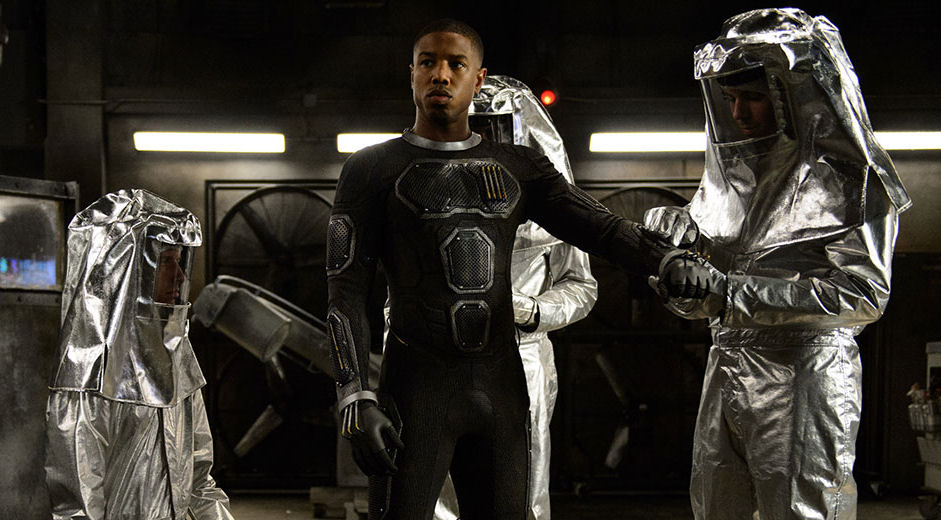
Michael B. Jordan gets into character while the film crew shields themselves from the toxic work environment.
As a longtime comics fan, John Byrne’s Fantastic Four was one of my favorite Marvel series as a kid. Years later I developed an appreciation for the first 103 issues in which Stan Lee and Jack Kirby gave us some of the greatest stories among their many collaborations. My FF fandom came and went as creative teams, interpretations, and times changed, but I have fond memories of great runs by Walt Simonson, Dwayne McDuffie and Paul Pelletier, Mark Waid and Mike Wieringo, and the long-forgotten team of Doug Moench and Bill Sienkiewicz (#219, 222-231) who introduced Marvel’s First Family to this impressionable eight-year-old. I have those runs, and I have my warm memories, but my emotional attachment to them as individual characters has faded enough over time that I’m open to seeing new and different reinterpretations. Honestly, though, I haven’t encountered a worthwhile use of the FF in years.
Meanwhile in the more recent past, I previously named Chronicle my favorite film of 2012. A previous entry already used up a couple hundred words explaining what impressed me about this found-footage mini-epic that imagined what would happen if one of Disney’s Witch Mountain films were remade as an episode of Black Mirror. Credit remains due to lead actors Dane DeHaan, Alex Russell, and The Wire‘s Michael B. Jordan; to screenwriter Max Landis making a heck of a feature-film debut; to cinematographer Matthew Jensen, editor Elliot Greenberg, and numerous other cast and crew members for an experience that still rattles me whenever I think back to key scenes.
In the MCC capsule summary I’d expressed my hopes of seeing big things from director Josh Trank in the future. Here we are today, living in that bleak future where the boundaries of Chronicle‘s imagination are visible in maybe two sequences from Fox’s newly rebooted Fantastic Four, which was mostly directed by Trank and finished by a producers’ committee using Trank as their contractually subjugated proxy/scapegoat. In a short-lived tweet last week Trank publicly blamed the studio for all the faults in the finished product. The multiple flaws that riddle this slipshod corporate product from start to finish belie Trank’s sorry attempt at a total cop-out.

 Midlife Crisis Crossover!