Heartland Film Festival 2025: “Happy Birthday”

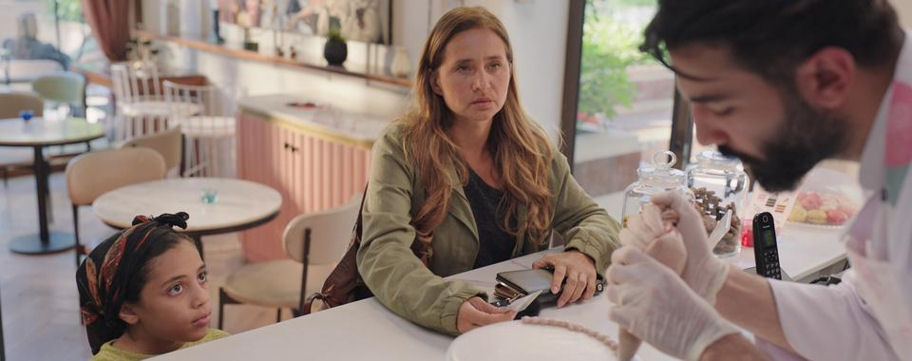
A middle-aged woman and a tiny girl at the counter of a brightly lit bakery, where the chef is icing a cake.

Last-minute birthday cake shopping: kind of a headache in every country.

Previously on Midlife Crisis Crossover:

It’s that time again! Since 1992 my hometown of Indianapolis has presented the Heartland International Film Festival, a multi-day, multi-theater celebration of cinema held every October. Local moviegoers have the opportunity to see over a hundred new works in the realms of documentaries, narrative features, shorts, and animation made across multiple continents from myriad points of the human experience. Some participants stop in Indy on their grand tour of Hollywood’s festival circuit; some are local productions on shoestring budgets; and a wide spectrum of claims are staked in the innumerable niches between, projects with well-known actors screening alongside indies with enormous hearts.

This’ll be my third year diving in and seeing more than just a single entrant. Heartland’s 34th edition runs October 9-19, for which I’ve made plans to catch at least six films in all (Lord willing) — maybe more if time permits…

As someone who watches every Marvel Cinematic Universe installment for better or worse, I’ve found it interesting to see what filmmakers do next after they’ve done their time in the machine. Sometimes they move on to equally gargantuan pop-culture universes (The Mandalorian, Superman). Sometimes they have a ball in their own sandboxes (Sinners, Wolfs). Sometimes they give the impression Marvel broke their brains (The Gray Man, Fast X). Sometimes they step back from Hollywood excess and find fulfillment in smaller works (Next Goal Wins, the upcoming Hamnet).

Case in point: our next film, Happy Birthday — Egypt’s official submission for Best International Feature at the next Academy Awards — comes to us from the talents of writer/director Sarah Goher, who was on the writing staff of Moon Knight, and her co-writer and longtime creative partner Mohamed Diab, who directed four of the show’s six episodes. (Two other writers receive a “Story By” credit, but as of today I can’t verify their names online for some reason.) Its total budget was probably less than what they paid the VFX team in charge of rendering Khonshu’s skull, but sometimes an indie film is just as capable, if not more so, of slipping through your jaded defenses with its sincerity right before it breaks your heart.

Continue reading

“Mickey 17”: The Day the Clone Cried

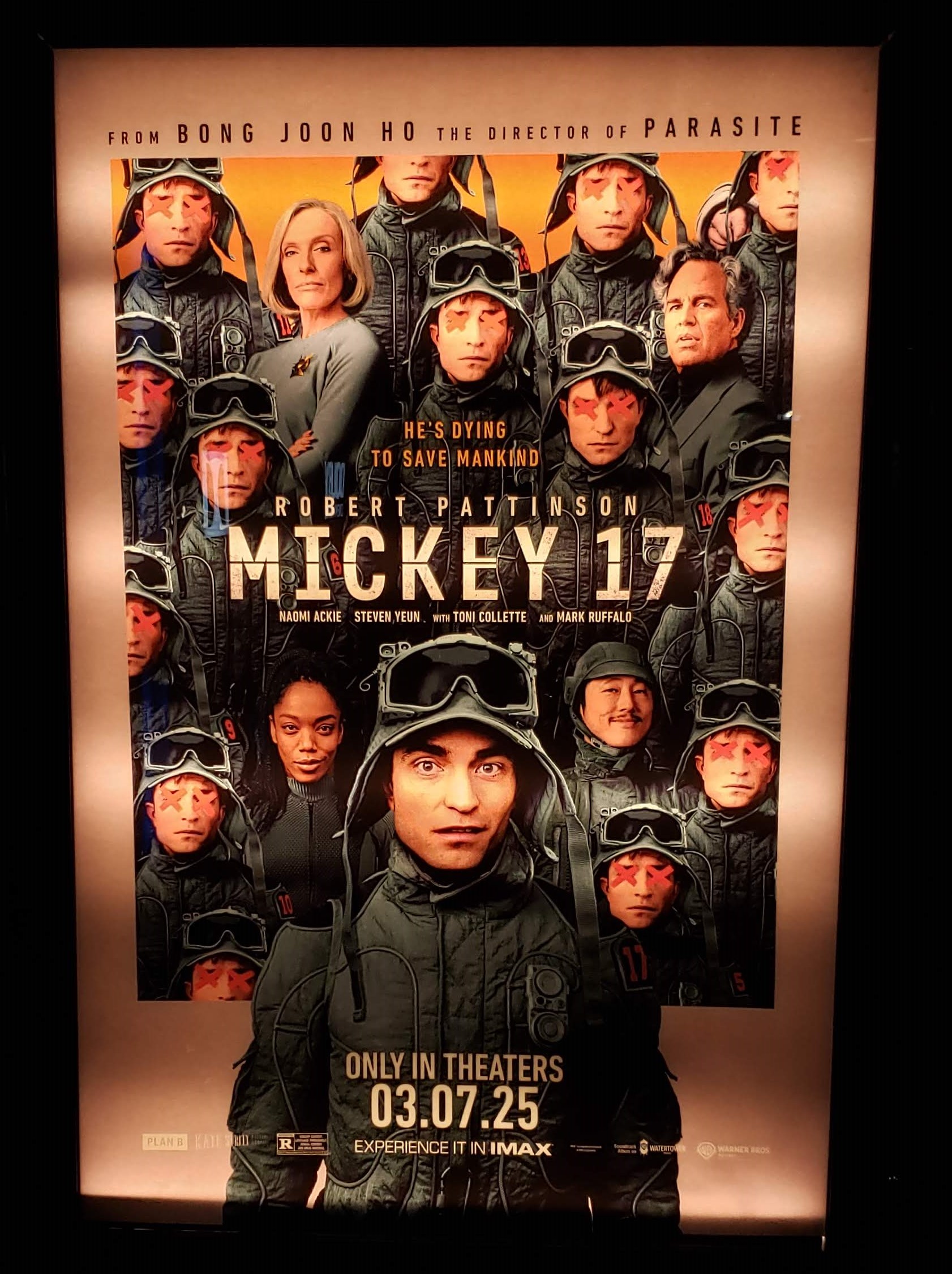
Movie poster for "Mickey 17" hanging in a dark theater with inconsistent backlighting. Poster has multiple Pattinsons surrounding the rest of the cast.

Edward Cullen! Cedric Diggory! Bruce Wayne! Lighthouse Guy! Crisis on Infinite Pattinsons!

Previously on Midlife Crisis Crossover: class warfare rules in the hands of South Korea’s Bong Joon Ho, from the improbable post-apocalyptic supertrain metaphor of Snowpiercer to the widely celebrated Parasite, Winner of Four Academy Awards Including Best Picture™. Whether it’s the filthy-rich versus the dirt-poor, the genteel-affluent versus the barely-getting-by, or the dirt-poor versus the dirtless-homeless-everythingless, satirical skewerings of the eternal tug-of-war between the have-it-alls and have-nots over their variances in have-measures are very much his favorite field of cinematic dissection.

As we waited patiently through the nearly six-year gestation of his post-Oscar follow-up Mickey 17 (the pandemic’s at fault for some of the hold-up), fans rightly expected his priciest foray into the American big-budget mainstream (with a budget twice that of his Netflix Original Okja) would play to his hot-topical interests, and that his knack for outlandish approaches would suit the material. He enjoyed access to better resources, bigger-name actors, and apparently more negotiable schedules for getting it all accomplished. Bong is in his element for much of the film’s first half, up until a midpoint onset of commentary mission-creep pivots everything off the opening premise and lurches toward another course, broader and much tireder.

Continue reading

“Parasite”: Scenes from the Class Struggle in South Korea

Parasite!

Beauty is in the eye of the beholder. Truth is in the ear of the believer.

From Bong Joon-Ho, the director of The Host, Snowpiercer, and Okja, a movie with a name like Parasite implies sooner or later there’ll be a monster and bloodletting and bigger, badder, wilder, all-out, off-the-wall, jaw-dropping pandemonium, because moviegoers expect escalation. Several words in that sentence come true and thus is the prophecy fulfilled, but with Joon-Ho it’s best never to think we can expect the unexpected. What most of us think of as “unexpected” is actually very expected because we think along a select number of unconsciously rigid tracks. We clench Occam’s Razor between our fingers and use it to sketch our predictions, drawn from among the most common forms of what average storytellers consider “unexpected” rather than unimaginable forms of unexpected. Preconceptions are a drag even when we think we don’t have any.

Parasite tinkers with quite a few of them. Among the most common and beloved in many a Hollywood tales of late: “Poor = good. Rich = bad.” As us-vs.-them conformist mentalities go, “rich vs. poor” has become among the most exploited. If that’s among your favorite simplistic conflicts, I’m pretty sure Hustlers is still playing in a multiplex near you. Go have fun!

Continue reading