So Long, Mr. Armstrong, and Thanks for All the Steps

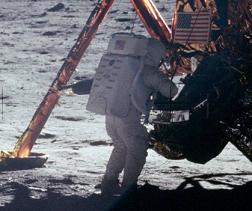
Neil Armstrong, 1930 - 2012When the crew of the Apollo 11 flew their previously voyage to the moon and took those fateful first steps on the Moon on behalf of all humankind, Neil Armstrong was 39, Buzz Aldrin was three weeks short of 39, and Michael Collins was three months short of 39. When I was 39, I took my first step in Manhattan. They win.

It should go without saying how easy it is to be impressed and intimidated by the monumental nature of such an accomplishment, and at what seems like such an early age, all things considered. It’s no surprise that all other Internet news was therefore benched and ignored today when word was received that Neil Armstrong just passed away at age 82.

Over the years, our family has encountered a smattering of examples of what Armstrong and other astronauts made possible, particularly the vehicles and tools they used to break all those barriers and dare the impossible.

The Rocket Garden at Kennedy Space Center, Florida, 2007. Some were unmanned; some very much weren’t. If the moon landing hadn’t happened, I imagine much of the later flights would’ve looked very different, if America had bothered with them at all in that depressing, isolationist alt-timeline.

Rocket Garden, Kennedy Space Center

In 2009, the Field Museum of Natural History offered us the chance to remote-control this li’l simulated Mars Rover. If Armstrong and His Amazing Friends hadn’t reached the Moon, it’s safe to say landing anything on the surface of Mars would’ve remained a science fiction pipe dream, and Curiosity would have never existed (to say nothing of the effect on curiosity with a lowercase ‘c’).

Mars Rover, museum RC version

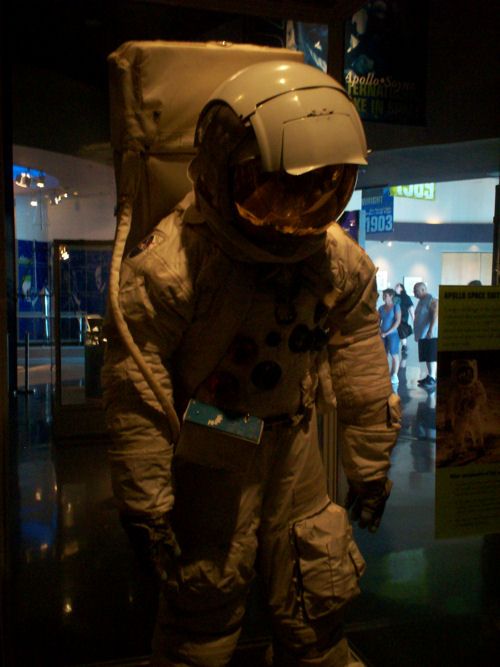
At first I thought about truncating this entry and centering solely on this image of an Apollo spacesuit (also from KSC, 2007), which seems more solemn than any astronaut ever ought to be.

Apollo  Spacesuit @ Kennedy Space Center, 2007

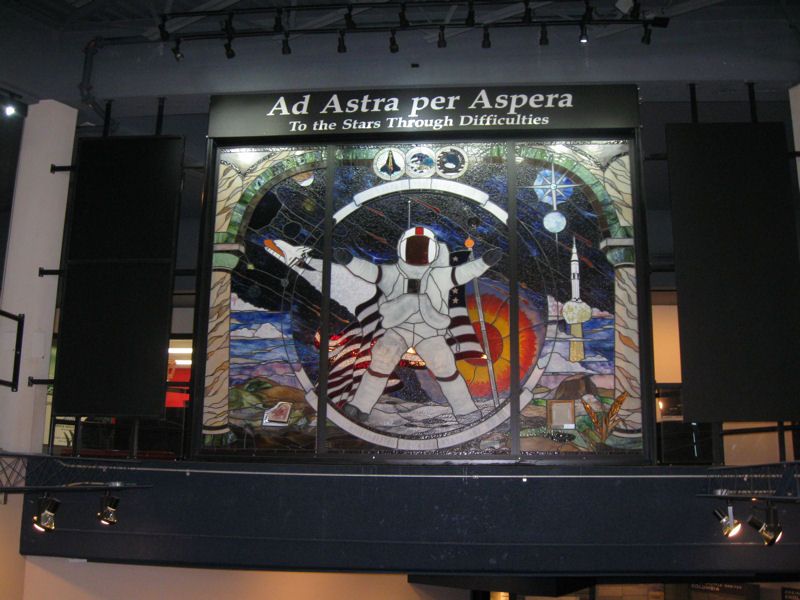
On second thought, I decided I prefer this heads-held-high tribute from the Kansas Cosmosphere, June 2012 — a fitting expression of admiration for those great deeds, emboldened by the hopes that someday they’ll inspire and be followed by deeds even greater.

Ad Astra per Aspera

May God bless you and keep you, Mr. Armstrong.

2012 Road Trip Photos #8: Rocky Mountain National Park, Part 1 of 2: Panoramas on Parade

After I acquiesced to my wife’s demand for a slow, careful descent down Lookout Mountain, our scenic Day Three continued north with a two-hour drive along the east side of the Rockies, through Boulder (very fancy and well-manicured, though not a single Mork & Mindy statue in sight) and northwest to the cozy, wooded town of Estes Park, home of Rocky Mountain National Park.

The drive can be accomplished in less than two hours if you keep your eyes focused on the road and ignore your surroundings. That’s a terrible way to experience the Rockies, though. I had a hard time deciding how often to stop, which views might stand out the most on camera, and which ones to pass by without stopping. Along that entire stretch, beautiful vistas were as common as mile markers. We thought highly of them, anyway. I don’t know if people who live near mountains take them for granted or genuinely wake up appreciating them every day, but we’re used to the topography of Indiana, where the nearest mountains are in West Virginia and all those rolling hills in the southern half of the state stopped impressing me around age 5. Then again, I can imagine Kansans driving up and down State Road 37 between Bloomington and the Ohio River, oohing and aahing at how not-flat everything is. It’s all about your geographic context and personal perspective, I suppose.

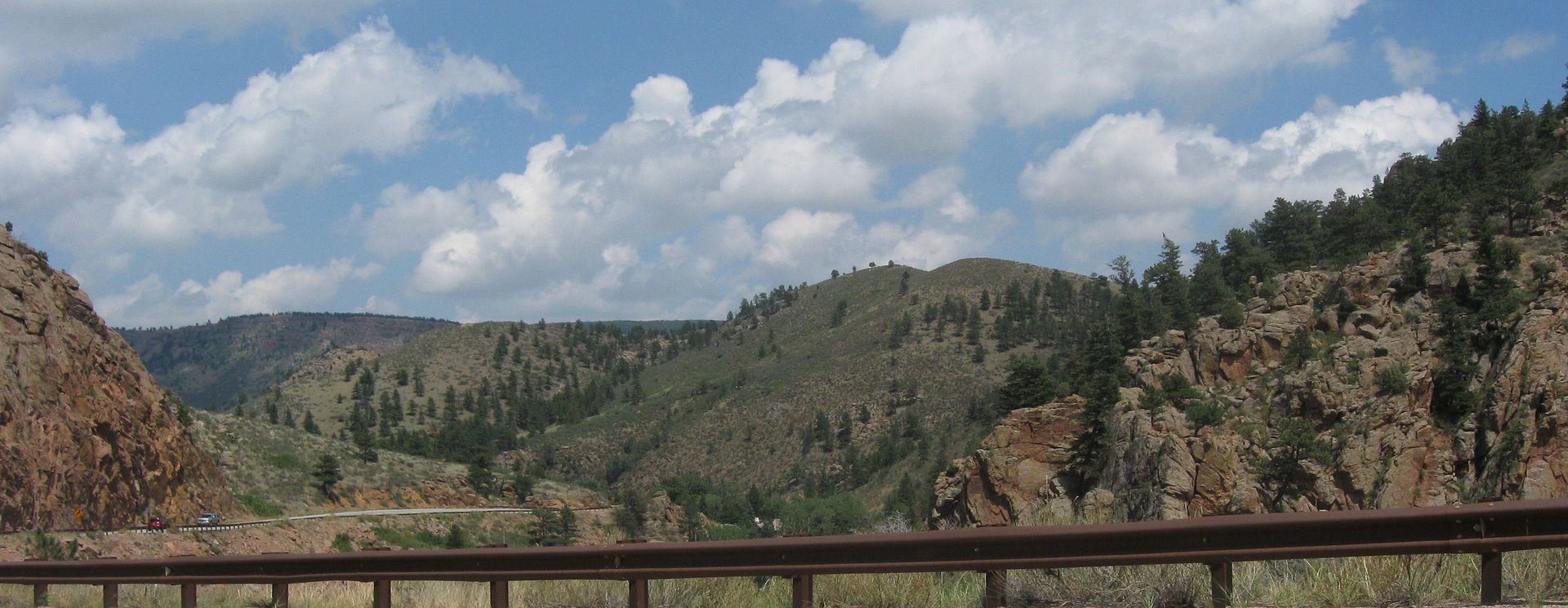
I have to admit to myself here that God’s majestic monoliths don’t really beg for puny human captions. This is me stepping back, shutting up for the space of several pics (some taken inside the park, some on the way to the park, all clickable for plus-sized goodness), and letting you enjoy the kind of views that have inspired many a landscape painter, poet, mountain climber, and cinematographer.

Rockies Panorama #1

Continue reading

2012 Road Trip Photos #7: the View from Buffalo Bill’s Memorial on Lookout Mountain

Just as Dinosaur Ridge was mere minutes from the Red Rocks Amphitheatre, so was our next stop ten minutes or so from Dinosaur Ridge, down the slope of Alameda Parkway, across the interstate, and up the forested residential side of Lookout Mountain. We were elated to suffer no ill effects from the changing altitudes this time. The real estate on the way was curiously maintained, as most of the home along Lookout Mountain appeared well-to-do, as if the local upper-class had all sought refuge together in case of another worldwide flood. At the very least, I imagine their homeowners’ association prides itself on strict upkeep.

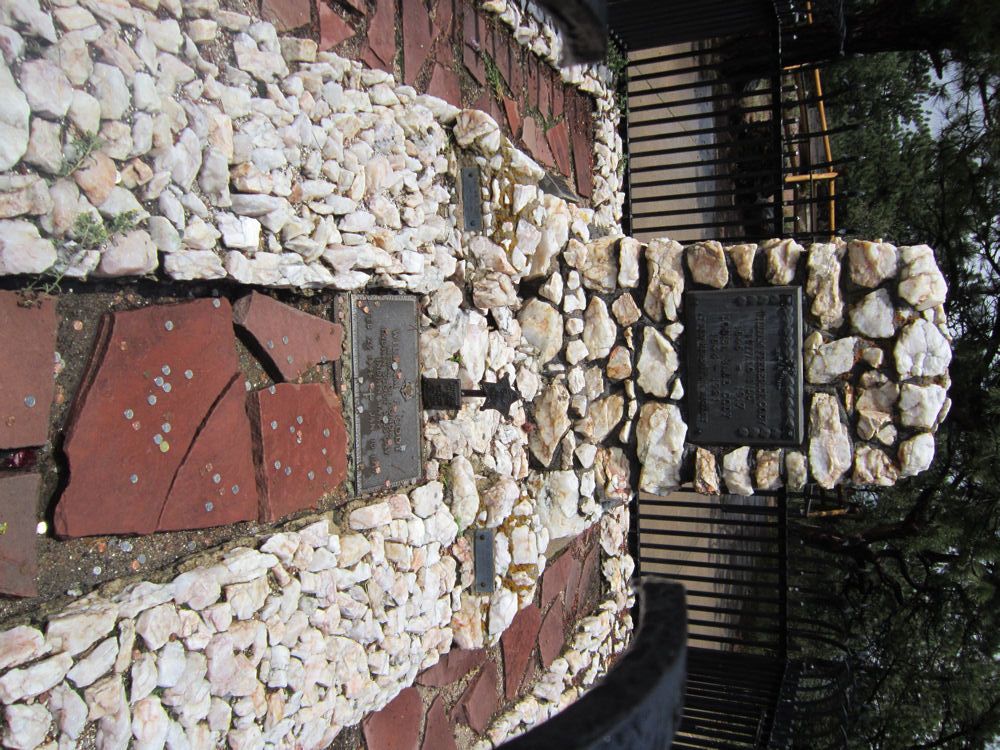
Past the mountainside suburbs and one abandoned restaurant was our next stop, the Buffalo Bill Memorial, final resting place of Old West legend William F. Cody himself. I’m not sure why visitors feel compelled to throw pennies at him. Perhaps famous people’s graves are like wishing wells if you toss them just right. Perhaps they’re meant as tributes to Charon. Perhaps they’re a down payment from those who think Buffalo Bill’s ghost is a detective who helps the helpless and gives hope to the hopeless…for a price. Perhaps they’ve somehow mistaken his grave for Benjamin Franklin’s. The world may never know.

Buffalo Bill Cody's final resting place

Continue reading

2012 Road Trip Photos #6: Fossils and Folly at Dinosaur Ridge

Our itinerary for Day Three continued from the Red Rocks Amphitheatre to nearby Dinosaur Ridge, less than a mile down the road as the crow flies. We’ve seen dinosaur fossils before at the Children’s Museum in Indianapolis, as well as the Natural History Museums in Manhattan, Chicago, and Washington, DC. Truth be known, simple fossil exhibits aren’t as exotic to me now as they were in my youth. The displays at Dinosaur Ridge offer a different take on the subject — their fossils and samples are outdoors and still embedded in solid rock, exposed ever so slightly for visitors to see them in their natural habitat instead of being reassembled on a dais or sealed inside a glass cabinet.

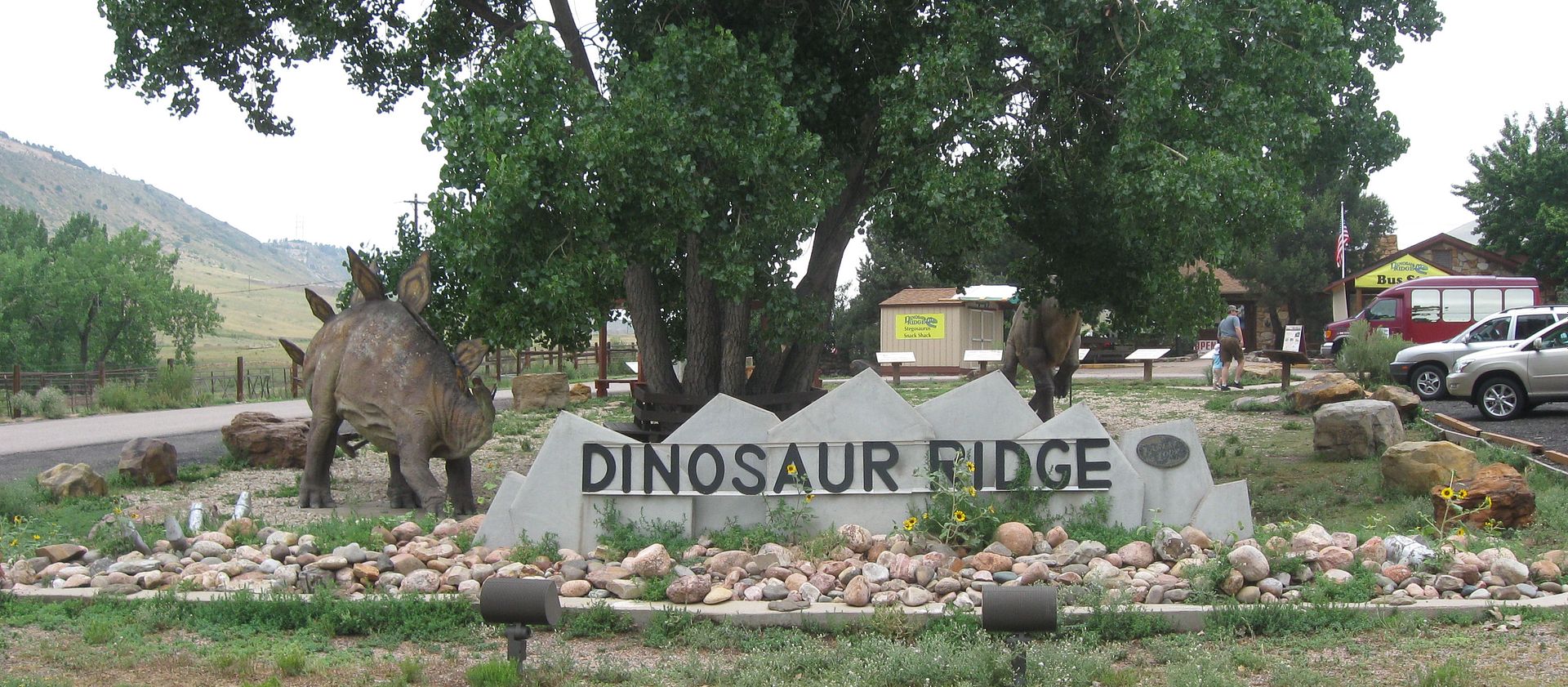
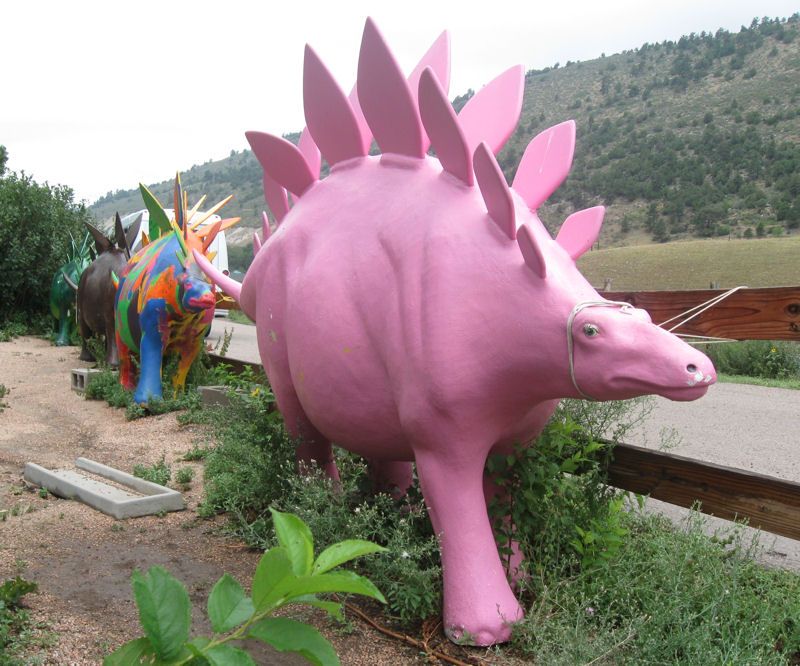
When I first learned of the Dinosaur Ridge premise, I imagined entire walls filled with a panoply of complete, recognizable skeletons. That’s not quite the reality. The entrance and welcome center set the stage just like any standard museum, with the prerequisite dinosaur statues and shelves of dinosaur toys. For an added flourish, off to one side is a stegosaurus pride parade.

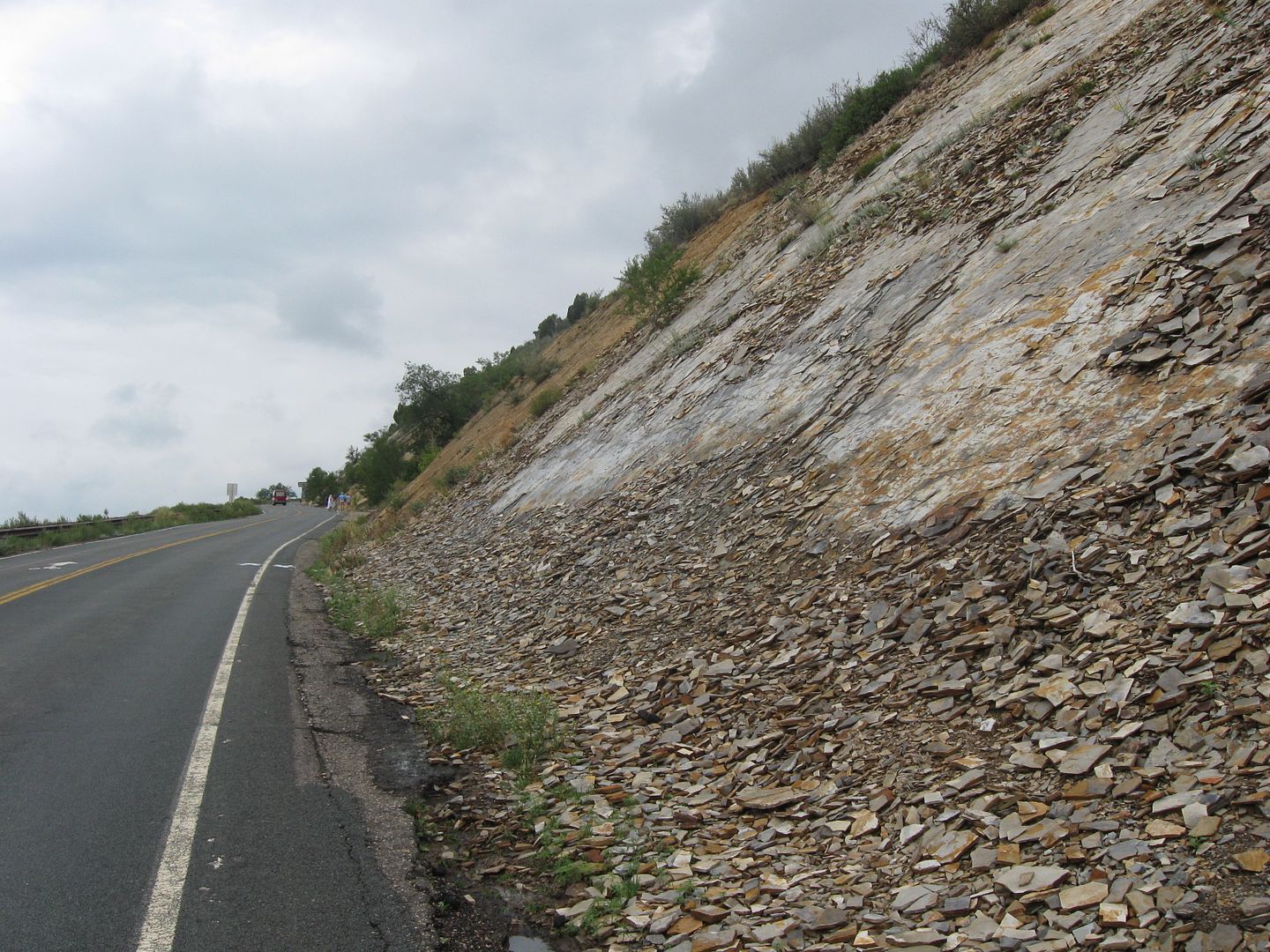
The natural exhibits comprise the wall along a curvy, uphill mile of Alameda Parkway heading west from the visitor center. No cars are allowed up the ridge except the official Dinosaur Ridge shuttles. The shuttle ride is free, as is their tour guide who elaborates on any points of interest and keeps you focused on the marvels you’d hoped to witness. If you’d prefer to chart your own destiny, pedestrians and bicyclists are permitted to traverse the ridge as they see fit. Our family policy is we prefer to set our own pace and avoid trapping ourselves in other tourists’ schedules or paces. In some situations this can be advantageous if you know what you’re doing and have all the same exhibit access that the tour groups do.

In this situation, it meant a stubborn one-mile walk uphill, which mostly looked like this. Open highway plains to the left of us, rough terrain to the right.

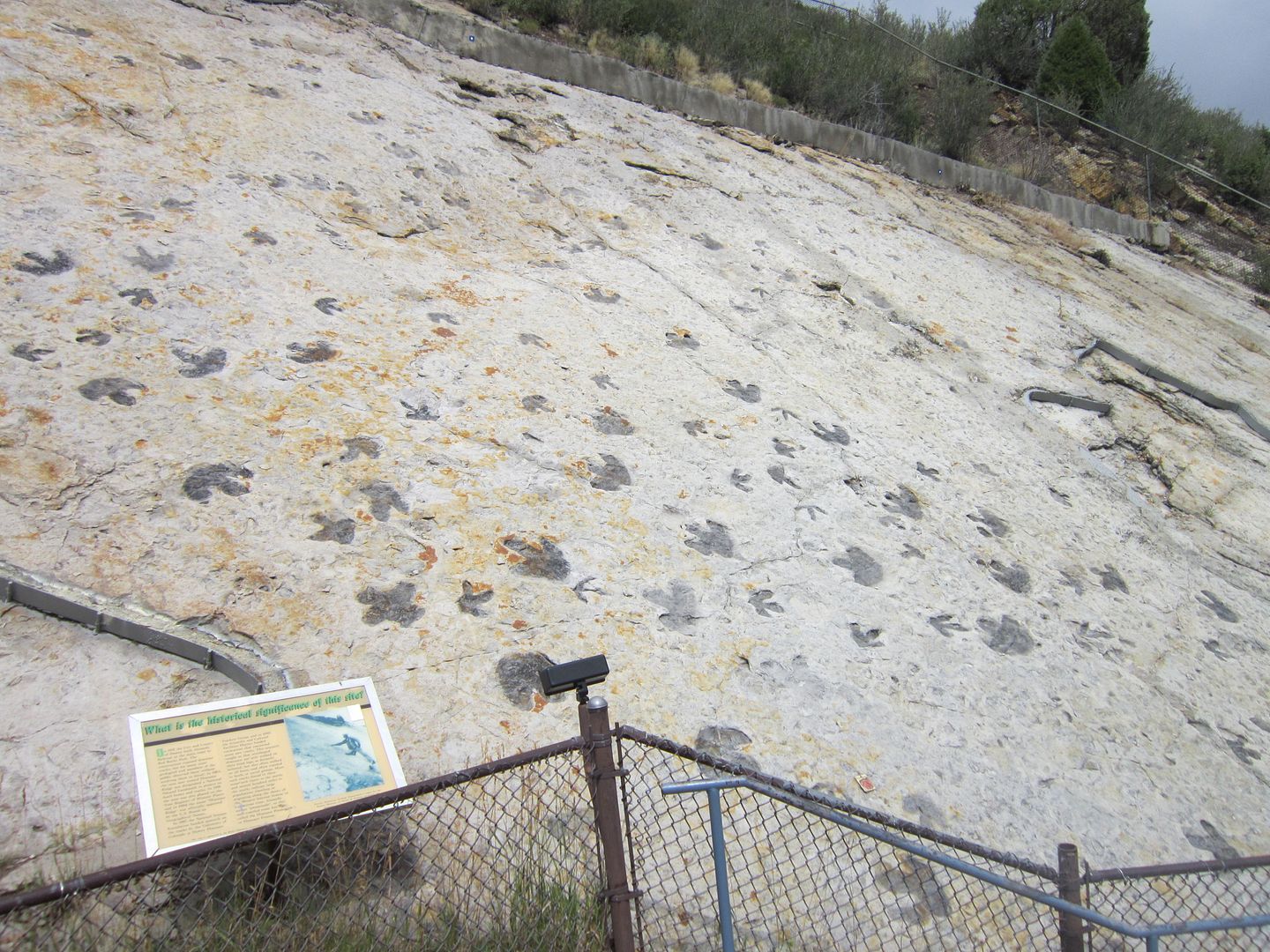
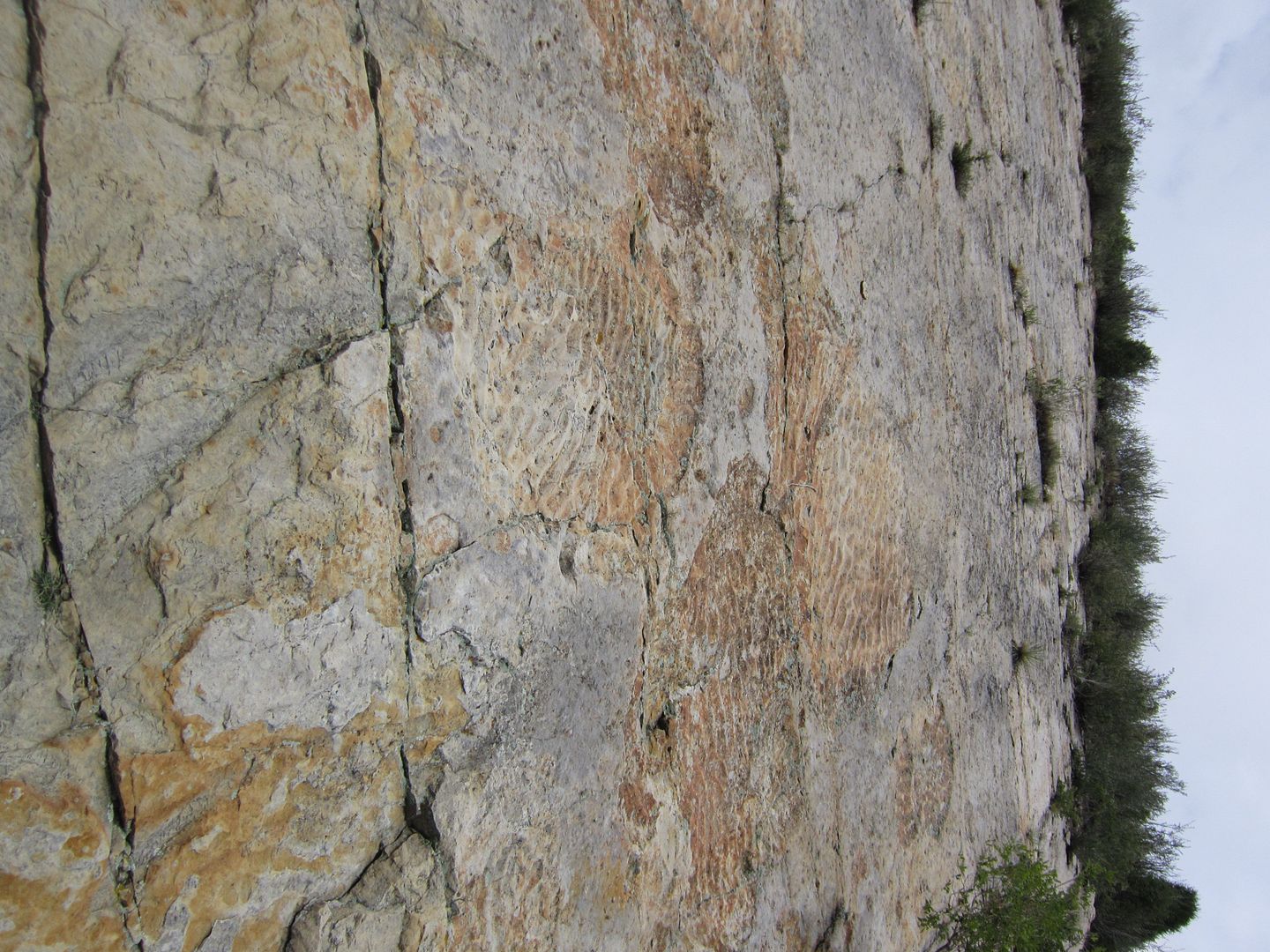
Every several hundred feet, we’d arrive at something of note. This collection of preserved footprints wins Best of Show, Dinosaur Ridge Exhibit category.

If your child thinks ancient plants are as cool as dinosaurs, this selection of imprints may make an interesting poster.

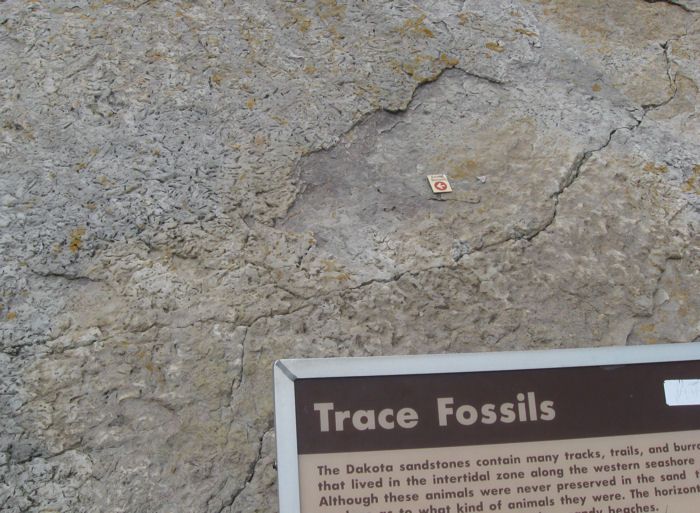
Most of the long walk was decorated with naught save rocks, stones, pebbles, boulders, and suffering grass. In a few spots, helpful signs invited more specific attention to traces that are scientifically noteworthy, easily overlooked, and nearly invisible to the untrained eye.

Closer inspection could reveal greater detail, or stump the more impatient onlookers.

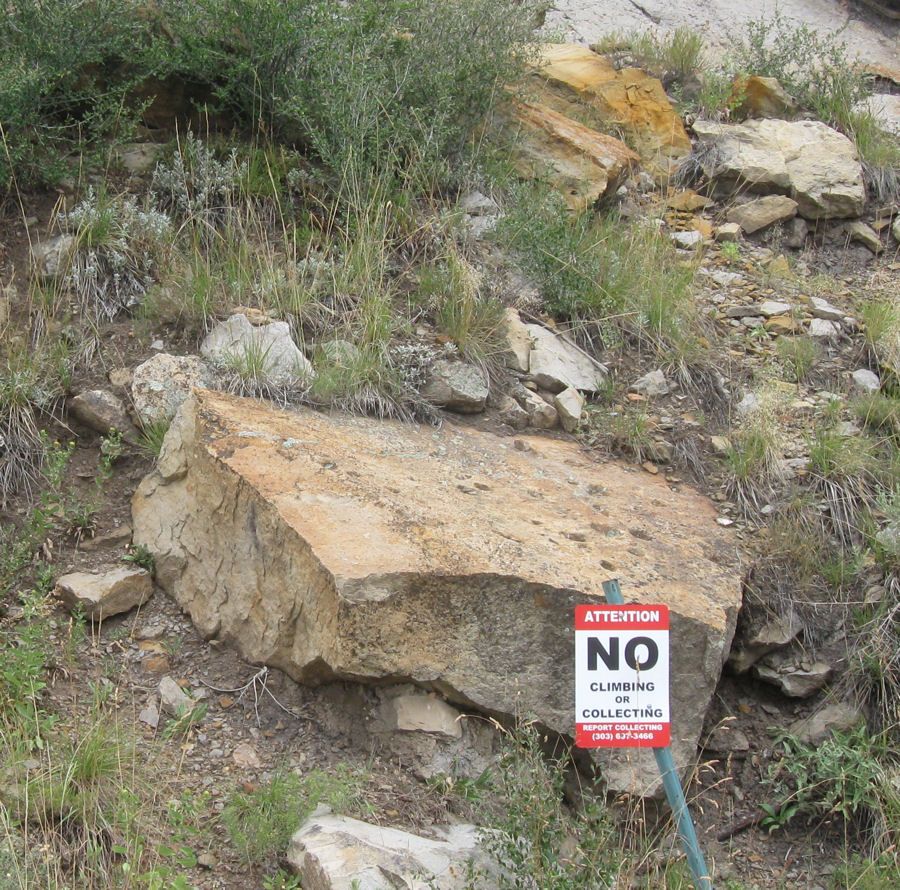
Thinking about chiseling your own souvenirs out of the walls? Think again! Guests are strongly encouraged to tattletale on other guests. Big Paleontology is Watching You. Amateur geology is ungood. We have always been at war with Eastdakota.

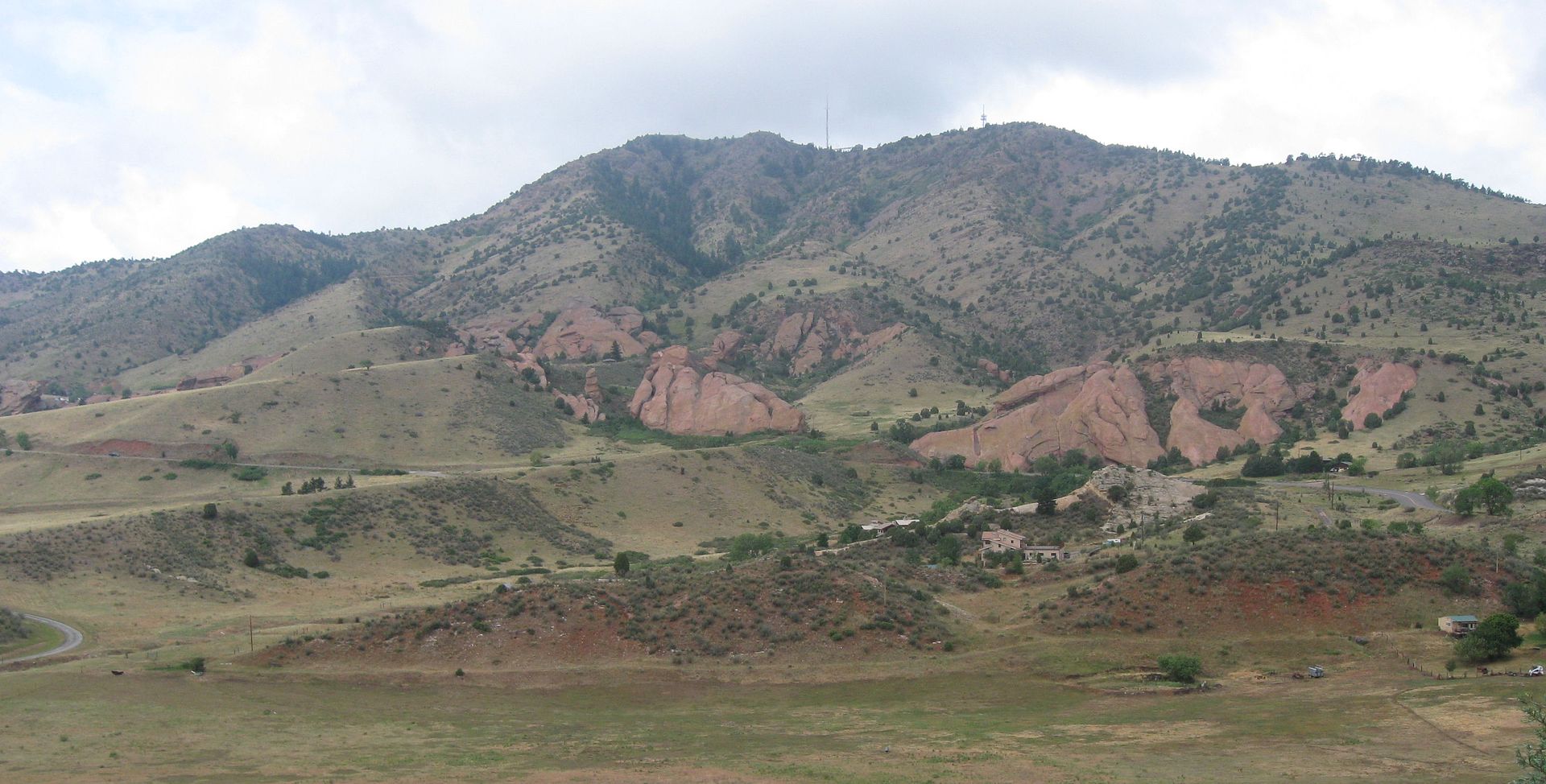
If you survive your one-mile uphill calisthenics, congratulations! Your reward is a breathtaking sight of other Rocky Mountains in your area. If you’re a seasoned hiker (which describes none of us), this was a cakewalk. If you’re my wife and you’re still acclimatizing to the thinner air at this elevation, a nearby bench offers a broad landscape view and a moment to reflect on your husband’s boneheaded decision to skip the shuttle.

The return trip downhill was thankfully easier and faster. The rematerializing storm clouds that dogged our heels certainly encouraged a brisker pace and inspired us to catch our second wind. By the time we reconvened at the car, the threat of downpour subsided and it was still only 11:30 a.m. MDT. Our long day in the Rockies was far from over. As you can imagine, walking requirements were negotiated down to a bare minimum at subsequent stops.

To be continued!

[Link enclosed here to handy checklist for previous and future chapters, and for our complete road trip history to date. Thanks for reading!]

2012 Road Trip Photos #5: Red Rocks Amphitheatre Under a Dull Gray Sky

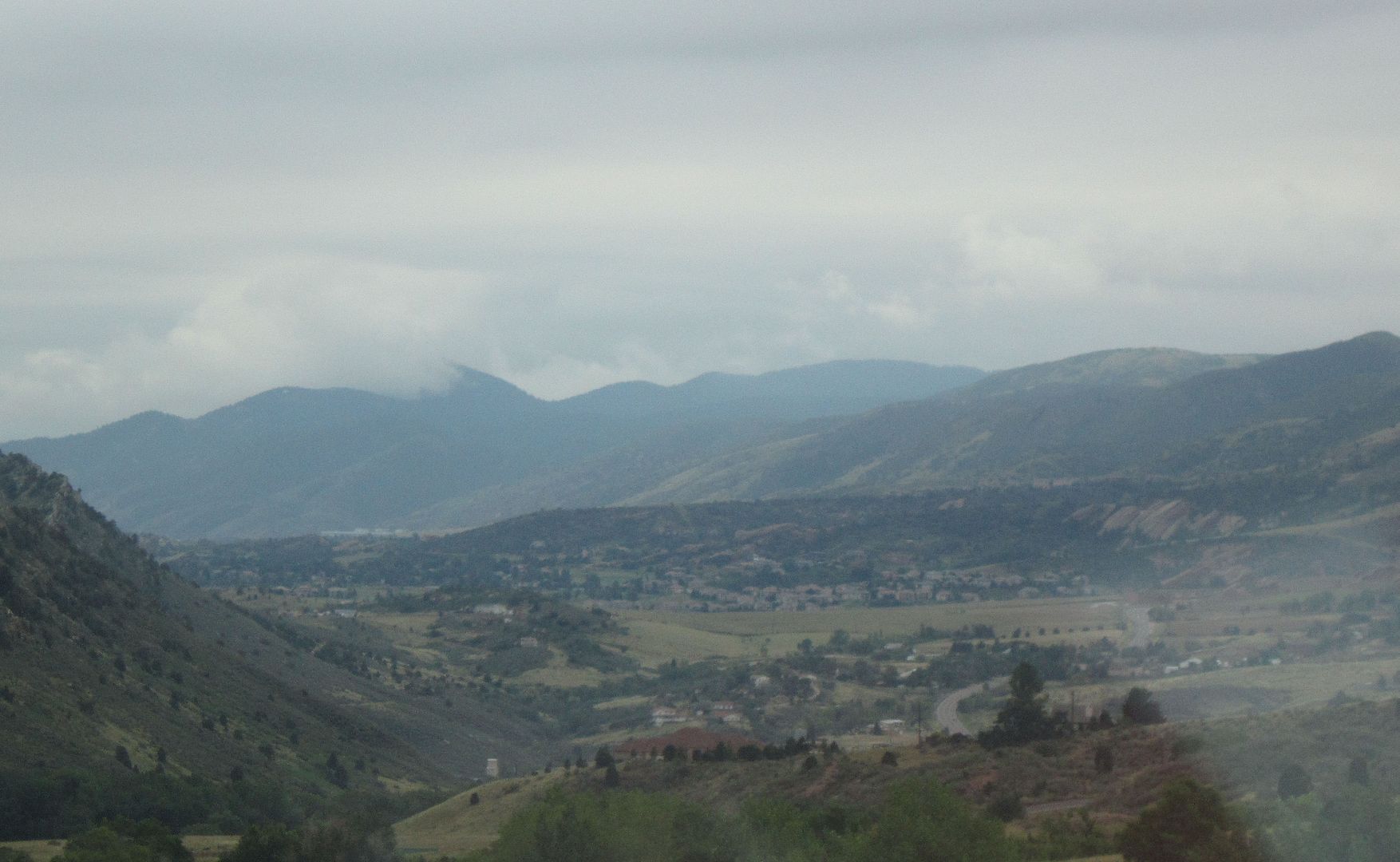
When we arose on Day Three, the sky remained cloudy and scary throughout the morning. As we headed west from our Aurora hotel through Denver, eventually we were privileged to cast our eyes at long last on the grandeur of the Rocky Mountains. Even with overcast weather, we were still in awe. Please enjoy the first of several clickable photos, uploaded in higher resolution than previous entries for extra mountainous goodness:

Continue reading

2012 Road Trip Photos #4: Between Topeka and Denver — Buffalo Bill, Black Copters, and MegaVanGogh

Other than the hour-plus we spent in Abilene, all other stops on Day Two were momentary diversions from the infinite plains of western Kansas and eastern Colorado. The early miles were brownish-green hills, less verdant than usual thanks to this year’s drought.

Continue reading

2012 Road Trip Photos #3: Abilene Presents the Eisenhower Museum and a Perplexed Bear Drowning in Chocolate

Upon leaving Topeka in the morning of Day Two, our first stops were an hour down the road in Abilene.

Their Visitors Center was quaint, but not open early enough for us on a Sunday morning.

Continue reading

2012 Road Trip Photos #2: Truman’s Grave, Bobo’s Drive-In, and Our Intro to Smashburger

Day One continued onward from Vandalia, out of Illinois and into Missouri. We’ve seen bits and pieces of St. Louis in the past, so we didn’t schedule a stop within city limits. Instead we headed west to St. Charles, where we stopped for lunch at a chain unfamiliar to us called Smashburger. It took us a few minutes to discern their road sign from afar because it looked like a GameStop. When we noticed that the strip mall had two such logos, we looked more closely and realized only one of them was a GameStop.

Continue reading

2012 Road Trip Photos #1: Vandalia the Ex-Capitol Presents Lincoln and Madonna

Each year our family takes a road trip to a different part of the United States, takes photos, and provides a travelogue for friends. In the past, my procedure has been to spend months assembling the stories in my head; actually write it once the right set of mental circumstances fall neatly into place (usually about the same time my wife starts asking me, “How much longer?” every other day); and refuse to share a single word of it with any other soul until the entire piece was a complete work from start to finish. The process was arduous and drawn out, but often fun and usually worth it.

Note how the careful use of adverbs in the previous sentence belies my reasons for trying a fresh approach this year. This year, with laptop in hand I wrote on the go, spending the last few hours of every evening capturing our day’s journey in print as thoroughly as I could, then posting them here on a nightly basis for nine consecutive entries. It meant sleeping a lot less than I normally do on vacation and temporarily relinquishing the entertainment/news aspect of my brain that sparks my writing impetus more often than not, but I enjoyed the immediacy of the experience and appreciated the support of those readers who graciously followed along.

In several non-consecutive entries, I’ll be sharing the photos of our experiences from our nine-day semi-adventure, which took us from Indiana, via Illinois and Missouri, to Kansas and our primary destination of Colorado. The trip had its ups and downs just as any road trip does. Even in the worst of times, we thought some of the pics were keen.

The photos will largely be presented in chronological order, but not slavishly so. Front-loading this with all the shots of breathtaking mountain scenery is tempting, to be sure. We’ll get there.

* * * * *

Day One was a nine-hour marathon from home to Topeka, with only one certified sightseeing stop in the small town of Vandalia, Illinois. My wife had one particular item on her agenda: their Madonna of the Trail statue.

A Madonna of the Trail

Continue reading

2012 Road Trip Notes on the Go, Day 9: the Season Finale, with Car Crashes and Dynamite

For our last day on the road, we had almost no stops planned to break up the expected monotony from Webb City to Indianapolis. We didn’t have the luxury of free time for a full-length visit to, say, the St. Louis Zoo because of mandatory chores that had to be squeezed in Sunday evening regardless of discomfort level. Every interesting short-visit southern-Missouri attraction we’d read about was either closed on Sundays or farther from I-44 than we felt compelled to stray. We threw caution to the wind and hit the open road anyway.

We did see one attraction in Webb City before heading out to the interstate, a giant statue of praying hands, positioned on an isolated hilltop. Our other sights and stops were mostly surprises, and fell in line with motifs from the first eight days, each recurring as follows:

Disappointing restaurants. Despite a lovingly provided breakfast, by late morning I found myself fatigued and starving anyway. I left the interstate on the west side of Springfield in search of additional breakfast protein and coffee, my usual cure-alls for such morning conditions. I approached a McDonald’s drive-thru at 10:35 knowing that our stores back home serve breakfast until 11:00 on Sundays. Before we reached the speaker, two young employees ran up to each menu board and concealed the breakfast section. At the speaker, I was informed that breakfast had just ended. My mood failed to improve in light of this news. Thankfully the Hardee’s across the corner was more than happy to serve me breakfast. Not long after, I regained total control of my safe driving skills. I wish I could’ve left them a tip.

Restaurants we don’t have back home. All our nearest Shoney’s locations were shut down two decades ago. Although they had a great breakfast buffet, I didn’t mourn the loss because the last time I’d visited them, their spoiled bleu cheese dressing left me sick for a day. I’m pleased to report the Shoney’s in Rolla induced no such physical trauma, though I wish I’d ordered something more creative than a burger. After this week, I’m kind of done with burgers for a while.

Gift shops. Thirty miles before you reach Redmon’s in Phillipsburg, the billboards begin boasting of the “World’s Largest Gift Shop”. The store in question is a full-size warehouse, filled with a combination of Route 66 merchandise, local arts-‘n’-crafts booths, and tons of leftover toys manufactured to the highest Dollar General standards. It may well be larger than world-famous Wall Drug, but it lacks their intensive signage, peculiar huckster’s charm, and free ice water. Redmon’s has a separate “Candy Factory” building that’s also prominent in those same billboards, but we were disinclined to investigate it.

Replicas. On the campus of the Missouri University of Science and Technology in Rolla, MO, is a small-scale recreation of a portion of Stonehenge, carved from granite with a super-science water jet. I’m unsure why the job was never finished. Perhaps the sculptors were punished for too much frivolous water usage during a time of drought. Unfortunately parking is scarce and inconvenient around the curve where it’s exhibited, so we had to settle for a fleeting glimpse on the go.

Vehicular accidents. Traffic was slowed on I-44 in mid-afternoon due to an accident at MM 151 that somehow resulted in a tractor-trailer being split in twain and set afire. Later at MM 200, we passed a car flipped on its side atop an embankment fifteen feet above the interstate. Still later in a construction zone near St. Louis, a hubcap flew off a westbound car and landed on our side of the median. I’m not sure I’ve ever witnessed so many drivers sharing the same bad day in separate incidents.

Encores. At my wife’s request we stopped a second time in Vandalia, Illinois, to check out something she noticed on our first visit but failed to view up close — a tiny area labeled Lincoln Park, sandwiched between two decrepit former businesses. It’s a small patch of grass and foliage with a statue of Lincoln seated on a bench, as well as an expository sign that my wife read but I didn’t.

Befuddling political signs. If anyone can tell us what was meant by a lone sign in the middle of an empty field proclaiming “OBAMA GAS USE (POND SLIME)”, we’d love to know. We think.

In all, the day was hardly a total bore, but I felt a deeper sense of appreciation in hindsight for what splendid diversions Kansas had offered us. As with the other lengthy driving bouts earlier in the trip, our visually unstimulating moments were balanced with audio entertainment, courtesy of my son’s MP3 collection. My Plan A had been to rely on the luxury of satellite radio, but I was touched that he’d gone to great lengths to create the digital equivalent of a series of mixtapes for us, and just for the occasion. Besides, radio was more interested in keeping “Call Me Maybe” in heavy rotation for preteens instead of catering to us. Our marathons were assembled like so:

Sunday the 8th, from Topeka to Denver: movie scores from all the popular favorites. Driving through western Kansas was disconcerting at times when the most recognizable segments from Jurassic Park — those originally accompanied by miraculous, majestic dinosaurs cavorting across lush greenery — were instead providing background music for miles of empty brownish fields populated by the occasional moo-cow.

Friday the 13th, from Pueblo to Hutchinson: The nearly complete oeuvre of Linkin Park. The tonal disconnect between miles of low-key pastoral settings and, say, “Bleed It Out” was an effective way of keeping me awake and on my toes. This really didn’t bother me as much as it would other listeners my age. I could sense my wife’s eyes glazing over at times, though.

Saturday the 14th, from Hutchinson to Webb City: Over five hours Owl City, including the latest EP, Adam Young’s older works under the stage name Sky Sailing, and a few solo efforts from the nice lady who sings with him on album tracks. It was a veritable comprehensive boxed-set that kept our spirits up through the long backroads of southern Kansas (including one genuine dirt road) and the skeletal remains of Route 66.

Today the 15th, from Webb City to Indianapolis: Nine-hour Japanese pop/rock marathon. Much of it was over my head or outside my fields of interest, but I’ll cop to bopping along to infectious tunes by Momoiro Clover Z, Stance Punks, Noanowa (their insanely contagious “Have a Good Day!” is the anti-“Call Me Maybe” in my book), Orange Range, Stereopony, Psychic Lover, and JAM Project. When my son first proposed the music schedule, I wasn’t sure this was the right soundtrack to conclude a vacation. On the other hand, I couldn’t help feeling a little extra triumphant reentering Indiana at long last while escorted by SUPER SONIC FULL SOUL DYNAMITE.

We arrived home about 8 p.m., elated to find our possessions intact, avoiding direct eye contact with the poor lawn, annoyed at the package left on our porch Lord-knows-how-many days ago, and physically ready for immediate bedtime. Alas, chores and tasks needed to be done, least of all this conclusion to acknowledge that we’re alive, home, and hoping to work our way back up to “well” in short order.

Nine days. Five states. 2,887 miles. 828 photos to sort. One mountaintop. Fourteen stops for gas. Ten tons of San Diego Comic Con news-skimming to catch up. Innumerable sights and memories.

Thanks for reading. I appreciate the encouragement. 🙂

2012 Road Trip Notes on the Go, Day 8: Salt, Space, and Route 66

Today was the day we found out exactly what Kansas had to offer besides flatlands and landfills. Our first two stops were in Hutchinson, each a few miles from our hotel.

The name may not engender instant excitement, but the Kansas Underground Salt Museum is a mother lode of hidden treasure to the right people and the right corporations. We thought it optimistic of them to offer advance reservations, but were surprised to see a formidable crowd amassed in the lobby when we left.

The basic tour begins with an elevator ride 650 feet underground to a cavern of salt, salt, salt. Exhibits include a three-ton brick of salt; a list of animal fossils discovered occasionally on the grounds (several small species from assorted families, plus dimetrodons, the only ex-denizens larger than my head); partly corroded surface vehicles used underground by the miners to traverse the passageways (all run on B100 soy biodiesel fuel for several years now); and a salute to a 2007 episode of Dirty Jobs in which star Mike Rowe tried his hand at Hutchinson salt mining.

The second half of the basic tour was the most fascinating to me, all about Underground Vaults & Storage, a company that uses several underground square miles as a secure facility for data storage, since the mine environs are ideal for slowing decomposition and preserving fragile media. In addition to stacks of paper files and boring computer records, since 1963 UVS has housed a significant collection of celluloid film reels for the noble purpose of preserving motion pictures for future generations. Exhibit stats claim that as many as 50% of all films made before 1950 have been lost to the mists of time, and that less than 20% of all silent films are now irretrievable and will never be seen again, and not necessarily just the really awful ones. UVS has spent nearly five decades doing their part to keep those percentages shored up.

To that end, Salt Museum visitors are treated to a variety of related sights. A retrospective about storage devices is mounted above an old IBM System/38, a 20-foot-long computer that cost $91,780.00 in 1979 and held a whopping 64 megabytes of storage. Stacks of sample film reel canisters showcase examples of fine art meant to be safeguarded for the ages, such as The Shawshank Redemption, Waiting for Guffman, Before Sunrise, The Spitfire Grill, Young Guns II, and Striptease. (Many canisters still bear labels with the 1990s-era addresses and phone numbers of the producers and studios who paid for the service.) Also stored safely by UVS by request are actual props from works as diverse as Men in Black II, Ali, Charlie’s Angels, and for some reason Batman and Robin.

A few miles northwest of the Salt Museum is Hutchinson’s other accomplished facility, the Kansas Cosmosphere and Space Center. Similar to other places we’ve visited such as the Kennedy Space Center and Chicago’s Museum of Science and Industry, the Cosmosphere presents genuine space-race artifacts for astronaut fans. Rather than focusing exclusively on Team America, their curation enncompasses the Russian side of the competition as well, not to mention a candid exploration of the vital role that Nazi engineers (willing or otherwise) played in rocket science during and after WWII. Especially eyebrow-raising are recounts of Wernher von Braun sneaking some of his space-travel concepts into ongoing U.S. military projects so that they wouldn’t be immediately rejected by an uninterested President Eisenhower. Next-best of show: quotes from Josef Stalin expressing his outrage at how Russia’s WWII spoils largely included entire new countries to rule, while America’s spoils included all the best German scientists.

Relics — some simulated, many real — include:

* A Lockheed SR-71A Blackbird hanging in the lobby
* An imitation lunar module that was used as an example on a 1969 Nightly News broadcast, then reused in the filming of the IMAX production Magnificent Desolation: Walking on the Moon
* Photos of famous cockpit interiors, such as the Enola Gay, the Space Shuttle Columbia, and a sample Vietnam War Huey
* German craft such as a V1 Flying Bomb, a V2 rocket, and the engine of a Me 163 Komet, whose special hyperacidic fuel could disfigure or kill its pilots upon contact
* A Redstone warhead assembly
* An outdoor enclosure for the Titan II with simulated rumbling
* A Vanguard I, America’s failed answer to Sputnik
* One of the five Luna mini-spacecraft ever produced by the Soviet Union
* Wreckage from the Mercury-Atlas 1 launch failure
* Disturbing blooper reels from other unmanned launch misfires — a parade of airborne explosions, booster collapses, and premature parachutes
* Two preserved panels from the Berlin Wall
* A small room touting the current state of private space travel, including the headline-grabbing SpaceX and Richard Branson’s Virgin Galactic

With two successful Kansas attractions to our credit in one day we rewarded ourselves accordingly for lunch: Freddy’s Frozen Custard and Steakburgers encore!

After that, we finally exited Hutchinson and had a few hundred more miles of Kansas “scenery” to abide. I noticed we crossed our old chum the Arkansas River three more times. We were at a loss to interpret the handmade sign we saw in the town of Niotaze that proposed all US flags should be kept at half-staff until both Obamacare and the Patriot Act are repealed. I wrote a haiku to recap the rest of that drive:

Plains, glorious plains
“Glorious” is the wrong word
I meant to say AAAAAAAUUGH.

To indulge my wife once again, I left the highway several miles west of Independence for a detour to the Little House on the Prairie Museum. The house on the grounds is a recreation of a domicile allegedly used in the vicinity by the Ingalls family for about a year. An adjacent schoolhouse is more of a nineteenth-century item in general than an Ingalls-specific remnant. Most authentic display is a well (now sealed) believed to have been dug by hand by the original Charles Ingalls himself. I was surprised that the wooden bathroom facility was well-kept and provided motion-sensor paper towel dispensers. I was dismayed to watch some other parent’s teenager knock a section of the fence out of place when he tried to climb over it.

If you select the right highways out of Independence, you can work your way down to the remains of the original Historic Route 66, America’s favorite nostalgic roadway and inspiration for the movie Cars. We missed Baxter Springs by a few miles, but we stopped in Galena to view a proud replica of the inimitable Tow Mater that used the exact model of tow truck and added eyes just like his. My son was annoyed that Faux-Mater had no buck teeth and still had his hood in place. I was disappointed that the store behind Faux-Mater was closed, with a Post-It Note reading “SORRY NO A/C” as our only clue as to a possible reason why. Most of the rundown “main street” was just as dispiriting, resembling the destitute Radiator Springs from the beginning of Cars. This part of Galena looked like a town that needs a Lightning McQueen to save it.

Due west of Galena was our final destination for tonight, across the border in Missouri, where we have family in Webb City that we don’t have opportunities to see nearly often enough. After such long days on the road, despite any and all fun to be had throughout, hanging out with loved ones is the next best thing to being home.

As a stark reminder of how blessed we are, after fabulous homemade dinner our host offered us a personal driving tour of a little town south of Webb City named Joplin. You may remember their name appearing in last year’s news when an F5 tornado left dozens of residents dead, countless more of them homeless, and many of their businesses instantly obsolete on Google Maps.

A year-plus later, the south end of Joplin is now made of reconstruction. Many longtime properties are now comprised of old, struggling lawns topped with new-model homes in various stages of assembly. Other random buildings that were only partly damaged are still undergoing repair. Long stretches that formerly held apartment complexes are now replicas of Kansas. A branch of Commerce Bank has continued operation with only a trailer and a flagpole on their premises. A major hospital was rendered condemned and is now in the process of being demolished to eliminate the unusable portions that refuse to fall on their own. We’re also told the tornado wiped out their only Freddy’s Frozen Custard and Steakburgers location.

Much recovery and reaffirmation has occurred in the intervening months. Many teams from all over descended upon Joplin to help restore what nature tore asunder. A billboard on Route 66 announced the recent reopening of the formerly decimated Home Depot. The nearest Wal*Mart was reportedly replaced from scratch in a matter of months. Hundreds of families are still living in FEMA trailers on the north side of town. The folks from Extreme Makeover: Home Edition even joined the cause and not only provided new homes for several survivors, but also refurbished what appeared to me a very lovely playground.

I’m tremendously grateful for our hosts for the night. Just the same, ever since I saw those FEMA trailers, I’ve been preoccupied with one thought: when we return home tomorrow, I really hope our house is still standing.

2012 Road Trip Notes on the Go, Day 7: Toto, I Think We’re in Kansas Forevermore

Leaving the Rocky Mountains behind was no cause for celebration. Spending the entire day on the plains of far-east Colorado and half of Kansas was minuscule consolation.

Friday morning we had no choice but to depart Pueblo and suffer the pangs of beautiful-scenery separation anxiety. As the miles passed, the horizon behind us swallowed the mountaintops and the horizon before us maintained a flatline status with only a few isolated blips of cranial activity to interrupt the monotonous despair of bleak, blackened vacation death.

Okay, it wasn’t quite that dark. To be fair, because of a few specific locations we wanted to access in southern Kansas, it was our own decision to brave mile after mile of plains, more plains, still more plains, plains upon plains, and plains wrapped in plains inside other plains. If you’ve ever seen Manos: the Hands of Fate, imagine reliving those initial non-breathless minutes of stuporific driving footage that was shot through someone’s car window, except with the laughable narration removed, then placed on infinite “Repeat” mode. When a trip reminds you of Manos, something clearly went wrong in the planning stage.

Our first saving grace of a tourist attraction was two hours east of Pueblo in the small town of Lamar, the first decently populated town to greet drivers entering Colorado via US Highway 50. Their official Colorado Welcome Center is surrounded by entertaining outdoor exhibits, such as a debilitated old train, an actual GE windmill blade mounted for display (until I read the label, I thought it was a light-aircraft wing), and a grove labeled the Enchanted Forest, possibly in the sense that evergreens are “enchanted” in their ability to resist browning during times of drought. A block north of the Welcome Center stands a former gas station (now used-car lot office) built from wood that petrified over time but retained its structural integrity. A “Believe It or Not!” sign has been hung on the front to belabor the weirdness.

Beyond that point, small towns, Subway franchises, and other markers were intermittent. A few signs advised that much of Highway 50 is part of the Santa Fe Trail. Other signs noted “Historical Markers” but refused to divulge their significance unless you were willing to pull over first on faith or out of desperation. Also infrequently dotting the landscape were election ads, entrances to landfills, farmers performing their daily machinery chores, and a few massive stockyards hundreds of acres wide, filled with thousands of cattle awaiting their fates. Somehow Highway 50 also criss-crossed over our old friend the Arkansas River at no less than five different points.

We were starving by the time we reached Garden City, the first small town to advertise a promise of copious restaurant options — over fifty, its advance billboard swore. We pulled off the main road, wandered aimlessly for a few miles, and found next to nothing except a few dinky, insular-looking establishments. We returned to the main road and drove further in discomfort until the next town after that, Cimarron, produced a modest joint called Richie’s Cafe. It looked like an old American Legion hall or former community clubhouse. We pulled up a few minutes after their posted after-lunch closing time of 2 p.m., but a thankfully benevolent waitress popped her head out the door and offered to serve us anyway. For this timely display of grace, and for my sufficient Frisco burger and my wife’s generous taco salad, we counted our blessings, averted the gaze of the employees pacing and working around us, and tipped generously.

Twenty more minutes of driving brought us to big, famous, totally commercialized Dodge City, crowded with dozens of major corporate fast-food joints, certain to be more crowd-pleasing and less awkward than a small-town cafeteria at closing time. Certain parties in the car gave me such a harsh look for having not pushed us twenty minutes further for lunch.

At my wife’s request we paid an unplanned visit to the Boot Hill Museum, whose grounds include a preserved, backyard-sized portion of the very first cemetery to bear that not-uncommon moniker. We were skeptical as to whether or not some of the wooden-plank tombstones were century-old originals, but decided against putting our hosts on the spot. Most of the grounds are occupied by a recreated block of Old West storefronts (plus one authentic transplant built in 1879), inside which were exhibits devoted to integral themes of the Old West — e.g., weapons, liquor, Native American mistreatment, prostitutes, and TV’s Gunsmoke. Inside an old one-room schoolhouse hung posters for informational and educational purposes, including a pair that listed famous Kansans in the entertainment industry — not just obscure old actors your grandma might recognize, but also recent names such as R. Lee Ermey, Paul Rudd, and Jason Sudeikis.

Sadly, the daily staged gunfight wasn’t scheduled for another three hours. I’m not sure what kind of sissy, photosensitive gunman agrees to a high-noon shootout after dinnertime, but it’s not the kind we felt like sticking around to catch, money’s worth or not. After a brief snack at the local overcrowded Dairy Queen (refuge for tourists who declined the Boot Hill Museum’s six-dollar drugstore sundaes), we spent two last hours on the road to our hotel in Hutchinson, located across the street from a dying shopping mall whose official site lists exactly five open restaurants. Kansas just couldn’t resist the urge to discourage us one more time.

We ventured a little further from the hotel so we could end the day on a brighter note. One successful supper was obtained at an unfamiliar chain called Freddy’s Frozen Custard and Steakburgers. To describe it for fellow Hoosiers, it’s Steak-‘n’-Shake with better burgers, crisper fries, Chicago-style hot dogs, optional Red Robin fry seasoning, and Ritter’s frozen custard. It was a veritable Frankenstein’s monster of familiar restaurant parts, but at least those parts were chosen wisely, even if none of them belonged to Smashburger.

2012 Road Trip Notes on the Go, Day 6: Waters Running Deep

As we packed our belongings this morning in our hotel room, I paused while checking the bathroom and noticed a centipede trapped in the sink. I’m not sure how he wandered into it, but he struggled to find purchase on the slope. Just as he would make progress and elevate himself several proud millimeters, invariably he would encounter water droplets from our ministrations, adhering to the sink and obstructing his path. After watching him try a few lateral moves in vain, my wife extended our complimentary copy of USA Today to him like a lifesaving rope and left him on the sink to pursue his appetites or frighten the housekeeper, whichever came first.

Our morning route wove through the south end of Colorado Springs, circumnavigating the former wildfire zones to the northwest. We never saw any of the much-publicized damage to forests and homes, nor were we interested in ogling it. We were heartened to see several local businesses with fundraising jars and cans at their registers, doing their part for charity, relief, and kindness. My wife spotted T-shirts for sale with a slogan to the effect of, “Community Doesn’t Burn.” For want of timely precipitation, opportunities to love and provide were born in response.

Our first attraction was Seven Falls, a mountainside chain of seven vertically successive waterfalls, each one a tributary to the next one below it. Several nearby geological formations also sport shapes vaguely resembling other things if you squint at them just right and use your imagination. A lengthy staircase leads healthy visitors several stories high, permitting a meaningful gaze upon the seven-part waterway from above, and connecting to a mile-long trail leading to the grave of a local author. Across from the falls and on the other side of the larger of two gift shops, an elevator carries visitors to a deck perched high enough to observe the falls in their entirety, but from a distance.

That was pretty much our entire Seven Falls experience: the one set of falls, the ways to see them, and the surrounding peculiar rocks. We arrived a few minutes before 9 a.m. as the first customers of the day. Neither gift shops nor snack bar were open yet. We enjoyed a two-way elevator ride, some brief marveling at the star attraction, and several minutes of my family watching me ascend and descend the first several dozen steps of the staircase without incident. Without a mood for a mile-long walk that early to pay respects to an unfamiliar author, we were over and out by 9:30. Paying admission to view some water grated on us a little. It was too simplistic an application of the basic roadside attraction formula: find unusual natural thing A; surround with gift shop B and cafe C; develop heavy marketing plan D; rake in profit E.

To the southwest, several miles past the town of Cañon City, lay another example of man corraling water for entertainment and employment, the Royal Gorge Bridge and Park. The centerpiece is the Royal Gorge Bridge, reputedly the highest suspension bridge in America, crossing nearly a thousand feet above the Arkansas River and spanning over 900 feet across canyon sides. Timid visitors can cross the bridge slowly in their car, viewing the sights from within a heavy metal capsule that wouldn’t save them if the cables were to snap. Bold visitors like us can walk across the bridge themselves and experience firsthand the swaying in the wind, the occasional loose board, and the sight of the gorge bottom between the cracks.

Walking across on foot also provides better photo ops. Each of the fifty state flags is hung across the length of the bridge in alphabetical order. We had to unfurl the snarled Indiana flag ourselves, then sighed as a group when we found it frayed and in dire need of replacement.

The bridge itself isn’t the only activity available. Their railway elevator can transport over two dozen visitors to the foot of the gorge for a closeup of the Arkansas River. We had fun watching a sextet of rafters courageously concentrating on rowing their way downriver, rather than sticking to the safety of a riverside deck. A few amusement park rides offer unrelated thrills for small children, as did a boisterous stage performer who fancied herself Minnie Pearl reborn, complete with shrill yet accurate “HooowDEEE!” that could be heard from blocks away. An overzealous local club was on hand to sell fundraiser lemonade to anyone not tempted by the park’s own free-refill amenity.

If you successully cross the bridge, promises of more entertainment await you on a series of adjacent hillsides. We were afraid to approach their pretend mountain-man shanty-town. A “wildlife park” had spacious enclosures for several bighorn sheep, a herd of bison, and some elk. A “petting zoo” allowed direct physical contact with a couple of cows, two llamas, and all the goats you want, including one particularly crafty kid who worked his way onto the roof of the goats’ shelter and tried gnawing at some stray grass wedged between the slats. Burro rides were available for anyone between 22 and 48 inches tall, thus disqualifying our party. A bungee-like contraption swung paying victims through midair and over the gorge in ways that interested none of us.

Once we concluded that the far side of the bridge wasn’t quite the draw that we thought it was, we tried making our way through the rising midday heat to the aerial tram that would spirit us to the other side. I followed their cartoon map to the best of my ability, guided us slowly up a few consecutive inclines, and stopped when I thought I was several feet short of victory…only to see the correct location still two hills away. At the same time, we also watched a park trolley pull past us, loaded with passengers riding to the other side in style. We fumed, fussed, and decided to cross the bridge on foot once more, back to the starting side. We already knew the way.

Once we returned to square one, we cooled down at their largest gift shop and celebrated our successful stubbornness with cheap cafe lunch. My elk bratwurst suited the occasion just fine. Although the ancillary activities were underwhelming, we found the gorge and bridge to be an impressive display of the peculiar relationship between man and water. In this instance, water and its surroundings maintained whatever forms they pleased, and man worked around them.

Four miles of winding roads returned us to Highway 50, which stretched directly east from Cañon City to our next night’s base in Pueblo. On the way we stopped in the town of Florence for photos of their Veterans Memorial Park, containing a veterans’ memory wall and several parked, decommissioned Army vehicles apparently donated by nearby Fort Carson — a Phantom II jet, one medical chopper, one war copter, a small tank, and a howitzer. It was a brief diversion that partly made up for no one being enticed of my offers to drive us to other local attractions such as the Dinosaur Museum or the Colorado Museum of Prisons.

After checking in to our Pueblo hotel, my wife and I let our son hang out with his friend Uncle Laptop while the two of us excused ourselves for a romantic time at Pueblo’s own Historic Arkansas Riverwalk. As it turns out, the Arkansas River flows from Cañon City forty-plus miles to Pueblo, where the city has contained and reconfigured it into a peaceful riverwalk, not unlike San Antonio’s famous Riverwalk or Indianapolis’ own White River Canal Walk. Pueblo’s Riverwalk is shorter than either of those for now (construction on one side may or may not have foreshadowed future extension), but not without its own charm. By sheer happenstance, we showed up the same night as a planned Farmers’ Market, which allowed us to view and sample local wares such as multiple varieties of goat cheese. (That was my favorite stand, anyway.)

Two restaurants offer dinner seating on their Riverwalk. Angelo’s Pizza looked overcrowded, so we opted instead for an Italian meal at The Sicilian, a recently opened establishment whose modest prices and quality meals shamed all our Olive Gardens back home. If their Eggplant Rollatini hadn’t already won me over, their cannoli would have for certain. Without my Italian-hating son with us, we relished a moment alone with a fabulous meal and waterway scenery. I wouldn’t’ve minded staying and enjoying the company of this tamed portion of the Arkansas for a while after that, but gathering stormclouds threatened us with a less captive, more aggressive form of water.

Our evening at the hotel was slightly deprived when we flipped through TV channels and witnessed the casualties of the DirecTV/Viacom brouhaha that has apparently gripped the nation with fear and rioting while we’ve been away from home and ignoring entertainment news. We had the same problem with the previous night’s hotel, as a good third of the hotel channels were now blank screens thanks to DirecTV’s corporate protest of corporate greed. With fewer options at our disposal — by which I mean no Adult Swim King of the Hill reruns for our second night in a row — we were forced to settle for lesser fare, such as a rerun of an episode of The Office we’d all hated the first time around. The subsequent top-notch Parks & Rec rerun was more to our liking.

Scraping the bottom of the TV barrel, we even sat through part of an episode of Wipeout, which I’d never seen before. In this poor man’s Ninja Warrior, or perhaps an even poorer man’s Double Dare, blustery contestants face physical humiliation for prizes and fleeting fame. Every slippery obstacle or jarring punishment sends the contestant unceremoniously plummeting into the water below the course.

Beyond fulfilling the necessities of life, bodies of water have been co-opted by man for countless secondary uses: to exemplify natural beauty; to foster creativity in overcoming or traversing it; to embody tranquility for quality-of-life enrichment; even to stimulate local economic gain.

But to see so much water wasted in service of something as low as reality TV? I felt embarrassed for that poor, sullied water.

2012 Road Trip Notes on the Go, Day 5: Beauty and Breakdowns

Today we bade farewell to our hotel outside Denver. Unfortunately, we departed just in time for rush hour and spent twice as long in the car as expected. We stopped for gas in the town of Castle Rock partly to let the traffic die down, partly for snacking purposes (some of us were burnt out on three straight days of the same hotel breakfast), and partly because I was amused to see a town sharing a name with a Stephen King motif, even if the town predated the setting.

When the coast was clearer, we headed south to the Colorado Springs vicinity, veered west for a return engagement with the great and powerful Rockies, and paid a visit to the Garden of the Gods, a coincidental collection of naturally occurring rock formations in unusual shapes great and large — a few monoliths, a couple shaped like animal heads, and some towering in pairs. Our favorite was Balanced Rock, a large, precariously perched roadside boulder that remains inexplicably secured. In addition to the uniquely shaped geological specimens, one other sight was new to me: Mennonite tourists using cameras much nicer than mine, tricked out with zoom lenses and tripods.

Five minutes down the road was our next attraction, the Manitou Cliff Dwellings. Over a century ago, a collection of Anasazi homes was uprooted and relocated in the side of a mountain near the town of Manitou Springs for preservation and education purposes. Visitors can enter any door or window and snake their way through the passages connecting each facade or dwelling, including one two-story, multi-family unit. That is, you can do so if you’re not in line behind a youth group on a field trip who’ve already filled all the ex-domiciles to full capacity. Fortunately for them, no ancient Anasazi fire marshals were anywhere in sight to cite the kids for overcrowding.

Alternatively, you can check out their multi-level museum and gift shop, which together occupy somewhere between two and eight stories. The layout was confusing, far from straightforward, separated me from my family at least once, and led me to two or three dead ends, each one filled with quality merchandise such as feather-shaped lollipops displayed like a war bonnet, the same pile of inseparable magnetites you can buy in every gift shop nationwide, and lethal weapons such as the “Deerslayer Boomerang”, a cardboard children’s tool that would cost one dollar if ordered from a comic book ad in the 1970s.

On the other side of US Highway 24 was downtown Manitou Springs, a tourist town comprised of numerous small businesses (including one comic book shop!) and one Subway. With limited time before our afternoon appointment, we fetched lunch at one of the restaurants nearest the public-parking area, a bar-‘n’-grill called the Keg. I wasn’t sure this was a family establishment that would serve my seventeen-year-old son, but no one broached the subject. It was his first opportunity to watch his lunch being cooked by a tattooed chef wearing a concert T-shirt in lieu of a garish fast-food uniform. Nevertheless, I can testify that my Mile-High Roast Beef sandwich was authentically meatier than any Arby’s product I’ve had to date. All the Slipknot logos in the world couldn’t have affected my enjoyment of that.

High above the town is the Pikes Peak Cog Railway station, which offers a handy train ride from Manitou Springs (elevation: 6,571 feet) to the top of Pikes Peak (elevation: 14,110 feet). Your alternatives to reach the top are: (1) a long hike, for which our family is ill suited; (2) a three-hour daredevil drive, which my wife refused to let me attempt; or (3) invent a flying machine, for which our family is also ill suited. The Cog Railway isn’t cheap, but it’s a once-in-a-lifetime chance for about the same price as admission to a bad amusement park.

Our departure was scheduled for 1:20. We began boarding at 1:00. We steeled for takeoff at 1:20. After sitting for another half-hour or so, we learned another train somewhere on the track was experiencing technical difficulties, At first they moved our train onto an alternate track so the impaired train could return to the station. Then they moved us back onto the main track. Then we returned to the alternate track again. Throughout the merry rearranging games, our cheerful conductor did her best to keep us entertained with situational updates, good-natured bad jokes, and individual anecdotes about the nearby apple tree, the nearby bench, and any other random objects we could see through our windows.

After an hour of waiting in a train that wasn’t getting any more air-conditioned, finally they moved us even further forward into their official train repair shop, had us disembark and walk back to the station so trains could be swapped around and tourism service could resume. This awkward transition allowed the Railway time to issue customer refunds if desired, resell those seats to new customers, and sell off any seats that had been previously unsold prior to our aborted departure. I can’t fault them for wanting to maximize service on what would prove to be a totally off-schedule day, but when we boarded our substitute train, it was discouraging to find that the additional elbow room we had claimed from those formerly empty seats was now revoked, leaving us more cramped than we had been before.

A full ninety minutes after our scheduled time, our journey to the Pikes Peak summit commenced at long last, The trip is roughly seventy minutes in each direction, and includes numerous sights beyond the mere breathtaking scenery — occasional rambunctious marmots; one waterfall; the ruins of a century-old shack; obsolete spigots that were necessary when steam engines ruled the Railway; trees murdered by pine bark beetles; storm clouds threatening other cities and states; and more, more, more. We also had the pleasure of company provided by a family from Tennessee sitting next to us, to whom my wife did most of the talking because the train engine drowned out their conversation too thoroughly for my poor hearing to catch consistently.

The top of Pikes Peak was a greater place than I could have imagined. We could see clouds drifing below us. We could view other states from afar. We could venture onto one of several outcroppings and have our photos taken by relatives terrified for our lives. We could warm up inside the Pikes Peak Summit House, a gift shop whose offerings includes hot coffee and renowned fried cake donuts that were fresh, crisp, and tender, not doughy and stale like Dolly Madison shelf-cloggers.

The top of Pikes Peak was also a more painful place than I could have imagined. In our rush to finish lunch and board the train on time (all that hurrying in vain, in retrospect), we forgot our jackets in the car, The summit is a few dozen degrees colder than the base of the mountains, and made for some discomfort among us older folks, (My son thrives in winter temps and was unfazed by his surroundings.) Despite drinking plenty of water all day and during the ride, I still found myself light-headed for the first several minutes up high in the thinner reaches of the atmosphere. (Donuts and decaf seemed to help cure that, or perhaps it was mere acclimatization.)

Despite borrowing chewing gum from our Tennessee companions (a necessary defense according to some sites), I also encountered troubles with my ears popping multiple times during our ascent, then stuffing themselves shut during the descent. I was practically deaf throughout said descent, as the noises of the world were buried under the incessant drone of train-engine combustion, muffled even further by altitude maladjustment, with occasional interruptions from the conductor’s intercom instructions and from half-conversation excerpts as spoken to others by my wife sitting next to me. I didn’t enjoy the isolation.

We returned to the station richer for the experience in general, yet not quite whole. By the time we adjourned to our hotel in Colorado Springs, the stuffiness had subsided somewhat, but whenever we weren’t in the presence of machinery or background music, everything around me sounded as though I were listening to the world through a seashell ocean-sound filter. This isn’t my first experience with a temporary hearing issue (see also: a Metallica concert I attended in 1992, one super-amped They Might Be Giants gig a few years ago), so my tentative plan is to sleep on it and see what happens. Sometimes these things fade. If it’s my hearing that fades instead, we’ll escalate the issue to the next level,

Thus endeth the adventure of the American who went up a mountain but came down a wreck. This bout of pain and suffering naturally called for an obvious dinner choice tonight: Smashburger second encore!

We rightly assumed that Colorado Springs also has a few locations, After tonight’s above-average meal I’m now officially sick of them, but I acquiesced to the majority vote with the knowledge that this may be our last Smashburger visit until either they reach Indianapolis or we conveniently schedule a future road trip in one of their present states of operation. Maybe by then I won’t be tired of their awesomeness anymore,

2012 Road Trip Notes on the Go, Day 4: Dallying in Downtown Denver

After our big day up in the mountains, a day down in the city seemed an appropriate counterbalance.

As all Denver tourists are required to do, we checked in at the west side of their gold Capitol Dome, where one of the steps allows visitors to experience the sensation of standing exactly one mile (5,280 feet) above sea level. It’s not an impressive height compared to the mountains, the nearby skyscrapers, or even the several steps above that step. What makes it special is that moment when you know you’ve achieved math-geek precision in physical form. Unless you hate math or measuring, in which case it’s just an ordinary stair-step with a large label on it.

Our first indoor activity was a tour of the Molly Brown House, former home of a two-time boat disaster survivor. The century-old brick exterior blends in with the other houses compacted into the same block, but the interior was, for its time, a forward-thinking modern marvel of electrical wiring, indoor plumbing, and exotic-artifact-based decor. While feasting our eyes on her collection of unusual items (my favorite was a genuine bearskin rug, just like in cartoons), we also learned about her crucial involvement in the early development of the juvenile justice system, and in the creation of the Dumb Friends League (a common-knowledge name in Denver, far more amusing to us foreigners from other states).

We also saw the second floor, which has a wide space where Mrs. Brown would invite bands to come play, opening the window so their music could waft out the window for the neighborhood to share, or for large outdoor parties to enjoy. This same window offered a gorgeous view of the Rocky Mountains and the Capitol Dome before office buildings were inconsiderately built across the street in later years and ruined everything.

As her husband’s eventually considerable earnings afforded her the opportunity for private tutelage and intellectual pursuits, she also amassed quite the book collection. I managed to note the names on her large collections of Dickens, Thackeray, O. Henry, Balzac, Bret Harte, and Memoirs of the Courts of Europe before I dropped my pen and watched in horror as it rolled against the wall behind an antique plant holder. Fortunately the docent was gracious enough to help me navigate a path to it without contaminating anything priceless. She very nicely overlooked my faux pas, as did the other tour-group members — a mother and daughter from Austria, and two men from Bloomington, in our very own home state of Indiana. This isn’t our first what-a-small-world vacation moment, but they’re always one of our favorite kinds of surprise joy.

The tour ends with the obligatory backroom of Titanic commemoration. One interactive portion allows children to write down their answers to the question, “What do you think we can learn from the disaster of the Titanic?” The most sensible answer I read was, “To make more life boats.”

The gift shop is expectedly well-stocked with all imaginable Titanic books (including one fictionalized trilogy!), Titanic merchandise, Titanic documentaries, and several copies of Debbie Reynolds in The Unsinkable Molly Brown. If they had copies of that one James Cameron flick on hand, I overlooked them.

From there we headed several blocks due west to the Denver Art Museum. With limited time at our disposal, each of us picked one section for the entire group to visit. My son, fan of all things Japanese because of how much more awesome they are about everything they have ever done in every field in all of existence compared to us losers from any other nation, predictably selected the Asian section. Highlights included various hand-painted screens, ridiculously intricate bamboo carvings, and line-art pieces by 19th-century artist Tsukioka Yoshitoshi that reminded me faintly of the delicate works of early Frank Miller.

I picked the Pacific Northwest Native American section, because all museums east of the Mississippi seem to feature arts and crafts by the same five or ten tribes, and I was curious to see what else is out there. I wasn’t disappointed as I beheld totem poles, argillite tools, unique masks, and other samples from tribes such as the Tlingit, the Haida, the Inupiaq, and the Kwakwaka’wakw, which I dearly, truly hope isn’t pronounced “wocka-wocka-wocka”.

My wife randomly chose the pre-Columbian and Spanish Colonial art section — again, not sections we typically run across in our usual stomping grounds. Much of what I perused was all about Catholic imagery, but I had to raise an excited eyebrow at one room that positioned paintings of Christ next to Mexican paintings about chocolate. This was one of my new favorite museum rooms of all time.

We had to leave the museum early for a lunch reservation at the world-famous Buckhorn Exchange, century-old establishment, proud possessor of State of Colorado Liquor License #1, servers of exotic game dishes, and displayers of numerous stuffed animal heads. Restaurants like the Buckhorn, with or without grand taxidermy, are several levels above my pay grade under normal living conditions, but we decided to splurge just this once. Speaking only for my own meal, I can say that quail was a delicious main dish, especially in its pear/apricot glaze; the game tips in a sort of Stroganoff sauce were an appealing appetizer; and our server was courteous and very engaging. By and large, I personally was content. Outnumbered by those who agreed to disagree, but content.

The remainder of our afternoon was spent wandering Denver’s downtown 16th Street Mall. Basically, it’s a downtown just like any other large city’s, except several areas are zoned off for pedestrians only, and shuttle buses carry shoppers from one end of the mile to the other, with impressive frequency and for no charge. The shoppers themselves were a gratifyingly wide variety of all possible demographics racial, social, economic, or otherwise distinctly categorical — tattoos next to ties, business suits next to nightclub wear, and mohawks on all ages from six to sixty. We’re more accustomed to The Way Things Are in Indianapolis, where particular malls and shopping districts tend to be more about birds-of-a-feather than about all-just-getting-along. On the other hand, I’ve never witnessed an actual arrest in one of our shopping strips back home, but I’d like to think the high young man we saw being accosted by four officers next to a waiting ambulance was an aberrant exception.

The stores didn’t look radically different from back home, unless Japanese fast food or Filipino stands count. The only two buildings we entered were a Colorado gift shop, at which my wife fulfilled most of her souvenirs-for-relatives checklist; and the free tour at the Federal Reserve Branch Bank, which requires a thorough security exam before you can enter and view three minutes’ worth of exhibits. At least they were nice enough to offer visitors free bags of shredded out-of-circulation money. I was thinking they might make great pillow-filling, but my wife was thinking further ahead to their potential as Christmas stocking stuffers for our nephews.

After our legs were once again worn down to nubs, we returned briefly to the hotel, relaxed and regrouped, and then ended our tourism day with a crowd-pleaser of a dinner best summed up in two words: Smashburger encore! Having discovered their fine product on Day 1 in St. Charles, MO, by popular demand I searched online for more locations for the benefit of those who’d experienced lunchtime issues earlier. Imagine our surprise to discover Denver is the Smashburger’s hometown.

And they all ate happily ever after.

2012 Road Trip Notes on the Go, Day 3: Misty Mountain Marathon

We’ve never been so happy to have rain on our vacation. Our various Colorado clerks and service reps were even more joyous for any weather other than “hot with a chance of combustion.”

Our entire day was spent in, around, and hugging the Rocky Mountains, which we finally located once the storm system lightened up. Fortunately all roads dried quickly, and temperatures stayed in the low 70s all day long. As the driver, I was afforded the opportunity to navigate the winding, twisting mountain roads with half my mind paying attention to the road and the other half overwhelmed by dozens of miles of looming, gargantuan majesty.

We started at the Red Rocks Amphitheater, a concert venue built into a mountainside, reportedly with fantastic acoustics. Numerous joggers convene there early in the morning for workouts, zipping up and down the stairs, back and forth across the rows. A setup crew was working onstage for tonight’s scheduled concert (weather permitting), the Beach Boys, on their 50th anniversary tour and far from their natural setting. The reverberations were keen enough that I could overhear one-half of a conversation between two joggers standing fifty feet away, one of whom was facing the side wall.

The drive up Alameda Parkway to the amphitheater was scenic in its own right. Back at ground level, the same parkway leads in the other direction directly to Dinosaur Ridge, but Google Maps hadn’t taken into consideration that this straightforward route was permitted only for pedestrians, bicyclists, and shuttle buses. That meant we had to leave the parkway, drive back north to the interstate, drive to the very next exit, then drive back south to where we nearly began. The folks at the gift shop were among the friendliest we’ve met this week, but we made the mistake of taking a self-guided walk up the ridge rather than taking the optional shuttle bus with a helpful, informed tour guide.

Without the bus or the guide, our experience amounted to an uphill one-mile walk to view one set of dinosaur footprints, several examples of variegated stratification, some plant fossil imprints, and one or two very tiny, singular fossils embedded in the cliff walls, no full sets of skeletons. After missing out on whatever the tour guide told the paying customers, we found the subsequent one-mile downhill walk back to the car a little disappointing. The healthier, better equipped bicyclists zipping past us up and down the route each added just a few grains of salt to our wounds. That salt was then washed away when the rain returned for a few minutes. This was not our finest hour.

From there to Lookout Mountain was a jaunt of less than ten minutes, thankfully by car and not by foot. We weaved through a network of posh mountainside homes to reach the Buffalo Bill Museum and final resting place of the man, the myth, the legend, and his wife. Since the only other restaurant along the way had been shut down, our lunch wound up being at the museum’s Pataska Tepee cafe, decent diner food at gift shop prices. Mr. Cody’s gravesite, adjacent to a panoramic lookout, notes his accomplishments as a husband, an Indian fighter, and a Masonic lodge brother.

Even more fun than all of the above was the adventurous trip down the other, more dangerous side of Lookout Mountain. That led us northward through Boulder (which resembled some of our upper-class suburbs back in Indy, except Colorado has ten times as many bicyclists), up through Lyons and into Estes Park, where we later stopped to check out the famous Stanley Hotel, Stephen King’s inspiration for The Shining and filming location for the Steven Weber TV adaptation (not Kubrick’s version). Alas, its lot is gated, secured, at at first glance not welcoming to any busybodies without reservations. Also odd: whereas the fictional Shining hotel is isolated from civilization, the Stanley is a stone’s throw away from a dense, sprawling conglomeration of tourist shopping traps.

Estes Park is also the eastern gateway to Rocky Mountain National Park, a natural smorgasbord of mountains, more mountains, animals, and still more mountains. Mostly I remember miles upon miles of looking and staring and pondering and then staring some more, with an occasional sidelong glance the road in front of me to confirm I wasn’t colliding with anything. In addition to the Alluvial Fan falls and the bighorn sheep meadow (empty today, alas), we also saw several squirrels, one weird black-and-white bird, and two sleeping snakes we didn’t dare disturb. By this time our legs were all damaged to varying degrees, so we enjoyed God’s grand works more from the car than I would’ve preferred, but it was a direct consequence of overextending ourselves. Enjoyed immensely, sure, but overextended nonetheless.

This is not unusual for us. Every one of our road trips has had its share of setbacks, oversights, and moments of humility. We accept the situation, note the results mentally for future reference, and make sure we took plenty of photos anyway. Today’s lessons learned the hard way:

1. Mind your altitude changes. The drive up Alameda Parkway, the walk up to the amphitheater, the excited walk down its sixty-odd steps, and the beginnings of the walk back up said steps combined with the thinner atmosphere to leave my wife dehydrated and struggling to breathe. We had all expected me, the least healthiest of us three, to succumb to illness first. No one would have bet on her to draw the short straw. I made the trip back to the car, fetched two bottles of water, and returned to where she left off, thankfully without falling ill myself. After some resting and drinking, her condition improved, but we paid more attention to our physical statuses the rest of the day. (Rest assured the subsequent Dinosaur Ridge two-mile round trip was marched at an extremely slow pace, foolhardy though it might’ve been nonetheless.)

2. Let your credit card company know your travel plans. My wife faithfully notifies her provider every year. I’ve always interpreted this as a polite courtesy on her part, not a mandatory task. When we tried to check in Sunday night at our hotel, my card was declined without comment. I wrongheadedly dismissed it as a card reader error. When we stopped for gas today in Boulder, lightning struck twice. Sure enough, after one unhappy phone call to my provider, I found my card had been flagged for “suspicious activity” because I’m out of town. We’re all straightened out now, but I was not excited about having to make other arrangements. I should be grateful that they’re watching out for my interests, but those two awkward moments in hindsight feel more as though I were subject to the whims of an overprotective parent.

3. Remember your time zone at all times. I keep forgetting we’re in Mountain Daylight Time rather than Eastern Daylight Time, and consequently failed to do the math in time to realize that Bunheads started at 7 p.m. here, not 9 p.m. I’ve another item to add to my back-home to-do list, then.

4. If someone offers you a shuttle bus that’s inexpensive or free, you say YES.

2012 Road Trip Notes on the Go, Day 2: the Plains, the Plane, the Hills, and the Bill

Today was 270 miles of Kansas plus 160 miles of Colorado. The unifying visual theme was unseemly drought damage.

The rolling hills of eastern Kansas didn’t last long and gave way to a lengthy journey earmarked by occasional herds roaming freely around endless, sickly yellow waves of grain. Breaking up the post-hillside monotony were countless anti-abortion billboards and handcrafted signs, all dotting the charred, flattened landscape. So many heartfelt expressions targeting the same thoroughfare gave the impression that Kansas’ share of I-70 is a teeming powderkeg of wanton lust and convenient Planned Parenthood centers.

After a hotel breakfast of lukewarm buffet sandwiches, our first diversion was in Abilene at the Eisenhower Presidential Library and Museum. We don’t normally brake for every Presidential museum, but a combination of historical significance, convenience, and lack of competition made this the perfect follow-up to yesterday’s brief stop at the Truman Museum. The gift shops at both museums were even selling the same “Ike and Harry 2012” merchandise, which appears to tie in to a website that I’m too tired to read closely at the moment.

The Eisenhower complex consists of the visitor center/gift shop, a functional research library, a museum, his boyhood home (tours only, no freely roaming inside), and a chapel containing the final resting place of President and Mrs. Mamie Eisenhower, along with their son Doud, who passed away too soon at age four. A small church stage and modest pews provided visitors the opportunity for moments of reflection. It was as apt a place as any for us to be on a Sunday morning, hundreds of miles away from our home church.

The less apt follow-up was a stop at Abilene’s Russell Stover factory, whose storefront sells all the Stover candies and Whitman’s sampler that a family could want, whether or not any holidays are imminent. The intense smell of chocolate pervades their air and punches you in the nose when you enter, even if you like sweets. Their backroom is all clearance-sale items — bags filled with deformed factory rejects, and numerous pallets of holiday leftovers dating back to at least Halloween 2011. I spent fifty cents on a timeless sugar-free sampler, while my son splurged on a three-dollar eighteen-inch-wide heart-shaped Valentine’s Day gift box, the kind whose unwieldy size says, “I’m really, really sorry that you think my stalking you is creepy instead of charming.” After paying, he opened his goodies and found that half of them tasted precisely five months old, and the other half were cherry-flavored, which to him is even worse.

Another recurring motif in Kansas, besides suffering flora: military things. As we passed the exit for Fort Riley, we noticed a parking lot out back filled with ominous black helicopters. (As great a photo as it may have made, parking outside a military base to take photos may have sent a wrong message.) Kansas’ very own Manhattan wasn’t nearly as awesome as the Manhattan we visited last year, but it did have a sign proclaiming itself the future home of the National Bio- and Agro-Defense Facility, which sounds only slightly benign. Still further down the road, stationed in the town of WaKeeney was a small, decommissioned fighter jet for any and all looky-loos to come poke and prod. When we detoured for an impromptu photo op with it, an older couple of geocachers were peering into the holes and opening the hatches in search of their elusive quarry of the day, deposited somewhere within this one-vehicle roadside exhibit.

We also digressed through the town of Oakley, home of a large Buffalo Bill statue and Buffalo Bill Cabin, ostensibly a gift shop but closed for the day. I’m not sure if this was a one-day inconvenience or a transitional state. Behind it, another house was in mid-construction. A flyer told us the cabin itself is for sale, but not the property. Moving and foundational arrangements, per the flyer, will be left to the discretion and responsibility of the buyer. We passed on the generous offer.

Prettier and closer to the interstate was a towering easel in Goodland, upon which rests a giant-sized replica of one of Van Gogh’s sunflower paintings, part of an ambitious Canadian painter’s planned seven-continent project. The painting itself is lovely at any size. The construction crane parked underneath the mega-easel was less photogenic.

After Kansas, our first 160 miles of Colorado were vaster, slightly hillier, even yellower fields. We were disappointed that their fair state’s alleged mountains weren’t simply flocked at the border to impress and intimidate us immediately upon entry. It’s our understanding the mountains will present themselves tomorrow once we venture further west into Denver proper.

We couldn’t decide whether or not to be disappointed that our approach to the hotel was surrounded by storm clouds. In light of recent conditions and events, I wouldn’t blame the residents if they threw the storms a ticker-tape parade.

2012 Road Trip Notes on the Go, Day 1: Trumans and Burgers

[The next nine days’ entries will be typed on the fly with minimal copy-editing or rewriting as time, energy, and hotel wi-fi access permit. Our photos, of which there are typically too many each year, will be uploaded and posted sometime after our return home.]

After driving 570+ miles from Indianapolis we’ve arrived safely in Topeka for the evening at a six-story hotel with only one working elevator, a short-handed staff, a passkey that worked exactly once before malfunctioning, and a wi-fi network with an easily guessed password, for which I’m grateful so I don’t have to add one more phone call to the staff’s burdens.

Today’s drive was planned as a nine-hour burn-through rather than a series of sightseeing escapades. Our ultimate goal is Colorado, for which Kansas is our way station. That’s not to say Kansas won’t have its share of highlights, but most of those weren’t planned for today. Despite construction sites the first leg of the journey through west Indiana and all of Illinois went smoothly until we entered Missouri and had to compete with aggressive St. Louis drivers in their natural element. In Illinois we stopped once at its former capital Vandalia to see their Madonna of the Trail — one of several such monuments nationwide — and to lament the disrepair of what once must have been their former main street, too common a sight in formerly bustling small towns.

Lunch was in St. Charles at a small national chain we don’t have in Indiana called Smashburger, which specializes in cooked-to-order burgers on four different types of buns (including wheat and pretzel). My St. Louis Burger was just fine, and the Smashfries (topped with olive oil, rosemary, and garlic) were above-average for a burger joint. In a shocking turn of events, my finicky son declared their non-greasy fare the best burger he’s ever had. We relished this moment of positivity for all it was worth.

The second leg of the trip was marred by an I-70 accident in Columbia, MO, that bottlenecked traffic for a while and somehow ended with a delivery truck lying on one side and having its other side torn off. We pray no one was seriously injured in what must have been one horrific action sequence. We exited for a while and avoided the blockage momentarily, searching in vain for a roadside attraction whose directions were apparently obsolete. When we returned to the interstate, several more minutes of patient sitting were necessary until drivers resumed inching forward. We whiled away the minutes by watching a small girl in the van in front of us tearing tiny handfuls of stuffing out of her poor scapegoated dolly and tossing them out the window, letting them drift away like so much unwanted dandelion seed.

Fortunately Missouri allowed us one successful sightseeing stop in Independence at the Harry S. Truman Presidential Library and Museum. The obstructions in Columbia delayed our arrival until fifteen minutes before closing time, but the staff, going above and beyond in the name of courtesy, allowed us access to the central courtyard — burial site of President and Mrs. Truman, as well as their daughter and son-in-law — free of charge. I would’ve bought something from their gift shop in gratitude, but they didn’t seem to have a single “DEWEY DEFEATS TRUMAN” mock newspaper anywhere in stock.

Dinner in Topeka was at Bobo’s Drive-In, as seen on Guy Fieri’s Diners, Drive-Ins and Dives. Despite their brief TV fame, I was surprised that a Saturday night found only three other cars in the lot. Their sandwiches were acceptable and affordably priced, though we had to forgive them for forgetting one of our burger topping requests. Half my onion rings had fused in the fryer into one unified mega-ring. My son, already taken aback at the concept of eating dinner in a car like primitive cultures of the distant 1960s, began having unhappy flashbacks when he realized their side dishes were held in the same paper food baskets as his school lunches. I was fine with my own experience in general, but it was a far cry from the sky-high bar set by our own beloved Mug-‘n’-Bun Drive-In back in Indianapolis.

Today’s most irrelevant note: the Missouri Department of Transportation is abbreviated “MoDOT”. As a Marvel fan, I couldn’t help imagining an alt-universe version of MODOK whose sinister plans involved world domination through infinite road construction and the ability to blast killer potholes in any flat surface.

Road Trip Clip Show: a Salute to Vacation Days, Part 2 of 2

Continuing my stroll down Memory Lane to revisit the spirits of road trips past, while looking forward to the spirit of road trips yet to come.

2009: South Dakota and friends

Our longest drive to date, our first foray into the Mountain Daylight Time zone, and our introduction to South Dakota, land of a thousand casinos. There’s more to see than mere impressive Mount Rushmore.

The Badlands greet you on your way into Rapid City, major tourism hub.

Badlands of SD

Custer State Park, located in the Black Hills, is inhabited by animals accustomed to being spoiled rotten by tourists. They have no compunction about invading your personal space, and may be the secret masters in charge of the park. Notice how Intrusive Burro is very intrusive.

Custer's Bad Burro

When you’re done with Rushmore, you can visit the other massive stone monument in the area, the perpetually in-progress Crazy Horse statue. The ongoing project is taller than Rushmore and funded entirely with private donations. The nearest approach is even more distant than Rushmore’s observation area, but you can do what I did for an extreme closeup: max out the digital zoom on your camera, pop a quarter into the stationary viewers, jam your camera lens into the viewer eyepiece, and snap away.

Crazy Horse, zoom within a zoom

Since we were only a few dozen miles away anyway, we spent one day on a diversion into neighborly Wyoming, home of Devil’s Tower, the free-standing mesa As Seen On Close Encounters of the Third Kind. Bring your own mashed potatoes.

Wyoming's Devil's Tower

2008: Virginia

Our primary destination was Virginia Beach, but I spent the week under the weather and trying my best not to dampen our spirits. The three of us also discovered something unanimous about ourselves on this vacation: none of us actually enjoy beaches. Consequently, many of our stops on the way to and from Virginia Beach were more interesting to us.

Largest of those was the U.S.S. Wisconsin, decommissioned and moored in Norfolk. Tours are guided by retired veterans proud to be serving as tour guides even when the weather is in the triple digits.

The USS Wisconsin

One of the nicest looking places in the area was Natural Bridge, great for scenic photos and some of the most unusual roadside attractions nearby. One caution: if you love animals, you might want to skip their zoo.

Us at Natural Bridge

All photos are excerpted from lengthy travelogues that I wrote for each of our last several vacations for fun and posterity. If it weren’t for humility and concerns about copyright issues (will theme parks really throw a tantrum if their mascots appear in your published photos?), I’d consider compiling them into a genuine Book, also for fun and posterity.

Road Trip Clip Show: a Salute to Vacation Days, Part 1 of 2

Once all the necessary errands are run and all defensive countermeasures are in place, we’ll be taking off this weekend for our annual road trip. Each year we drive hundreds, sometimes thousands of miles to other states to view their museums, witness amazing works of God and man, check out roadside attractions of varying degrees of imagination and quality, and generally see firsthand what lies beyond Indiana.

Our 2012 road trip will take us through Kansas to Colorado, including a circuitous route through Denver, Colorado Springs, and Pueblo. With the Waldo Canyon fire now 70% contained as of today and the other extant fires being beyond the scope of our plans, we’re feeling less intrepid and more emboldened to sally forth toward the Rockies and whatever they might surround. We’re challenging ourselves to find good points about Kansas as well.

In honor of Independence Day, one of America’s busiest traveling holidays of the year, and in honor of the fact that I have less free time this week because of vacation preparations and mandatory family-holiday quality time, I present a cursory look back at our road trips from previous years, select snippets of a few of my favorite faraway things.

2011: Manhattan

Our first time in New York City became my favorite vacation to date. The sights, the sounds, the subways, the cleanliness, the overwhelming density of activity options — it was like three vacations packed into one and then marinated in adrenalin.

Naturally we photographed Times Square too many times. We attended The Lion King, found ourselves blown away and wishing the other shows had been inexpensive enough to attend four or five more.

Times Square ad frenzy

Most people view the city from atop the Empire State Building. For a few dollars less, and with no haranguing from enthusiastic street guides, you can ride to the upper floors of 30 Rockefeller Center and see most of the same rooftops. At that height, the view plus or minus a few stories isn’t appreciably different, unless we missed something really cool on 30 Rock’s roof.

the view from 30 Rock

A couple of New Yorkers we know thought it odd that we included Grant’s Tomb on our itinerary. My wife the history buff insisted after reading his autobiography. This seemed like an awful lot of building just to provide a tomb for two, but I was happy to oblige.

Grant's Tomb: Conveniently on the Way to Harlem

2010: Pennsylvania via Ohio

Our primary destination was Philadelphia — again, because of history — but our attention wandered to numerous other sights along the way.

My personal favorite: Eastern State Penitentiary, a former famous prison that’s now a “stabilized ruin” you can visit and view from within. Most notable features include a cell once occupied by Al Capone and a self-guided audio tour narrated by Steve Buscemi.

Eastern State Penitentiary, second floor

Diverging from the Pennsylvania Turnpike for several miles allowed us opportunities for small-town roadside wonders such as this giant quarter in Everett, created as part of a local contest.

Everett's giant quarter

On the way to Pennsylvania, we stopped for lunch at the Thurman Cafe in Columbus, a certified As Seen on Man v. Food pit stop. Below is the Thurman Burger, which is larger than some house pets. Not even in my overeating college days could I leave a clean plate after this meal.

Thurman Burger, Thurman Cafe

More to come tomorrow!