IRON MAN IIIN SPAAACE!
Previously on Midlife Crisis Crossover: Solo astronauts are our heroes! Sure, the full crews of Apollo 13 and The Right Stuff are fine, but ever since Stanley Kubrick’s visionary 2001: A Space Odyssey saw Keir “Dave” Dullea pull the plug on Richard Daystrom’s malfunctioning Ultimate Computer — a full year before Neil Armstrong walked on the moon pretty easily because no evil A.I. showed up to stop him — filmmakers have enjoyed pondering the scenario, “What if you had an entire massive spaceship all to yourself and you alone had to save the day or get killed?” In my case it would be a short film: the Dramamine I’d need to overcome my motion-sickness issues would probably get used up before reaching the first million-mile marker and I’d end up dead by dehydration due to nonstop vomiting.
The astro-lone-wolf tradition has come up in such recent sci-fi dramas as Moon, Gravity, Ad Astra, and The Martian. Andy Weir, whose novel was the foundation of the latter, apparently loved the concept so much that he reexamined it from a new angle in his most recent book Project Hail Mary: instead of stranding an astronaut on Mars and forcing him to survive till the scientists back home could rescue him…what if the stranded astronaut had to save the scientists back home? And everyone else back home? Also, what if he wasn’t even an astronaut?
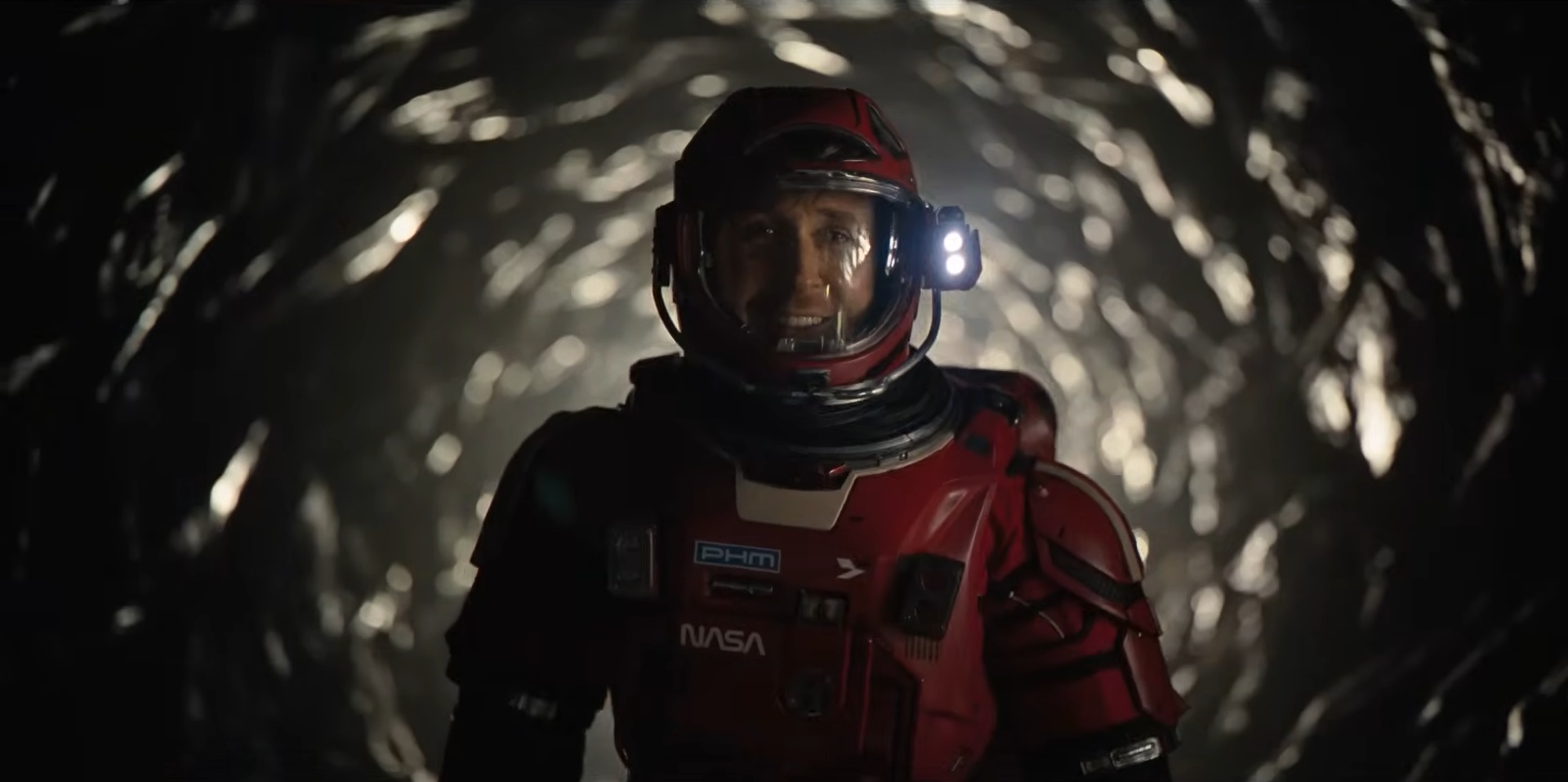
The Gist: Ken #1 himself, Academy Award Nominee Ryan Gosling is middle-school science teacher Ryland Grace, an idealized version of all your favorite teachers who were a lot younger than you realized at the time, and the opposite of those old 1950s grumps who hated having to add a ninth planet and a couple dozen extra elements to their curriculum. Grace wasn’t always cool among young teens: he used to be a biologist who got himself exiled from the adult scientist community for mouthing off to the wrong elder. But the community soon remembers him when it matters most.
Big Science discovers a horde of single-celled organisms, which they dub “astrophage” to demonstrate the usefulness of learning Greco/Latin derivatives for your SATs, have manifested their own migratory infrared freeway between Venus and the sun. Their sustenance at each respective endpoint is the carbon dioxide in Venus’ atmosphere and the sun’s actual star-stuff itself, not just solar energy. The more sun they eat, the cooler it gets. Within a few decades, their insatiable sunshine appetite may spell doom for all life on Earth if we don’t kill each other first.
(The latter prospective competition is never brought up. Any sense of politics is limited to such broadly revolutionary statements as “Science is cool” and “Teamwork makes the dream work.” American schools stopped teaching these morals years ago; hence the current era when, now more than ever, some people need practical advice.)
Alas, Big Science’s finest minds are stumped, leaving them no choice but to turn to their rejects. The only name on the list is Grace, whose quickly dismissed crackpot thesis was tangential to the monocellular matter at hand. One series of unfortunate events later, Grace the jokey non-astronaut finds himself alone in a spaceship million of miles from home and heading toward Tau Ceti, the only star within sci-fi travel-range not infected by the astrophage. Since the United Federation of Planets doesn’t exist yet to do the necessary exploring, it’s up to him to study Tau Ceti really hard, learn its secret anti-astrophage vaccine, transmit his findings back to Earth, and save the day. Regrettably, “make the return trip home” is on his extra-credit to-do list, with a pretty low probability of happening.
One years-long Weyland-Yutani cryosleep later, Grace is on site and in position to start doing science. To his surprise…he’s not alone. Another, even bigger spaceship shows up at Tau Ceti with a single living crew member: a stone-skinned, awkwardly ambulatory space spider (chiefly performed by stage puppeteer James Ortiz) with no eyes, no humanoid face, screeching vocalizations that would make whales’ inner auditory canals bleed, and no handy-dandy Universal Translator. After first contact is made and their ships interlink, the tentative communication process between them is funnier and less bizarre than the language-learning sequence in Arrival, and necessarily leads to an intergalactic team-up. Now two sentient beings have to study Tau Ceti really hard, learn its secret anti-astrophage vaccine, transmit their findings back to their superiors, and save their respective days.
The familiar faces: Sandra Hüller (Anatomy of a Fall, The Zone of Interest) (or Hueller or Huller, for you stray Googlers) is the chief spokesperson for Big Science. Lionel Boyce (Marcus from The Bear!) is Big Science’s lead security guy. Trained astronauts working the problem include Ken Leung (Industry, Lost, X-Men: The Last Stand) and Milana Vayntrub (Other Space, numerous AT&T commercials). Among the other scientists are First Cow costar Orion Lee, Polite Society star Priya Kansara, and Aaron Neil (Paddington 2, Apple’s Down Cemetery Road).
In the scene where Grace tests out text-to-speech voices for Rocky on his laptop, a series of one-line candidates include an Academy Award Winner who frequently agrees to gags like this, and it always works.
The Impressions: Project Hail Mary comes highly pedigreed beyond its novelist creator: directors Phil Lord and Chris Miller were the team behind the first Lego Movie, much of the Spider-Verse, and probably some of the better portions of Solo: A Star Wars Story before they were fired. Screenwriter Drew Goddard, a solid director in his own right (The Cabin in the Woods, Bad Times at the El Royale), received an Oscar nom for adapting The Martian and has a stellar resume that includes Buffy, Daredevil, Cloverfield, and other universes. I knew we were in good hands before frame one rolled, and wasn’t let down.
What could’ve been written as a cutthroat race-to-the-cure between dysfunctional species — a simpler flick with shooting, punching, and only one planet left standing — aims in the opposite direction for a more inspiring tale of diplomacy, collaboration, admiration and informed epiphanies. After Our Heroes get to know each other and Grace nicknames his colleague Rocky, we learn the latter calls their own race Eridian — a familiar name to Borderlands players who prize their energy-based weaponry — but if Rocky has or invents any guns, apparently he keeps them all locked away in case Grace is one of those kinds of aliens. Or maybe, like Grace, he didn’t pack any.
Just like The Martian, there’s no sinister villain to defeat — no leering tyrant who commands a vast astrophage army, no Galactus consuming celestial bodies despite our helpless pleas, and no Vogons demolishing planets to make way for a new hyperspace bypass. Mostly we’re watching two scientists solve tough puzzles, riffing through complicated concepts and complex equations not fully dumbed-down for maximum audience condescension. Only small portions seem to be fanciful Trek technobabble, but not noticeable enough to dispel the verisimilitude of their exchanges. We feel like flies on the wall while two scientists compare notes without worrying about talking at us civilians. There’re wispy climate-change parallels in the big problem, but the threat is externalized so humanity’s sins aren’t to blame. This time we’re all the innocent victims.
I wasn’t enamored of Ryan Gosling’s previous astronaut work in First Man as a taciturn, inscrutable Neil Armstrong who made the historic moon landing seem like a depressing chore. Much as Armstrong means to us today, Grace’s character is tooled more for big-screen crowd-pleasing than for righteous historical pioneering. He’s not the man’s man of yesteryear; in this near-future fable, he’s a product of today. In between astrophage stumpers and occasional equipment malfunctions, more than a little of Hail Mary‘s obstacles are his own shortcomings. Doing the Right Thing isn’t a reflex response for this reluctant “hero” — a role thrust upon him — who hates making hard choices but has to accept that he needs to make hard choices anyway, whether or not they feel comfy.
Gosling only gets to interact with other humans in the pre-mission flashbacks, alternately connecting with kids and disappointing adults who look to him for answers in vain. His intriguing chemistry with Hüller isn’t conventionally romantic — she’s an authority figure who stays on task, but not in a icily matronly way. Hüller reveals only controlled glimmers of a droll sense of humor (revealed in a curiously rueful karaoke scene) because she has to remain serious-minded in the face of Grace’s unserious pushback. She accepts the weight of eight billion humans and countless billions of other Earthbound lifeforms depending on them, but first she has to rehabilitate a presumably capable colleague who’s lost his way. In some other sci-fi film, Grace would be one of those second-tier scientists in the room more for slacker comic-relief than for their input, and who’d be written out or dead before the final reel, while she’d be the one boarding Starship Janeway and venturing unto the final frontier. Here, we’re reminded not all scientists master all the science skill sets. We have to make the best of who we’re given and what they bring.
Barbie and The Fall Guy helped Gosling reclaim the charming side that made him a star in the first place. Easygoing and put-upon, haunted by personal failures yet delighted at new discoveries if you can goad him toward making them, Grace thankfully loosens up and digs in for the long haul, which is a good thing considering long stretches of the film are just him rambling to himself, or to his new space neighbor. Surprisingly, Rocky the flying silicate and their surrounding ship interiors are old-fashioned feats of practical wizardry and amazing puppetry rather than relying entirely on CGI and green-screening. The effects and the performances play off each other so well that viewers of a certain softness like myself might get a bit misty-eyed at the climax when Gosling and the puppet are endangered.
Meanwhile beyond their ships’ hulls, outer space looks beautifully captivating and deadly, as it should in any story where space is more than a selfie backdrop. (Paying extra for a Dolby Cinema upcharge doesn’t hurt.) Once upon a time, space was someplace we looked to for inspiration and aspiration. In a time when violent warfare is humankind’s baseline interaction — whether between multiple countries or between any two people — Project Hail Mary is the kind of throwback that feels welcome with its objectives of hope and cooperation, and a timely reminder that not every problem we have boils down to Us v. Them. If we can’t figure that out together as a singular species, maybe all that sunlight is wasted on us anyway.
The end credits? No, there’s no scene after the Project Hail Mary end credits, but at the very very end, fans of mission patches — those cool fabric patches that astronauts have sewn into their jumpsuits to commemorate their flights and team projects — might be amused at the sight of multiple production-company logos turned into mission patches, including the iconic MGM lion. My wife used to collect patches, and one of those would’ve been an awesome addition to her backpack.
Discover more from Midlife Crisis Crossover!
Subscribe to get the latest posts sent to your email.

