
New | Continue | Load | Save | Options | Extras
Previously on Midlife Crisis Crossover: Oscar Quest ’25 continues! Once again we see how many among the latest wave of Academy Award nominees I can catch before the big ABC ceremony. Every year it’s a lively ballroom dance between new voices and For Your Oscar Consideration familiarity. Sometimes it’s two for the price of one.
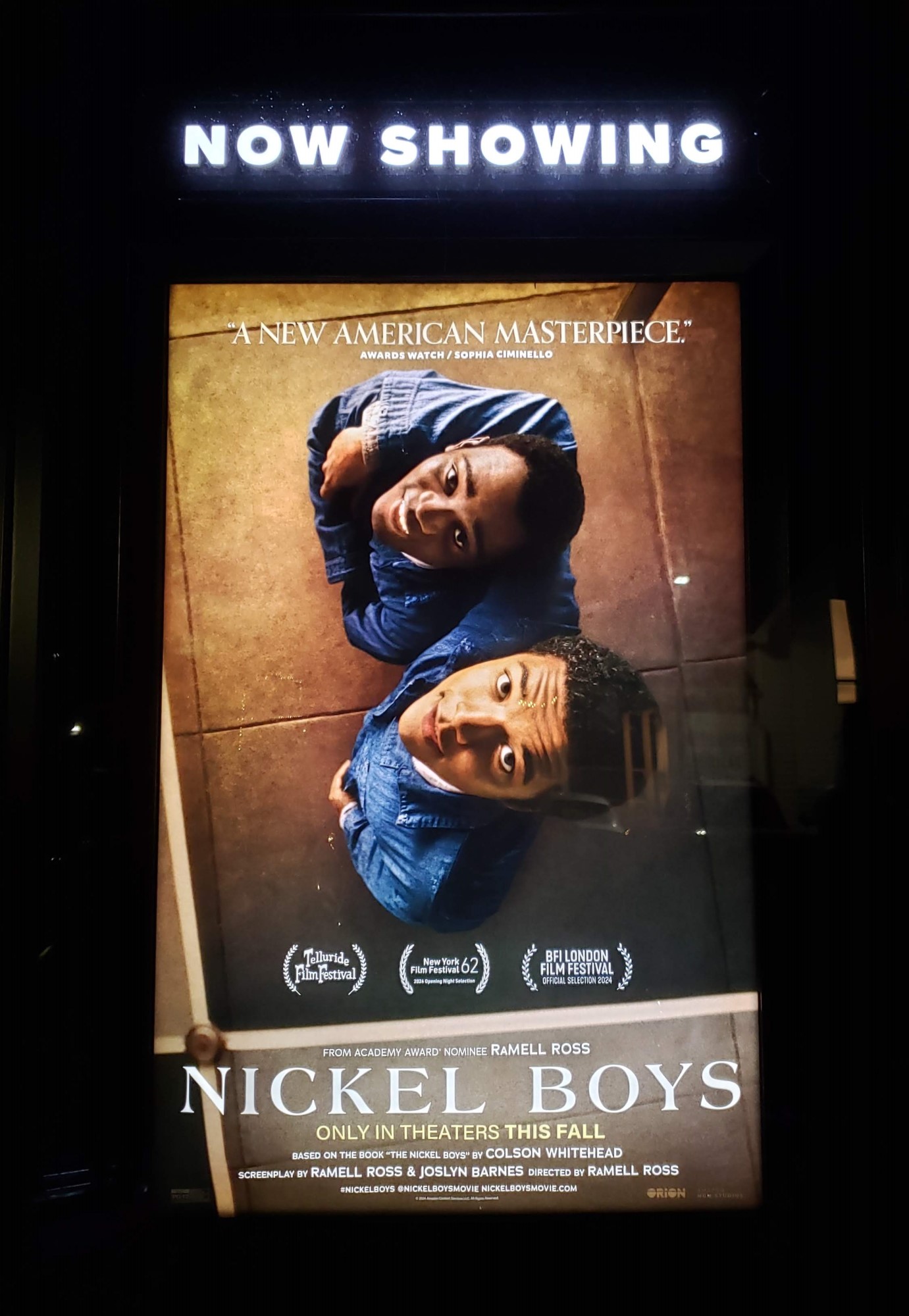
Academy Award Winner RaMell Ross won that honorific with the live-action short film Hale County This Morning, This Evening back in 2019. This year the director scored another shot at the trophies with his first full-length feature, Nickel Boys — a period-piece drama about a subject familiar to longtime Oscar fans, not to mention historians and other decent folks still working and/or waiting for social sciences to discover the cure for American racism. To differentiate the film from past exemplars, Ross conducts an extended experiment with the narrative vantage approach that’s seemed revolutionary to scores of film critics whose only pastime is movies.
Based on the Colson Whitehead novel The Nickel Boys (they dropped the “the”; it’s cleaner), the film follows a pair of Black teens in the 1960s Deep South, where things go exactly as well as one expects. Ethan Herrisse (When They See Us) is Elwood, a well-read student whose promise hasn’t gone unnoticed by goodly people, including his loving grandma played by the indefatigable Aunjanue Ellis-Taylor (King Richard, The Color Purple, et al.). An opportunity that might lead toward a bright future is yanked away like a Lucy Van Pelt football when a wrong place/wrong time incident lands him in Nickel Academy, a segregated reform school. The white juvie offenders bunk in a plantation-style mansion and get trained in racist middle-management, while the Blacks are run out to a sort of shanty town and schooled using a sub-Walnut Grove curriculum. (Their first half-Mexican inmate poses quite the sorting stumper.)
The “student” body have already acclimatized to quasi-prison life, alternately bullying and dismissive. One kinder soul is a bit more welcoming. Brandon Wilson (The Way Back) is Turner, whose street-smarts offset Elwood’s book-smarts. Friendship comes quickly, with bouts of nurtured optimism versus inured pessimism, the merit of planning to make changes versus helplessly enduring the institutional oppression, and so on. Herisse’s eyes reflect a more deliberate, introspective approach, which makes Elwood slower to act, and thus the easier prey to their scapegoating bunkmates as well as to the white toadies. Wilson, the somewhat slicker of the two, balances their pairing with a rueful smile and a willingness to share some hope with his new friend, but not all the hope.
The duo’s chemistry forms a solid core for the tale, but they aren’t the center of our attention per se. Ross and his co-adapter, Hale County collaborator Joslyn Barnes, designed the entire film to be shot and experienced in first-person perspective. Every scene, every moment, every abuse, every feeling is filtered through the eyes of either Elwood or Turner. The intent is logical enough — to create and foster empathy by inviting us to walk a mile in their shoes and witness the events and the world through them. More than a few critics have absolutely adored this approach and hailed it as a revolutionary new form of filmmaking. Some apparently forgot or willfully ignored all the precedents — 1947’s Lady in the Lake, the M*A*S*H episode “Point of View”, Doom, Hardcore Henry, or, most voluminously, the entire multi-billion-dollar industry of FPS video games going back to Wolfenstein and its obscure predecessors. This all has, in fact, been done before. Not always done well, but still.
Ross’s approach is more nuanced than many as Our Heroes take turns steering (so, co-op play, then) through this harsh environment. (Although as racist institutions go, Nickel Academy seems pretty low-key and not exactly Southern Full Metal Jacket, until we learn more about the Deep Dark Secret out back.) At times he captures glimpses of wooded natural beauty in the periphery with faintest Terrence Malick echoes. Pop culture emerges for context and parallels — news updates about Apollo 8 (science marches on even while the South stays regressed), a reading of Stan Lee and John Buscema’s Silver Surfer (a superhero imprisoned far from his home and loved ones), multiple screenings of The Defiant Ones, including two entire scenes for prison-escape patterning. (My wife and I just watched it a couple weeks prior, which felt like an amazing coincidence till I remembered we saw it on Prime Video, proprietors of the MGM/UA catalog and Nickel Boys‘ distributor. Homages are easy when the tribute and the honoree are in the same corporate pocket.)
But that uncommon design becomes our focus. I’m observing how that affects the framing of what each guy chooses to look at, how Steadicam calm compares to frantic handheld shaky-cam, and so on. I began counting how many times we spot the POV character’s reflection in assorted objects, and found four in the first half-hour before I let it go. Some scenes lose clarity whenever they don’t know what’s happening around them (intentionally muddying their interpretation, I guess?). One sequence involving corporal punishment and machinery noise might or might not cross the line into torture, but it’s impossible to tell because they can’t bear to look, which means we can’t look. We’re supposed to feel their fear, but I’m too puzzled by such bits of Blair Witchery — too preoccupied with evaluating the gimmick.
This shot is from an actual scene, and not even among the first four moments with trick reflections in them.
We’re afforded a broader scope later on, in a series of flash-forward interludes that reveal more details that were unknowable within the teenage memories of one character buckling under the weight of past trauma and driven to search for closure and maybe even justice. But then the camera retreats from first- to third-person, fixed firmly and immovably behind the back of their head and shoulders. I’m reminded of one of my son’s favorite game series, Ratchet and Clank, and thinking that, had the game been shown entirely through Clank’s perspective on Ratchet’s back, we players would’ve gotten killed a lot by forces unseen, and would have missed out on the artistic excellence around us, unless we spent the game spinning around in circles instead of defending ourselves.
Again, I note the empathy angle, especially as a fan of empathy, but I lament the experimental distraction and why this was the story that deserved to be its guinea pig. I can’t believe this implies a lack of confidence in Whitehead’s work or in the film’s own actors. To a minuscule extent it prohibits an easy slide into violent poverty-porn. But honestly: were they worried that without the gimmick, the film might’ve been merely a pedestrian Afterschool Special? It would’ve been great to see our two leads interacting onscreen physically at the same time rather than simply shooting one-sided coverage for each other’s halves, but what we do feel of Herrisse’s and Wilson’s performances assures us their buddy-duo could’ve handled that challenge. As it stands…well, if nothing else, now we know which film critics aren’t double-proficiency gamers.
…
Meanwhile in the customary MCC film breakdowns:
Hey, look, it’s that one actor!: Hamilton‘s Daveed Diggs enters partway with significance. Reform school racists include Hamish Linklater (Legion, The Big Short) as an instructor and Fred Hechinger (Kraven the Hunter, Gladiator II) as a crew chief
Jimmie Fails (The Last Black Man in San Francisco) is Elwood’s inspirational teacher before his world got flipped, turned upside down. Fortunately Elwood finds that source of encouragement before lockup so it could provide an invaluable guiding light later and for the rest of his life.
How about those end credits? No, there’s no scene after the Nickel Boys end credits, which confirm a handful of VFX artists were involved in pulling off the FPS conceit. So now I’m unsure which mirror images were nifty camera trickery and which were Photoshopped into those scenes.
Discover more from Midlife Crisis Crossover!
Subscribe to get the latest posts sent to your email.
 Midlife Crisis Crossover!
I read the book a few years ago, but didn’t realize until very recently that a movie was being made off it. I missed it in the theatre, so I now wait for the DVD…
LikeLike
I’d bet the book’s better, though I haven’t read it. A comparison of the two might be interesting…
LikeLiked by 1 person