 As with most big-budget sci-fi films nowadays, many viewers will spend half the running time of the new Tom Cruise vehicle Oblivion mentally tallying how many refurbished components they recognize from other sci-fi flicks. That doesn’t automatically make the film bad in my book, but it can be a pervasive distraction that turns my viewing experience into one long Highlights for Children puzzle. (Score one point for every borrowed element you spot! If you spot ten or more, you’re a Certified Movie Maven!) Oblivion is the second feature film from Joseph Kosinski, the director of Tron: Legacy, which was a visual wonderland and a surprisingly classy act considering it was a Disney sequel to a film I’ve disliked since I was ten.
In a future when humanity deserted Earth after an alien attack laid waste to most of the surface and left sizable chunks of the Moon floating in orbit, Tom Cruise is our hero Jack Harper — not to be confused with Jack Reacher — a maintenance worker designated Tech 49, who repairs and monitors the spheroidal surveillance drones that comb the world’s husk for signs of evil while guarding the gigantic engines that work 24/7 at vacuuming the remaining contents of all the oceans and converting them for use elsewhere. Basically he’s Wall-E with guns, vehicles, and the same affinity for obsolete Earth culture, though his memory’s been wiped for work-related purposes (never an innocuous, meaningless character trait). Back at home base, his teammate/lover Victoria (British stage actress Andrea Riseborough) keeps tabs on his progress and reports back to human command, represented via low-res monitor by a supervisor named Sally (The Fighter‘s Melissa Leo), who sticks to a strict script and has a Southern accent, which in common Hollywood shorthand means she’s either lowbrow or evil.
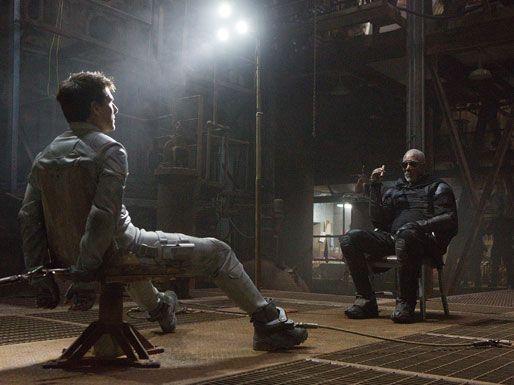
Jack spends his work day riding over or across the same post-apocalyptic wasteland we’ve seen elsewhere, decorated as usual with remnants of New York City landmarks (the Empire State Building and the New York Public Library play prominent roles). His work day is turned upside down when his encounters with so-called “Scavs” — the purported destroyers of the world — result in startling discoveries, hint that Everything He Knows Is Wrong, and bring him face to face with Academy Award Winner Morgan Freeman as the mysterious leader of a mysterious band of mystery men whose very existence implies even more mystery. His only aide with lines is Nikolaj Coster-Waldau (Game of Thrones), whose attitude is straight out of the “He’s useless! Let me kill him!” annoying-henchman school. Even more mysterious: Jack’s recurring dreams of a woman (Olga Kurylenko from Quantum of Solace) that he no longer remembers, can’t get out of his mind, and doesn’t notice is fairly anachronistic in context of the timeline given to us (and, of course, dreams in movies are never innocuous or meaningless).
Amidst a dazzling display of future-tech designs and a few dizzying aerial chase sequences, Jack strives to extract more clues and explanations from characters who can’t speak in straightforward answers — for once, not because they’re being coy, but because almost no one in the movie holds all the answers. The game is frustrating to watch at first, leaving you to try solving it by second-guessing which movies they’re actually borrowing and thereby nailing the solution. I’ve seen other reviewers draw comparisons to the likes of The Matrix, Total Recall, Blade Runner, and 2001: a Space Odyssey, three of which are ultimately incorrect, and the fourth is reaching. When we finally discern the one true menace behind it all, the answer is straight out of comics, except said menace has zero charisma and virtually no screen presence. The movie’s biggest surprise, which the trailers remarkably dodged altogether, reminded me of a wildly underrated 2009 film I’m hesitant to name-check here for fear of spoiling too much. (Its name is buried somewhere in this entry, for value-added unhelpful fun. If you spot it, you’re a Fantastic Film Fanatic!) Suffice it to say, one can only cobble together so many sci-fi tropes into a single film, even if an aspect of one of them is misused in a spoiler-y way that makes no sense at all.
Cruise is once again dependable and frequently uplifting as a hero willing to do the right thing no matter the cost. The other characters are necessarily limited in their opportunities to shine because, if they could do, know, or say any more than they’re allowed, the film would end an hour early. Not even Freeman has much of a chance to stand out — his part is limited to shadowy lurking, foul cigars, and expository speeches that would be dull if they weren’t coming from a pro narrator. Cruise’s best costars are the gadgets and items that comprise his universe — his exotic spacecraft; his fancy motorcycle Of The Future; the nimble killer drones; the Scavs’ Tusken-Raider-in-Black gear; and other surprises that populate the film’s final half-hour.
In general, if you avoid raising your expectations to instant-lifelong-ciassic level, Oblivion works well as a sleek, eye-catching glide that at its very core is the kind of simple us-vs.-them conflict that doesn’t normally require this much unraveling. If you’re patient enough to wait and forgiving enough to overlook any similarities to other movies living or dead, Oblivion may be this spring’s best bet for light viewing.
* * * * *
Postscript: Oblivion is ostensibly based on a graphic novel whose creation Kosinski oversaw for Radical Entertainment, but was written by Rex Mundi creator Arvid Nelson and illustrated by Swedish digital painter Andrée Wallin, who would later be responsible for the official movie poster as well. Radical is one of a few known companies who use the comics medium not with the intent to become a bestselling publisher, but as an intellectual-property generator for movie productions that can later append their credits with “Based on the Graphic Novel” as if this adds a cachet of geek cred that will somehow translate into extra ticket sales. As of this writing the Oblivion graphic novel has yet to be published, not even meriting so much as a “Coming Soon” listing on Amazon. The company’s official site swears it’s coming sometime in 2012, and misspells the writer’s name as “Arvin”. All things considered, I’m not convinced it’s earned the privilege of the “Based on the Graphic Novel” tag.
Post-Postscript: for the MCC record, there’s no scene after the end credits, though I did notice three things:
* Of all the movies ever not filmed in a Scandinavian country, this one had more crew members with last names ending in “-sson” than all the rest in history, combined.
* Comics fans may recognize three of the four credited storyboard artists — Richard Bennett (Brass), Phill Norwood (Alien vs. Predator), and Stephen Platt (Prophet, Moon Knight). I’d like to think their contributions helped the action sequences work as well as they did.
* The aforementioned Arvid Nelson receives a courtesy fine-print credit partway through. It’s tiny and easy to overlook…but at least it’s spelled correctly.
Discover more from Midlife Crisis Crossover!
Subscribe to get the latest posts sent to your email.


Pingback: Ah, Oblivion | Stars in Her Eye