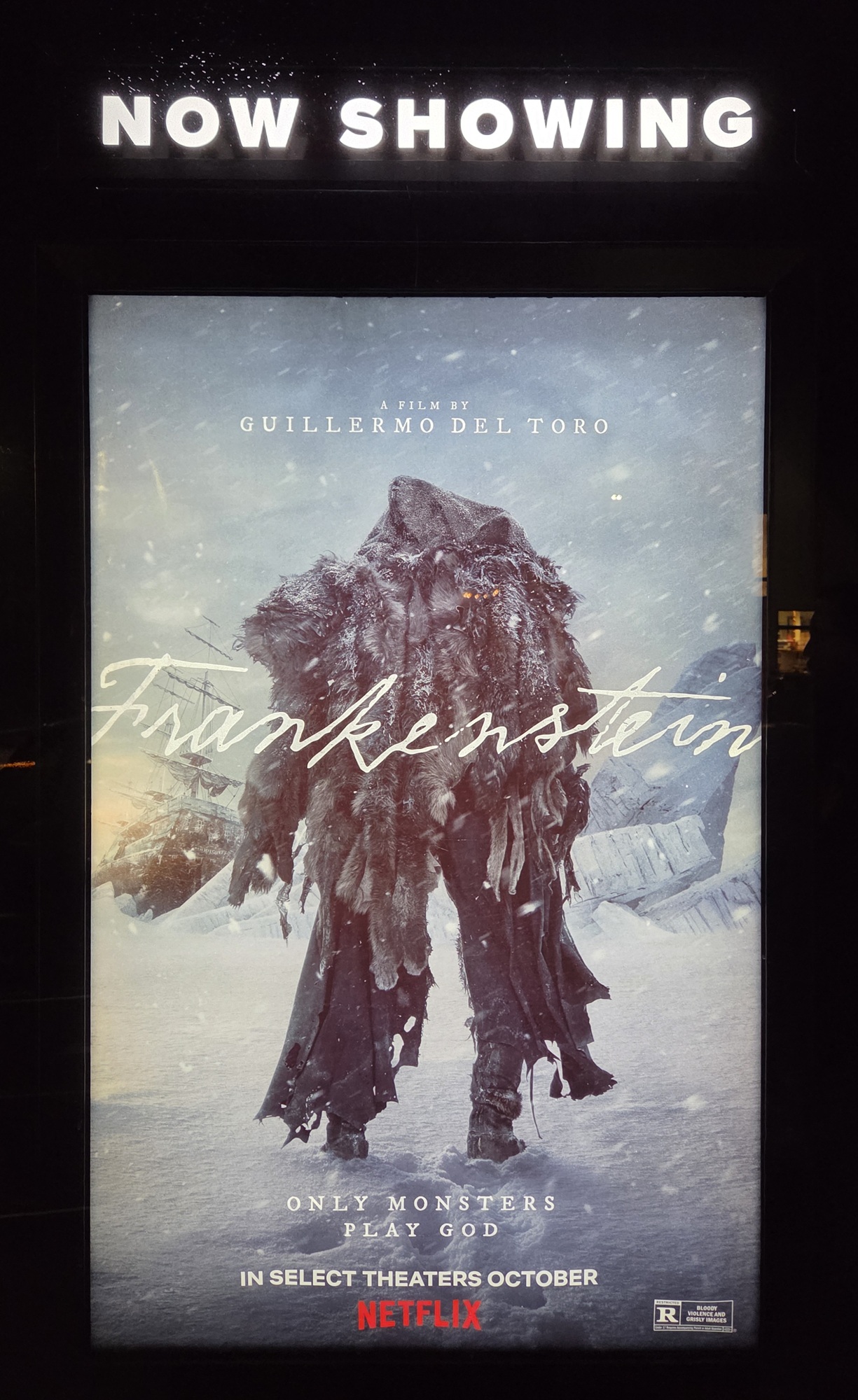
Now showing at a theater near few!
Midlife Crisis Crossover Calls Guillermo del Toro’s Frankenstein One of the Year’s Best Films™!
Once again the Academy Award Winner has collaborated with Netflix after the previous successes of his animated version of Pinocchio, his Cabinet of Curiosities anthology miniseries, and the Trollhunters stuff I never looked into. Frankenstein was clearly one of the highest ranking dream projects on his wish list, fulfilled at last with a noticeably enormous budget, a stellar cast, his most lavish production design ever, and a too-brief theatrical exhibition before the November 7th relegation to its forever-home in the app’s small-screen back-catalog cellar.
Sure, streaming convenience is nice and our family TV is amply wide, but considering how the trailers stoked my already optimistic expectations, its destiny seemed so unfair that I broke my personal moratorium and made it the first Netflix film I’ve ever gone out of my way to see in a theater. Regular MCC readers are well aware I do get out to the movies fairly often despite our numerous home-video subscriptions, but having grown up in an era when a film released “direct-to-video” was code for “C-minus at best“, I’ve struggled to wrap my head around how that’s now a standard pipeline for many films — some of then possibly good! — that never get the chance to earn millions so fans of all classes can view them optimally super-sized, not just self-spoiled owners of wall-sized screens who half-watch during their overdressed cocktail binges.
Netflix has begrudgingly allowed a few select offerings into theaters over the past few years as they’ve gotten enamored of this whole “Oscars” prestige fad and how those statuettes look spiffier on their office shelves than Emmys. Their limited releases haven’t done me much good — most of our nearest theaters are large chains that refuse to screen Netflix works due to the latter’s insistence on extremely short big-screen runs, as opposed to the traditional method of showing films for as many weeks as they want. Paying extra to see a potentially just-okay film writ large — including gas money for journeys to our smaller art-houses on the other sides of town — is a bit of a gamble when I can wait two mere weeks to confirm if it’s above-okay and save money in this economy.
Would it make a difference for all Netflix Originals? I’m annoyed we were never given the option for Gareth Evans’ Havoc, though the parts between the bone-crushing fight sequences are threadbare ligaments. But would I have paid closer attention to Roma if I’d seen it away from home? Would bigger speakers and a plush recliner have made Rebel Moon watchable? (Okay, we can guess the answer to that last one.) And this isn’t just a Netflix problem: the machinations behind Fox sending Prey straight to Hulu remain an irritating letdown.
I’m thrilled to report Frankenstein was worth the gamble and the mileage. And I’m hardly an unconditional del Toro cheerleader. His Hellboy films were just-okay comics adventures centered on a cool yet charmlessly pulpy hero, the Nightmare Alley remake sieved out all the noir subtleties from the original, and let’s not get into my vastly outnumbered shrugging at The Shape of Water. Rather, give me the tragedies of Cronos and Pan’s Labyrinth, the giddy dexterity of the best Blade movie, the shamelessly toyetic glee of Pacific Rim, and the candid Mimic commentary in which he talked to us DVD collectors about his first head-on collision with Hollywood execs.
Now I cheerfully add Frankenstein to the latter thumbs-up list, bolstered all the more by The Magic of Cinema when consumed in full-size dosage. Because:
1. The killer majesty of the Arctic Circle expedition. Channeling the essence of Mary Shelley while injecting a few of his own ideas, our writer/director keeps the novel’s framing structure but cleverly inverts the in media res chase that opens the story. Pursuer and quarry trudge through “The Farthermost North” toward a massive sailing ship trapped in an endless gauntlet of ice. There our mad scientist Victor Frankenstein (Oscar Isaac) finds refuge and a welcoming host in its captain (Lars Mikkelsen, freed of his Ahsoka skin paint) who’ll listen to this unreliable narrator’s lengthy flashbacks. Every inch of the ship from bow to stern fills the big screen and begs the question of whether del Toro had it lovingly built from the ground up by hundreds of artisanal shipwrights just because he and they could. And the surrounding polar scenery is a prison of daunting proportions.
2. The panoramas in general. The Arctic Circle isn’t the only wide expanse you can peer into for miles and miles. Anytime the characters venture outside, nature is the true star through the lenses of cinematographer Dan Laustsen. Every horizon is an unsettling prism. The Stygian wildernesses of 19th-century Europe are strewn with the battlefield remnants of the Crimean War and harbor predators in every shadowy corner. Portentous thunderstorms bring God’s wrath and, right on schedule, The Monster’s seemingly unholy lifeforce. Such vistas shouldn’t be reduced to desktop wallpaper.
3. Castle Frankenstein. It’s never called that, but we know what we’re seeing. A tower beyond any possible skyscraper of the time, it’s impossible on the outside and even bigger on the inside. The doctor’s project demands a new pad with more square mileage, its awe-striking architecture defies physics and dares Frank Lloyd Wright to gaze upon it without running away screaming. Every chamber is large enough to host a comic-con and its interior decor feels plundered from thousands of haunted-mansion estate sales and painstakingly curated for maximum discomfort. This scientific workspace is no comforting home; it’s a veritable mouth of madness built to devour the Titans of myth.
4. For Your Oscar Consideration for Best Visual Effects! Obviously! LIGHTNING! FIRE! EXPLOSIONS! WOLF FIGHTS! SUPER-STRENGTH FACE-PUNCHING! Fans of practical prosthetics and sculptures will smile through their nausea at Victor’s realistically disgusting montage of cadaver disassembly and reassembly! It’s the part of Frankenstein’s story del Toro was born to maximize! The bloodshed is nasty and jarring per his reliable wont, but it feels less egregious and closer to essential, given the whole “monster” thing. (One exception: a brief wolves-vs.-sheep cartoon is like a jarring throwback to the 2000s.)
5. Bigger screen means louder sound! Maybe this goes without saying because you can crank up your speakers till your windows shatter and the neighborhood kids crawl in and loot your kitchen. I, on the other hand, have to share this suburban Midwest hovel with two relatives whose hearing is better than mine, who aren’t always watching what I’m watching, and don’t appreciate it whenever I crank the volume to Spinal Tap levels. Even if I spend our next tax check on a floor-to-ceiling TV, buying bigger speakers would be a waste of time if I can’t actually use them. Hence, cinema: my favorite source of noise, noise, NOISE!
6. Mia Goth’s dresses. I’ve only seen the scream queen in 2020’s Emma, though I doubt her other roles have much resembled the conflicted Elizabeth, Victor’s sister-in-law-to-be. She’s trapped in a sort of love square between three men. She enjoys chatting about science with Victor, the rare man who can keep up with her intellectually. She’s enraptured by The Monster’s fragile mental condition and simpleton gestures of kindness. But she’s stuck because Victor’s brother William (Felix Kammerer, star of the recent All Quiet on the Western Front) called dibs on her first — never mind that he has all the charisma and backbone of a napkin soaked in milk. Navigating the corridors of repressed Gothic romance, she bounces from one male to the other in the most outlandish dresses as if they’re her version of security blankets, crafted in colors and patterns that, if synchronized with her surrounding correctly, might summon Lovecraftian fiends from beyond. And I’m not usually one to think much about dress designs, not even when I sat through the entirety of Downton Abbey.
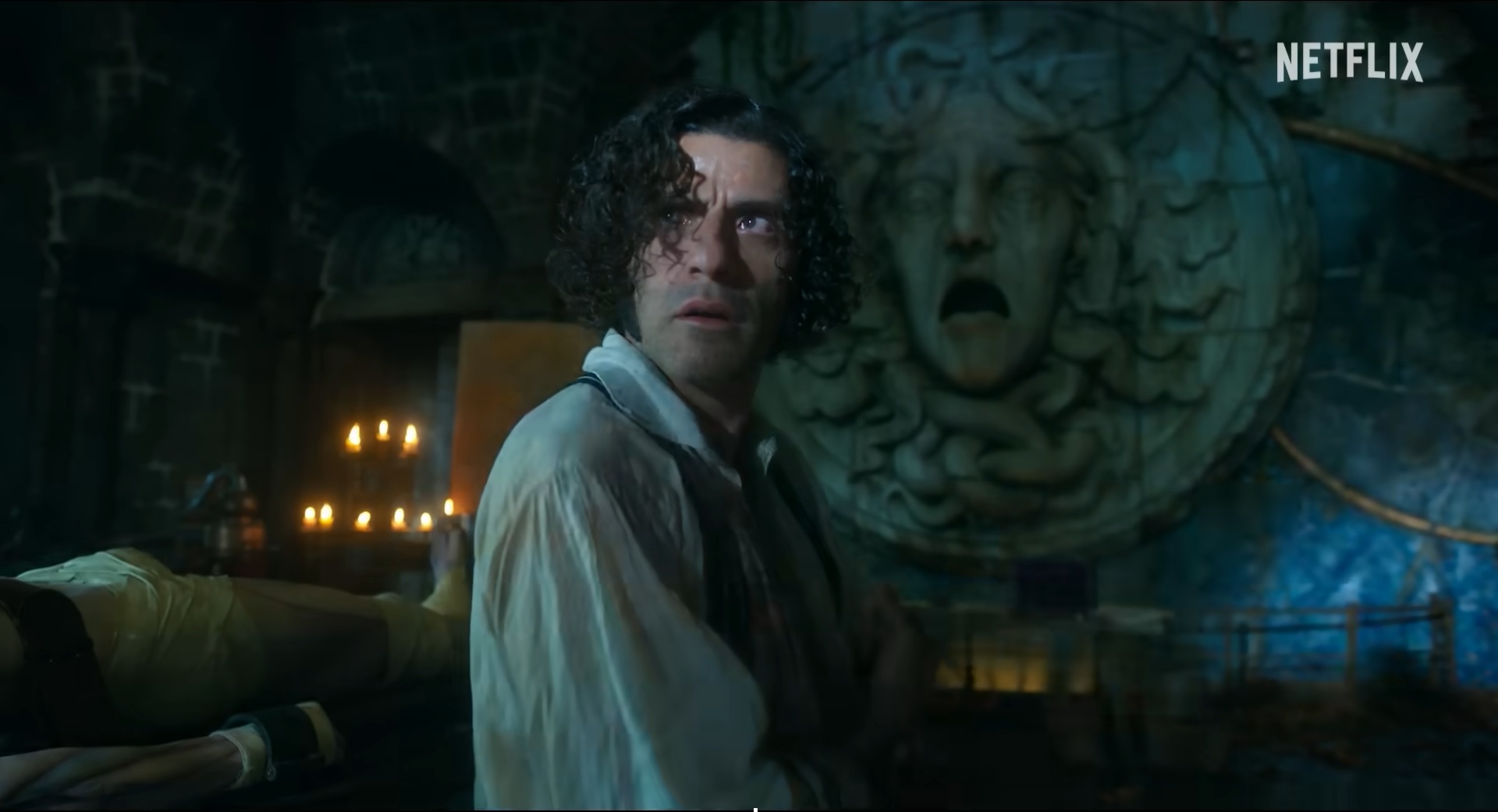
“Somehow Frankenstein returned!”
7. ALL the grandiose feels. More so than in some of his other films, del Toro lends more weight to the emotional journeys in between all the phantasmagoria. Isaac’s rendition of Victor’s psychological free-fall is less aggro-hysterical than the average Frankenstein, pausing for longer breaths as he passes the signposts downward from lifelong preoccupation into full-bore madness, borne of frustration with the living miracle that hasn’t met his ever-changing expectations. At first we’re rooting for the successful creator, only to withdraw our cheers as he begins recycling the forms of abuse he learned from his own father (Charles Dance, whom I last saw in The Sandman).
Before long he’s perpetrating straight-up villainy on the true star we all came to see — avatar of the ultimate othered outsider in all of us, misunderstood by crowds and feared by tinier creatures until they get to know him…
8. Our Hero, The Monster. Jacob Elordi (Euphoria, Saltburn) is a radical change of pace from the lumbering, mesa-faced juggernauts of Frankensteins past. At a natural six-foot-five without elevator shoes, Elordi’s crazy-quilt specimen is lanky, limber, ghostly pallid in his slave-like rags, and at first stunted in the art of conversation. To his advantage is a new twist: this version has Wolverine’s regenerative powers, so he seemingly can’t be killed. (The opening scene shows him plowing through several sailors bearing torches, so “FIRE BAD!” isn’t a thing here.)
Elordi wrings every nuance out of his Groot-ish vocabulary until a midpoint narrative shift yields control to The Monster, revealing his gradual evolution into an eloquent tatterdemalion who learns and feels more deeply as he outgrows his creator and meets other role models with far more patience and sanity. Away from captivity, he has the space to contemplate deeper questions of his unique existence: whether or not he has a soul, if he can experience sensations besides pain, how easily he succumbs to man’s propensity for violence, and — given that he may never know the most human act of dying — how he might fathom the potential curse of immortality that denies him an afterlife, doomed to receive “neither punishment nor absolution” forevermore for the things he’s done. He emerges a survivor in the Byronic romanticism tradition. (The poet himself is even quoted later.) By the end I was in tears.
9. Bragging rights for seeing it in the theater before it was online. Who doesn’t love those?
…
Why only nine? Because ten would be gratuitous. If del Toro can resist gratuitous for once, so can I. Frankenstein is my new favorite film of his and one of the best films of the year. And now I can watch it again for free, technically!
…
Meanwhile in the customary MCC film breakdowns:
Hey, look, it’s that one actor!: Academy Award Winner Christoph Waltz (Inglourious Basterds) is the intrigued benefactor who bankrolls Victor’s unorthodox experiments after his colleagues kick him out of their society, as well as providing him with the de facto Castle Frankenstein. He’s a pretty impressed patron until he also has to double as the voice of reason.
David Bradley (Game of Thrones, Harry Potter) is the blind hermit from Bride of Frankenstein and Young Frankenstein. Christian Convery (Sweet Tooth, Invincible) is convincing in flashbacks-within-flashback as Young Victor. Ralph Ineson (Marvel’s Galactus himself!) is a peer presiding over Victor’s expulsion trial on charges of Tampering in God’s Domain. Pacific Rim‘s Burn Gorman is an executioner who pre-sells cadavers to Victor before they’re hanged.
How about those end credits? No, there’s no scene after the Frankenstein end credits, though they do include such original job titles as “Balaclava Trainer”. The Special Thanks section includes Mr. & Mrs. Steven Spielberg, Bill Hader, and — per del Toro’s tradition — his old pals Alfonso Cuarón and Alejandro González Iñárritu. Comics fans will appreciate the acknowledgment that this version of the Monster is based in part on the late Bernie Wrightson’s renowned version, and note the film’s concept artist is former comics artist Guy Davis.
Also, if you see it at the theater, the extra 2-3 minutes of Netflix’s customary foreign-language credits are not tacked on at the very end.
Discover more from Midlife Crisis Crossover!
Subscribe to get the latest posts sent to your email.
 Midlife Crisis Crossover!