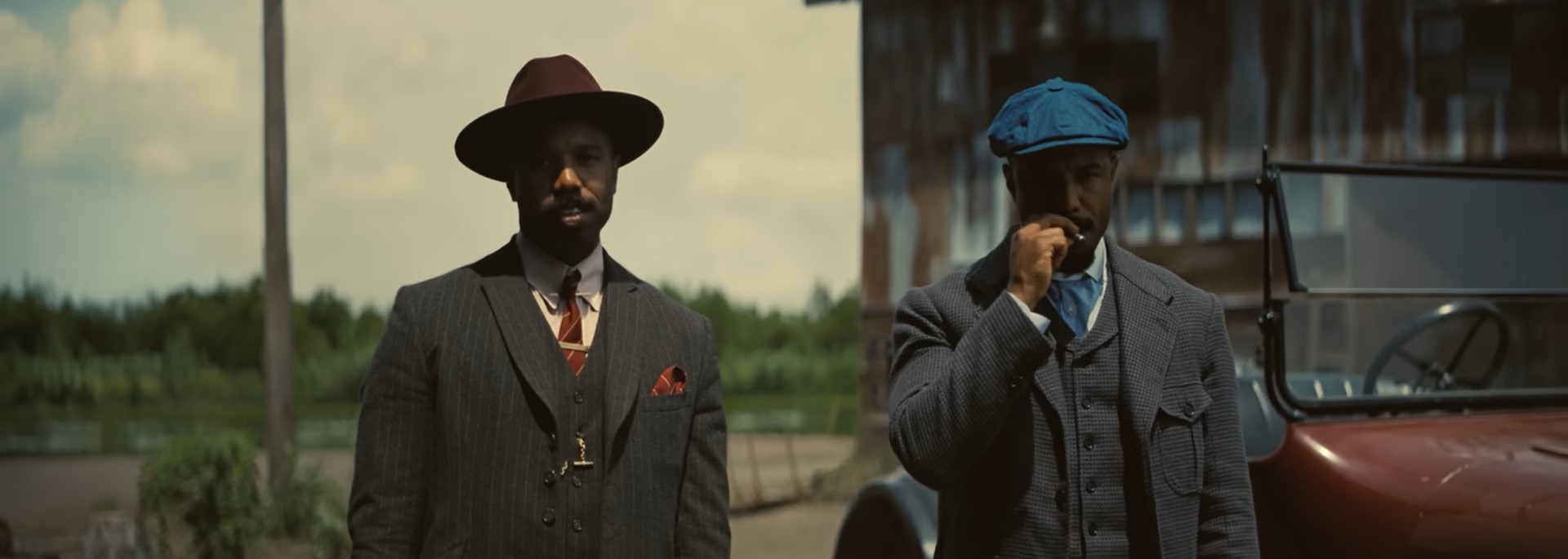
Thankfully it’s easy to tell which one’s Raphael and which one’s Leonardo.
Previously on Midlife Crisis Crossover: Ryan Coogler rules! The writer/director/producer’s film career began a year after I launched this blog in 2012. I’ve seen them all in theaters and written about them along the way. His devastating indie debut Fruitvale Station was my favorite film that year (back when Coogler was still on Twitter and tossed me a Like for my efforts!). The legacy sequel Creed thoroughly wrecked me at the end. The Academy Award-Winning Black Panther is still one of the MCU’s best entries despite some janky CG in the underground-railroad climax. Its sequel Wakanda Forever is — microscopically splitting hairs — his least-best to date despite that powerful prologue, a worldwide wake for the late Chadwick Boseman. It’s still streets ahead of most Marvel films that followed in its shadow, but it buckled under the weight of the company’s self-perpetuating marketing plans.
With only four films grossing almost a combined $2.5 billion in international box office (well, now he’s passed that mark), the auteur stepped back from work-for-hire and threw some earned clout toward a project of his own, the very first to feature characters of his own creation without shouldering any inherited IP mantles. With that creative control Coogler scores another win in Sinners, once again collaborating with actor Michael B. Jordan, who’s been in all his films to date (erm, light Wakanda Forever spoilers, sorry) and who’s one of this blog’s frequent excuses to name-check The Wire whenever gratuitously possible. (We will never forget Wallace. NEVER.) It defies easy pigeonholing as a vampire survival-horror period-piece musical that demands a 21st-century Black Cinema Renaissance rise up and keep up with him. For anyone who thought the Panther films were still a liiittle bit white at heart, Sinners is here for you.
Coogler’s self-dared technical challenges begin with its lead. What could give a film bigger star power than Jordan? The answer is, of course, two Jordans. He plays the brothers Smoke and Stack, both of them veterans who spent years after the Great War doing “business” up in Chicago, in suits and hats that practically advertise how much cash and booze they got out of Capone’s turf. Sinners picks up in 1932 with a proud return to their hometown of Clarksville, Mississippi, where they aim to pour those resources into opening a juke joint that might or might not count as giving back to The Community. An early proof-of-concept scene with the Jordans passing a cigarette back and forth impressively persuades nitpickers to settle in, roll with the concept, and stop trying to discern which shots relied on VFX versus the more practical ones using body doubles. Stop playing Cinema Sins “gotcha” and enjoy two charismatic Jordan performances for the price of one.
Coogler allows a good hour or so for a scenic tour of Clarksville with the brothers and the folks they used to know — a lengthy Main Street stretch, a tiny Black church, a selection of homesteads, the former mill they’re renovating into their new club, and so on. Some residents are more welcoming than others, though at least one obvious KKK leader checks his loathing for a quick buck and a short minute. Wunmi Mosaku (Loki‘s Hunter B-15 and a onetime Luther partner) is Smoke’s old flame Annie, who isn’t happy he left her behind all those years. Fellow MCU alumna Hailee Steinfeld (Hawkeye! Spider-Verse!) is an old flame named Mary that Stack did not want to see again, but Clarksville isn’t that big. Along the way they recruit musicians for their house band, most crucially a preacher’s son named Sammie (reality-TV standout Miles Caton) who’s become a soul-stirring blues-guitar phenom despite his father’s objections. He’s basically, unsubtly the legendary Robert Johnson in all but name and cause of death. (Caton is about the same age today that Johnson was circa ’32.)
Opening night is a big hit, but unfortunately for Smoke ‘n’ Stack and America in general, the Depression is in full swing and wooden nickels are still in use, among other forms of placeholder currency in Jim Crow’s heyday. What’s good enough amongst each other isn’t worth so much beyond their boundaries, to the chagrin of our big-city expats. Somehow the wealthy antiheroes thought giving back to The Community would turn a bigger profit. Coogler could’ve devoted the entire film to the prodigal mobsters and the economic gulf at their homecoming party, but maybe that didn’t feel quite complicated enough.
Before we get too attached to the historical drama, here come party-crashers! A a trio of white musicians shows up at the front door, led by a poor Irishman named Remmick (Jack O’Connell from the UK’s Skins and the upcoming 28 Years Later). They’d love to set aside the potential oil-and-water minority mixture (the Irish weren’t much loving the early 20th century in America, either) and come perform happy bluegrass jigs at the Smoke-Stack shindig. But rather than barge in, they keep asking to be invited in — not because they’re humble or outnumbered. They’re vampires!
Buffy/Angel fans know the score: unless they’re verbally invited inside (or unless they exploit the loophole Colin Farrell used in the Fright Night remake), they’re magically barred from going inside and massacring all the patrons. So they hang around the parking lot and just wait. Everyone can’t stay in there forever. The longer the night goes on, the bigger and louder their hootenanny grows. The vampires and their newly turned Black comrades Riverdance in high spirits and harmonize in new octaves of whiteness. Sensitive viewers may develop such an intense fear of jigs that they can no longer rewatch Titanic without breaking out in hives.
And so goes the intense culture clash, the threat of assimilation, and the heartbreak of watching loved ones betray their roots. Even if this were a straightforward vampire film — on top of the mere historical drama, mind you — Coogler knows how to ace that part. Blockbuster filmmaking let him hone his action chops to an impeccable level, even with one-third the budget here. Away from the overlit superhero realms he relishes the chance to cloak it all in darkness and bloodshed, serving up more shocking surprises than merely who all dies in what order. By that point he’s also gotten us enamored enough of his ensemble that it’s really aggravating when we start losing them to Bonnie Prince Bitey.
But the most powerful force of nature that binds all the metaphors together is music — mostly the blues, but not just the blues. Sammie, our blues-maestro Preacher Boy, chafed at his father’s dismissal of his passion for “devil music”, but the vampire Remmick, all sinister smiles, insinuates he was drawn to the juke joint by the supernatural allure of the blues, almost like Pastor Dad wasn’t totally off-base. That’s maybe a stretch of opinions intersecting in provocative places, but it signifies two of Sinners‘ highest-level cultural influences at odds: the Christian faith that was proselytized to and/or forced upon American slaves by white masters; and, front and center, The Blues, the ultimate Black-created American artform. Those Black-empowering blues rising from Preacher Boy’s pipes and unique guitar becomes the devil’s catnip and a means of worldly salvation. In at least one scene Preacher Boy’s faith seemingly has the same effect on one vampire as crosses do for Christian characters in ye olde vampire flicks.
Miles Caton’s Preacher Boy and his natural talents are the film’s soul on multiple levels. Under the supervision of the eminently versatile Academy Award Winner Ludwig Göransson (Black Panther, Oppenheimer) and abetted by armies of musicians (including among them Lars Ulrich from Metallica), Sinners feels at times like a mere Color Purple yearns to break out, but the juke-joint dance party transcends its hastily renovated trappings to become a veritable nexus of songs and stylings from across the continuum of music history, all the ley lines converging in one of the year’s most astonishing scenes in cinema (hey, I dare the next eight months’ worth of movies to try touching it). Even when it’s still daylight and no one’s dancing yet, music creeps in around the edges, backing some of the lengthier exposition pieces with subtle aural flashbacks concurrently underneath, foreshadowing the dark festivities to come. It’s an entirely different kind of sorcery from the playacting in Dr. Strange’s domains, a tent revival fit for the temple of cinema.
Oh, and then there’s carnage. It’s definitely no ordinary vampire film — following their traditional rules, sure (one scene involving garlic tests is fun), but Coogler finds new ways to subvert the limitations of old, creatively and budgetarily. It’s ferocious and merciless and doesn’t skimp on the vampire stuntwork. And, while this part isn’t my thing, it’s exceedingly rare for Black filmmakers to go hard on the, shall we say, steaminess and still convince a major studio to release their final cut. Older viewers might recall those bygone days when Sidney Poitier was forbidden from having onscreen romances and whose characters were allowed around women only if they needed his platonic help and were preferably frail white spinsters. Suffice it to say Coogler is not having that. Critics who’ve been complaining about the lack of sexytimes in recent films can shut up and thank Coogler now, because if this is their sort of thing, here some is, and then some. Y’all can have those, while I’m fine sitting here in my documented prudery and enjoying all the other goings-on.
(Sidebar: if there aren’t already scores of literary-horndog thinkpieces out there celebrating Wunmi Mosaku’s performance as the avatar of a new kind of sex symbol, then that oversight is either because of body-shaming, racism, or all of Film Twitter and Blacksky are lying about actually having seen Sinners.)
But wait! There’s more! Yes, somehow even more! Even past the climax, Coogler returns to one plot thread we thought had been hand-waved away, only to resolve it after all in its very own coda that goes full-tilt Tarantino-esque, as if the final boss battle weren’t thrilling enough.
And there’s still more! How is this not longer than Endgame? Anyway, back to that in a sec…
…
Meanwhile in the customary MCC film breakdowns:
Hey, look, it’s that one actor!: Other band members include Delroy Lindo (whom I last saw as Bass Reeves in Netflix’s The Harder They Fall) as a pianist and Jayme Lawson (The Batman, The Woman King) as a singer who helps bring down the house. Other party attendees include Omar Benson Miller (the first Transformers movie; that one episode of The West Wing with Charlie’s footballer friend) as the juke-joint bouncer Cornbread, ostensibly the first line of defense against the vampire-hick invasion; and Li Jun Li (Babylon, Wu Assassins) as the wife and mom of the one Chinese family in town.
How about those end credits? To answer the burning question that MCC is always happy to verify: yes, there are indeed scenes during and after the Sinners end credits. For those who tuned out prematurely and really want to know, and didn’t already click elsewhere…
…
…
[…insert space for courtesy spoiler alert in case anyone needs to abandon ship…]
…
…
…frankly, if you couldn’t stick around for a whole extra minute and ran away screaming at the sight of letters, then you literally missed The End.
We fast-forward to 1992, when Preacher Boy is a venerated blues legend, now played by real-life bluesman Buddy Guy. He’s in a Chicago bar enjoying a quiet night when two unexpected visitors drop by: surviving vampires Stack and Mary, obviously monied and stylin’ like they’re the musical guests at the end of next week’s In Living Color. We pretty much knew Mary escaped amid all the pandemonium, but this is when we learn Smoke let Stack live that night, albeit only on the condition that he promise never to sink his fangs into Preacher Boy. Despite any bloodlust, Stack kept his word, brother to brother.
Stack and Mary listen to Preacher Boy play one more time, proving he’s still got it. (Hence why he’s played by Buddy Guy and not Morgan Freeman.) They offer to “turn” him for immortality’s sake anyway, but he’s good. He and Stack agree that one fateful night was Best Night Ever, but for very different reasons, as long as they don’t think too hard about the deaths that have haunted them each ever since. With that, Stack and Mary take their leave and presumably go sit by the phone to wait for Coogler to write them a sequel.
That, then, is the official ever-lovin’ The End.
But wait! Yes, wait again! More waiting! There’s still more beyond the more after the more! Stick around until the very end of the credits for one last bonus: an encore from Miles Caton, sitting alone in that church and giving “This Little Light of Mine” the full blues treatment in one take, looking heavenward after the final lick.
Discover more from Midlife Crisis Crossover!
Subscribe to get the latest posts sent to your email.
 Midlife Crisis Crossover!