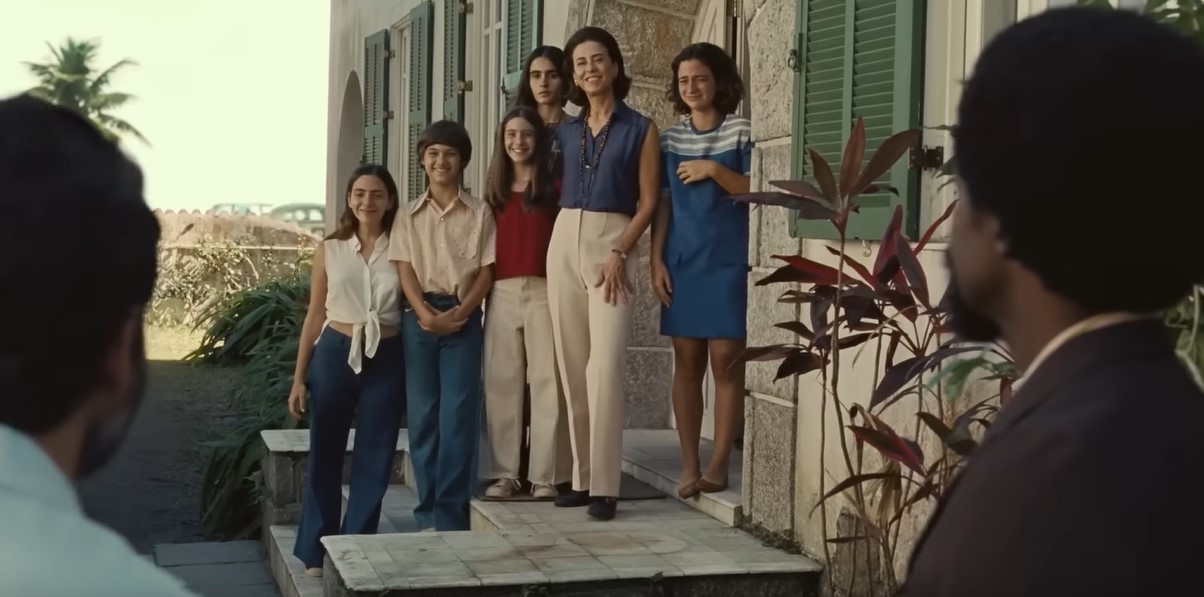
We’re a happy family! We’re a happy family! We’re a happy family! Me, Mom, and…oh.
Previously on Midlife Crisis Crossover: Oscar Quest ’25 continues! Once again we see how many among the latest wave of Academy Award nominees I can catch before the big ABC ceremony. That includes any and all works I never heard of before they were nominated. I have no fear of subtitles — I relish them, in fact — and I’m always happy to learn more about the world history they failed to teach me in school, which was nearly all of it.
One of the interesting side effects of AMPAS’ membership diversification efforts of the past few years (contrasting with all their many other years of existence) is the Best Picture nominee lineups offer more surprises from other countries — works that only film-festival attendees could’ve possibly seen in their official year of release. Nominees about dictatorships are sadly commonplace across several categories, which is understandable considering our sinful humankind has spawned far too many tyrants throughout the millennia and on most continents. Most of those works used to be Holocaust films, but in recent times filmmakers from other countries have been taking turns sorting their own tragic histories. Next up is Brazil with I’m Still Here, following in the footsteps of recent-vintage, Oscar-recognized tales of South American regimes such as Argentina, 1985 and (technically) El Conde.
Writer/director Walter Salles (The Motorcycle Diaries, 2012’s On the Road adaptation) teams with co-writer Heitor Lorega to tell the true story of one family’s experiences during and after the military dictatorship that ruled from 1968 to 1985, which all my social studies teachers definitely never brought up. Once upon a time in 1971, henchmen were sent hither and yon to snatch dissidents and other persons of interest in perceived crimes against their regimes for interrogation and worse. Among them was former congressman Rubens Paiva (Selton Mello, who’ll be in the Anaconda remake that’s now filming), who’d left the country for a while but couldn’t stay away. In modern rebellion terms he was technically more of a Mon Mothma than a Cassian Andor, but he did his part to support the Rebel Alliance until the Empire took him into custody.
Rather than follow Paiva closely and hypothesize what specific Brazilian forms of torture might’ve been used on him, Salles instead centers the narrative around his wife Eunice (Fernanda Torres, from the 1997 Oscar-nominated Four Days in September). The two of them and their five children (the oldest of whom was living carefree in London) had been living their best lives — as Salles sets up in sunny days and oceanside breezes — until the “they” that Martin Niemoller warned us about comes for them. Ruben and Eunice are escorted separately to the military’s lair, each held in their own cells. They never saw each other again.
For a time we’re as disoriented as she is, as her questioners stump her with odd demands and books filled with mugshots of hundreds of others who might or might not be enemies of the new overlords. The foreboding walls of her solitary confinement are standard-issue for such films, but Salles doesn’t indulge any violent Hollywood impulses for the sake of oppression overkill. To be honest, I foresaw a light touch when I noticed the film’s PG-13 rating before going in. That doesn’t make those sequences feel any less authentic, or Torres’ fright any less intense.
That’s only the first half of the film, though. Eunice was released twelve days later without fanfare or explanation. Her kids and the help had managed the best they could without Mom and Dad, albeit with army flunkies hanging around instead — guarding them 24/7 and waiting for something subversive to happen. They’ve withdrawn and downsized to merely a streetside stakeoue by the time of Eunice’s dead-of-night homecoming — a powerful scene of quietly unraveling heartbreak.
Eunice’s pursuit of the truth will eventually come. Where’s her husband? What happened to him? Is he dead? Leading guerrilla squads? Lingering in a dungeon? For years they’re told nothing. During the regime, though, her pushback options are limited and her remaining family are priority one. Her coping mechanism is to get the kids back to everyday living, pretend everything is fine, downplay Dad’s missing-person status, and definitely never let on to the daughter in London that anything is amiss. Torres holds back a tsunami of emotion behind her maternal motions, reminding me of all those British costume dramas that used to be routinely nominated for their tricky depictions of anguish and despair buried under twelve-foot layers of repression bedrock. Also, to a differently oddball extent, I recalled the frustration of Benigni’s Life Is Beautiful.
Salles takes two time-jumps later to get to the most pertinent parts of that Pursuit of Truth, which can’t see real gains until after Brazil’s gradual transition back to democracy in the mid-’80s. Along the way I spotted quite a few resemblances to some of our other Oscar Quest ’25 nominees. Much like The Seed of the Sacred Fig, the Paivas are a family shattered by the ruling tyranny of the day, except Brazil’s day would prove shorter than Iran’s. Not unlike The Girl with the Needle, a missing man not yet proven dead causes issues for the loved ones left behind. Exactly like Soundtrack to a Coup d’Etat, all this happened under a dictatorship partially enabled by the American government. (I’m Still Here doesn’t dive into that part because it would’ve been imperceptible to Eunice’s ground-level vantage, but Operation Brother Sam was very much a documented thing.)
Salles couldn’t keep everything in, of course. I do wish more of the Dragnet text epilogue could’ve been portrayed within the film itself, but at least it brings a form of closure for us bystanders, just as the described later events eventually brought closure to the Paivas. The nearer we approach the 21st century, the defter his chosen slices-of-life cuts have to be, giving us smaller and subtler hints of how the family turned out — not just Eunice’s fate, but that of their son Marcelo, who grew up to write the book that was adapted into this very film. In its own way, I’m Still Here is the ultimate family memento — not just a testimony to injustices and evils, but a record of their saintly patience and ennobled persistence.
…
Meanwhile in the customary MCC film breakdowns:
Hey, look, it’s that one actor!: In a clever, much-celebrated casting trick, in the final scene an aged Eunice is played by special guest Fernanda Montgomery, who is Torres’ own mother and a previous Best Actress nominee for Salles’ 1998 drama Central Station. (Like mother, like daughter!) With the merest of hints from behind a haze of Alzheimer’s, Torres nails the happy ending.
How about those end credits? No, there’s no scene after the I’m Still Here end credits, but there’s a touching reason to stick around: they’re accompanied by photos of the real-life Paiva family from back in the day, many of which were recreated by the cast throughout the film. Most memorable among them is the photo taken in a great scene (shown in our lead pic) involving a professional photographer who’s been sent to capture how the Paivas live on with their loving patriarch still missing and most likely murdered. The photog is a bit miffed because these ostensibly long-suffering victims just won’t stop smiling.
Discover more from Midlife Crisis Crossover!
Subscribe to get the latest posts sent to your email.
 Midlife Crisis Crossover!