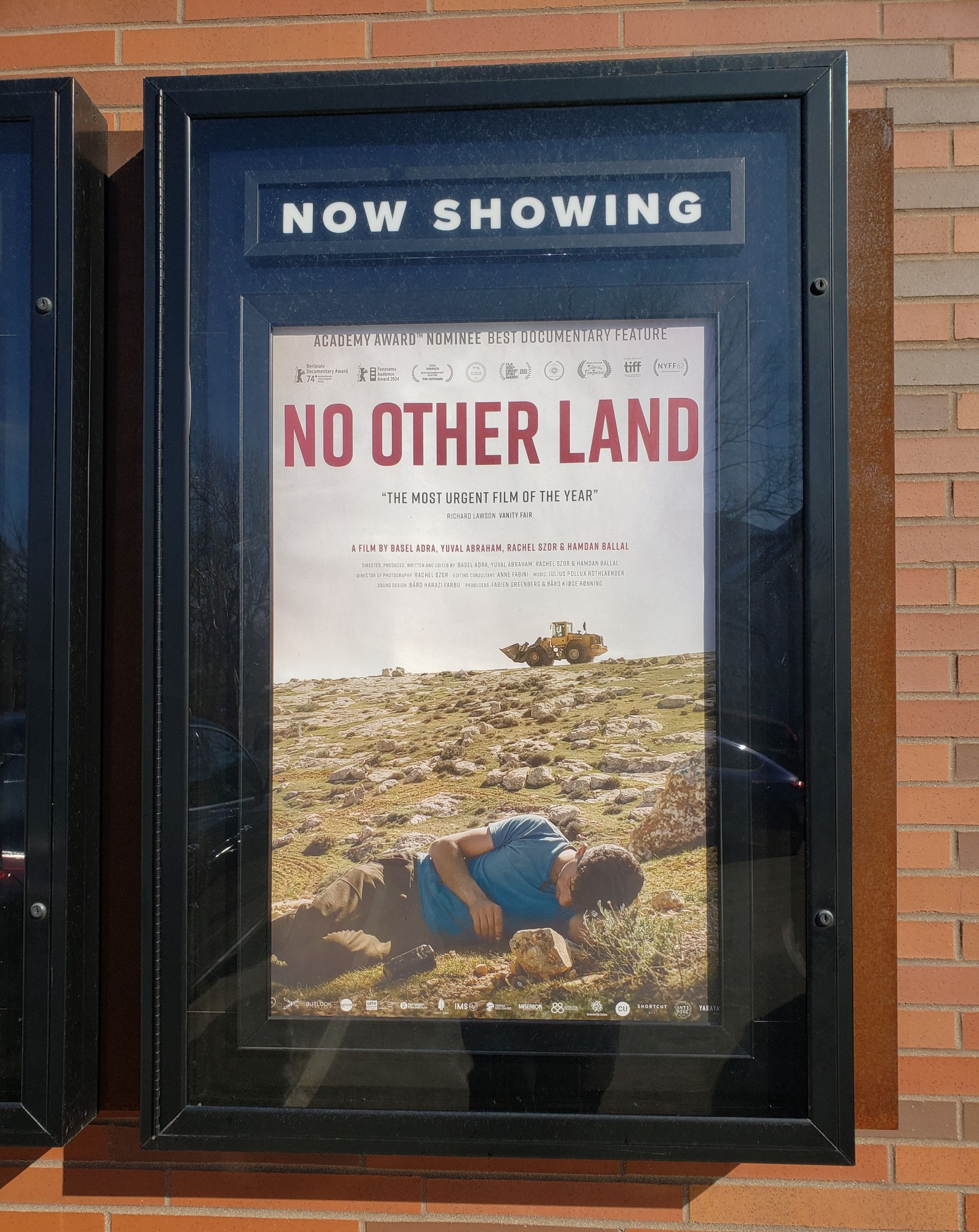
Now playing in 54 theaters this weekend, as opposed to Captain America 4‘s 4,100+ screens.
Previously on Midlife Crisis Crossover: Oscar Quest ’25 continues! Once again we see how many among the latest wave of Academy Award nominees I can catch before the big ABC ceremony, assuming the filmmakers can afford a release wide enough to reach us Midwest film fans in time.
As of February 17th my Oscar Quest scorecard was down to the final five unseen works, all of which I’d assumed would remain out of my grasp for the rest of the season. Then up stepped Indy’s own Kan-Kan Cinema, an eclectic nonprofit who frequently hosts tiny new films that the major chains overlook or think aren’t worth their time and space, because they really really need a dozen screens showing Dog Man for the rest of the year. Of all our theaters, I should’ve known they’d be the first (and as of this weekend the only one) to jump at the chance to bring us No Other Land. In a true rarity for recent Oscar history, it was nominated for Best Documentary Feature without a preexisting distribution deal. The filmmakers themselves have had to foot the bills for a slow rollout because all the studios passed on it (major and minor), possibly because it contains that magic hot-button word guaranteed to start a riot whenever it’s dropped into a conversation among two or more people: “Palestine”.
The self-release difference is noticeable from the first frame: a single film festival’s static logo and the production company’s typed name (sans animation) are all we get before the film proper begins…as opposed to other films today that can begin with at least three or four other studios, distributors, or exec producers’ vanity cards. (Most annoying collection of credit-hogs this Oscar season: the otherwise exemplary animated feature Flow takes a full 105 seconds to list all the entities that insisted on their names above the title. I’m glad so many people wanted to help make that one happen, but after the first five or six logos it started to feel like an SNL sketch mocking the practice.)
[Before proceeding, allow me a preemptive disclaimer: this topic is not among my areas of expertise, to put it extremely mildly as a confessed ignoramus in the political sciences. If you’re interested in such debates or in nitpicking any relevant semantics, there’re six hundred million internet users out there on any given side who’d love to exchange screaming fits with you. I am not among them.]
Anyway: rather than attempt a complete history of Israeli v. Palestine and all possible perspectives on the conflict of seemingly infinite duration, the heart of No Other Land is a personal story of Masafer Yatta, an area in the southern West Bank comprising some nineteen villages, maybe give or take a few at the time the narrative joins events in progress. Local former law student Basel Adra was raised in the digital age with the nurtured reflex to be prepared to video any and everything around him of interest. After sharing a few old home movies, he foreshadows the calamities coming to his homeland: “I started filming when we started to end.”
As the film tells it, the residents of Masafer Yatta fought a 22-year legal battle to justify their settlements in that very location, with records thereof dating back to at least the mid-19th century, well before the Israeli occupation in 1967. (At one point I’m pretty sure someone cites a happening in 1830.) Circa 2019 the Israeli government in the Israeli courts, planning to turn that portion of the Israeli-occupied territories into Israeli military training grounds, rules in favor of Israeli interests and responds to the Palestinians’ passionate defense with [checks notes] “Nuh-uh.”
Thus are Masafer Yatta’s population ordered to commence evacuation so tanks could roll in for target practice or oil change lessons or whatever. But the villagers would not go gently into that good night. They’d lived there all their lives and feel they have every right to stay put and keep living as if nothing new had happened. Amid this fraught prelude, Basel befriends an Israeli journalist named Yuval Abraham who considers his government’s actions “a crime” and embeds with Basel’s family and neighbors, hoping to shed light on the situation back home despite the low clicks such stories supposedly netted at the time. I imagine his traffic has had its upswings since then.
(Basel and Yuval are two of the film’s four credited writers, directors and editors. Of the other two, Rachel Szor held the most cameras and gets the cinematography credit, and Hamdan Ballal is a photographer and researcher from Hebdon. The total activist filmmaker count: two Israeli, two Palestinian.)
Hometown pride sustains and emboldens the villagers as we meet a few of them. Then one day come the soldiers to begin clearing everyone and everything out, with construction crews set to demolish every structure in sight. Masafer Yatta covers nearly fourteen square miles, so it’s a slow process over the next few years — a few homes here, a few blocks there. Some retreat to nearby caves, while the more resourceful and tenacious knuckle down and begin rebuilding. Each time the soldiers return to continue the pulverizing, they confiscate their tools, requisition their cars, disperse their many organized protests, and deny all vain attempts at obtaining rebuilding permits. Far as Israel is concerned, negotiation is no longer an option and they “need” all that prime space for their warring exercises, as if devastated wastelands were in short supply ’round those parts.
Whatever one’s opinions might be on any of this, the basic premise of No Other Land is we’re helplessly watching the heart-rending process of good people losing their homes, possessions, infrastructure, communities, everything they know. Appliances and bathrooms and collections are crushed. Children boggle in wonder and fear as a line of armed, uniformed gunmen march toward their school, which is later torn to rubble by an uncaring backhoe. A cement mixer dumps its load down one village’s well while henchmen saw through the connected pipes. Some Palestinians are chased and even attacked on camera, including Basel himself more than once, as well as another townsman who’s shot and left paralyzed from the shoulders down. Some farm animals absolutely are harmed in the making of this film. And so it goes.
As events unfold through the various cameras and phones, I experienced something I haven’t felt at a film in years: motion sickness. Our screening was packed and possibly even sold out, with seemingly only one empty seat left at showtime, right next to me in the third row. (I tried not to be offended by the late-arriving gentleman who watched the film standing up in the entrance hall rather than sit next to me.) Mine was a pretty choice seat until the confrontations escalates with the encroaching soldiers, everything grows increasingly frantic with all the necessary fleeing to safety, and all that understandable, potentially vertigo-inducing shakiness keeps going for long takes. If I’d known, I’d’ve taken a Dramamine in advance, same as I used to do for amusement park trips. As it was, I had to drive with the windows down the whole way home until the nausea passed.
To Western audiences with stronger stomachs than mine, at times it’s awfully reminiscent of all those movies and TV shows we’ve been raised on, where real estate magnates evict goodly tenants out of the old tenements or longstanding city blocks they’ve just bought up so they can get filthy-richer gentrifying them into more profitable upscale districts. Or hey, remember that time Judge Doom wanted to pave over Toontown with an all-new freeway? Or that time the Vogons destroyed Earth to make way for a new hyperspace bypass, only that turned out to be a lie? (During the text epilogue, one sentence implies the Israelis might actually have taken a page out of the Vogon playbook.)
Keep in mind, all of the above occurred and was shot prior to October 7, 2023, which is yet another date on the calendar we’ve lost to modern-day infamy along with 9/11, January 6th, and May the Fourth. Neither Hamas nor October 7th are mentioned at all until a short coda fast-forwards to the week after that date. One last bit of footage — Basel’s final, personal recording in Masafer Yatta — ranks among the ugliest moments shown to us. The next sixteen months’ history-in-progress are beyond the scope of this particular document.
Obviously there’re detractors who’ll never see the film (not even for their own Oscar Quests!), or have a litany of “well actually” rebuttals prepped for sharing at the drop of a mention. If anyone in Masafer Yatta were criminals, terrorists, rampaging invaders, or so much as slightly rude to restaurant waitstaff, none of that is portrayed here. If your stance is that such absences are irrelevant because all Palestinians are trespassers without rights just on instant principle, and if you are all about rendering your judgments of entire peoples in broad generalizations, then you and No Other Land will not be friends. It probably isn’t playing in your city anyway. I hear Dog Man has some cute parts, though.
…
Meanwhile in the customary MCC film breakdowns:
Hey, look, it’s that one actor!: Among numerous news clips spliced in among the verité, one features former UK Prime Minister Tony Blair taking a seven-mile walk through Masafer Yatta to tour the wreckage and some of the remaining homes. We’re told some demolition orders were subsequently rescinded for a while, long enough to make England feel a difference was made by this light intervention. ‘Twas only a temporary reprieve, judging by how the film does not end immediately with that report.
How about those end credits? No, there’s no scene after the No Other Land end credits, which are quite short and conclude with a list of the grants and funds that made the film possible despite seemingly zero support from Hollywood.
Out in the lobby afterward, representatives from the Indiana chapter of Jewish Voice for Peace had a table set up and were giving out free pamphlets, buttons, and info for those who want to learn more from their perspective.
Discover more from Midlife Crisis Crossover!
Subscribe to get the latest posts sent to your email.
 Midlife Crisis Crossover!