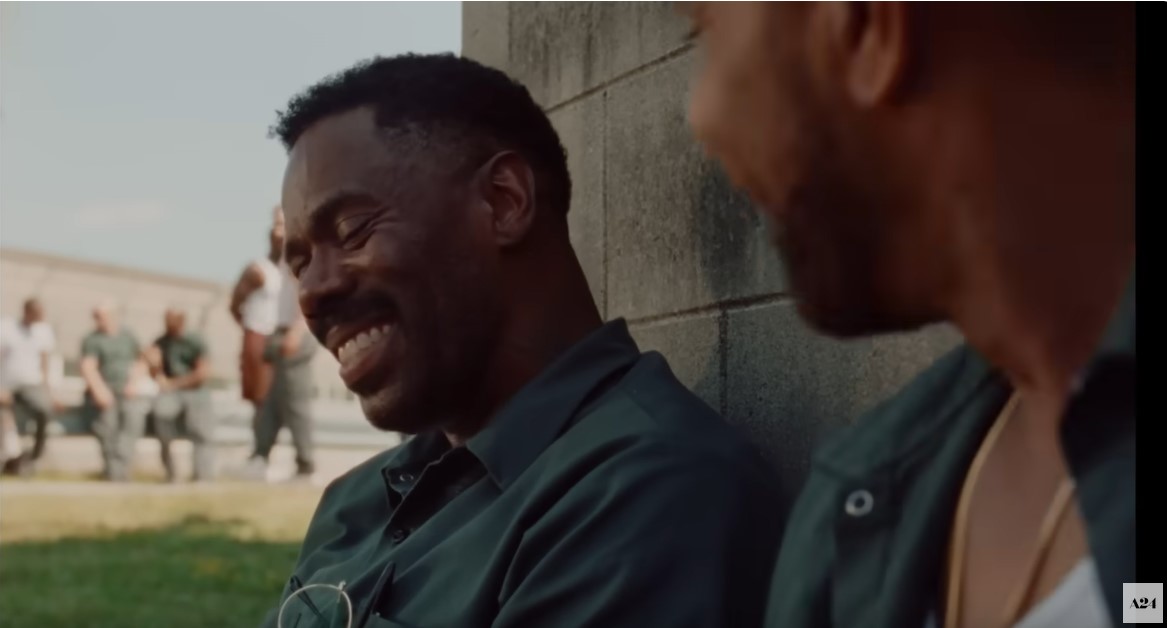
Colman Domingo, two-time nominee for Best Actor — for this and last year’s Rustin.
Previously on Midlife Crisis Crossover: Oscar Quest ’25 continues! Once again we see how many among the latest wave of Academy Award nominees I can catch before the big ABC ceremony, no matter how much chase they give me as their showtimes are few and far between — disappearing from all local screens one week, only to pop up the next as a last-minute addition to fill up any remaining back-of-the-theater showings that weren’t already taken up by the cartoon about the weredog beat-cop.
Such was the elusive cat-and-mouse chase between me and Sing Sing, which seemed to hold down more screens here in Indy before its three Oscar nominations were announced. It finally slowed down and let me catch up so I could marvel at Colman Domingo’s bravura performance in a very different prison drama — no sex, drugs, gore, riots, or interfaith gang wars among tattooed factions. (There are tattoos, but no one declares war over wearing the wrong ones.) It’s based on the true story of a community of men encouraging each other to find new purpose in their broken lives behind bars.
Domingo inhabits the life of John Whitfield, a.k.a. Divine G, who was convicted of second-degree murder and other related charges. He was sent to the infamous Sing Sing Correctional Facility (thirty miles north of NYC), where — in between his pursuit of self-improvement and proving his innocence to the courts — co-founded Rehabilitation Through the Arts, a theater program for those on the inside who feel called to the stage, are willing to do the work, and can let go of any macho limitations imposed either by society, their environments, or themselves. Divine G has had plenty of time and drive to commit and get educated, judging by the library stacks in his cell. By this time he’s extremely well-read and written a few plays of his own. Sometimes RTA has performed the classics and sometimes they’ve done G’s works. All of it’s under the supervision of their teacher/director Brent Buell, played by Academy Award Nominee Paul Raci (Sound of Metal). The troupe has been at it so long, Brent never has to scream or threaten anyone. Again: far more benign than your ordinary unconstructive Hollywood jailhouse misery-porn.
The status quo gets shaken up when a newcomer asks to be let in. Clarence Maclin, a.k.a. Divine Eye, is one of numerous real-life RTA alumni playing versions of themselves, reprising their own Sing Sing stints and lending the film insightful stage-cred and verisimilitude. Divine Eye (who, along with the real Divine G, also receive “Story By” credit) is the skeptical gangsta who isn’t sure he buys into what looks silly from the outside, but a chance encounter with a copy of King Lear hit him with just the right soliloquy, so he feels like he oughta do something with that. G isn’t sure Eye is the right fit, but Eye’s charisma strikes the other guys just right, so G relents and takes his presence as a creative challenge.
While the group is brainstorming their next project, Eye casually suggests they break away from the classics and from G’s self-made oeuvre, and do a comedy for once — really not G’s forte. Next thing he knows, Brent is writing them a wacky kitchen-sink time-travel farce called Breakin’ the Mummy’s Code with any historical eras they feel like. Cowboys! Pharaohs! Shakespeare! Freddy Krueger, for some reason! Everyone’s excited by the possibilities of this potential free-for-all except G. This isn’t how Art works! This isn’t how any of this works! Questions about time-travel mechanics and plot logic are rebuffed with a critical catchphrase among RTA players: “Trust the Process” — their equivalent to MST3K’s “You Should Really Just Relax”. RTA isn’t about making bulletproof masterpieces for the literati.
The ensuing production goes through the standard beats of your Films about filmmaking or about stagecraft. Wacky audition montage! Mixed feelings for the winners and losers of the parts! Endless rehearsals! An unexpected tragedy! An emotional meltdown! But The Show Must Go On! Much like Brent, director Greg Kwedar and his co-writer Clint Bentley (both of whom have been RTA teaching volunteers at another facility) provide the framework, then step back and let the cast shine through much of their own talents, including some value-adding improv. Often the camera embeds within their group circles spinning from one actor to the next like it’s just one of them. No time is spent rehashing the men’s crimes or litigating their baggage. For purposes of RTA’s story and message, what’s past is past.
Well, mostly. The more Eye learns the ropes, the more G stresses out about his own personal business. Their tension is the heart of the piece — comparing and contrasting their stories, their tangles with the legal system, and their chances of ever touching grass beyond those concrete walls again. While Eye works hard on his big speech (you know the one, about to-being or not to-being) and struggles to bypass the sort of self-consciousness that trips up a lot of folks, G begins feeling like everything’s toppling backward on him. We don’t get to watch the complete Code on the big night, which is fine, because by that time we’re more invested in seeing what G and Eye end up doing for each other, minus your standard preachy sentimentality. Domingo’s no stranger to drilling down to his own core and exposing every nerve ending to the light of day, but it’s the unenviable task of Eye’s grounded, lived-out performance to help his peer put some of that back in the box. It’s a repertory pas de deux of ostensible master-and-apprentice evolving into a more nuanced, rare example of men helping each other be better men.
If you prefer nihilistic grindhouse in your prison stories, Sing Sing may feel a little antiseptic to you. If you personally were a victim of any of the participants, you might not feel the sympathy that Kwedar and the cast aim to elicit. If you think RTA is a joke and all convicts should just spent the rest of their lives standing in corners wearing dunce caps, or let loose into gen-pop with shivs and playing Battle Royale until the last men standing finish out their sentences…well, maybe give ’em a chance to demonstrate the good that RTA has done for thousands of incarcerated men over the decades. If rehabilitation is the true goal, rather than consigning them to life in a bonus season of HBO’s Oz, or glorified time-outs before ineffective for-profit centers send them spinning through the system’s revolving door…Sing Sing is the best possible proof-of-concept for RTA’s mission — a valid, touching, uplifting argument for each person’s potential for encouragement, hope, change, and redemption.
…
Meanwhile in the customary MCC film breakdowns:
Hey, look, it’s that one actor!: Other self-representing RTA alumni include Jon-Adrian Velazquez, whose wrongful conviction was the subject of a 2012 episode of Dateline NBC. He was eventually freed in 2021 after a persevering slog through The System, but wasn’t officially exonerated of the crime till this past September.
Sharon Washington (Arthur Fleck’s social worker across both Jokers) is in charge of Divine G’s clemency hearing, which she concludes with a probing question that pierces his heart. Sean San José (1996’s Dream for an Insomniac) is Mike Mike, the most boisterous and carefree among the thespians and Divine G’s next-door cell-block neighbor. The real Divine G himself cameos as a fan who asks Domingo’s G for an autograph. Squint extremely hard at the other nameless residents and you might just catch Johnny Simmons (Scott Pilgrim‘s pal Young Neil!), who starred in one of Kwedar’s earlier films, Transpecos.
How about those end credits? No, there’s no scene after the Sing Sing end credits, but they confirm parts were actually shot at Sing Sing, and sign off with a pointer to RTA’s official website for those interested in learning more about the program.
Discover more from Midlife Crisis Crossover!
Subscribe to get the latest posts sent to your email.
 Midlife Crisis Crossover!