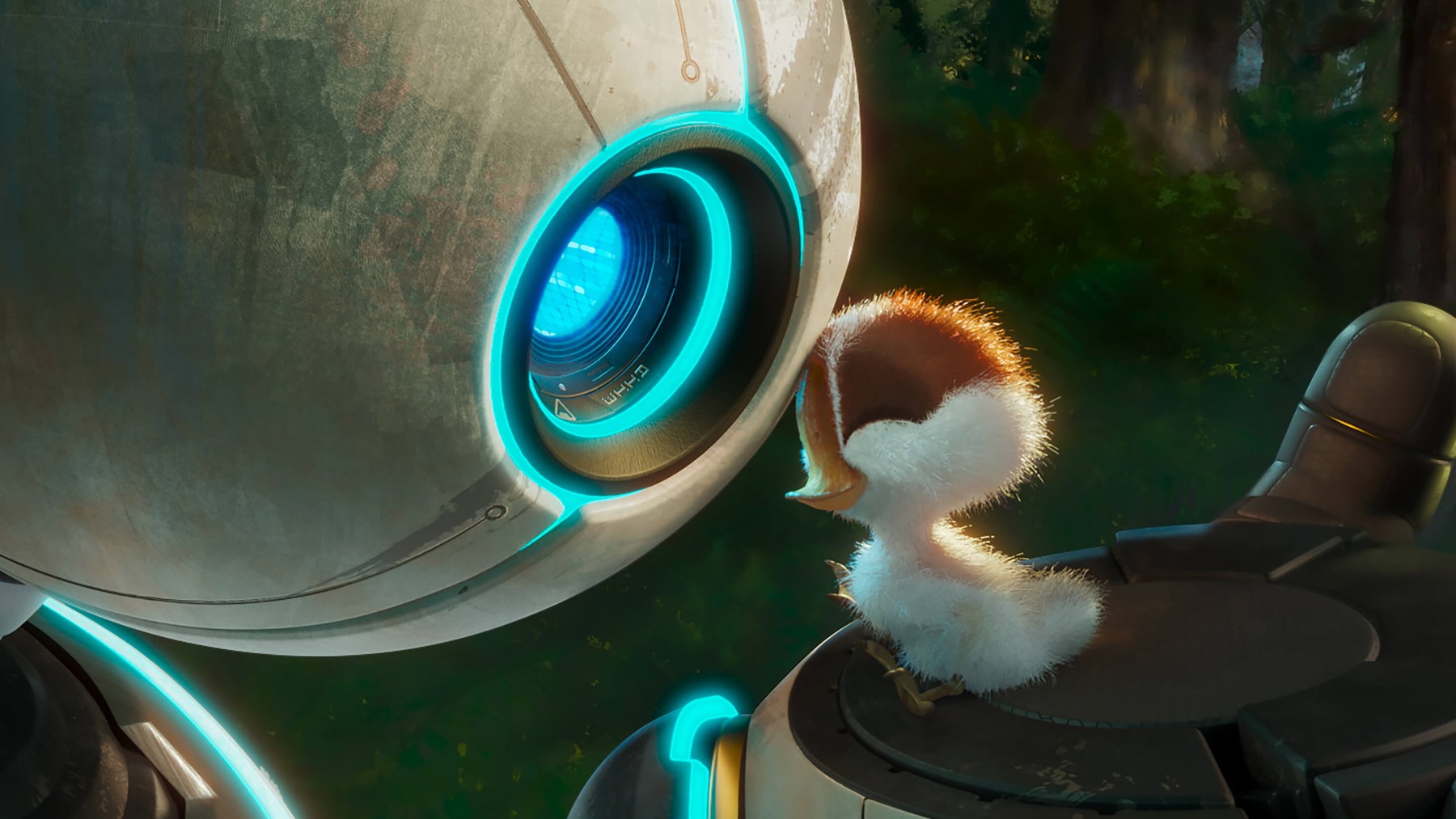
Concept art for my upcoming fanfic, “Atomic Robo Meets Henery Hawk”.
Today all animated films are guaranteed a release on popular streaming services pretty quickly after completion, whether the studios think they’re worth the effort of a few weeks’ theatrical run first or they’re quitters who send them direct-to-video, which isn’t quite as stigmatizing as it was in the Blockbuster Video era. In happier times my year-end movie-going lists used to be filled with animation, often ranking near or at the top. Nowadays, not so much — trailers and pro reviews aren’t dissuading my middle-ager’s skeptical inertia even when those films do become available for my streaming convenience. I haven’t bothered to add Strange World or Wish to my Disney+ queue, let alone watched them. Whether it’s rampant sequelitis or the innate mediocrity of jukebox musicals or a studio satisfied with selling half-hearted results, don’t hold your breath waiting for my opinions on Kung Fu Panda 4, the Trolls series, or anything containing a Minion after their debut.
Last time I paid full price for a DreamWorks Animated joint, it was in 2019 when the third How to Train Your Dragon proved the weakest of the trilogy. I largely ignored their subsequent, determinedly populist fare till I “had to” watch 2022’s Puss in Boots: The Last Wish as part of my annual Oscar Quest and was astonished at the results. I was therefore a little more receptive when DreamWorks announced their big 2024 release, The Wild Robot, would be directed by Chris Sanders, whose past works include Lilo & Stitch and the first How to Train Your Dragon — two all-ages spectacles he co-directed that I went into with low expectations only for my heart to grow three sizes too big by the end. With The Wild Robot, Sanders has now gone three-for-three with said enlarged heart.
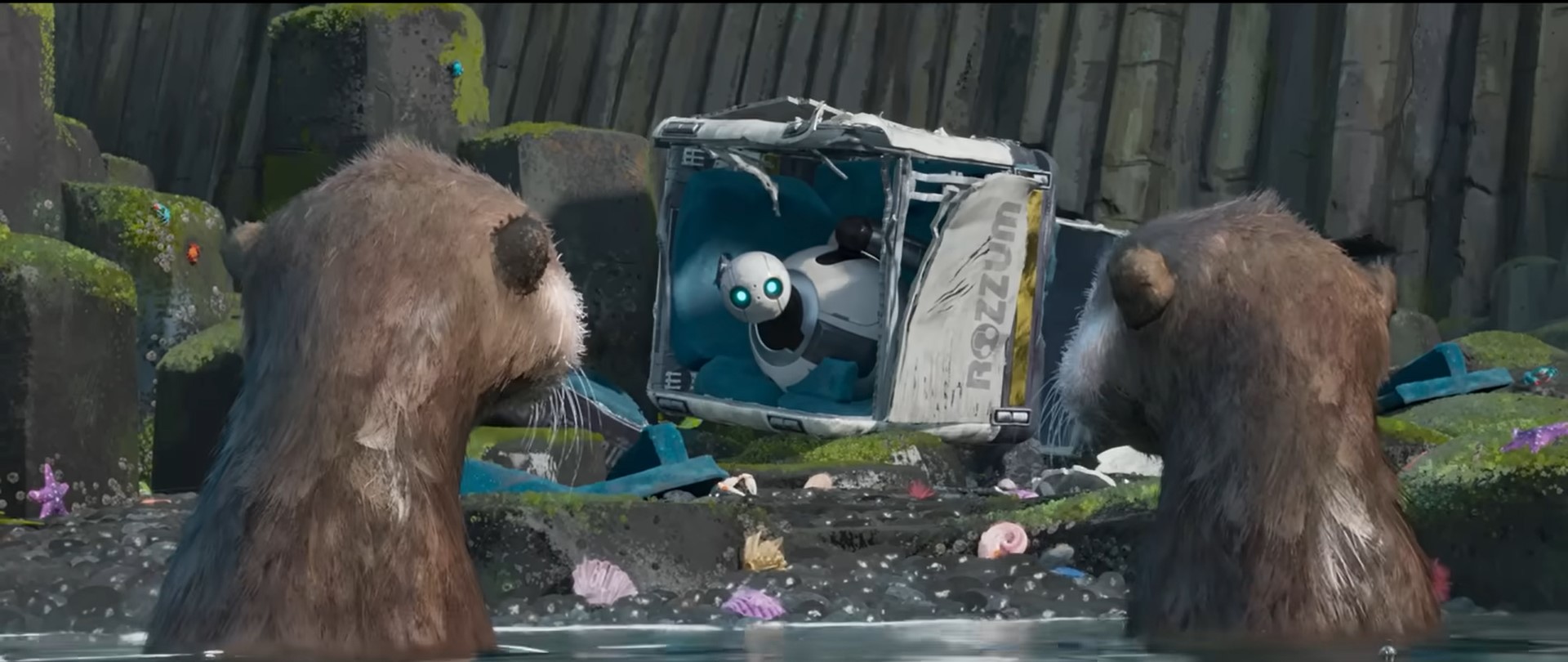
Not nearly as bumpy a landing as some actual “Your package has been delivered” Amazon porch pics we’ve seen.
Based on some books I don’t know, The Wild Robot stars Lupita Nyong’o, last seen in A Quiet Place: Day One dodging sci-fi death-bringers dropped from above, as the voice of a sci-fi life-saver dropped from above. She’s a mass-produced helper robot designated ROZZUM Unit 7134, with a visual design not unlike a doorway-sized Iron Giant sans guns-‘n’-ammo, that washes up on an unidentified shore along with other flotsam and jetsam. (Geographic clues point toward an island with a deciduous forest, snowy winters, and no evidence of human civilization, somewhere along the west coast of South America or slightly out in the Pacific. Good luck, investigative cartographers!)
Its product line is intended for short-term rentals to complete a singular task for each customer, much like a U-Haul truck or a bounce house for parties. Once ROZ activates, it keeps querying, “Do you need assistance?” (much like the 2005 animated feature Robots‘ motto, “See a need, fill a need!”) only to find itself feared, shunned, attacked, chased, and battered around this vivid, frenetic landscape where the food chain is realistically enforced and every creature wants to kill it and each other. The first twenty minutes alone rack up a body count well above average for an all-ages film. Most are split-second gags with the bloodiness merely implied rather than splattered, but the point is clear: this ain’t Disney country and some cartoon animals are harmed during the making of this motion picture.
We see the consequences of that very peril when the first exhilarating, several-minutes-long chase sequence climaxes with ROZ falling onto a nest and crushing all its occupants except a single surviving goose egg. For lack of direct commands, ROZ focuses entirely upon that defenseless li’l customer as a task to be performed — arguably autonomously, as an attempt to comply with its programming. By this time ROZ has widened its input parameters by sitting still, listening to its surroundings for an extended period, and eventually deciphered the language(s) of all the forest dwellers. Then kiddie viewers get some big talking-animal fun as other cast members begin speaking through the magic of science fiction!

A rare moment of a listening device put toward positive use.
From spring through autumn, ROZ is chiefly dedicated to raising that wee gosling now named Brightbill (Heartstopper‘s Kit Connor) from cute widdle hatchling to a full-fledged goose ready for migration when that nonnegotiable time arrives. Assisting and frustrating ROZ is a fox named Fink (Pedro Pascal, cranked up to Jim Carrey speed) who belays the instinctual urge to devour Brightbill in exchange for some foster-co-parenting help. You’d think he’d be burned out on SF-dad roles after The Mandalorian and The Last of Us, but maybe he appreciated the slight change of pace — here he gets to be the worst available role model rather than least-worst. (In the broader animation spectrum, Fink isn’t too far removed from Jason Bateman’s Zootopia hustler, minus the evolved civility.)
And so Fly Away Home meets Over the Hedge as ROZ and Fink do their best to prep Brightbill for the most important flight of his life, even though neither of them can fly. The forest’s other denizens offer assistance, indifference, or unhelpful hunger as the year goes on and the lesson plan changes as it must. The fox and the ‘droid feel the enormous difficulties of being thrust into a parental role to a whelp not remotely like themselves, negotiating their innately hard-wired “rules” to do what’s best for their downy charge, to say nothing of the temporary truces needed along the way.
That journey comes to life through utterly gorgeous, oft painterly animation — flashes of Impressionist wilderness, real-world lighting for every hour of every season (especially the nighttime scenes ensconced in natural moonlight), subtle shifts to grittier shadings during action sequences, and majestic soaring and banking and diving through the skies above once they bring in a flight instructor. The animals maintain their cartoon expressiveness even as they live and interact within an extravagant recreation of the world’s natural beauty around us.

I, Robot meets Rog-2000 meets WALL-E meets Machine Man meets etc. etc. etc. etc. etc.
Nyong’o lovingly brings ROZ’s growing sense of wonder to life as months pass and her prerecorded customer-service voice subtly alters to reflect the influence of the lifeforms around her. As with virtually every artificial good-guy ever, its zeroes-and-ones human-made consciousness charts a path toward actual emoting and coming “alive”. Unlike pop culture’s other favorite ‘bots, ROZ doesn’t openly rhapsodize about it — no long speeches about envying humans or wanting to be like them or hoping one day some Blue Fairy will come make it a real live person. ROZ just does the thing. In some ways she’s like a real adult who sucks at adulting but has to learn to adult so the kids in their charge don’t suffer for it.
Meanwhile in the background, open-ended questions linger about the state of this near-future’s humankind (depicted as bustling shadows at a remove, supervising their robo-proxies and never deigning to take an in-person role) until inevitably our hearts sink as human “civilization” intrudes and the duly assigned reps of ROZ’s corporate overlords come to retrieve their lost merchandise. EXPLOSIONS ensue, the community must decide whether to unite or die, the fate of ROZ’s self-updates are at stake, and Brightbill finally ages up enough to make some crucial decisions of his own. The surprises outnumber the predictable bits, and the ending isn’t perfectly happy.
Nevertheless: “We must become more than we were programmed to be,” insists ROZ, to itself as much as to any of the neighboring wildlife. As they transcend the loopholes in their programming, so too the film transcends the corporate limitations that compromise other, lesser works. The imagery is beautiful to behold on the big screen and some of those found-family parent/child moments are rather feels-inducing, apropos of Our Heroes themselves. So far The Wild Robot is my favorite film of 2024. This year’s meager Oscar bait-to-come is of course welcome to challenge that standing in the 2½ months to go, whether live-action or animated.

…I just couldn’t stop screen-shotting.
Meanwhile in the customary MCC film breakdowns:
Hey, look, it’s that one actor!: Fans of What We Do in the Shadows will be unsurprised to know Matt Berry numbers among the MVPs — his beaver named Paddler is prone to Laszlo-esque selfishness, condescension, and vainglorious elocution. Catherine O’Hara (already in theaters with Beetlejuice Beetlejuice) is a possum who’s candid about the fragility of life with her seven kids for as long as they last. Ving Rhames (who worked with Sanders on Lilo and Stitch) is instantly identifiable as a bird of prey. Bill Nighy (Living; Love, Actually) is an elder Canadian goose who accurately sums up their innate awfulness while helping perpetuate their species.
Star Wars costar Mark Hamill is a bear, as we previously reported in August. Late in the game, Academy Award Nominee Stephanie Hsu (Everything Everywhere All at Once) arrives as a robot middle-manager who’s likewise programmed to complete an assigned task by any means necessary. And much of the assorted, unnamed background citizenry are Dee Bradley Baker.
How about those end credits? To answer the burning question that MCC is always happy to verify: yes, there is indeed a scene after The Wild Robot end credits. The rosters roll and a dozen Production Babies are name-checked in front of an infinitely scrolling dark forest where cast members scamper and flit through the shadows. For those who tuned out prematurely and really want to know what they missed, and didn’t already click elsewhere…
…
…
[…insert space for courtesy spoiler alert in case anyone needs to abandon ship…]
…
…
…somewhere in their now-leveled forest, Fink and Paddler work together to plant a new li’l evergreen tree amid the devastation. A squirrel runs up and laughs at them, and is promptly rebuked with an acorn fastball to the head. If there’s one role that’s useless for rebuilding a broken community, it’s a heckler.
Discover more from Midlife Crisis Crossover!
Subscribe to get the latest posts sent to your email.
 Midlife Crisis Crossover!