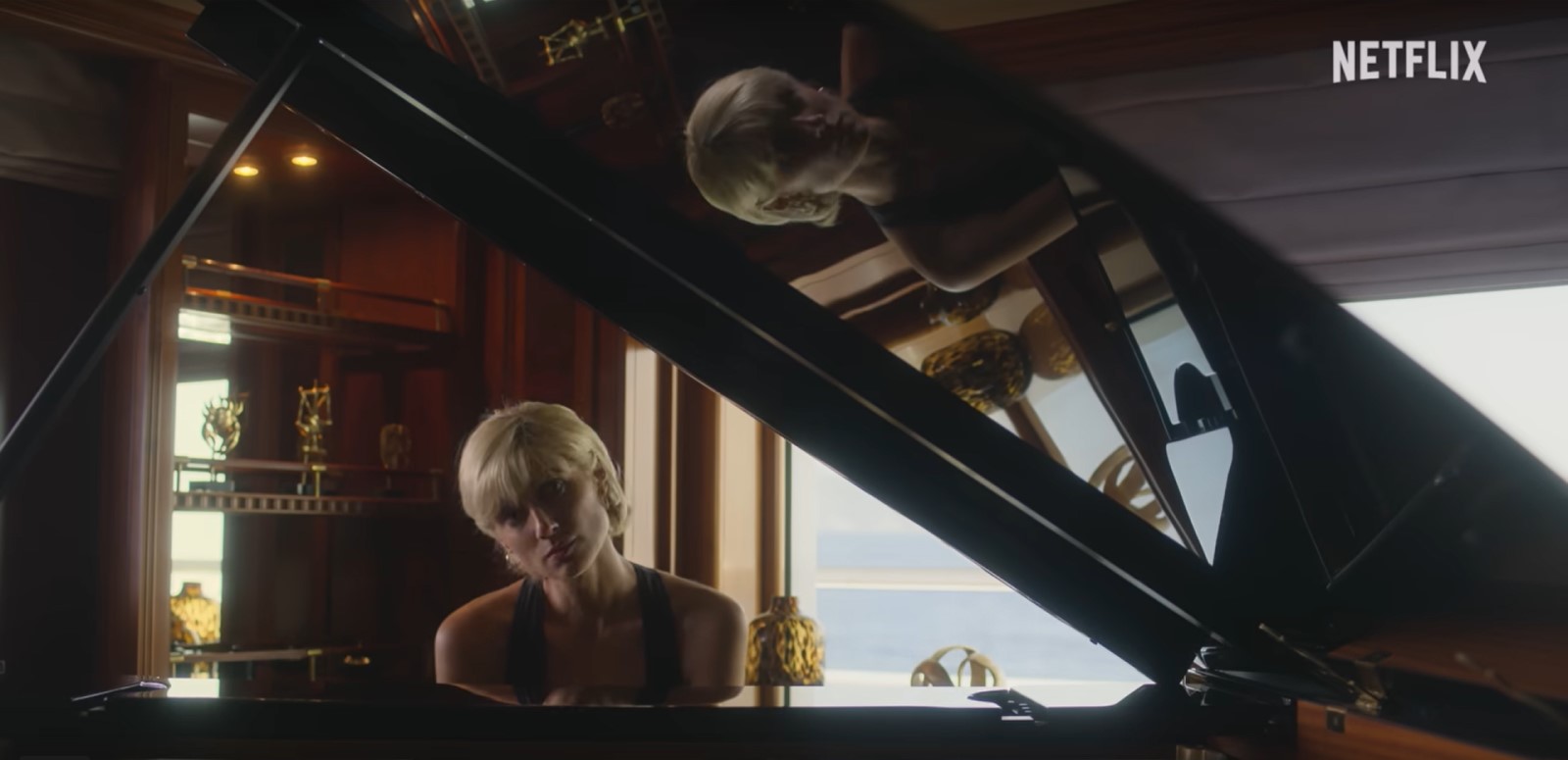
“It seems to Elton I lived my life like a candle in the wind…”
Previously on Midlife Crisis Crossover:
At the start of the pandemic my wife Anne and I binged the first three seasons of Netflix’s The Crown and soon caught up with the rest of fandom. One slight hitch: while Anne is a major history aficionado, that was never my forte. Compared to my blissfully ignorant self, Anne is far more knowledgeable of history in general and British royalty in particular. Frankly, I’ve learned more about their country’s storied past from my wife and from Oscar-nominated movies than I ever did from school. So far I’ve enjoyed anyway, and understood most of what’s gone on…
After catching up on the first three seasons in one mid-quarantine lump sum, followed by focused listicles for Season Four and Season Five respectively as they debuted…here we go again! Creator Peter Morgan and returning directors Christian Schwochow and Alex Gabassi bring us the first three-fifths of season 6, a four-part arc devoted to the biggest elephant among Buckingham Palace’s numerous elephant-filled rooms: the Death of Di. (Spoilers ahead. You probably know the ins and outs of her tragedy better than I do, but a few show-specific artifices will come into play.)
Much as we were looking forward to Morgan’s frequently insightful and incisive take on Royal Family history — covering aspects public and private, real and dramatized, documented and extrapolated — a not-so-funny thing happened along the way after Season 5, which had the misfortune of dropping a mere ten weeks after the passing of the real-life Queen Elizabeth II herself, and five months before the end of her funeral procession. Suddenly an entire United Kingdom, most of whom lodged more lifetime complaints about her 70-year reign than they ever had about the show’s first four warts-and-all seasons, suddenly decided the whole series was now retroactively Too Soon and the once-esteemed Mr. Morgan was history’s greatest monster. Over six thousand EastEnders veterans stopped returning the casting director’s calls. Dame Judi Dench placed a 50-million-euro bounty on his head. Beefeaters were chucking rotten shepherd’s-pie pucks through his transoms. The Crown had unwittingly jumped the shark, or whatever they call sharks in England.
Consequently, Season Six is (so far) the lowest-risk, most ordinarily structured season to date. Elizabeth’s tolerance-of-Lady-Di phase was always going to demand a longform chunk of her narrative if the show survived this long, given her ex-daughter-in-law’s integral role as mother of a future King of England (odds remain high so far, anyway), the myriad controversies and convolutions of her life, and the inescapable fact that Everybody Loves Diana. I personally may not have paid attention to her headlines wherever possible (when they weren’t broadcast worldwide loudly enough to reach every human from suboceanic hermit caves to top-secret moon bases), but my young-adult indifference is irrelevant. She attracted more fans than the Beatles and Elvis combined — veritable squads of ride-or-die lifelong Royal Family superfans, Anglophilic artifact collectors, hyper-parasocial tabloid subscribers, and/or employees and beneficiaries of the many charities for whom Diana toiled to raise millions, heighten awareness, and make a true difference in countless lives.
Morgan’s version of Diana’s last eight weeks alive therefore seems to tread her territory a lot more gingerly than the last two seasons did. That’s understandable, as I’m sure Morgan & co. would very much like to continue living and working where they are, not in exile or in the Tower of London. Whereas we’ve previously witnessed the catalogued flaws of her and her ex-husband that would each aid in unwinding their soured fairy tale, Final Mode Diana is no longer the once-spoiled Royal-by-marriage whose willful naivete about the princessing life emboldened her to disregard traditions and tiara-contractual duties, nor is she still visibly wracked with bulimia or any other debilitating conditions. Amid her post-divorce purpose-driven pursuits of noble charities (landmine removal, AIDS care, etc.) she’s largely a victim of various males who’ve backed her into a damsel-in-distress corner. In her favor, Elizabeth Debicki (Tenet, The Night Manager) continues excelling at playing her remaining facets — at turns demur, mercurial, and publicly possessed of a heart three times enlarged…but more often she’s relentlessly put-upon and ultimately endangered.
Once she’s securely ensconced in that vantage, Morgan invites the audience to team up with him in pursuit of this half-season’s real villains — easy boo-able scapegoats in a complex set of circumstances where anyone who can spell “hindsight” could point fingers in every direction across four dimensions. We open her case and the season with The Crash, which is kept offscreen in a manner intended as respectfully quasi-Hitchcockian to avoid ungainly forensic speculation or fueling any and all conspiracies (I just cannot with the epic-length list) yet heavily foley-amped for cold-open action-scene cred. Then we flash back eight weeks and begin accumulating a lineup of suspects. Who done Diana wrong the worst? “LET’S GET THEM, YOU GUYS!” shouts Morgan as he gestures at Diana’s Rogues’ Gallery with his favorite quill pen:
- Her ex-husband! Despite the last three seasons’ worth of antagonistic backstory buildup, real-life Prince Charles is now actual King of England with a nonzero approval rating, for lack of any overtly Thatcher-esque actions in the months since his ascension to The Throne. (It was a long, long wait for him, but he was still five years younger than Biden was at his inauguration.) The first two episodes, “Persona Non Grata” and “Two Photographs”, continue his trajectory as as a perpetually unrequited adult-aged teen starved for validation, begging Mummy to come to his mistress-turned-girlfriend’s 50th birthday party because his ex won’t stop overshadowing her (Lilibet pays closer attention to her corgis than to his pleas) and competing with said ex for front-page attention using their sons as props (in lieu of corgis). But in apparent deference to The Literal King, his character arc tapers off in a suddenly redemptive direction heretofore not foreshadowed. One of this season’s most magical feats is The Wire‘s Dominic West believably charting a journey from pettiness to redemption from a performance perspective, but it feels like he’s playing disparate twins. On paper it’s an enormous leap from one mindset to the other.
- Her final boyfriend! More of a minion than a mastermind, Dodi Fayed (Moon Knight‘s Khalid Abdalla) is assigned the deep undercover task of ingratiating himself to the Princess, even wooing and enthralling her with his ostensible masculine wiles, even though he’s engaged to model Kelly Fisher (Erin Richards, also a thwarted fiancée in Fox’s Gotham). Mostly he comes off as a Nice Guy, which for Diana makes him perfectly okay company to keep. He doesn’t quite stick the landing with his seriously poorly timed marriage proposal, but his sins include commandeering her last day’s itinerary and charming her just enough to subdue any guilt she might’ve felt at being Kelly’s Camilla. Up until his eleventh-hour growth of a spine evinces one (1) shred of repentance, he’s but a lackey to…
- Her final boyfriend’s father! Salim Daw returns as entrepreneur Mohamed al-Fayed, still a rich man chasing international respectability, British citizenship, and/or the Queen’s attention from the same courtside bench as Charles. Believing Diana is the weakest link in the royal chain, the domineering opportunist schemes to use his eager-to-please son-puppet to proxy-woo his way into the Royal Family Tree. He would’ve gotten away with it too, except as we see in episode 3, “Dis-Moi Oui”: (a) Diana on the rebound isn’t that pliable; (b) Dodi’s post-rejection humiliation gave him the strength to scissor his marionette strings; and even if those are mere supposition on Morgan’s part, there’s irrevocably (c) The Crash. In the arc finale “Aftermath” he’s given the gift of closure with Dodi’s funeral proceedings and some time to dwell in his inconsolable grief in silence, but we must never forget who the most reviled players are in this entire sordid tale…
- Paparazzi! At which the entire viewership boos and howls like the dream-crone in The Princess Bride. They’re everywhere in this arc, swarming and festering and snapping their pics on their expensively intrusive cameras, both from afar and in everyone’s faces. Viewers are denied the real-life sight of several of them being arrested at The Crash site, because we have a lot of grief to ogle. Only one is important enough to be named, a slick Italian pro named Mario Brenna (Enzo Cilenti, a big-bad from Luther season 5) who’s an ace money-shot mercenary in a world where image is everything and ergo image-catchers are the masters of everything. BOOOOOOOOOO. (Thirty years later their kind remain an unsolved societal plague — witness the recurring paparazzi in Scott Pilgrim Takes Off, which also debuted on Netflix this week and gives them swords.)
- Diana and Dodi’s final driver! We do get a scene of driver Henri Paul (Yoann Blanc) having more than a few drinks that fateful evening because he hadn’t expected to be needed. W’re held at a remove and asked to withhold our armchair-detective probes, but his culpability is noted. At least he was trying to be helpful to Diana. It was his job, sure, but still.
- Prince Philip! Jonathan Pryce is a Statler and Waldorf combined, glaring and grumbling and reminding everyone Diana has been more formally, bureaucratically disavowed than the average MI5 rogue spy and insisting she should be denied all further privileges or courtesies, pre- and posthumously. Matt Smith’s erstwhile royal rebel is now Buckingham Palace’s unkindest, nitpickiest hall monitor.
Between the machinations of the Anti-Diana League and the legacy of Diana herself, these four episodes don’t leave much wiggle room for Imelda Staunton’s Queen, who’s reduced to a guest role in her own show and whose intangible monolithic status technically has more screen time than her corporeal self does. Granted, our previous Queens endured the occasional one-off from the periphery, with her all-towering significance nonetheless rippling through the lives of other characters on her behalf in absentia…but not usually for 3½ straight episodes.
The spotlight finally returns to her for the second half of “Aftermath”, but at a price: Staunton finds herself starring in a remake of The Queen, a Best Picture nominee also written by Morgan, which won Dame Helen Mirren an Academy Award for her interpretation of Elizabeth’s inner conflict over how to deal publicly with Diana’s death given the latter’s status as an ex-Royal. Staunton’s performance is consistent with last season and her alt-timeline rendition is perfectly fine, but The Queen was better.
Elizabeth isn’t the only short-shrift sufferer here. Diana and her nemeses crowd out still others, each allowed only mixed results:
- The Queen‘s big hero Tony Blair (Bertie Carvel from The Tragedy of Macbeth), trying to PM from the back row, though he could be called up to the stand if the season’s back half includes a 9/11 episode.
- Rushmore‘s Olivia Williams’ Camilla The Other Woman, so appreciably humanized last season, is consigned to Charles’ dugout, emerging only for her own birthday party.
- Phantom Thread‘s Lesley Manville’s Princess Margaret, the closest thing this series has had to a punk icon, gets just a few seconds of underdog cheerleading. Manville hasn’t yet gotten truly a great Margaret-centric episode (as Vanessa Kirby and Helena Bonham Carter each scored), so I’m trusting one of the final six will be The Death of Margaret and my heart will be torn from my chest, or else we riot.
- Ben Lloyd-Hughes (the Insurgent series) as Mark Bolland, Charles’ Deputy Private Secretary, whose shrewd efforts to damage-control his employer’s second-fiddle public image could’ve been more amusing in larger increments.
- Marcia Warren (a killer on Sherlock) as a silent, spectral reminder that the Queen Mother isn’t dead yet. In reality she died seven weeks after Margaret (and less than seven months after 9/11), so Elizabeth has to be in for a deeply crushing episode ahead.
- Any and all other Spencers, who are the Not Appearing in This Season Family.
Other little pleasures can be found here and there. There’s the heavy-handed yet wholly apt paralleled metaphor of Diana walking through a field of land mines while the Sunday morning publication of her kissy-kissy photos with Dodi explodes in her ex’s family’s faces. The funniest line of the arc is awarded to Charles, scoring points off Philip in a moment of rage with a rejoinder involving Harrods. At first I thought the best episode was “Two Photographs”, the most self-contained of the four, until Anne reminded me season 2’s “Beryl” already used the idea of comparing and contrasting approved Royal Family photos with unapproved scandal-sheet pics. Also, do not get me started on the ghosts.
Overall, The Crown has had better runs. Morgan’s acquired hesitancy is surprising and disappointing, resulting in the sort of made-for-TV miniseries that went out of vogue around the same time as the events it depicts. It’s especially weird how Charles, whom he’s been roasting since episode 1, pulls a heel-reversal and becomes the protector of Diana’s nobility in the end. Whether this kindness scores Morgan any points with Charles the New Monarch remains to be seen.
Speaking of which, thinly tangential fun trivia: this arc’s finale has the same title as the first episode of Apple’s Monarch: Legacy of Monsters, which also premiered this week.
(I may have watched way too much TV this week. I blame TV.)
To be concluded when The Crown returns for its farewell address on December 14th!
Discover more from Midlife Crisis Crossover!
Subscribe to get the latest posts sent to your email.
 Midlife Crisis Crossover!