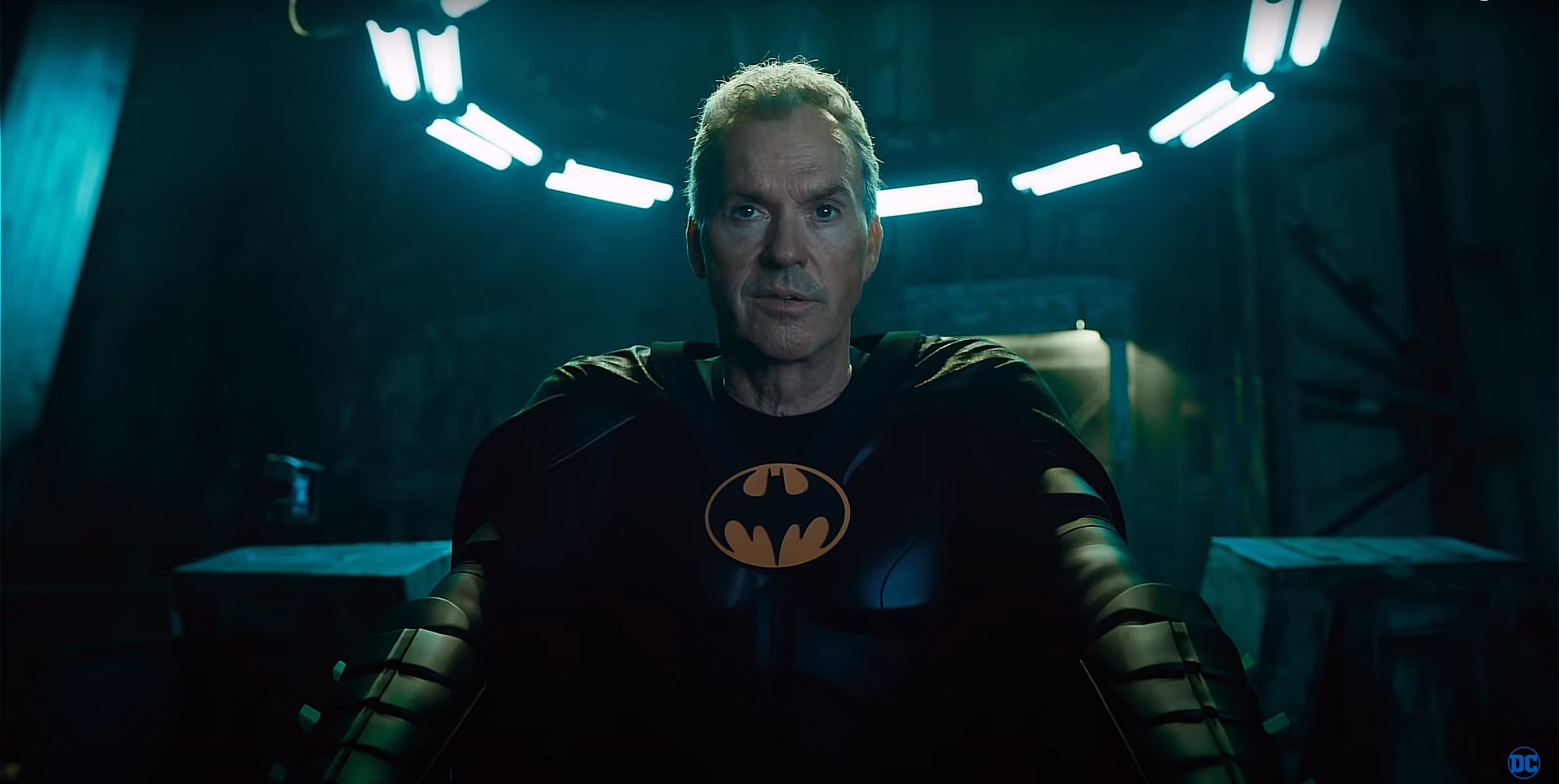
…a.k.a. Batman III, as far as Warner Bros. and nostalgia addicts are concerned.
Weaksauce disclaimers up front. Your Mileage May Vary.
Sometimes we spend money on things you wouldn’t. Sometimes it’s for stuff we don’t endorse, like that time we paid to see the largest inherently racist monument in America, or when we watched House of Cards during the pandemic. Sure, we’re happier when our expenditures are a wholehearted vote for the parties responsible for the thing we’re about to experience or consume, but sometimes we pay the price because we want to see the flawed thing for ourselves and formulate our own impressions, for better or worse or worst. Any personal reservations and/or revulsion are then taken into consideration when expressing our opinions and/or regrets in the final analysis. Interpret it however you will, but we define it however we will.
In a sense, we compromised: my son and I went to see the latest superhero film starring an actor accused of felonies, misdemeanors, and misdeeds ranging on a scale from obnoxious to irresponsibly gross. Anne stayed home, enjoyed a free afternoon, and gave me permission to share all the spoilers later at dinner, from the funniest to the stupidest.
The TL; DR version: The Flash was better than I expected, which is more than I can say for some of this year’s other sequels. That’s neither a justification nor an unconditional thumbs-up for it. Onward we press with the usual wordiness.
Previously on Midlife Crisis Crossover: it’s been six years since Joss Whedon’s mismatched kludge of Zack Snyder’s Justice League thundered into theaters with pompous slightness and yet with slight improvement over the previous year’s Batman vs. Superman: Dawn of Justice, which introduced Ezra Miller as a redundant Flash at the same time Grant Gustin was rocking his third season in the role on The CW. Their Barry Allens weren’t the same and Gustin was in his prime (man, do I miss his hero-speeches, which were The Best), but Miller made a convincing case for coexisting alternative interpretations, like DC Comics having two different creative teams writing and drawing series starring the same hero.
(I don’t have HBO or the rebranded Max, and therefore haven’t seen Zack Snyder’s Justice League, his four-hour overhaul funded in part by a multi-million-dollar condolence card from Warner Brothers for the tragedy that kept him from finishing it the first time around. If Miller’s role was beefed up or extensively reformatted, I wouldn’t know.)
Over the next six years, studio execs went through roughly three thousand directors and an entire nation of writers before someone shackled this lumbering gorilla of a production to the ankles of Andy Muschietti (Stephen King’s It) and wouldn’t let him go. While surviving script pages were pieced together and overwritten into hopefully something more coherent by Christina Hodson (Bumblebee, Birds of Prey), Miller began amassing a rap sheet longer than all the screenplays combined and changed status to “nonbinary”, further complicating every relevant conversation and giving various factions reasons not to watch any results if it were miraculously completed.
That day has arrived at last, to everyone’s surprise…including possibly to the surprise of several visual effects companies who honestly thought Warner Bros. was bluffing and the plug would be pulled on the project in the new Warner Bros. Discovery tradition. Judging by the results that range from kinda dodgy to laughably sub-Doctor Who, some contracted artists hadn’t worked on a single frame of footage in months until well after filming had completed and they suddenly realized they had four to six weeks to turn everything in. I speak here as someone who wrote a lot of multi-page homework projects the night before they were due back in high school and college, sometimes on my grandma’s old non-electric typewriter with a broken carriage that would randomly slide forward 15-20 spaces mid-word. Large portions of The Flash — especially the overblown climax — answer the question, “What if I personally had grown up to become a VFX artist?”
This long-awaited return to the DC Extended Universe, at its foundation, is by and large an extended cover version of arcs already done to grade-A level on Gustin’s show. Crime-lab tech Barry Allen leads a secret double life as The Fastest Man Alive, but he never got over the tragic murder of his mom, for which his father was framed and sent to prison. When Barry realizes he can use the The Speed Force to time-travel and change history, he saves her life but threatens to make everything far worse and/or unravel the space-time continuum. The ensuing pandemonium sees two Barry Allens come forward, and it’s up to him/them and friends to undo the damage, save the day, and learn Everything Happens for a Reason, Actions Have Consequences, and Things Could Always Be Worse.
Gustin already did all that. It was stupendous for quite a few seasons. The main difference is, whereas the show could only explore the ramifications on a CW budget — which meant relying on their existing cast and sets, and maybe a handful of additional aspiring actors — the big-screen remake could spend hundreds of millions on effects instead of just hundreds, shoot in locations anywhere besides tired-looking Vancouver, and welcome back the stars of past DC productions at all imaginable paycheck levels, whether living or dead or never-even-released. Gustin doesn’t make it to this party, nor is much tribute paid to his work beyond a single throwaway use of “Run, Barry, run!” that gets trampled by sloppy editing.
The trailer already spoiled the guests with the most screen time, chiefly Michael Keaton’s Batman — so prominent in the trailers that it’s a wonder they kept The Flash as the film title. After Barry meddles with the timeline, runs headlong into Young Barry, and comes to realize he’s broken reality, their first viable stop for assistance is at formerly Stately Wayne Manor. Inside its ramshackle, butlerless halls they discover a very different Bruce Wayne — a grizzled codger with a desert-island beard and physique, but who can still throw down with intruders ninja-style if necessary. For a while, Keaton clearly enjoys the challenge of playing a Batman we’ve never seen — one who did his job so well that his beloved Gotham City has become the safest city in America and no longer needs him, and all it cost was everyone he loved. That’s an interesting new tack till it’s time for him to suit up for the final act like a Vegas nostalgia act, recycling props and dialogue from his two films minus any of the magic that made Tim Burton’s Caped Crusader or his distinctive Gotham such a superhero landmark of the pre-DCEU era.
(In the middle of writing this entry, I ran across a piece by film critic Sam Adams that recaptures what it was like as a 1989 geek with precious few, genuinely good comic-book films in the wild, an age of first-world deprivation when the ordinary public knew Batman largely from Adam West’s square-jawed, unserious kiddie-Pop-Art sensation. Parts of Burton’s Batman haven’t aged well, but his baroque imagination helped push superhero flicks up the evolutionary ladder upward from Batman ’66…though leading to today’s well-populated superhero field of malaise. We olds may never again enjoy a similar moment of a superhero breaking a barrier like that, and it’s a little saddening that the best we can hope for is variations on a Bat-theme, even when such revivals are as finessed as, say, Matt Reeves’ The Batman.)
(Related digression-from-a-digression, while we’re on the subject of Bat-themes: for as heavily as Benjamin Wallfisch’s score photocopies the Burton era, I hope Danny Elfman was handsomely paid for its blatant reuse, in lieu of little note in the end credits except waaaaaay down in the music-section fine print.)
With the assistance of Grandpa Bats, Our Heroes move on from something old to something new. In this World Without a Superman (also Barry’s fault, one of several head-scratching quantum-mechanical feats), their next recruit is an all-new-all-different Supergirl. Today due to complete absence of Melissa Benoist, the part of Kara Zor-El will be played by Sasha Calle from The Young and the Restless. Her Kryptonian escape pod landed in Russia, where she was somehow overcome and imprisoned in an underground bunker, away from the sun that would charge her internal batteries and activate all the trademark Super-powers. She’s somewhat new to English and even newer to having any reason to care about the race whose impulse upon first contact was to lock her up in Stranger Things jail. Consequently she doesn’t talk much and is only given time and room to express Big Reactions, plus do a lot of flying and punching and flying-punching. She’d be right at home in the OG Snyderverse.
Why the gathering of some kind of league out for some justice? As it happens, Barry time-traveled to the Worst Day Ever: the very date Michael Shannon’s Zod arrived on Earth and prepared to genocide us all into oblivion. First time around in Man of Steel nine years ago, Superman showed up to greet him, they fought and fought and fought, thousands died but Superman ended the massacre by snapping Zod’s neck. And to this very day, geeks worldwide fight and fight and fight over that. This time Zod’s here and Superman isn’t. He should be more maniacal than ever without Kal-El in his face; instead it’s possibly the most bored performance of Shannon’s otherwise remarkable career, with all the exuberance and cadences of a fourth-grader ordered to participate in the school Christmas pageant.
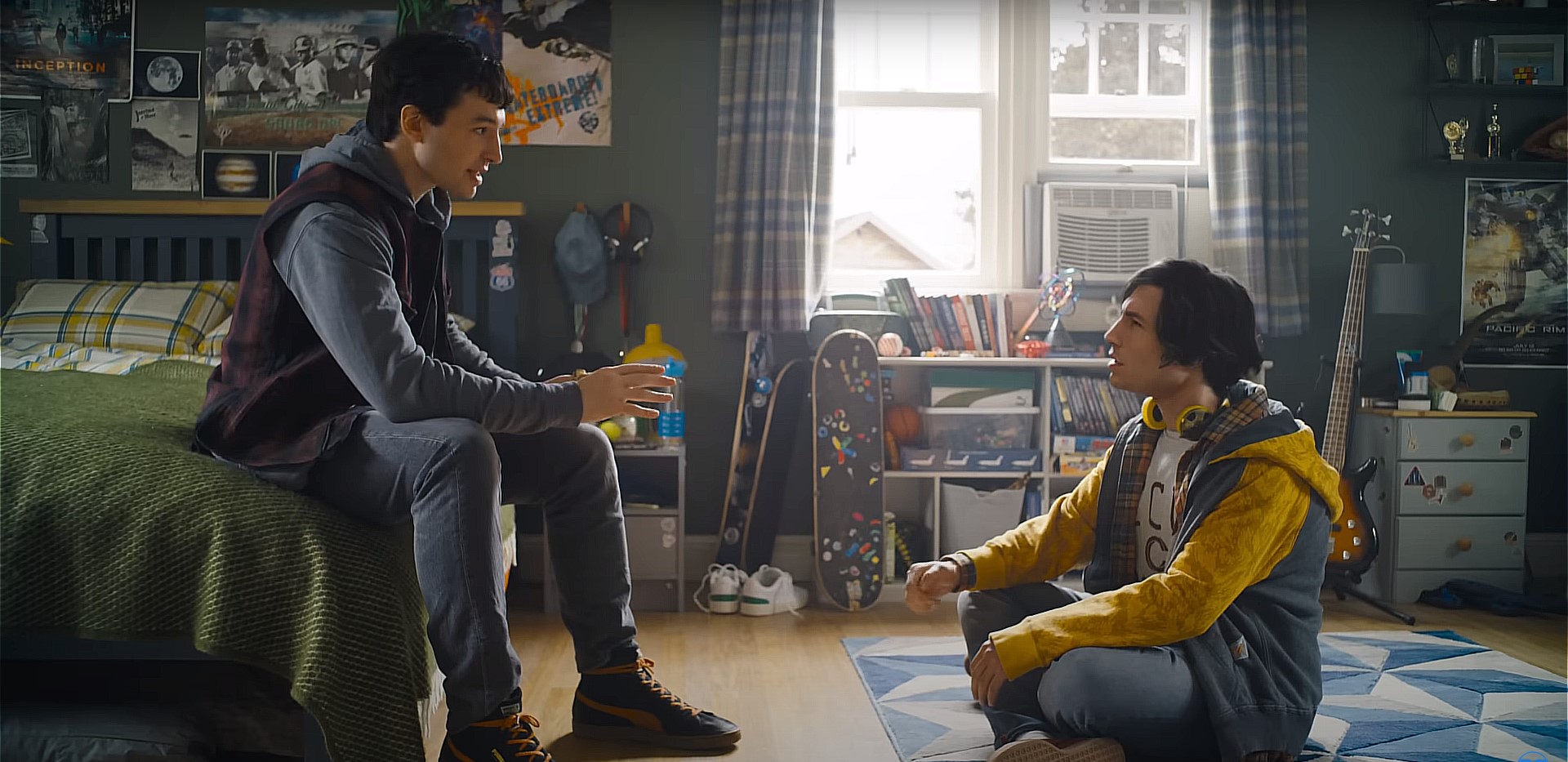
Flash-forward to a 2035 Off-Off-Off-Off-Off-Broadway performance of Chaucer’s The Millers’ Tale.
What’s a ragtag team of misfits to do? The answer is clear: go back in time and relive the first half of the film instead, which promised better and put the ‘S’ back in “hope”. The mandatory opening action sequence lets Ben Affleck’s Batman — who hasn’t been wiped from existence yet, and whose one maturely performed, out-of-costume chat reminds us wistfully What Might Have Been — whip out one last round of Bat-gizmos and do one last Bat-chase, punctuated with a cameo from a Very Special Guest and their Very Special Theme Music (“Every good hero should have some,” as we learned from I’m Gonna Git You Sucka!), but its wildest part sees Barry rescuing an entire room of babies from a collapsing hospital. Muschietti is trying a bit hard to let the original Scarlet Speedster out-Quicksilver Quicksilver, with amusing if not quite superior results, but it’s an indicator of the potential in store, if properly tapped into like Barry tapping the Speed Force.
For a while, everything’s running full speed ahead. Miller’s comic timing comes in especially handy through the setup of Barry’s job at RESEARCH CENTER (possibly down in the Seinfeld district) and the clumsy intro of this film’s barely included Iris West (Kiersey Clemons from Hearts Beat Loud), then throttles into hyperdrive when his series of dunder-headed mistakes drop him in his own past at age 18, when Young Barry is a mere half-hour away from the secret origin that he’s in danger of missing. The aftermath of Young Barry’s life-changing moment and his Day One learning curve set up a hilarious Rube Goldberg sequence, one of many precision-timed laughs to come.
The Flashes prove a solid dynamic duo (demonstrating how far we’ve come in twin/clone/lookalike dual-role VFX-tech) with deep contrasts between Old Barry’s comparatively matured motormouth realizing Young Barry is so insufferable. Like two quantum particles, each ultimately changes the other and they wind up in very different places by the end. Amid the more dramatic moments that we old fans hope for in our superhero flicks, my favorite might be Old Barry’s confession to the question of where he was the first time Zod came to Earth. It’s one of several scenes that hints toward why Warner Bros. execs refused to let Miller go despite all the negative press. Well, that and the Sunken Cost Fallacy.
If only Muschietti had sustained that delicate balance of Snyder drama and Whedon yuks throughout the full 2½-hour runtime, this could’ve been something great. At its core, though, are fatal flaws. Old Man Bruce lays out the prevailing time-travel theory, which sets it apart from most other time-travel stories yet is nonetheless ignored altogether later in the climax when Our Heroes have to save the day by changing the timeline again. And again. And again. It begins to feel like that Simpsons “Treehouse of Horror” segment when Homer’s hijinks led to a world where clouds rain donuts. And that theory lies forgotten in the dust several parsecs and centuries behind.
The film’s biggest letdown not involving alleged felonies: considering how many years the filmmakers had to work on this, much of the visuals suck. Barry’s Speed Force time-travel artifice is symbolized as a hazy mystic amphitheater filled with images from Barry’s past. In its first scene, it’s littered with flashbacks to the first 15 minutes, because that’s how far back its shallow memory storage goes. With each successive scene the image sources expand geometrically, overlapping and colliding and tearing each other apart as Fate waits to see which versions make the final, post-The Flash timeline (for as long as that’ll matter in the terminally ill DCEU). But they look terrible. They’re not exactly repeats of footage we just watched, so much as they’re concept art based on that footage. The longer the film goes, the less realistic they get, bordering on the impressionistic. The major climax sees the amphitheater explode into a city-sized tapestry loaded with Very, Very Special Surprise Guests rendered entirely as journeyman Artists Alley prints. We’re supposed to be either awed by the legacies on display or pointing Rick Dalton-style at the Easter eggs on parade. Putting aside the disjointedness of letting pure fan service interrupt what’s supposed to be the film’s dramatic apex, I was neither awed nor served.
Again: what might have been? How many more years did Muschietti and company really need to finish the job? Why are the first and second halves of this film such a mismatched pair of repellent particles rather than quantum-entangled in harmony? Does any of this even matter if the DCEU will be history as of 2024 anyway? And whither Miller’s formerly promising career from here, if at all? Was last year’s contractually contrite “mental health” press statement serious, or will that offer expire after The Flash comes to home video and we’re back to dreading news of Miller’s next spree?
All these questions and less might or might not be answered in the final DCEU films coming in 2023! Same Bat-time, same Bat-channel!
…
Meanwhile in the customary MCC film breakdowns:
Hey, look, it’s that one actor!: Ron Livingston, the once-cool star of Office Space, is just-okay as Barry’s dad, but a pale shadow compared to John Wesley Shipp’s performance on the show. (Shipp’s characters in general — like, at least three of ’em — were among that show’s highlights.) Stepping in for Nora Allen is Maribel Verdú, the housekeeper from Pan’s Labyrinth. Other DCEU returnees include Antje Traue (a recurring figure on Netflix’s Dark) as Zod’s chief minion Faora-Ul; and Jeremy Irons as grouchy butler/guy-in-the-chair Alfred. Other characters reprised from The CW include Sanjeev Bhaskar (Paddington 2) as Old Barry’s boss Captain Singh. Blink and you’ll miss Game of Thrones‘ Nikolaj Coster-Waldau as a hungry guy.
As noted, there’re other Very, Very Special Surprise Guests. Only a few are played by live, in-person actors, including the jaw-dropper at the end. The majority appear via expensive fan art — some animated, some static, none a substitute for the Real Things in any way. If you loved the dead guy at the end of Ghostbusters: Afterlife, your heart will explode with fanboy zeal at who’s rehired or resurrected here.
How about those end credits? To answer the burning question that MCC is always happy to verify: yes, there is indeed a scene after The Flash end credits, once we’re done smiling at an extended main-credits air-dance with a therapy dog set to the most Rube Goldberg-evocative ditty of our time. For those who tuned out prematurely and really want to know, and didn’t already click elsewhere…
…
…
[…insert space for courtesy spoiler alert in case anyone needs to abandon ship, and I should mention this scene is spoiled about thirty seconds before it happens if you read the music-section fine print too closely…]
…
…
…Barry goes drinking at night with his old pal Arthur Curry and summarizes the entire film for him. Barry can’t get drunk because of his super-metabolism, but Arthur is thoroughly wasted. Thus we end with Barry still standing and beloved actor Jason Momoa face-down in a large puddle, cheerfully singing some drunken-sailor song and breathing pothole rainwater just fine because that’s how he rolls.
Hopefully this moment isn’t a metaphor for the upcoming and probably final DCEU film Aquaman and the Lost Kingdom, only in theaters December 2023!
Discover more from Midlife Crisis Crossover!
Subscribe to get the latest posts sent to your email.
 Midlife Crisis Crossover!