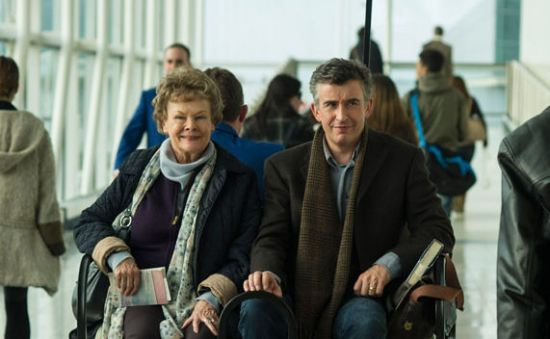
The Academy Awards aren’t complete without at least one token high-caliber British nominee on the Best Picture shortlist. Leave it to director Stephen Frears (whose past nominees include The Queen and Dangerous Liaisons) to fit the bill this year with a transatlantic odd-couple quest for reconnection or closure, for truth or justice, and for fury or forgiveness.
Short version for the unfamiliar: Philomena Lee was an unwed mother suffering penance in a convent, devastated when the Sisters gave her child up for adoption against her will to persons unknown. Fifty years later, disgraced BBC correspondent Martin Sixsmith (the normally comedic Steve Coogan, also credited as co-screenwriter) took up the cause for a now-70-year-old Philomena (Judi Dench, dressed way down compared to her usual roles) — partly from nobility, partly because he needed work, and writing “human interest” stories outside his normal Russian-history bailiwick counted as work nonetheless. What seemed at first like a simple matter of digging through file cabinets becomes a complex tale involving a curious cover-up; a fact-finding trip to Washington, D.C.; conflicting religious convictions; and one nun who holds the key to it all.
Hey, look, it’s that one actor!: Alas, smaller films aren’t always packed with quirky character actors. The only other face I recognized was former Brat Packer Mare Winningham, in a single scene as an American person of interest who turns out to be less than helpful and kind of a downer.
More name-checking trivia I can add here for gratuitous section-expansion purposes: my favorite Stephen Frears film is High Fidelity, which should frighten any self-professed geek into serious reevaluation of whether or not their obsessions are warping their adulthood.
Nitpicking? As portrayed by Coogan, Sixsmith is smug about his lapsed Roman Catholicism and fine with mocking the beliefs of others. Fortunately for those who tire of Hollywood’s frequent anti-religious streak, the movie doesn’t idolize him for this. His irreverence is frequently pitted against Philomena’s beliefs, which she continues to hold deeply despite the convent’s treatment of her. Sixsmith is flabbergasted at the end in the face of what he considers an unfathomable act on Philomena’s part that his own worldview couldn’t possibly comprehend.
While it would be easy to generalize some of this as anti-Catholic posturing, I saw it more as an indictment of the actions of a particular few individuals than of any one denomination as a sweeping whole. Philomena herself prizes such novel concepts as patience, benefit of doubt, and steadfast faith in God despite the challenges imposed by some of his believers.
So…no, not much in the way of nitpicking from me, though I can imagine it rankling others.
Meaning or EXPLOSIONS? Act Two is largely a study in class contrasts — Sixsmith’s well-to-do, cultured professional snob versus Philomena’s undereducated big fan of crappy romance novels. He’s smart and impertinent; she’s simple and respectful. Can this wacky couple get along well enough to track down a fifty-year-old orphan?
While the comedy works well in itself for as long as it lasts, it lays the groundwork for a final-act moral comeuppance that suggests being the smartest man in the room doesn’t always mean you win at everything by default. As outlined above, Philomena represents and lives out her tenets surprisingly well considering the negative role models she had to endure.
So did I like it or not? Coogan proves to be as adept in serious material as he’s been in his past comedic career. Dench is an unstoppable force as always, even when she’s not playing British upper management or ancient royalty. Their relationship is the film’s core — building slowly, naturally, and charmingly despite their differences. Their quest has its twists and turns, its detours and red herrings, but also its little victories at unexpected moments. Though Philomena is neither action-packed nor ostentatious, so far it’s the most heartfelt, spiritually encouraging nominee of the bunch.
How about those end credits? There’s no scene after the Philomena end credits, but the final seconds are accompanied by haunting carnival music that evokes the memory of that one fateful night when young Philomena Lee met a dashing young man, indulged an impulse, and changed her life forever.
Discover more from Midlife Crisis Crossover!
Subscribe to get the latest posts sent to your email.
 Midlife Crisis Crossover!
Good review Randall. I wasn’t a huge fan of this like some were, and I think that’s just because I didn’t care for its one-sided approach. I get that the story is focusing on Philomena and her struggles, but for me, I felt like the approach to showing the Catholic Church themselves made them seem like they were straight-out of a horror flick or something.
LikeLike