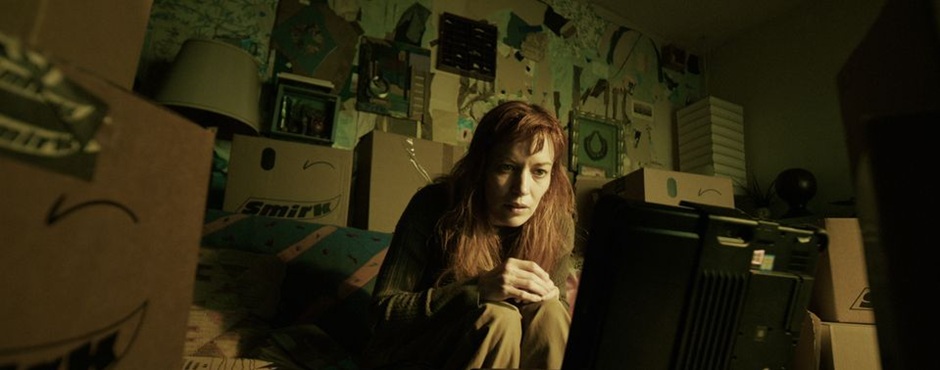
Helly from Severance sprouted a new innie!
Previously on Midlife Crisis Crossover:
Since 1992 my hometown of Indianapolis has presented the Heartland International Film Festival, a multi-day, multi-theater celebration of cinema held every October. Local moviegoers have the opportunity to see over a hundred new works in the realms of documentaries, narrative features, shorts, and animation made across multiple continents from myriad points of the human experience. Heartland’s 35th edition runs October 7-18 and will be my fourth time diving in. I’ve made plans to catch at least six films in all, maybe more if time permits…
Next up: the mystery-shopper thriller Sender — the feature-length debut of writer/director Russell Goldman, which premiered last March at South by Southwest with a small yet mighty cast. It’s based on his previous short Return to Sender, which starred Fargo‘s Allison Tolman and isn’t currently available streaming, unless you count a copy I found with some YouTuber talking over all eighteen minutes of it. So I’m unable to watch it for value-added compare-and-contrast fun — all the more annoying because I just started watching Fargo a few months ago and now I’m intrigued.
The Gist: Severance star Britt Lower is a high-strung artist named Julia who’s three weeks sober, unemployed, and alienated from nearly everyone she used to know. Off the sauce, she’s a jittery mess who seems to have traded laterally for a shopping addiction instead. She orders so much stuff from a monolithic everything-anytime retailer called Smirk (I SEE WHAT THEY DID THERE) her local driver Charlie drops by nearly every day, played with speedy-delivery ambivalence by ace eccentric David Dastmalchian (coming to theaters this Friday in Street Fighter!).
As the boxes keep coming and coming and Charlie has to show up more than once a day, she soon realizes she didn’t order all this stuff. Seemingly random objects show up in separate boxes, sometimes in duplicate, sometimes meant to go with other boxes (e.g., an entire drum kit, piece by piece). By the time she’s calling Smirk’s vestigial hotline in vain and getting stonewalled by their website in hopes of getting anyone in customer service to acknowledge her problem without robot boilerplate, she’s already surrounded by enough packages to build an entire town of box-forts. Has their ordering system gone berserk? Is Charlie stalking her? Is someone pranking her? Is Rod Serling’s ghost doing a morality play on her? Or has she just become a blackout shopaholic?
The familiar faces: Anna Baryshnikov (Manchester by the Sea, The Drama) (who looks so much like her dad) is Julia’s sister, who wants to help but can’t get around her stubborn, forceful demeanor. When Julia sits in on an AA meeting — her first in a while, if not her very first — other attendees include the great Rhea Seehorn (Better Caul Saul! Pluribus!) and Utkarsh Ambudkar (CBS’ Ghosts, a Free Guy I.T. lackey).
Academy Award Winner Jamie Lee Curtis (!!) is another, unrelated Smirk customer. Mike Mitchell (a recurring Parks and Rec Pawnee resident) is a flashback acquaintance. Community‘s Ken Jeong is briefly a person of interest.
The Impressions: Through a canny blend of TikTok-kinetic editing, minimalist backstory, and high-caliber casting, Goldman crams an entire eight-episode Apple+ puzzlebox show into a single ninety-minute mosaic of fuzzy flashbacks, julienne-spliced unstuck-in-time imagery, and YouTube unboxing videos — that modern vapidity of living vicariously through the webcams of fame-starved Amazon accountholders as they rip through cardboard and mailing tape, the online Peanut Gallery reveling from afar as dopamine ecstasy courses through someone else’s veins.
Lower’s ferocity in particular carries us along through her Ferengi-like acquisition frenzy…until the consumer bliss fades and the packing-peanut scent dissipates, industrial-fanned away by confusion and paranoia. We never see Julia verify whether she’s actually being charged for all the unwanted crap, but any financial damage is secondary to the nagging question of “WHY IS THIS HAPPENING TO ME?” We never get a bead on her baseline in this fragmented state of mind, but that’s a feature of today’s instant-gratification mindset. We’re defined by the coolest things we bought just the other day, until the next shiny new thing comes along ten minutes later. (I’m not claiming immunity. As I type this, I’m eagerly anticipating deliveries of a new Rod Serling book and a John Wesley Harding reissue. But at least I know those orders were my doing.) We Severance fans are used to seeing Lower playing two different characters against each other, so it’s a familiar pleasure watching Julia segue from high-volume Smirker to persistent amateur detective. Similarly, any fellow fans of Kim Wexler and/or Carol Sturka who wonder why Seehorn is only a supporting player will love her slow-burn emergence.
Goldman keeps us guessing as to which narrative fork in the road he’s taken: is this just another capitalist satire with the obvious lesson “AMAZON = BAD”? That seems so commonplace anymore, I assume there’re children’s books covering that Moral of the Story, like Bluey Loves the “Buy Now” Button or Diary of a Wimpy Kid’s Third Straight Bankruptcy Filing. Yes, we know Big Brother is watching us, profiling us, anticipating and/or creating our wants, emptying our billfolds into his coffers, and sucking the life force out of the countless local businesses we’re depriving of their livelihoods…but Big Brother has all the best discounts! And he’s about ten minutes away from inventing new magic-tech that would teleport our orders right into our laps before we’ve even closed the browser!
Goldman’s goals aren’t quite so obvious as he tantalizes the audience with questions: is all this a fantasy/SF fable? Is someone specifically responsible? Does the Law of Economy of Characters apply? Did Julia do this to herself? Dastmalchian usually plays weirdos, so it was him, right? Or is she the random victim of a “brushing” scam? I’d honestly never heard of those until this very movie, so bonus points to Goldman for that informative PSA.
But in between Julia’s frustrating help-desk duels, her interactions with the world around her remind us that, sure, uncaring international corporations can be The Worst, but how often do they single out one person in a billion to use as their chew toy? And supersized companies don’t have a monopoly on spying and manipulating; individuals can be just as intrusive and controlling on their own without a multibillion-dollar infrastructure. Sometimes they think they know what you need, too.
The end credits? No, there’s no scene after the Sender end credits, but over half their runtime is accompanied by an exuberantly metal drum-dance. Or metal dance-drumming. Or spasming with drumsticks, whatever. It’s an exuberant celebration of that relief when you’ve just solved a problem, all your knotted head-space has been disentangled, and you’re free to relax and enjoy the cool new thing you just got the other day.
Discover more from Midlife Crisis Crossover!
Subscribe to get the latest posts sent to your email.

