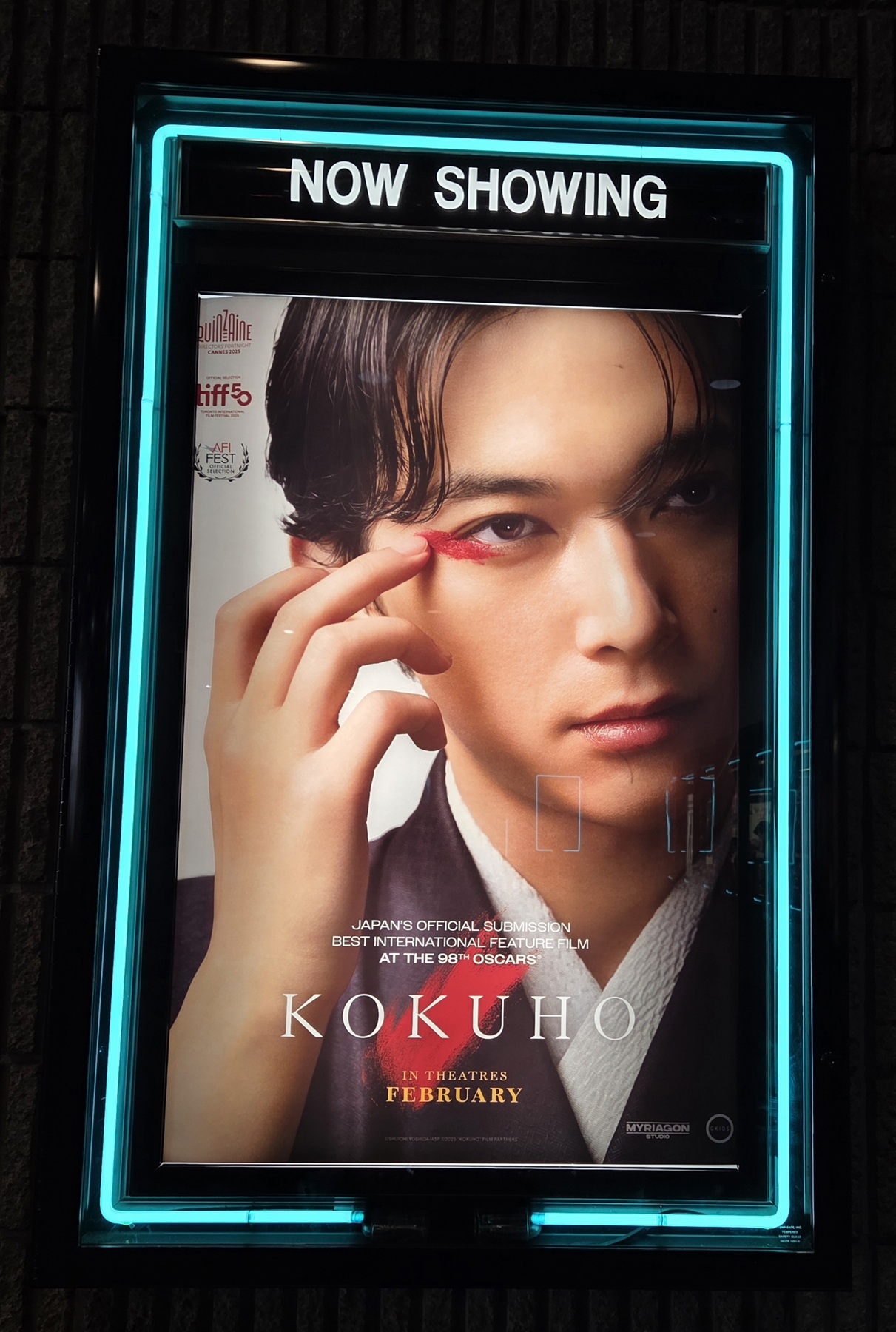
At last, a rare sighting in the wild!
Previously on Midlife Crisis Crossover: Oscars Quest ’26 continues! Once again we see how many among the latest wave of Academy Award nominees I can catch before the big ABC ceremony, often taking unusual measures to collect all those viewing experiences. Sometimes that’s meant catching indie films in their one-week runs here in Indianapolis theaters, using streaming services I’d never heard of before, or lucking into limited-time opportunities through cultural organizations. In the case of Kokuho, all those avenues failed me. I had to go to a new extreme like none I’d committed before: a 160-mile road trip.
I kept checking showtimes for weeks and weeks, but not a single theater in central Indiana — not even the three coolest ones that routinely show all the latest limited releases as soon as they’re allowed to — stepped up to the challenge of screening a three-hour Japanese drama about the world of kabuki. It’s been playing at multiple Chicago locations for weeks, and for a while ran in Columbus, Ohio, about the same distance from us. In mid-February it played at a single Cincinnati theater that I didn’t find out about till it was too late. Alas, Indy came up short, though all my fruitless searches did reveal unto me the lone small-town miniplex that was still showing Melania, which shouldn’t be necessary for next year’s Oscars Quest.
Kokuho was Japan’s official submission for the Best International Feature category, but was shut out by some exceptionally fierce competition. Instead it was noticed just barely enough to get nodded into Best Makeup and Hairstyling, where it’s the darkest of dark horses up against the massive crowd favorite Sinners, del Toro’s amazing Frankenstein, The Rock wearing another guy’s entire face in The Smashing Machine, and the Norwegian body-horror fairy tale The Ugly Stepsister. It’s a minor category, but Oscars Quest isn’t about “major” versus “minor”. It’s about seeing all the nominees.
I got tired of crossing my fingers and wishing really hard for it to show up here. Rather than hold my breath gambling on a last-minute opening anywhere nearby on Oscars’ very weekend, with my wife Anne’s blessing — and at her half-serious suggestion — I took a day off and drove alone to Evansville, 160 miles southwest of Indy, where their Showplace Cinemas East 20 was the only theater hosting it in the entire state of Indiana. I’ve never gone to this extreme before just for Oscars’ sake, but if you think about it, it’s not too different from all those music fans who follow their favorite bands on tour to other states. Not too many people consider poorly distributed foreign films worth the same effort; then again, not too many people are me. I have decades of road-trip experience, I had a deadline to meet, and Evansville is a little closer to us than Chicago and has 1/100th its traffic. I refused to wait for it to come to the Criterion Channel in August 2027 or whatever.
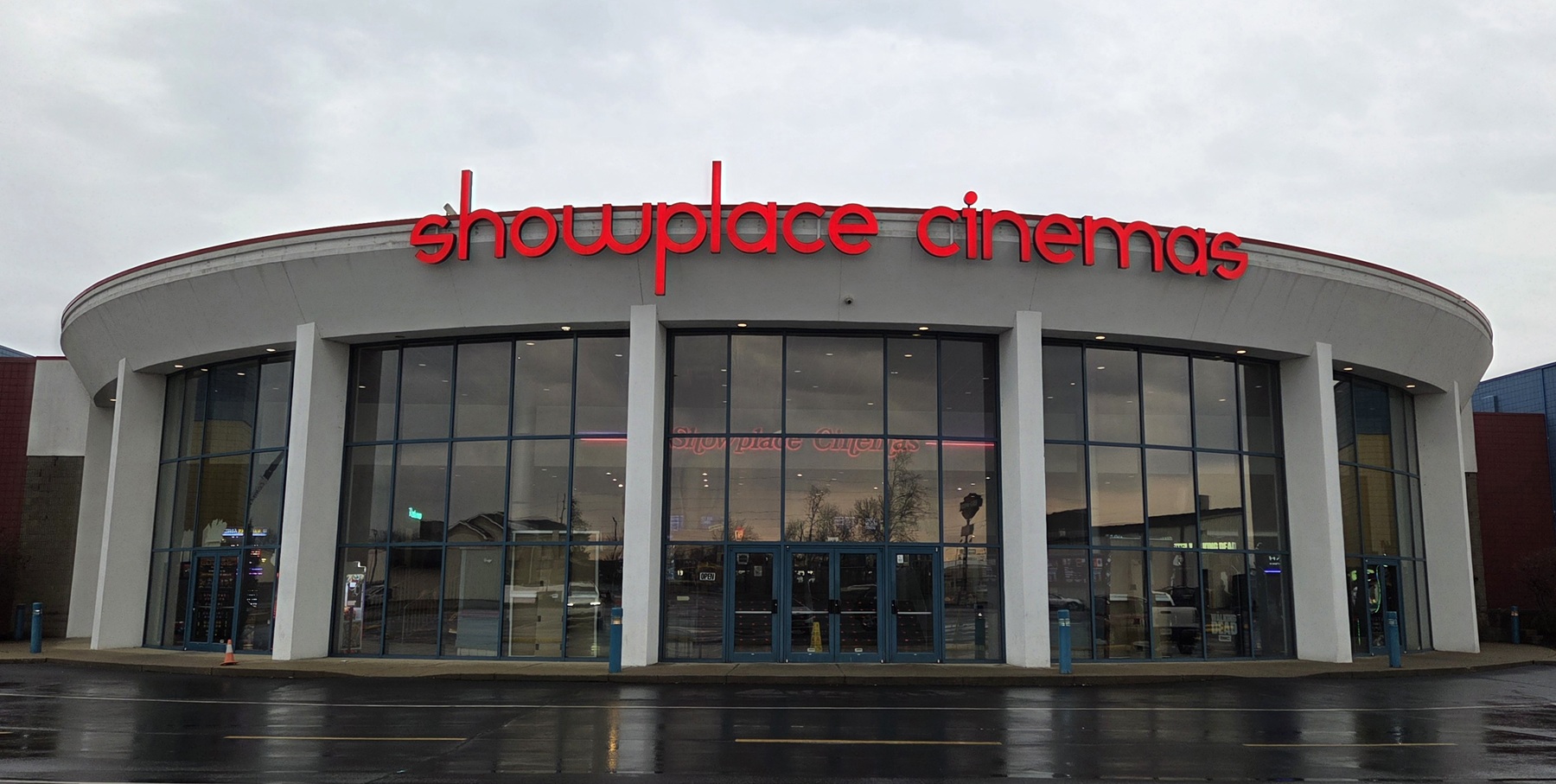
Enormous special thanks to the Showplace Cinemas East 20 for being the right place at the right time. And a shout-out to the other five attendees in my showing.
(Naturally, after I set my schedule in stone, then I learned it’s now playing at the Fort Wayne Cinema Center this very week, which is a little closer than Evansville to us. Too late! It’s finished. I’m moving on with my life now.)
Oh, and about that movie:
The Gist: To recap: it’s a three-hour Japanese drama about the world of kabuki. I knew nothing about it beforehand except that it’s Japanese, time-honored, and requires heavy makeup. The musical form dates back to the 17th century, but much like the Globe Theatre back in Shakespeare’s time, women were banned from it in 1629, so men had to play all the female parts. Actors who specialized in those roles were called onnagata and could take on a rock-star level of fame among upper-class Japanese society. True onnagata mastery apparently required years of intensive training to meet its strict expectations, as depicted here by director Lee Sang-il — a bit nightmarishly at times, like Whiplash did for college jazz or Black Swan did for ballet. So kabuki is a highly prestigious artform whose intense theatricality lies kindasorta at the intersection of opera and drag queens. Its legacy is treated more as an honored genre of gender-nonconforming stage performance rather than as a necessary task to enable sexism in the arts. Even though the ban on women in kabuki was lifted some 200+ years later, onnagata are still a thing and still a big deal.
Based on a novel by Shuichi Yoshida, Kokuho is the story of two boys who grow up into the kabuki world. The most well-known cast member to American audiences is Ken Watanabe (The Last Samurai, Batman Begins, the American Godzilla series), playing a renowned kabuki instructor named Hanjiro, whose son Shunsuke (Keitatsu Koshiyama) eagerly follows in his footsteps. That’s in keeping with the art’s traditional, Slytherin-like emphasis on bloodlines. One does not simply walk into kabuki college off the street and sign up for classes; one is expected to be born into it, as a family business passed down through generations. Their household expands when Hanjiro becomes the ward of an orphan Shunsuke’s age named Kikuo (Soya Kurokawa, from Kore-eda’s excellent Monster), whose local dinner-theater performance Hanjiro catches one day and finds most promising. The two boys become fast friends, de facto brothers, and fellow kabuki students.
As the film moves forward from its starting point in 1964 Nagasaki to its 2014 endpoint, Kikuo and Shunsuke remain inseparable and become a popular kabuki duo in their own right, even as they’re replaced in adulthood by actors Ryo Yoshizawa (a Kamen Rider veteran) and Ryusei Yokohama (a Super Sentai veteran). One issue slowly reveals itself as everyone comes to realize Kikuo the interloper seems more of a natural, graceful talent than Hanjiro’s flesh-and-blood inheritor, thus shocking and offending kabuki’s appointed gatekeepers. In the manner of other historical dramas, we follow them throughout their lives as their excellence in the craft leads to fame, differences, tumults, separation, falls from grace, emotional reckonings in their advanced years, and of course One Last Important Kabuki Performance.
The familiar faces: A few actors show up from other Japanese films I’ve seen. Min Tanaka (Perfect Days, The Great War of Archimedes) commands full respect as kabuki’s eldest grandmaster of their time. Ryusei Yokohama (from the main cast of Jim Jarmusch’s Mystery Train) is Kikuo’s real father, who isn’t in the picture long. Mitsuki Takahata (who had a small part in Monster) is a Concerned Girlfriend.
The Impressions: For anyone like me who’s never seen actual kabuki before, Kokuho is valuable for that introductory learning experience alone. Several pieces are performed throughout, each helpfully captioned with its name and a short plot description — a simple yet brilliant courtesy for us viewers who weren’t preexisting kabuki geeks. We newcomers take some time getting used to onnagata singing voices, those men attempting a sort of quasi-feminine timbre a key or two above falsetto yet too peculiarly strained and sustained to feel like spiteful stereotyping. Kabuki educators could surely place it in a broader historical context, but as an outsider coming into this cold, I can only say they don’t conform to Western vocal notions outside of ’80s NYC no-wave performance art.
In between the stage performances — sometimes shot from audience perspective, at other times up close with the actors — the structure follows familiar beats, but in an unfamiliar context. Even in playful scenes the two teens develop a warm, brotherly rapport as they constantly talk about the work, rehearse their lines, practice their steps, and razz each other for their slip-ups. The bond deepens in later years after the adult actors take over and life gets stressful between them offstage as we see the rift torn between them growing ever wider — Shunsuke the loyal son who loves what they do, but feels he’s becoming Kikuo’s pale shadow; Kikuo, in turn, never meant to usurp his ostensible birthright, but has no intention to quit doing what he loves just to be a good friend. As the teacher and father figure to both, Watanabe looks really disconcerting with his mustache shaved off, but once you get used to that, he’s more nuanced than the average demanding stage-dad, and cuts an imposing figure in his one fully stage-costumed scene, intense makeup and all.
The occasional, abrupt twist of fate can throw viewers for a loop. (The most jarring one is only ten minutes in!) The mood vacillates from sadly amusing (as when one of the guys, going through a dark period, is reduced to doing nursing-home dinner theater) to the horrific (e.g., the scariest-looking diabetic foot gangrene since the Jackie Gleason body-horror in 1986’s Nothing in Common) and back again, but it always centers the art itself. At nearly three hours, Kokuho is this year’s second-longest Oscar nominee (after Avatar: Fire and Ash), but found ways to hold my attention without explosions or inhuman monsters or 3-D. It has a few weak spots, such as the female characters sketched too thinly for us to appreciate how much they mean to the men, which is key to understanding some of their choices. And it’s more than a little distracting when the grand finale shifts from the Japanese music we’ve been adapting to, into 4/4-time movie-orchestra strings for the sake of hitting old-fashioned Hollywood denouement notes. But in all, Kokuho was worth the long trip to a faraway land to take a cinematic trip to an even farther-away land.
One last minor peeve: not once is the audience directly privy to what “Kokuho” means. I had to look it up after the fact and learn it means “National Treasure”. Now I get why they stuck with the original Japanese, but also I’m dying to see Nicolas Cage performing The Heron Maiden in Watanabe’s makeup.
The end credits? No, there’s no scene after the Kokuho end credits, which are almost entirely in Japanese kanji except for a few random Western names here and there, and at least one Middle Eastern crew member. Curiously, nearly the entire VFX section is non-Japanese.
Discover more from Midlife Crisis Crossover!
Subscribe to get the latest posts sent to your email.

