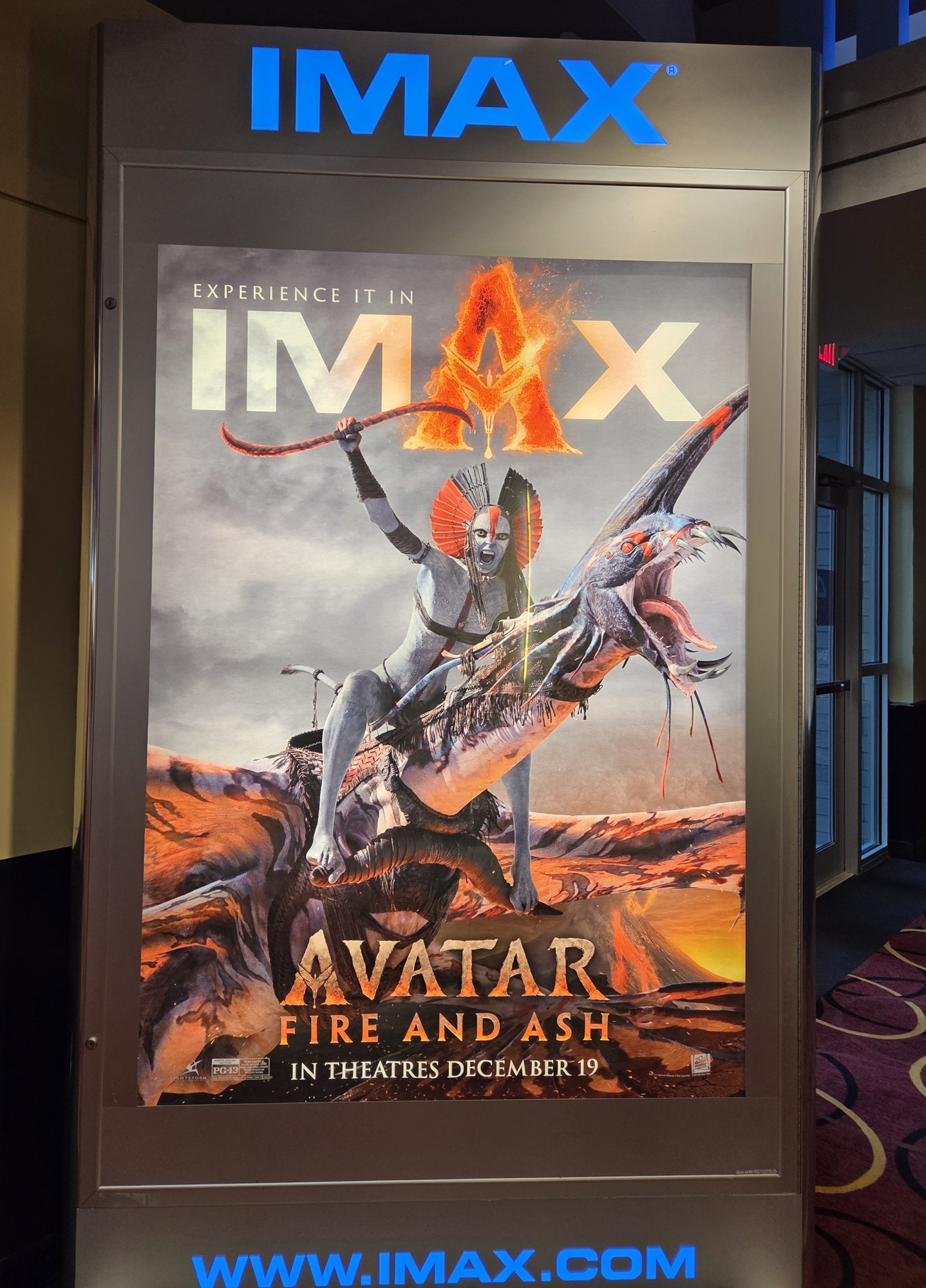
Beware the Dragonriders of BURN!
Previously on Avatar: three years ago James Cameron did his part to help save beleaguered theaters worldwide after the pandemic with the billion-dollar spectacle Avatar: The Way of Water, the long-awaited sequel to the 2009 blockbuster. At the time I boiled down my impressions:
The predictably huge box-office smash is the visually stunning James Cameron comeback we expected, an underwater world of wonder that left our IMAX 3-D audience stunned all throughout its three-hour runtime. The beautifully panoramic Pandora ocean-tribe expansion pack and the extended no-holds-barred final-battle extravaganza exceed the baselines even by Cameron standards in all their gloriously maximized CGI razzle-dazzle nonpareil…[but] after exiting the theater and regaining your senses it’s much easier to think again, and disappointing to realize you’ve just watched the most expensive witness-protection story in world history, one in which Our Hero sought to stop endangering his community by moving his family to a strange new neighborhood and endangering them instead. And much of the family’s stresses feel like Cameron reusing salvaged parts from his previous films and from any number of fish-out-of-water family dramas. The technological bells-‘n’-whistles have been upgraded in accelerated leaps and bounds, but the chassis could use some new solder and an oil can.
But oil and water don’t mix, and some guys love laying amazing paint jobs over refurbished parts, so here we go again. Cameron and the same four co-writers continue the saga with Avatar: Fire and Ash, which is here to re-rescue the box office through the healing power of space magic and environmentally friendly EXPLOSIONS!
Part 3 in the series seems more character-driven than plot-driven in its better moments, if only by default because the story boils down to thin algae traces. Sam Worthington’s former human soldier Jake Sully is still a Na’vi head-of-household trying to keep his family safe, which once again goes poorly because his choices are almost always terrible. Their latest chartered trip across planet Pandora goes awry when their ships and flying space dragons are accosted by a new tribe called the Mangkwan. These rebels have turned their backs on Eywa, Pandora’s answer to Mother Nature, because she didn’t save them from disaster this one time and a lot of them died, so now they’re anti-religious bandits. Their mad-on for the Na’vi mainstream aligns with the imperious motives of Earth’s invading military, who are still a threat that hasn’t been quashed, kinda like how G.I. Joe never, ever defeated Cobra and wasted countless taxpayer dollars that no amount of action figure sales could ever recoup.
All those greedy Earthmen who survived the first two films are still bent on conquering and colonizing Pandora despite the unbreathable atmosphere, and forge an alliance with the Mangkwan, who just want to watch the world burn. With the two enemy forces united against Our Heroes, naturally A War is Coming. Yes, AGAIN. Yes, same as the first two, but instead of The Way of Water‘s sci-fi recreation of the sinking of the Titanic, this time the centerpiece of the feature-length Final Battle is an old-fashioned Pillar of Light, this one made of swirling magnetic fields that wreck anything they suck in. Considering the Na’vi don’t use much metal, you’d think the good guys could win simply by shoving all those heavy-metal starships and exoskeletons toward the Pillar of Light and letting it finish the job, but audiences don’t shell out top dollar to see heroes just nudging their way to victory.
Each character takes turns living their own arcs within that straightforward framework, most of which Jake keeps making worse as everyone’s still grieving the death of his son Neteyam (Jamie Flatters) at the end of the second film. Zoe Saldana, whose career status can beat up Wortington’s, gets more screen time and more archery action as grieving warrior-mom Neytiri. Sigourney Weaver is still their teen daughter Kiri, the space reincarnation of the human scientist she played in the first one, whose strange connection to Eywa might yield superpowers if she can figure it out, but it’s hard for her to concentrate when the family and the film won’t hold still. Her other brother Lo’ak (Britain Dalton) is crushed by survivor’s guilt and struggles to make Neteyam’s sacrifice count for something. Youngest sister Tuk (Trinity Bliss, who’s since been in The Life of Chuck) is alternately a liability, a cheerleader, and a hostage as plot needs dictate.
And then there’s Spider. Character moments are usually among Cameron’s firmest non-computer-related strengths, but much of Fire and Ash rests on the assumption that everyone loves Spider, the Sullies’ Kamandi-esque adopted human son. He’s plucky and well-meaning in the face of adversity, but lacks Na’vi resilience, height, lungs, dazzling VFX skin palette, and plug-‘n’-play creature-control neck-tails. He’s cursed with the dialogue of a ’90s teen skateboarder, shielded in the thickest plot armor Cameron could construct, and somehow in the family’s many running scenes he and his tiny human legs are always in first place. Jack Champion was mostly harmless in Scream VI, but his scenes as Spider were filmed years earlier and feel coddled every step of the way. Much of the film’s first half is devoted to magically solving some of his innate deficiencies, but power upgrades aren’t enough to ameliorate his Cousin Oliver complex. He’s the most irritating Chosen One since Anakin Skywalker.
Meanwhile on the side of warmongering, Stephen Lang is yet again magnificently brutal as Colonel Quaritch, the Na’vi-bodied digital reincarnation of his human self who died so memorably and satisfyingly at the end of the first one. That human self was also Spider’s real father, so the current Quaritch suffers conflicts of interest as he continues following orders from his military Earthling overlords, still lusts for revenge against Jake, and intermittently thinks about reaching out to his abandoned son. Much of the drama in between EXPLOSIONS rests on the deadbeat-dad disconnection between Spider and Quaritch. Lang holds up his end to the extent that he can penetrate Spider’s plot armor, but they aren’t exactly Vader and Luke.
As a consolation prize, Quaritch also makes himself a new special friend. Oona Chaplin (Game of Thrones, FX’s Taboo) is the series’ best new face as Varang, fiery matriarch of the Mangkwan raiders — a shrewd, limber, ceaselessly furious tyrant who’ll massacre anyone standing in the way of her surviving followers. At first Quaritch negotiates with her like any would-be enemy occupier trying to establish diplomatic ties with the enemy of their enemy (100 points for every real-world parallel you can brainstorm!), but before long their shared love of self-serving cruelty sparks a rather twisted space romance that’s consummated in a hallucinatory sex-fueled drug trip that’s one of the film’s most visually inventive scenes, absolutely unlike anything in the first two films, while remaining as chaste as a TV soap opera.
And really, aren’t those effects the reason we all came in the first place? I wrote about The Way of Water:
On a technical level, “Way of Water” is an impeccable visual masterpiece in IMAX 3-D. Part of me wonders if the film loses some hypnotic power in 2-D, and whether that explains why some critics were harsher than others. For my format choice the alien ocean scenery was beautiful, the details on the various organisms and humanoids were fascinating to scrutinize whenever they slowed down long enough for me to focus my eyes through the second pair of glasses, and the machinery of course met the director’s standards — and then some — set by all his past military-SF milieus.
Without computer facelifts, our real world already looks magnificent up close. Cameron created Pandora as a Mary Sue of Earth itself, a hyperreal elaboration on life as we know it — everything shines, bioluminescence is everywhere, and all organisms are interconnected. On Pandora, if you mess with one aspect of nature, you mess with all of nature, and you’ll ooh and ahh in wonder as its enforcers wreak vengeance upon your face. Who’d want to be cruel to a world where beauty and teamwork are equally inherent in the ecosphere?
That nonstop action blockbuster finale proves Cameron still has the old sensibilities, the reflexes, the showmanship, and the master architect’s eye and ear for constructing the perfect thrill ride. Granted, a lot of it recycles used parts from all his other films, but leave it to the environmentalist to put recycling to maximum use. In IMAX 3-D that last hour flies by as everyone and everything is catapulted headlong from one skirmish to the next, the survivors keep tripping over new obstacles, all those space whalers get blown up real good, Quaritch gets tons of action screen-time, Weaver finds ways to contribute to the battle without reprising Ellen Ripley in any way whatsoever, the parents’ ostensible sacrifices to save the kids eventually inspire the kids to step up and use their own talents and connections to return the favor, and the emotional beats can hit you up for a few earned tears.
…all of which still holds true. I’m not retyping all that. Granted, most of the digital splendor in this chapter isn’t remarkably different from that one, in terms of offering new sights. Also, I felt fewer tears this time around, though one scene involving a despondent character facing suicidal thoughts is an overwhelming gut-punch that’s so, so much heavier than the rest of the film surrounding it. On the opposite end, a contrived Abraham-and-Isaac moment comes practically out of nowhere and doesn’t earn the reaction Cameron strains to evoke. (Jaded viewers may in fact root for the opposite outcome and cue up the Willy Wonka “stop, don’t” meme.) Kaiju fans might dig a convening of Pandora’s resident Parliament of Space Whales if they can indulge its intent as a maritime courtroom drama.
One new development for me in this series, which isn’t necessarily a filmmaking fault: Fire and Ash left me reeling from intense motion sickness. I had the same problem earlier this year with the Oscar-winning documentary No Other Land, an understandably shaky-cam project that’s the opposite of Avatar on nearly every conceivable level (save a shared longing for world peace among disparate factions). Maybe it’s my fault for selecting sixth-row IMAX seats, but those first 60-90 minutes were really rough going till my autonomic systems somehow adapted and settled down for the second half. I usually bring Dramamine whenever I expect turbulence in my leisure (e.g., our occasional forays to amusement parks, or that one time we were on a boat for more than ten minutes), but I hadn’t expected to encounter that. So, fair warning to physically sensitive viewers out there.
For any viewers never harmed by roller coasters, the Avatar: Fire and Ash thrill-ride spectacle is quite the achievement as long as you don’t sweat all the non-visual components. Then again, much as Netflix and other streamers have realized in recent times with their increasingly more pedestrian dramas, Cameron knows convoluted, avant-garde films rarely earn a billion dollars worldwide. He keeps the thinking parts simple, leaning into time-honored Morals of the Story such as “Planet and nature good, greedy humans bad” and “You don’t turn your back on family.” And he makes it all extremely pretty. It’s merely a bonus that he also casually invents new forms of cinematic technology along the way that’ll revolutionize the medium for years to come if any other filmmakers are smart enough to follow his epic-length instruction manuals. Cameron’s got a system and it works for him, setting aside his blind spot for the itsy-bitsy Spider that keeps climbing up his waterspout.
…
Meanwhile in the customary MCC film breakdowns:
Hey, look, it’s that one actor!: Given that almost no other named characters died in The Way of Water, nearly its entire cast returns. Welcome back Academy Award Winner Kate Winslet and Cliff Curtis as Tonowari and Ronal, the heads of the Metkayina tribe who’re still hosting the Sullies amongst their waterborne community; Joel David Moore and Dileep Rao as our happy helper scientists; and CCH Pounder as Neytiri’s mom. Over on Team Greed, The Sopranos‘ Edie Falco is still Quaritch’s commanding officer, who’s struggling to keep him in line; Giovanni Ribisi’s skeevy corporate overlord has a little more screen time; Matt Geralt (Daredevil, G.I. Joe: Retaliation) is Quaritch’s lead henchman; Jemaine Clement is still a complicit scientist, but not so compliant anymore; and Brendan Cowell (Dune: Prophecy) survives as the head whaler, minus the arm he lost last time.
The only other prominent newcomer is David Thewlis (Harry Potter, Wonder Woman) as a traveling Na’vi merchant.
How about those end credits? No, there’s no scene after the Avatar: Fire and Ash end credits, but in light of the aforementioned scene involving possible suicide, for any audience members who might be struggling with harmful thoughts and who happen to stick around long enough to read the entire cast list, after that comes a message to them and a number they can contact for help. If they leave immediately as the credits start, they’ll miss the attempted outreach. If you’re aware someone in your party might need a kind word, do whatever you can to stall for time till the credits get to it, I guess?
Discover more from Midlife Crisis Crossover!
Subscribe to get the latest posts sent to your email.
 Midlife Crisis Crossover!