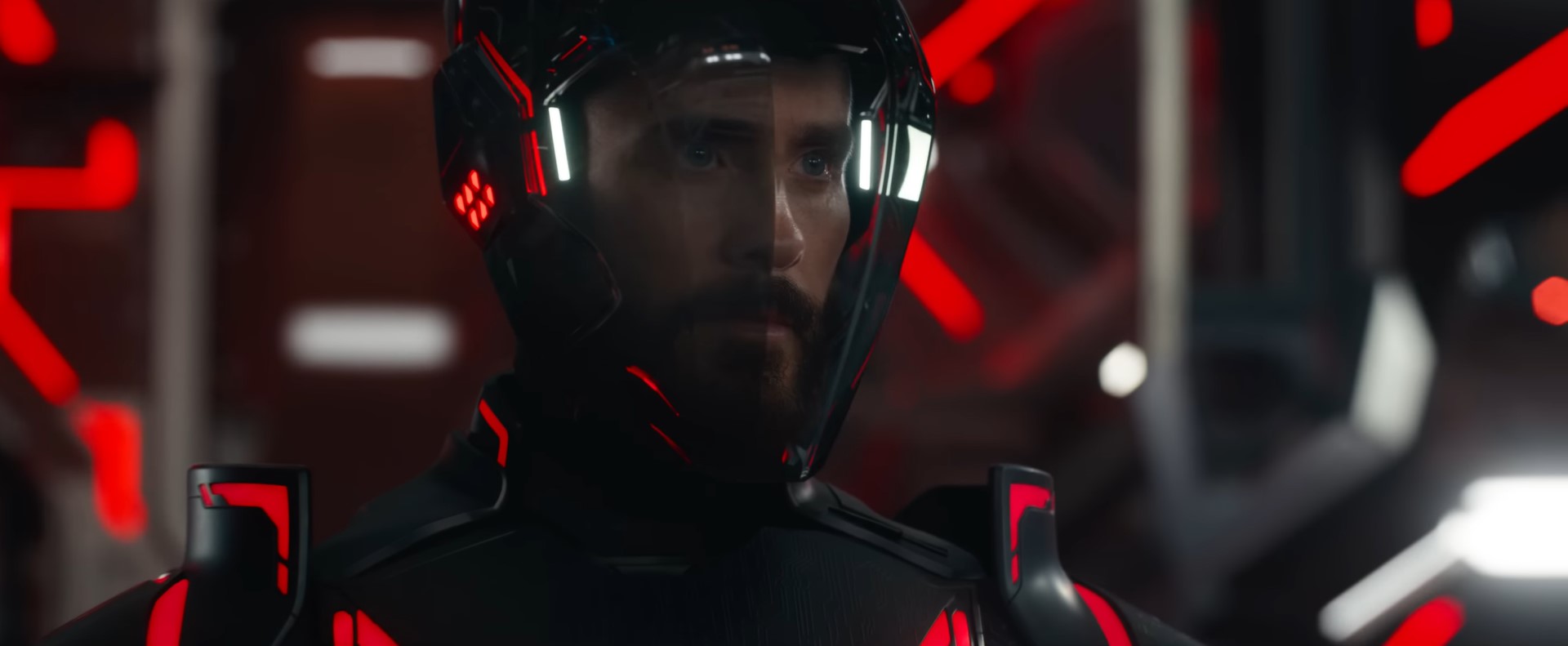
In a better film we’d see Morbius evolve into Morpheus and leave the Grid for the Matrix.
When I was 10, the original Tron was one of the last films I saw at the Westlake Drive-In before it closed a month later. I remember being bored, my typical response to a lot of Disney live-action, and got more fun out of the 4-in-1 arcade game even though some malls charged double to play it (i.e., fifty whole cents, a ripoff at the time). My son was a teenager when we saw Tron: Legacy and quickly forgot most of it, though the action sequences were impressive enough that I noted fledgling director Joseph Kosinski’s name before he went on to bigger, better works. In between those wobbly goalposts, Nine Inch Nails’ 1989 debut Pretty Hate Machine was in heavy rotation in my various high school cassette players, so a young Trent Reznor’s industrial synth-metal assaults hold a certain place in my pop-culture heart even though I haven’t kept up with his later, lesser albums. (Fun trivia: Reznor and I share a birthday!)
Nostalgia isn’t an automatic drug of choice for me, but sometimes I’ll play along with its corporate pushers just to see what they think might get me high by injecting my own liquefied childhood into my eyeballs. Fifteen years later Disney has turned Tron‘s CPU off and back on again to install its latest IP expansion pack Tron: Ares, whose marketing tries awfully hard to target Gen-X as if anyone my age yearned for this to be a trilogy to save on our DVD shelves until we die and our beneficiaries give all our boxed sets to Goodwill. The thin dimensional boundaries between video games and the real world have been breached quite a bit since 1982 (Wreck-It Ralph! Pixels! Ready Player One!), to say nothing of invasions from their kid cousin Virtual Reality (from The Lawnmower Man on up), so really, what’s Tron have to offer besides grasping for an extended warranty on its own obsolescence?
As superficially contemplated by Disney’s trained sequel handler Joachim Rønning (Pirates 5, Maleficent 2) along with screenwriters Jesse Wigutow (Daredevil: Born Again) and David DiGilio (The Terminal List), the answers are derivative. In the not-too-distant future, Greta Lee (Past Lives, Russian Doll) is ENCOM CEO Eve Kim, in charge of the company once run by Tron OG Kevin Flynn (Jeff Bridges) and passed down in Legacy to his son Sam (Garrett Hedlund), who’s Sir Not Appearing in This Film after his character ostensibly writes himself out due to “personal reasons”. In honor of a Family Tragedy in Her Past, Eve pursues a passion project of using the Flynns’ game-lasers to create resources out of nothing and solve world hunger, carbon footprints, and other consequences of scarcity, which could wreck large portions of the world economy if such magical machines were mass-produced for every household. Like, how cool would it be if we could all manifest our own Starbucks drinks — maybe even coffee that’s not burnt! — and put the entire company out of business? Or, y’know, feeding the impoverished is also a choice.
Meanwhile on the Dark Side: Dillinger Systems, the competing company started by Tron villain David Warner (whose face adorns one office wall), is now run by his grandson Julian, played by Evan Peters (American Horror Story, the last four X-Men films) as Evil Tech-Bro #600,000,000 in a series — collect all their trading cards from Hollywood films of the last fifty years! (Yes, evil tech-bros do suck, but true-to-life or not, bandwagons get boring.) Kid Dillinger’s people have pretty much the same game-laser magic-tech as ENCOM, but they want to make trillions off the potential military applications, which translates into churning out disposable space-motorcycling soldiers in goth-rave Iron Man armor and slightly redesigned 45-year-old video-game weapons and vehicles. That’s the best his Silicon Valley castoffs could imagine, because in their world no other games exist — no tamed RPG dragons, no Borderlands arsenals, no grenades, no cool swords, not even the ridiculous gun from Fallout 3 that shot literal nukes and nearly always killed its own wielder within the same blast radius. (Or was it just me?)
Despite some online chitchat, Tron: Ares isn’t really about the current A.I. debate so much as it’s about greedy deviants wanting to co-opt Star Trek replicators for 3D-printing guns and ammo, though the film pretends only the American government would have the means, not other countries and totally not lone gunmen aspiring to be a quickly forgotten mass shooter or the internet’s Antihero Assassin Dreamboat of the Week. One major setback, though: the printouts only last 29 minutes before they disintegrate and more have to be printed. Hypothetically this wouldn’t be an issue if a prospective warlord could print an army-on-demand large enough to win every battle in 29 minutes or less, but that’s a big “if”. In Eve’s favor, she starts the movie with a fetch-quest in the middle of nowhere where the treasure is top-secret computer code written by Flynn that would make the VR print-outs permanent. With the code in hand and saved on a single MacGuffin-brand flash drive, the chase is on to see whose team can implement it first, whether for philanthropy or profit.
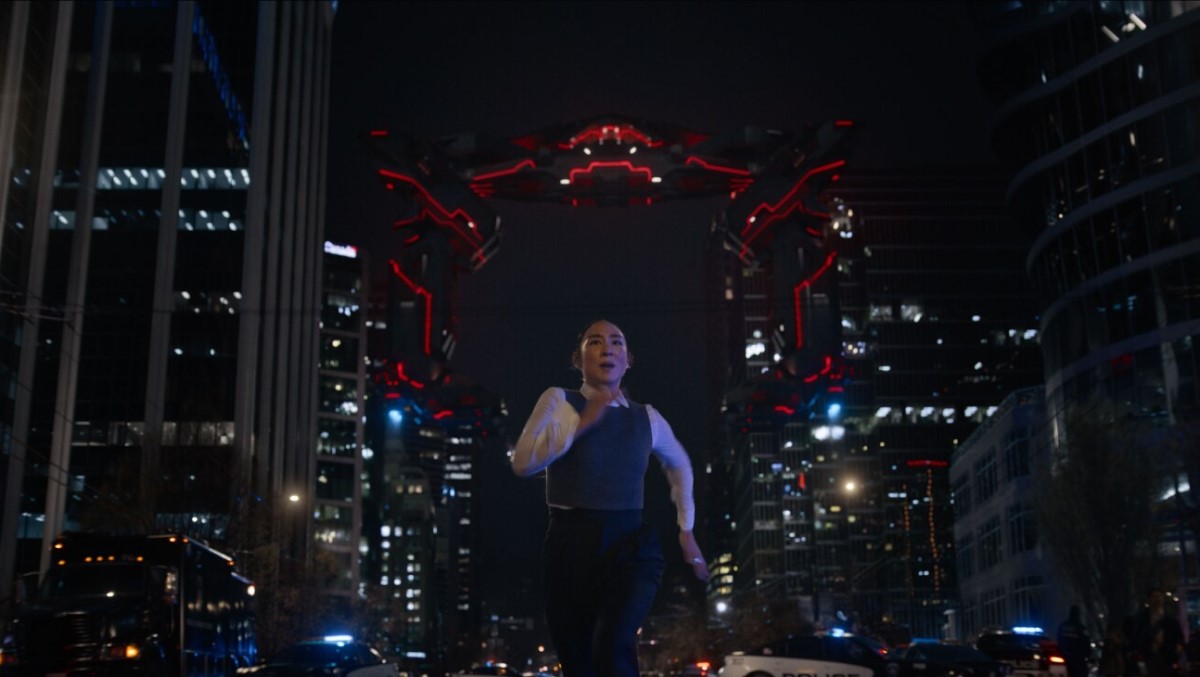
At no point does Greta Lee appear to enjoy herself half as much as she did in her great episode of The Studio.
Caught in the middle is the titular figure himself, Academy Award Winner Jared Leto as Dillinger’s head toy soldier Ares. At first he works fine, obeys all directives, shoots and kicks and power-Frisbees where he’s told. Then, after a few scenes of staring expressionlessly at the other characters, at some crucial moment that’s imperceptible to the human eye and the finished script he decides being a murderous minion is bad and he should help Eve win the movie so he can become a real live boy, or at least reset his Infamy score to zero. “Living weapon yearns to become sensitive human” is a familiar path that intersects with Short Circuit, The Iron Giant, and a plethora of others, to say nothing of non-weaponized tools who envy our humanity. (Frankenstein’s Monster! Data! The Vision!) One character does make sure to name-check Pinocchio, a weak “we’re in on the joke!” signal from the writers. Thus begins and ends any nostalgic sop to Gen-X irony.
Leto has squandered much of the goodwill he earned from My So-Called Life up to Dallas Buyers Club in more recent questionable choices such as Morbius, House of Gucci, and Suicide Squad…but honestly, in this case I think he’s simply playing what was (under)written. In the middle of the chases and explosions is a two-minute intermission where Ares inexplicably turns motormouth and begins yammering away about how he just can’t get enough of Depeche Mode and randomly decides the coast is clear enough that he should psychoanalyze Eve after consuming her entire texting history. That Leto performance would’ve been more engaging than his nimble-yet-numb T-800 bodyguard.
For prospective audiences with simpler demands of their popcorn flicks: sure, everything looks expensively cool. A Tron vintage lightcycle duel in our world — with all those frustrating jetwalls they leave in their path that’ll crash you into Game Over every time — finesses some creative corners, while a dogfight between human fighter jets and CGI flyers offers nifty visuals as long as you don’t fret about the fact that American soldiers engage the enemy over civilian airspace freely and without double-checking the rulebook first. The inner world of the Master Control Program has all the requisite neon track-lighting and green-screened sci-fi shininess. So the trilogy is three-for-three on super awesome laser light-shows.
Razzle-dazzle can only mesmerize us so far. The ground-level Frisbee-fights are julienne-edited into Taken-esque tedium, and the contractual fixation on the original Tron‘s gadgetry prizes repetitive familiarity over innovation. Look, we know the in-universe Space Paranoids game had sequels! The latest release in the franchise is a plot point! Have they never added any new robo-creatures, or new cyber-cars they could license to the Hot Wheels people? I couldn’t stop laughing at the climactic set piece in which the villains materialize a full-size Recognizer — those massive, flying, sideways-bracket warships that look like The Claw with a prong missing — to chase a single running human clumsily through the streets of nighttime Vancouver. It has zero maneuverability, its dangling legs can’t fit between the skyscrapers, and its sad takedown has all the grace of a drunken Godzilla.
The highly anticipated score helps in some parts, but veers a bit too close to dated Tangerine Dream homages at times. The trailers trumpet the Nine Inch Nails brand as if we weren’t aware of Reznor’s more recent accomplishments with fellow Oscar-winning composing partner Atticus Ross. We only get snippets of two vocal tracks before the end credits (even the lead single “As Alive As You Want Me to Be” barely gets in a full verse) and, during the end credits, “Who Wants to Live Forever”, which subverts a Final Fantasy main-menu homage into a sappy love-ballad duet For Your Oscar Consideration. In the background you can almost hear Nobuo Uematsu sighing and face-palming. As recent Reznor/Ross films go, Challengers hit much harder, as did the discord of The Gorge even though it irritated my wife so much that I had to turn the TV volume down for my own safety.
The general NIN mood points toward the overall biggest liability: for a series about an ancient arcade game run amuck, Tron: Ares takes itself far too seriously. 21st-century games aren’t all necessarily lighthearted fun for the whole family, but Steven Lisberger’s extremely era-specific quaintness is a poor fit for Hollywood’s rapacious grim-and-gritty revival machine. The VFX crews clearly had a blast in their Day-Glo explode-o sequences, but what straw-audience do they imagine craved further adventures, an antiwar political statement, and complicated canon in a “What if we had to fight actual Space Invaders” lark from the same studio’s era that brought us Herbie Goes Bananas?
…
Meanwhile in the customary MCC film breakdowns:
Hey, look, it’s that one actor!: Yes, Jeff Bridges returns for a few scenes as OG Flynn, basically playing a digital Saint Dude. We get absolutely no mention of former costar Bruce Boxleitner or his character who was LITERALLY NAMED TRON.
TV legend Gillian Anderson is Kid Dillinger’s mom, the ex-CEO who comes to regret retiring and turning the company over to her spoiled brat. Dillinger’s other programmable lackeys include Jodie Turner-Smith (Apple’s Bad Monkey, Star Wars: The Acolyte) as Ares’ partner Athena and Cameron Monaghan (the Joker from Fox’s Gotham).
Eve’s employees include comedian Hasan Minhaj as a super-coder and Arturo Castro (The Menu, Weird: The Al Yankovic Story) as her Sancho Panza. If you can squint through all the pyrotechnic flash, Reznor and Ross have cameos as fighter pilots.
How about those end credits? To answer the burning question that MCC is always happy to verify: yes, there is indeed a scene during the Tron: Ares end credits, but it’s like fifteen seconds in. For those who were dying for a bathroom, had to sprint out the door immediately and really want to know…
…
…
[…insert space for courtesy spoiler alert in case anyone needs to abandon ship…]
…
…
…Julian Dillinger lives! He sprouts anew in the virtual world inside his company’s evil mainframes, pushes a big glowing red button that screams PRESS HERE FOR SEQUEL, and gets enveloped by glowing red armor and an augmented archival recording of David Warner’s voice as Sark, the Big-Bad from the original Tron. To be continued in 2040, maybe!
As for the end credits themselves: the designers cutely typeset everyone’s names with underscores in them instead of spaces, a very ’80s computing touch. It’s probably for the best that they didn’t abide by all MS-DOS rules and limit every name to eight characters. For example, “TRONARES.EXE” would be an acceptable filename, and all the easier to find using the BASIC “dir” command and then “del TRONARES.EXE” to make it go away.
Discover more from Midlife Crisis Crossover!
Subscribe to get the latest posts sent to your email.
 Midlife Crisis Crossover!