We are all made of screens.
Previously on Midlife Crisis Crossover: Oscar Quest ’25 continues! Once again we see how many among the latest wave of Academy Award nominees I can catch before the big ABC ceremony, even those named in just one category. In a possible historical first, one of our nominees is actually about ABC.
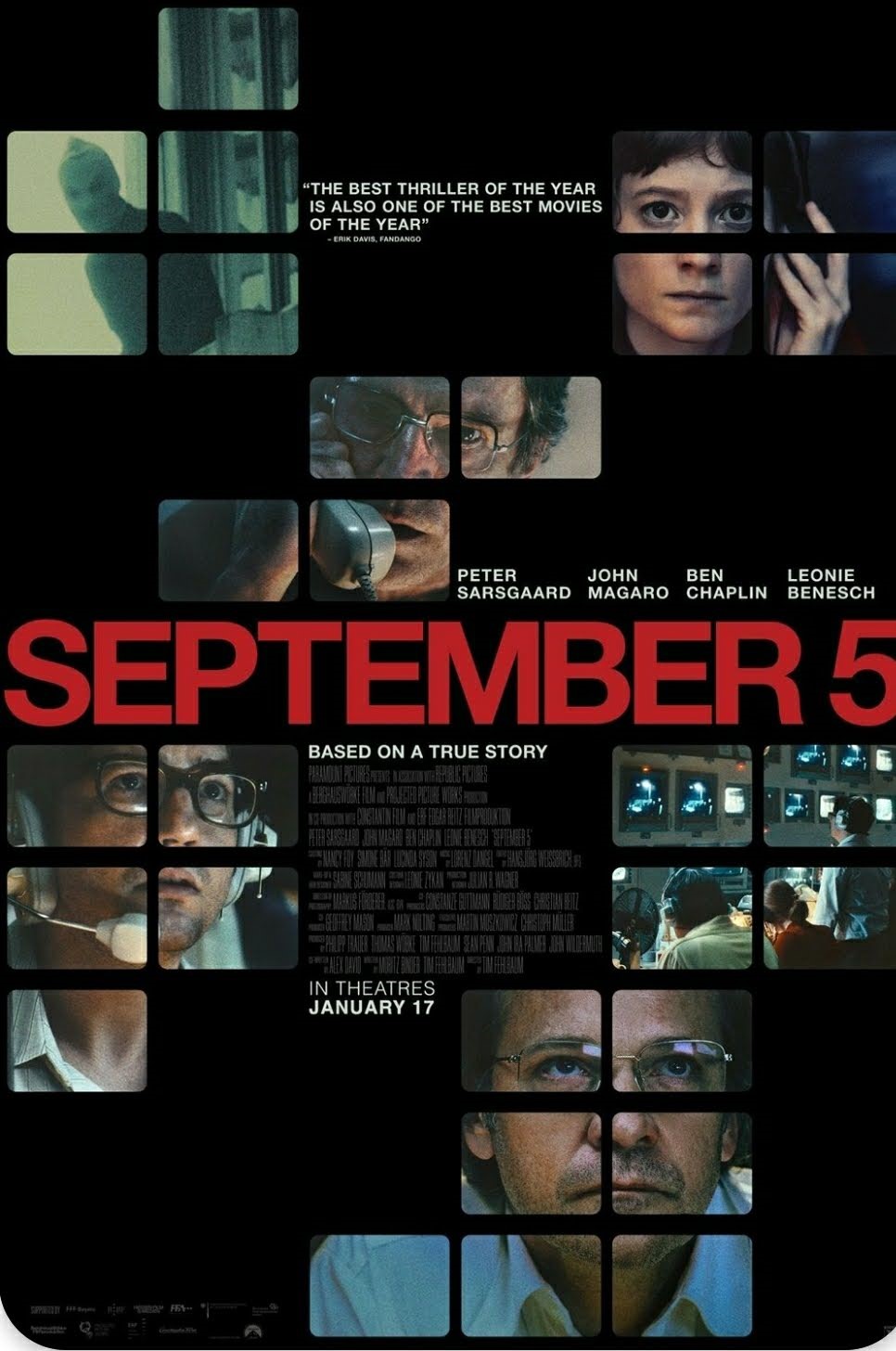
The last time Peter Sarsgaard starred in a true-life tale of journalism and ethics, Shattered Glass was riveting and remains The Greatest Hayden Christensen Film of All Time. Sarsgaard returns to the news beat in September 5, moving from newsprint to live TV in an unofficial yet historically sequential headline-news prequel to Steven Spielberg’s 2005 Best Picture nominee Munich. It’s a true-life drama that’s half found-footage suspense and half You Are There recreation of one of the most horrifying moments in sports history.
Your grandparents or your sports-loving uncle might remember the tragedy of the 1972 Munich Summer Olympics, when a team of Palestinian terrorists calling themselves Black September accosted eleven members of the Israeli team and ultimately murdered all of them, as well as one of the German police at the airport standoff. Swiss director Tim Fehlbaum and two co-writers explore that horrible day almost entirely from a limited vantage — inside the broadcasting booth of ABC Sports. Departmental president Roone Arledge (Sarsgaard) has been personally presiding over their live broadcasts and negotiating with other TV organizations for airtime over the one (1) available satellite feed. Worldwide event coverage was an invention in its infancy, not the modern convenience we take for granted that lets billions of us see skewed perspectives on every major happening simultaneously and then post our misinformed hot takes and overreactions in real time through unreliable narration borne of full-throttled hysteria.
Arledge’s team has juggled the various Olympic competitions under their new director Geoffrey Mason, played by John Magaro (Orange is the New Black, First Cow) as a relative rookie with the flashes of self-doubt that tend to accompany resumés as short as his. But it takes him about three minutes to show he can keep up with the medal handouts and satisfy the other long-timers, including VP of Olympic Operations Marvin Bader (Ben Chaplin from The Truth About Cats and Dogs), whom Fehlbaum cuts to frequently for the requisite Jewish perspectives on the imminent developing story. Later that evening, a few of them hear the unmistakable sound of gunfire in the distance. Before long, they’re sending runners out-‘n’-about to scrounge for details, learning two Israelis have been killed and nine more are being held captive in their apartment. Suddenly they’re living in unprecedented times.
As developments unfold and German police swoop in to negotiate the situation — to the extent that they can, 27 years after World War II when they’re also trying not to evoke collective memories of Germans with lots of guns on TV worldwide — Arledge makes the judgment call for ABC Sports to stay on it themselves rather than turn it over to the news desk back home, urging Mason to “follow the story” by all means. Bulky ’70s camera rigs are lugged to awkward locations. One crewman uses a fake Olympic-athlete ID to sprint through police cordons and shuttle film canisters back and forth. Even the graphics department gets a few minutes of action as they take hasty steps to ensure ABC gets full credit whenever their footage starts popping up on other networks’ evening news.
Also, somehow ABC Sports only brought one employee onsite who speaks any German. Enter Leonie Benesch — star of The Teachers’ Lounge, a great Best International Feature nominee last year whose main character was likewise multilingual — as an assistant named Marianne who ends up pulling double-duty as everyone’s translator. She has to intercede in phone calls with officials and tell everyone what local media outlets are sharing on TV or radio from their own viewpoints and sources. In reality ABC had multiple interpreters and office assistants; in this alt-timeline she’s all of them in one, ping-ponging from one communique to the next as the sole keeper of die Deutschgesprache.
Before all Hell breaks loose, Magaro’s moments in command are a lively demo of the art of TV directing, which I’ve barely ever seen in action myself. (I learned a smidgen back in the day whenever David Letterman used to go backstage between segments and pester his director Hal Gurnee.) I honestly wouldn’t mind a second watch with subtitles so I can catch all the control-room chatter and technical terms I missed.
But as the kidnapping crisis begins, Fehlbaum realizes many in the audience will know what’s coming, and sets up his high-wire act accordingly. Anyone new to the subject will be shocked and horrified to learn the tragic details as we go, in which the specters of Black September are seen only through cameras or as faraway pinprick lights during the finale. Those more familiar will instead feel the overwhelming dread in their foreknowledge of what’s in store for Our Heroes, hoping for the best for them while waiting for them to catch up with those inevitable final fates.
The challenges of the job surround them on all sides. In the face of the ongoing situation, some Olympic events are immediately suspended and their in-person audiences are left adrift in chaos. Elsewhere in town, other competitions keep going while all this is happening despite the lives at stake. Someone higher up the Olympic chain of command has apparently decided the show must go on. Amid all the compartmentalization in action, Our Heroes debate the ethical conflicts of worldwide television that no one had yet brainstormed or encountered. How polite should they be in sharing with other news teams? If the terrorists murder anyone on camera, should they let it air? And if they scrutinize the operation in progress to keep You, The Viewers at Home, fully informed of every single step…what if Black September turns on a TV?
The most heartbreaking moment arrives with its final outcome, which becomes a boondoggle in the control booth as they search for at least the bare minimum of corroborating sources, which might still not be enough in such a fluid, fear-fraught scenario. Arledge’s team are only human and have run themselves ragged over the course of the day. Not every decision was the best one, but the news — a show like any other — must go on. Eventually we get why Paramount distributed this film and not ABC’s parent company, who likely would’ve just tossed it in the Disney+ true-story dustbin next to the Daisy Ridley biopic no one knows exists, and it wouldn’t be up for Best Original Screenplay.
I was only three months old on September 5, 1972, and watch about as much sports today as I did in babyhood. So I appreciated Fehlbaum’s September 5 for the learning experience and for its intense dramatization of journalist improvisation at its most nerve-wracking in the face of what the end credits call the first act of terrorism ever televised worldwide. It would send aftershocks throughout the sports community and the world for decades to come. Today’s internet may deliver catastrophes faster and more directly to our eyeballs than network TV, but it’s no better at preventing them.
…
Meanwhile in the customary MCC film breakdowns:
Hey, look, it’s that one actor!: Benjamin Walker, the elf-king Gil-galad from The Lord of the Rings: The Rings of Power, is ABC’s Peter Jennings, the most well-known TV personality above all others here. Other ABC crew members include character actor Corey Johnson (last seen in Morbius and Black Mirror) as a sound guy, Georgina Rich (a different Black Mirror) as the other woman on the team (I don’t recall her and Benesch passing the Bechdel Test), and Marcus Rutherford from A Wheel in Time.
ABC News anchor Jim McKay (who won an Emmy for his work that day) is a major character played entirely by his original on-air footage, seemingly woven into the narrative with no Forrest-Gumping required. Archival audio of the legendary voice of Howard Cosell literally phones in a scene, one of the film’s more accurate details reflecting the fact that he was not the center of attention that day, despite his petitioning for that exact role.
How about those end credits? There’s no scene after the September 5 end credits, which do honor those involved by naming all twelve victims as well as the complete ABC Sports crew, including Arledge and Jennings. However, after the credits, those who see the film in theaters are then treated to a 14-minute excerpt from a festival Q&A with Fehlbaum, the four main cast members and their casting director. Among the tidbits and memories shared, Magaro talks about how the real-life Geoffrey Mason — who went on to a long career at ESPN — was extremely generous about sharing every possible detail with him about that day.
Magaro also reveals one of his earliest movie gigs was as an extra in Munich. At last, he’s closed the loop.
Discover more from Midlife Crisis Crossover!
Subscribe to get the latest posts sent to your email.

