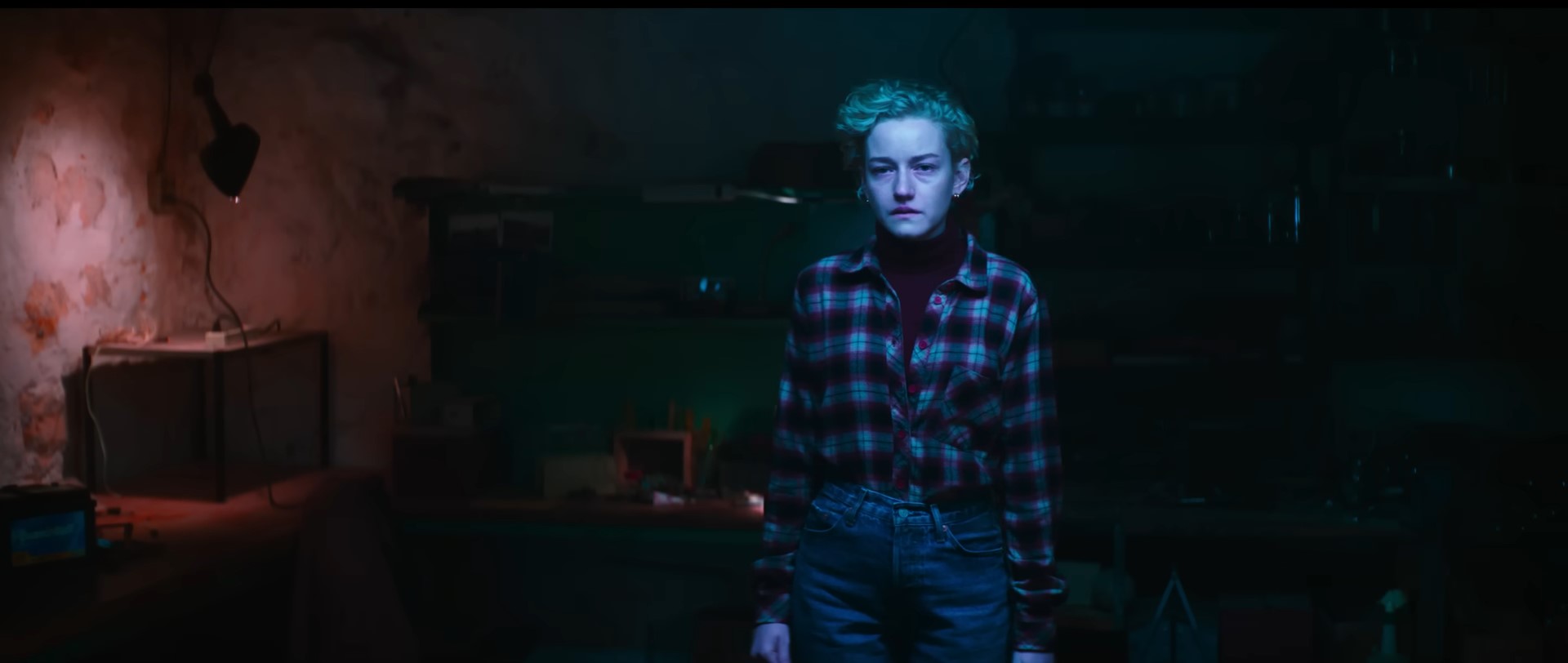
Life viewed through the eyes of a werewolf — warped colors and very few survivors.
Previously on Midlife Crisis Crossover: Leigh Whannell’s reinvention of The Invisible Man was my favorite of the four whole films I saw in theaters in 2020 and smartly updated James Whale’s original mad scientist into a millennial tech-bro stalker who just wanted to dominate a single fed-up ex rather than the whole unwieldy world. Though Universal Pictures claims they’ve given up on their plan to reboot their classic monsters in an all-new shared universe (with or without a vaudeville act to string them together again), it wasn’t exactly counterevidential when they let Whannell take another crack at the catalog.
The next title on his checklist is The Wolf Man, but he’s dropped the “the” (it’s cleaner!) and adapted it to another modern metaphor rather than perpetuate the whole “gypsy curse” origin that would invite the wrath of the Romani on social media. The metaphor suits a smaller, more intimate thriller, a phrase that might not appeal to the millions who love their Universal Monsters big ‘n’ broad, or to fans of Twilight or Underworld who were hoping to see an entire team of vulpine antiheroes fighting a horror-fantasy gang war.
Whannell reuses a smidgen of the original setup that sent Lon Chaney Jr. to his furred fate: once again the man who’ll turn into our titular creature must travel to a faraway wilderness upon the death of a relative, only to be wounded by a strange creature that transmits its condition to him, and shadowy spookiness ensues. Rather than absconding to the forests of Wales, Christopher Abbott (Poor Things, Kraven the Hunter), as househusband Blake, must drive a moving van from The Big City way out to the deep woods of Oregon and empty out the cabin of his father, who’s been a missing person long enough that his death has just been declared official on paper. A childhood prologue reveals Dad took him on father/son hunting trips but wasn’t particularly warm about it — just like Kraven, in more ways than one. Even when Blake was young, someone or something was lurking ’round the forest, though apparently faraway enough from Portland that no one else ever noticed or lived to Instagram about it.
Blake decides the estate cleanup would be an awesome opportunity for a family road trip that’ll fix his ailing marriage, the popular therapy that succeeds in maybe 10% of all films centered around a failing marriage. Julia Garner (Ozark, The Assistant) is his wife Charlotte, a Big City journalist who cherishes the old-fashioned habit of working daily in a physical office alongside her coworkers. We never learn of her beat or her writings, only of her sole-breadwinner guilt at becoming an absentee mother to their only child Ginger (British tween Matilda Firth). So they do it for The Family.
Soon they’re driving through the woods smiling, playing with the radio, and sharing askance looks at the occasional odd concern along the path. Yadda yadda yadda, MONSTER ATTACK! Soon they’re running and running and seeking refuge in Dad’s cabin from the mysterious being that could easily overpower them or at least smash its way in if it tried maybe 20% harder. The ladies are terrified but okay. Blake has a nasty scratch on his arm. We know what this means, and soon so will they. Clearly they don’t get it because no one’s searching for the moon and desperately hoping to see a nice, harmless crescent. This is not a self-aware reboot, nor does anyone recognize the signs and start listing werewolf movie tropes.
Speaking of which: Whannell is engrossed in the mechanics of wolfing out, the core of every werewolf story ever, and devotes a lot of time to Blake’s special-effects evolution from man to monster. Like, a lot of time. As in, the entire rest of the movie. Of course hair starts growing in all the wrong places, beyond the boundaries of basic puberty. His fingers stretch out of shape, his puny human nails make room for advanced weaponry, lucid thought becomes harder, and, in the creepiest scenes, his five senses alter radically to befit his new anatomy. Expert practical makeup and effects are always a welcome sight and reflect Blake’s mental collapse throughout the physical metamorphosis. The Breaking Bad watchwords — “growth, decay, transformation” — are in full effect as his new state of being emerges at a studious rate.
That pacing is so measured, at times Wolf Man really does feel like “what if Vince Gilligan and Peter Gould made a werewolf movie” — those details would fascinate them, and a fan of their extremely process-oriented works could rest assured they’d add up to something dynamic at the climax. Wolf Man likewise aspires to a metaphorical level — how The Sins of the Father and other familial cycles of abuse are like a contagion passed down generations if not nipped in the bud. Blake was already working on his temper issues even before that fateful scratch made things way worse, which he’d rather not inflict upon his loved ones if he can help it. Kind of a big “if” under the circumstances, as it can be for some heads of household who suffered less supernatural traumas in their youth.
Also like their works, the film follows the “what if” falling dominoes to a conclusion that isn’t necessarily heartwarmingly Hollywoodesque but could be considered the only logical outcome if we accept: (a) the weakness to silver from ye olde-tyme werewolf lore has been deleted and they can be injured or killed like any other animal; (b) virtually no other subplots or supporting characters exist that might send the main story careening in any other direction except straightforward; and (c) oh hey did we kindasorta completely forget to set up how Charlotte knows her way around auto repair and hunting gear, the sort of useful survival knowledge they don’t teach in your accredited Big City journalism schools?
it’s one thing for a seemingly overwhelmed protagonist to figure things out on the fly and slowly acquire some advantages (cf. Radio Silence’s Ready or Not), but Charlotte reveals herself to be quite the outdoorswoman. Whannell offers no no foreshadowing or elaboration of her character’s existence prior to this film except the flannel shirt she wore for the trip, which she clearly didn’t buy down at the general store with her hunting license. Obviously she doesn’t have any surprise superpowers, unless you count her awareness of how a truck that’s been parked unused for months or years will not easily start on the first try. That defiance of another hoary B-movie trope is a fun sequences — again, extremely process-oriented as she collects the necessary gear and gets to work on the engine so they can escape — but Whannell assumes we’ll accept at face value that Charlotte contains multitudes unseen and roll with it. Either they saved her backstory for a sequel or they assumed the mere presence of Strong Female Protagonist needs no introduction. Or something.
The conflicts among the family and with their Mysterious Stalker are the entirety of the film’s second half, which ends barely past the 90-minute mark. Now I get why they only ever released a single full trailer: because they didn’t have much left to preview. Wolf Man is a sometimes fascinating bottle episode about what’s usually the coolest part of mythical lycanthropy, albeit with intermittent moments of “scary” intensity, more cerebral than visceral. I liked it on those terms, but it’s missing any popcorn-flick zeal that might refresh ye olde Universal Monsters for a new generation.
…
Meanwhile in the customary MCC film breakdowns:
Hey, look, it’s that one actor!: Such a small-scale film means an equally small cast with not much more to name. Benedict Hardie, a Whannell veteran (Invisible Man, Upgrade) is the requisite local man who offers to show the family around those deep, dark woods. Sam Jaeger (The Handmaid’s Tale, The Eyes of Tammy Faye) is Blake’s rage-monster dad in the prologue.
How about those end credits? No, there’s no scene after the Wolf Man end credits, though they saved the best parts of Benjamin Wallfisch’s score for dead last, as the strings and percussionists wage avant-garde war in the final march toward darkness. We also learn that today due to illness the role of Oregon was played by New Zealand and Ireland.
And for reasons unknown the Special Thanks section ends with a shout-out to Ethan Hawke, who’s never done a werewolf movie unless there’s a lost cut of 1991’s White Fang in which the dog bites him and he begins leaping across the mountains in search of prospector flesh.
Discover more from Midlife Crisis Crossover!
Subscribe to get the latest posts sent to your email.

